
Lede
The absurdity is simple: some factories will spend months watching waste happen rather than fixing the machine that keeps making it.
Words used
- Robot density: the number of industrial robots per 10,000 manufacturing workers.
- System integrator: the specialist company that designs and installs a working robot or automation system around real factory problems.
- Capital investment: money spent on equipment, machinery, software, buildings or systems that make the business stronger over time.
Hermit Off Script
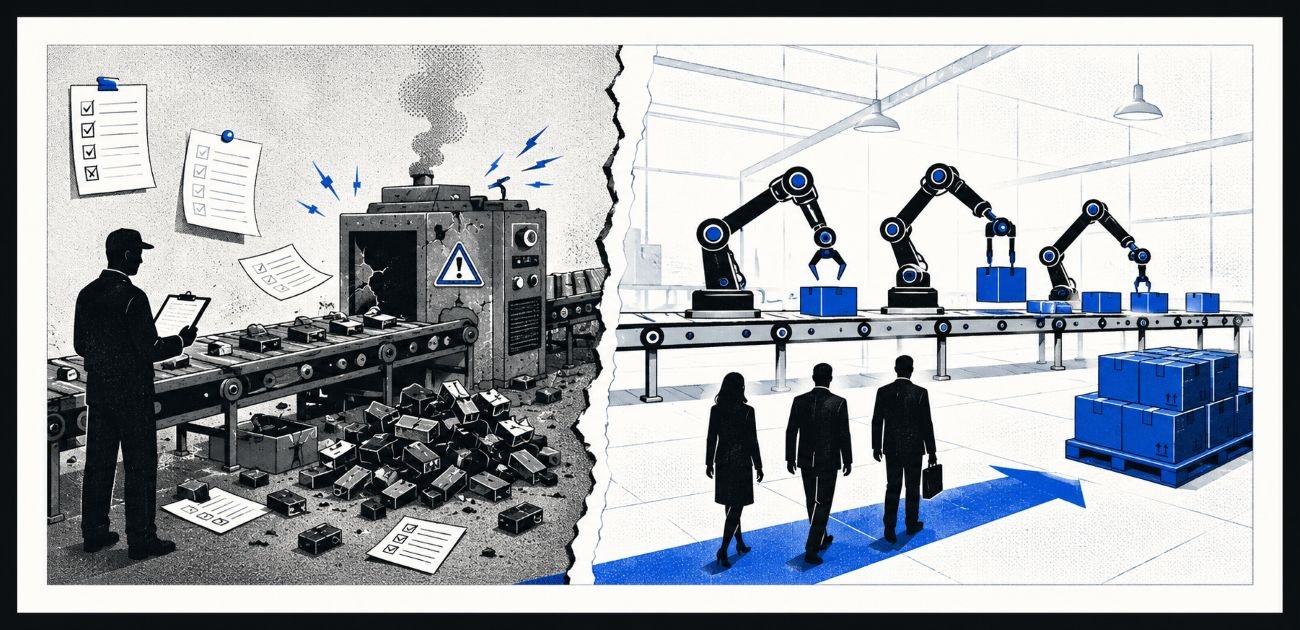
Companies that don’t invest properly are cooked in the new era of AI, and I don’t mean in the motivational LinkedIn sense where a man in a tight blazer tells you to “embrace change” before selling a webinar. I mean cooked like a production line that knows exactly where the waste is coming from and still decides the best answer is more checks, more forms, more operator responsibility and another 24-hour inspection sheet. Imagine a middleweight company, not tiny, not giant, probably looking respectable from the outside. The same issue happens for months across different production lines. Everyone knows the machinery or part of the process is creating waste. Everyone can see that proper investment would probably reduce the problem. But instead of fixing the root, the company pushes the problem down to machine operators. Check it. Watch it. Record it. Catch it before it becomes expensive. Lovely. The machine keeps misbehaving, the worker becomes the human plaster, and management gets to call that “control”. Now imagine a new investment group watching this from the outside. They don’t need romance. They don’t need nostalgia. They don’t need a framed photo of the factory in 1987. They see waste, repeated defects, weak capital spending and a company treating humans like cheap sensors. In the AI era, that is an invitation. They can use AI to model the process, design better workflow, price machinery, map labour, simulate cost and build the business case much faster than old management can schedule another meeting to ask why the line is still producing leakers. Maybe they don’t build the whole factory in one month. Reality still has planning, suppliers, finance, skills and boring paperwork. But the direction is clear. The gap between “we should invest” and “someone else has already built the better version” is getting shorter. This is not a prediction, more like the moral direction of the argument: production will be one of the first great battlegrounds because production is the base of everything. Billionaires and investment groups will not just buy apps and pretty dashboards. They will buy factories, supply chains, machines, robots, data and clients. The company that refuses to fix a faulty process because it is cheaper to blame operators is not saving money. It is training its replacement. One side counts waste. The other side counts clients.
What does not make sense
- Calling it “quality control” when the real job is making workers babysit a broken process.
- Treating repeated waste as an operator issue when the same fault appears across lines.
- Delaying machinery investment while competitors are using AI to shorten design, planning and cost modelling.
- Expecting clients to stay loyal while better-capitalised firms offer fewer defects and faster delivery.
- Saving money on equipment, then losing it through scrap, rework, complaints, downtime and damaged trust.
- Pretending AI is only an office tool when factories are already full of sensors, data, robotics and measurable errors.
Sense check / The numbers
- In 2024, 542,076 industrial robots were installed worldwide, and the global operational stock reached 4,663,698 units, up 9 per cent. [IFR]
- The average robot density in manufacturing reached 177 robots per 10,000 employees in 2024, while Asia reached 204, Europe 148 and the Americas 131. [IFR]
- China installed 295,045 industrial robots in 2024, equal to 54 per cent of global installations. The United States installed 34,164, down 9 per cent. [IFR]
- UK business investment rose 0.7 per cent in Quarter 1 2026 but remained 1.8 per cent below the same quarter in 2025. [ONS]
- Make UK said manufacturers invested 6.8 per cent of annual turnover in plant and machinery in 2025, down from 8.1 per cent in 2024, according to Reuters. [Reuters]
- A Make UK survey reported by the Guardian said 38 per cent of industrial firms had delayed investment and 21 per cent had cut headcount after pressure on profit margins. [Guardian]
The sketch
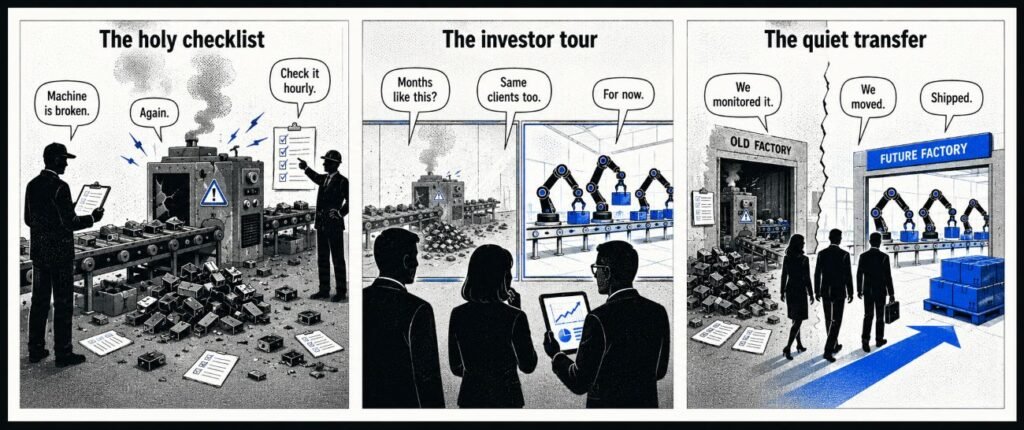
Scene 1: The holy checklist
An operator stands beside a faulty machine holding a clipboard. Waste products pile up on the floor while a manager points at another form.
Dialogue:
Manager: “Check it hourly.”
Operator: “Machine is broken.”
Machine: “Again.”
Scene 2: The investor tour
Three investor silhouettes look through a glass wall at the same waste pile. One holds a tablet showing a clean automated line.
Dialogue:
Investor: “Months like this?”
Analyst: “Same clients too.”
Robot: “For now.”
Scene 3: The quiet transfer
Two factory doors stand side by side. The old factory has checklists on the wall. The new factory has robots packing clean products into boxes.
Dialogue:
Old factory: “We monitored it.”
Client: “We moved.”
New factory: “Shipped.”
What to watch, not the show
- Whether waste is treated as a root-cause engineering problem or dumped on operators.
- Whether capital spending goes into machinery, sensors, software and process redesign, not just reports.
- Whether clients start asking harder questions about defects, lead times and consistency.
- Whether AI is used for real production planning or only for emails and meeting notes.
- Whether owners understand that automation needs engineers, data, integrators and maintenance.
- Whether squeezed manufacturers cut investment first, which can make tomorrow’s failure cheaper to buy.
- Whether robots become a productivity tool for workers or a blunt weapon for owners.
The Hermit take
A factory that refuses to fix the source of waste is not being careful.
It is leaving a signed invitation for someone richer, faster and colder.
Keep or toss
Verdict: Keep / Toss.
Keep the human checks where judgement matters.
Toss the fantasy that checklists can replace investment.
Sources
- IFR World Robotics 2025 executive summary: https://ifr.org/img/worldrobotics/Executive_Summary_WR_2025_Industrial_Robots.pdf
- ONS business investment in the UK, January to March 2026: https://www.ons.gov.uk/economy/grossdomesticproductgdp/bulletins/businessinvestment/latest
- Reuters on Make UK manufacturing investment, October 2025: https://www.reuters.com/world/uk/uk-manufacturers-invest-slowest-pace-since-2017-report-says-2025-10-27/
- Guardian on Make UK energy and investment survey, June 2026: https://www.theguardian.com/business/2026/jun/15/britain-faces-deindustrialisation-relief-energy-prices-survey-make-uk
- GOV.UK AI Opportunities Action Plan, January 2025: https://www.gov.uk/government/publications/ai-opportunities-action-plan/ai-opportunities-action-plan