
Lede
Some bosses still treat the factory like a filing cabinet with a power socket.
Updated 18 June 2026
This article has been refreshed because the old problem has not gone away. AI, robots and sensor systems are moving fast, but too many factories still copy live data onto boards, emails and spreadsheets as if duplication is a production strategy.
Hermit Off Script
I keep seeing the same factory ritual. The machine has the data. The software has the data. The screen has the data. Then someone still writes the same thing on a board, sends it in an email, puts it into Excel, and later everyone wonders why the numbers don’t match. This is not control. This is duplication with a hi-vis vest. I am not against visual boards. A clean board on the shop floor can help people see what is happening quickly. The problem starts when the board becomes a second system, then a third system, then a museum of manual copying. If a fault is already logged by the machine, why does someone need to write it again by hand? If the product change is already in the system, why does the line need a paper note, an email chain and a spreadsheet with formulas nobody dares to touch?
When the same fault comes back again and again, the answer is often another checker with a clipboard. Not a sensor. Not a camera. Not a simple screen. Not a clean data pipe. A human being, standing there, catching what the process should have caught before. That is not smart production. That is using people as cheap sensors with shoes. Companies say sensors cost money. Screens cost money. Gateways cost money. Proper software support costs money. Fair enough. But mistakes also cost money. Downtime costs money. Waste costs money. Rework costs money. Burnt-out workers cost money, even if the spreadsheet prefers not to see them. The old way often looks cheaper only because the damage is hidden inside people’s time, stress and patience. I understand caution. Not every line needs a robot arm. Not every task needs AI. But if a repeated task can be counted, copied, checked and corrected, then the first question should be simple: can we remove it, automate it, or make it visible in one place? Humans should solve problems. Humans should improve work. Humans should notice what machines cannot. They should not spend half a shift proving that paper still exists.
Maybe the future of manufacturing does not begin with AGI. Maybe it begins with the courage to stop writing the same number twice.
Related sense check: this same old-factory problem becomes even uglier in an AGI world, where advanced companies talk about robots and trillions while slower companies still ask workers to copy software data onto a whiteboard. Read the wider version here: AGI Dreams, Spreadsheet Factories And Safety Glasses Rule.
What does not make sense
- Writing tasks twice on a wall when the data already sits in the system.
- Using hand ticks for Kanban while the machine logs every event.
- Hiring checkers after repeated faults instead of fitting sensors where the fault happens.
- Taking paper notes in meetings, then typing them later, then calling it discipline.
- No budget for screens, gateways or dashboards, but endless time for audit theatre.
- Letting one fragile spreadsheet run half the process while nobody officially owns it.
- Blaming workers for mistakes after asking them to copy the same data across three places.
- Treating old habits as wisdom when some of them are only fear of spending money properly.
Sense check / The numbers
- ONS data for Quarter 1 2026 says output per hour was 0.4 per cent higher than Quarter 1 2025 using the Labour Force Survey method. That is not a productivity revolution. That is the floor creaking politely. [ONS]
- GOV.UK’s 2026 AI adoption research says 16 per cent of UK businesses currently use at least one AI technology, while 80 per cent neither use AI nor plan to adopt it. The future is apparently still waiting at reception. [GOV.UK AI Adoption]
- The SME Digital Adoption Taskforce says the UK has over 5.5 million SMEs, making up 99.8 per cent of businesses, and that a 1 per cent productivity uplift across SMEs could add GBP 94 billion annually to GDP. That is a lot of money trapped behind “we’ve always done it this way”. [DBT]
- The International Federation of Robotics recorded 4,281,585 industrial robots operating in factories worldwide in 2023, with 541,302 new installations that year. Robots are not science fiction. Bad process design is. [IFR]
- Predictive maintenance typically cuts machine downtime by 30 per cent to 50 per cent and increases machine life by 20 per cent to 40 per cent, according to McKinsey. Sensors are not magic. They are what happens when guessing gets a budget. [McKinsey]
- HSE recorded 964,000 workers suffering from work-related stress, depression or anxiety in Great Britain in 2024/25, and 40.1 million working days lost due to work-related ill health and workplace injury. Burnout is not a weak character trait. It is often a management receipt. [HSE]
- HSE says PPE should follow risk assessment and should be used as the last resort after other controls. Safety matters, but policy without task sense becomes theatre with goggles. [HSE PPE]
The sketch
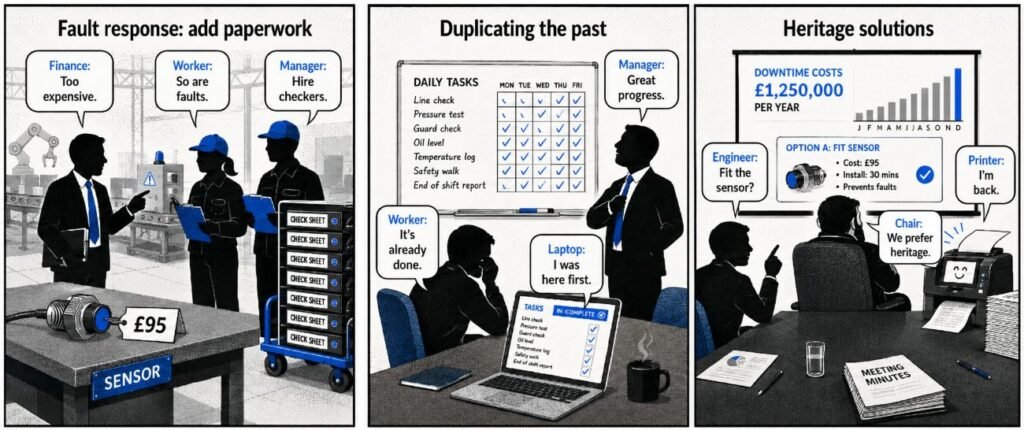
Scene 1: Fault response: add paperwork
Production line. A small sensor with a price tag sits on a table. Beside it, two new hires stand with clipboards.
Dialogue:
Finance: “Too expensive.”
Worker: “So are faults.”
Manager: “Hire checkers.”
Scene 2: Duplicating the past
Boardroom. A whiteboard is crammed with hand ticks. A laptop on the table shows the same tasks already closed.
Dialogue:
Manager: “Great progress.”
Worker: “It’s already done.”
Laptop: “I was here first.”
Scene 3: Heritage solutions
Finance meeting. A slide shows downtime costs. Someone points quietly at a sensor option while the chair looks away.
Dialogue:
Engineer: “Fit the sensor?”
Chair: “We prefer heritage.”
Printer: “I’m back.”
What to watch, not the show
- Capex fear dressed as prudence while downtime leaks money every week.
- Training treated as optional, then workers blamed for poor digital use.
- Compliance theatre built for audits, not for stopping repeated failure.
- Siloed machine data with no clean route into dashboards or decisions.
- Procurement rewarding the lowest upfront price, not the lowest real cost.
- Managers praising busyness while cycle time, defects and stress do the accounting.
- IT teams reduced to repair crews instead of being allowed to improve the system.
- Automation used only to cut headcount, not to remove waste, strain and boring duplication.
- Safety rules written broadly because careful risk assessment takes more effort than another poster.
The Hermit take
Count what breaks, how often it breaks, and how much it costs.
If you can write it twice, you can automate it once.
Keep or toss
Verdict: Toss.
Toss handwritten duplication, orphan spreadsheets and paper check rituals.
Keep visual boards only if they sync to live data. Keep humans for judgement, repair and improvement, not for pretending to be sensors with shoes.
Sources
- ONS productivity flash estimate and overview, 19 May 2026: https://www.ons.gov.uk/employmentandlabourmarket/peopleinwork/labourproductivity/articles/ukproductivityintroduction/latest
- GOV.UK AI Adoption Research, updated 13 Feb 2026: https://www.gov.uk/government/publications/ai-adoption-research/ai-adoption-research
- UK Government, SME Digital Adoption Taskforce final report, 31 Jul 2025: https://www.gov.uk/government/publications/sme-digital-adoption-taskforce-final-report/sme-digital-adoption-taskforce-final-report
- International Federation of Robotics, World Robotics 2024 press release: https://ifr.org/ifr-press-releases/news/record-of-4-million-robots-working-in-factories-worldwide
- McKinsey, manufacturing analytics and predictive maintenance: https://www.mckinsey.com/capabilities/operations/our-insights/manufacturing-analytics-unleashes-productivity-and-profitability
- HSE key figures for Great Britain 2024/25: https://www.hse.gov.uk/statistics/overview.htm
- HSE PPE overview: https://www.hse.gov.uk/ppe/overview.htm
- HSE managing risk using PPE: https://www.hse.gov.uk/ppe/managing-risk-using-ppe.htm