Lede
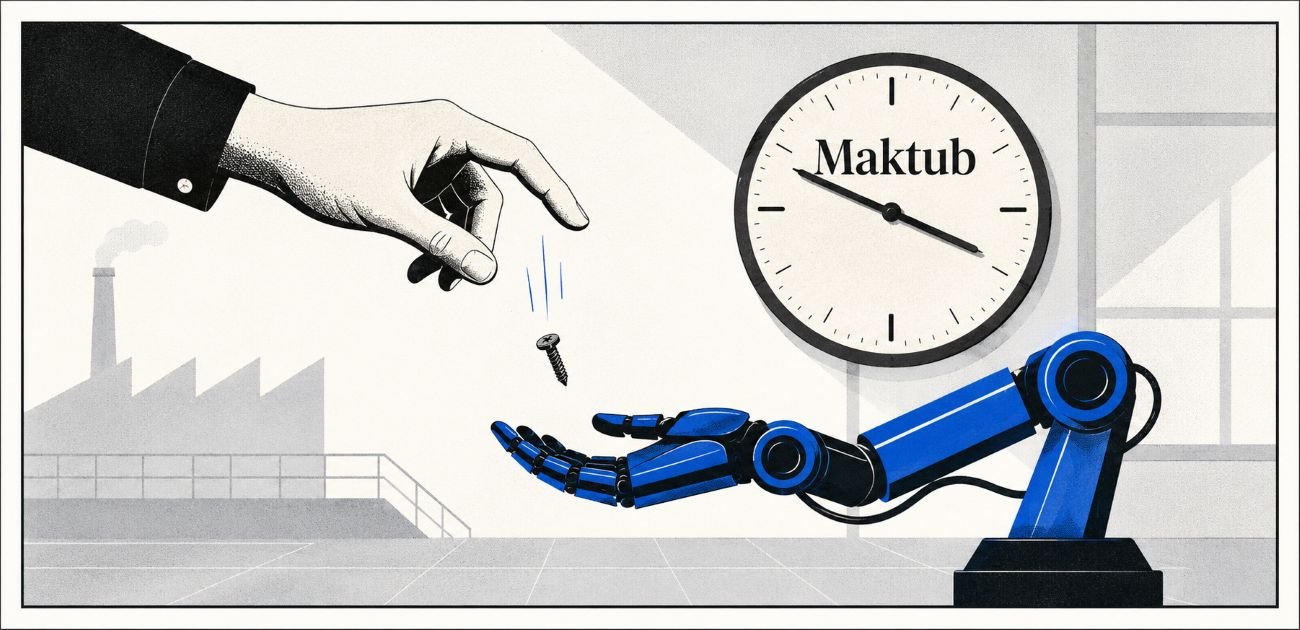
Humans call it fate when the mistake happens anyway, then build a machine to make sure fate fills in a form first.
Words used
- Maktub: commonly used to mean “it is written”, fate, or destiny.
- Poka-yoke: mistake-proofing, where a process makes an error impossible or immediately obvious.
Hermit Off Script
Maktub – that was written.
Even when I pay attention to all the details, even when I try to prevent the error through every possible means, if something is bound to happen, it finds the smallest crack in the wall and walks through smiling. This is where machines, robotics, automation and now AI make the human condition look slightly embarrassing. A machine, once set correctly, does not get tired, distracted, emotional, proud, bored, hungry, romantic, offended, or suddenly inspired to ignore the checklist because “it will be fine”. It detects what it was built to detect. With AI, the net grows wider, because it can analyse more signals in real time and maybe spot patterns we miss with our limited bodies, limited attention and very dramatic inner weather. Of course, AI will still fail. It will have its own version of karma, bad data, strange edge cases, broken incentives, or some genius manager asking it to save money by pretending gravity is optional. But the guardrails can be broader than ours: more sensors, more memory, more testing, more correction, less blinking at exactly the wrong second. Maybe what we call random events is partly the design of human existence itself, this inner self built to miss things, to be touched by external events, to live inside destiny rather than above it. And maybe the age of abundance comes from that: waste falling close to nothing, quality control becoming so sharp that production stops being a casino with forklifts. It happened before with agriculture, then industrialisation, then robotics and AI. Who knows what comes after – nanobots, smaller minds inside matter, or some future tool that catches the mistake before the thought becomes a screw in the wrong hole.
We kept calling it fate until machines started asking for the timestamp.
Maktub in other books and beliefs
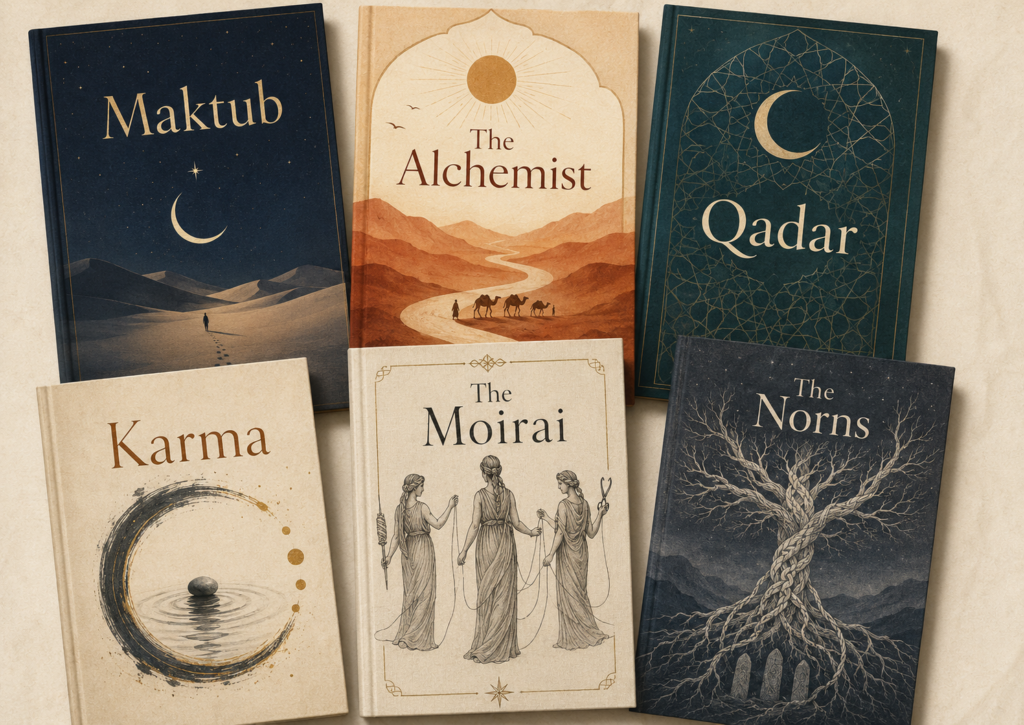
“Maktub” carries the sense of “written” in Arabic, but in modern spiritual reading it is strongly tied to Paulo Coelho. In The Alchemist, it works as a simple word for destiny, and Coelho later published Maktub, a 1994 collection of columns and parables drawing from different cultural traditions. A new English-language edition came out in 2024.
In Islam, the closest serious idea is qadar, divine decree. But that shouldn’t be flattened into “do nothing because fate wrote the invoice already”. Islamic thought has long wrestled with divine decree and human responsibility, which is exactly where the article lives: the error may feel written, but the human still has to answer for the process.
Other beliefs carry the same old fear in different clothes. The Greek Moirai spin, measure and cut the thread of life. The Norse Norns shape fate beside Yggdrasill. Stoicism treats fate as the causal order of the whole. Karma, in Indian traditions, is not random destiny but moral cause and effect across existence. Different systems, same human ache: we see chaos, then imagine a hidden ledger.
Just Love Her

Raz Mihal’s Just Love Her treats fate as something felt through love, timing, the body, the soul and the strange pressure of events that seem to arrive already carrying their own direction. The book does not use destiny as an excuse to sit still. It keeps returning to a harder question: if some things are written, what is still left for the heart, the mind and the human being to do?
The strongest link is the section “Predestination or Free Will?”, where the argument sits between both sides. Some events may be bound to happen, but awareness still matters. If an error, glitch or wrong path appears in front of you, the right response is not romantic fatalism. It is action, now, before destiny makes the bill larger. That connects directly with this roast: fate may write the weather, but quality control still checks the roof.
The book also connects “Maktub” with love and acceptance. In the section “When Love Is Not Strong Enough”, the phrase “Maktub … It is written!” appears beside the idea that the journey and experience still matter, even if the outcome is not the one desired. That is the cleaner spiritual bridge: what is written may happen, but the soul is still judged by how it responds.
What does not make sense
- Humans built quality systems, then still rely on someone remembering to tick the box while tired at 4.47 pm.
- Companies praise human judgement until human judgement costs money, then suddenly automation becomes a saint in a metal apron.
- We call a preventable defect “bad luck” because “bad process” makes the meeting longer.
- AI is sold as magic, but half the real value is glorified vigilance: watching, comparing, flagging and refusing to blink.
- The future promises less waste, while the present still produces mountains of waste with PowerPoint confidence.
- We keep blaming fate for failures designed by poor incentives, poor training and managers allergic to prevention.
- A machine can stop a line when something is wrong; a human often has to ask permission from someone who hasn’t seen the line since 2019.
Sense check / The numbers
- The International Federation of Robotics reported 542,000 industrial robots installed worldwide in 2024, with annual installations above 500,000 for the 4th year in a row. Asia accounted for 74 per cent of new deployments. [IFR]
- Globally, 13.2 per cent of food is lost after harvest and before retail, while another 19 per cent is wasted at retail, food service and household levels, according to FAO figures citing 2024 UNEP statistics. [FAO]
- OECD says manufacturing employs more than 30 million people in the EU and accounts for about 16 per cent of total value added, with AI use in manufacturing linked to predictive maintenance, quality assurance and supply chain optimisation. [OECD]
- NIST released its AI Risk Management Framework in 2023 to help manage risks to people, organisations and society from AI systems. Translation: even the grown-ups know the robot can trip over its own clever shoes. [NIST]
- ASQ defines mistake-proofing, or poka-yoke, as a device or method that makes an error impossible or makes it immediately obvious once it occurs. The idea is simple: stop worshipping luck and design the trapdoor out of the floor. [ASQ]
The sketch
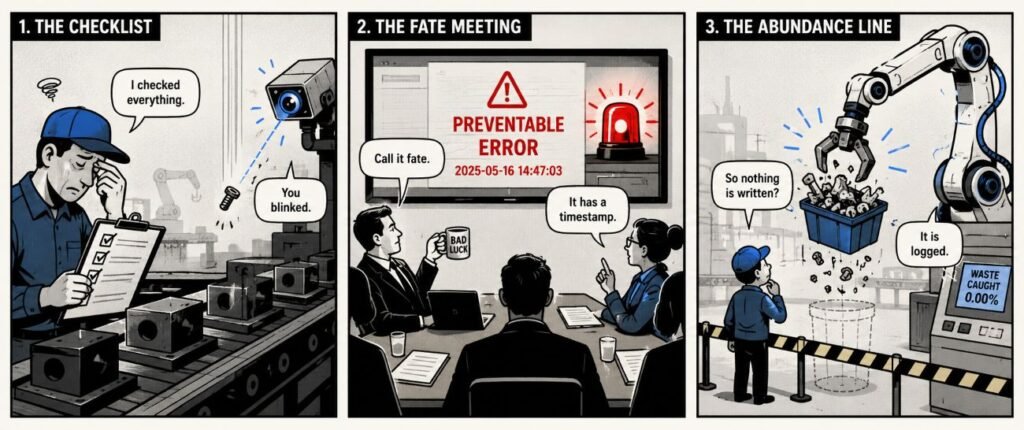
Scene 1: The checklist
Panel description. A tired human stands beside a production line holding a clipboard. A tiny screw falls from above while a machine eye spots it instantly.
Dialogue:
Human: “I checked everything.”
Machine: “You blinked.”
Scene 2: The fate meeting
Panel description. A boardroom watches a red warning light flash on a screen labelled “preventable error”. A manager holds a mug reading “bad luck”.
Dialogue:
Manager: “Call it fate.”
Engineer: “It has a timestamp.”
Scene 3: The abundance line
Panel description. A robot catches waste before it hits the floor while a small human watches from behind a safety line.
Dialogue:
Human: “So nothing is written?”
Robot: “It is logged.”
What to watch, not the show
- Who owns the production data that teaches the machines where errors begin.
- Whether AI reduces waste or simply moves waste into energy use, mining, servers and hidden supply chains.
- Whether humans stay in control of safety decisions or become decorative witnesses beside dashboards.
- Whether quality gains become lower prices, better products and less waste, or just fatter margins.
- Whether companies use automation to protect workers from repetitive danger or to erase labour without sharing the benefit.
- Whether AI systems are tested for failure before they are trusted with real factories, food, health and infrastructure.
- Whether “fate” becomes the new excuse for bad data, bad management and bad accountability.
The Hermit take
Maktub is beautiful for poetry.
In production, it should still trigger a root-cause analysis.
Keep or toss
Verdict: Keep / Toss.
Keep the humility before fate.
Toss the laziness that calls preventable failure destiny.
Sources
- Maktub definition: https://en.wikipedia.org/wiki/Maktub
- IFR World Robotics 2025 press release: https://ifr.org/ifr-press-releases/news/global-robot-demand-in-factories-doubles-over-10-years
- FAO Food Loss and Food Waste: https://www.fao.org/policy-support/policy-themes/food-loss-and-food-waste/en
- OECD AI in manufacturing report: https://www.oecd.org/en/publications/progress-in-implementing-the-european-union-coordinated-plan-on-artificial-intelligence-volume-2_3ac96d41-en/full-report/ai-in-manufacturing_5df4a60d.html
- NIST AI Risk Management Framework: https://www.nist.gov/itl/ai-risk-management-framework
- ASQ mistake-proofing definition: https://asq.org/quality-resources/mistake-proofing
- ISO 9001 quality management systems: https://www.iso.org/standard/62085.html
- Paulo Coelho, Maktub, HarperCollins UK: https://harpercollins.co.uk/products/maktub-paulo-coelho
- Paulo Coelho, Maktub, HarperCollins US: https://www.harpercollins.com/products/maktub-paulo-coelho
- Paulo Coelho official books page: https://www.paulocoelho.com/books/
- Raz Mihal, Just Love Her: https://razmihal.com/just-love-her/
- Raz Mihal, Just Love Her uploaded reference PDF: use the uploaded book file as internal reference, especially pages 70, 128 to 131
- Islamic concept of qadr, Yaqeen Institute: https://yaqeeninstitute.org/read/paper/predestination-vs-free-will-in-islam-understanding-allahs-qadr
- Islamic concept of al-qadar, Islamweb: https://www.islamweb.net/en/article/135341/the-pillars-of-belief-in-predestination-and-divine-decree-i
- Greek and Roman Fate, Encyclopaedia Britannica: https://www.britannica.com/topic/Fate-Greek-and-Roman-mythology
- Norse Norns, Encyclopaedia Britannica: https://www.britannica.com/topic/Norn
- Karma, Encyclopaedia Britannica: https://www.britannica.com/topic/karma
- Ancient freedom and determinism, Stanford Encyclopedia of Philosophy: https://plato.stanford.edu/entries/freedom-ancient/
- International Federation of Robotics, World Robotics 2025 press release: https://ifr.org/ifr-press-releases/news/global-robot-demand-in-factories-doubles-over-10-years
Book Source:
Just Love Her by Raz Mihal
Raz Mihal, Just Love Her (2024 Edition), Chapter: WHEN LOVE IS NOT STRONG ENOUGH, pp. 70-71:
WHEN LOVE IS NOT STRONG ENOUGH
13 Oct 2019
You love the chosen soul image with all your being, though
nothing related to happiness and feelings of love happen in the
real world other than inside you.
Love means sacrifi ce from your side most of the time,
sometimes the whole life. The ideal of divine love refl ection is not
the accomplishment of your desires in real life but the practice
and concentration of your mind through the love mantra to keep
divine love alive in your heart.
Sometimes, I wonder if my practice wasn’t strong enough in
time, giving up some energy to learn and gain the material things
while losing a fi ght with fate for the beloved soul image in the long
run.
Yes, you can blame both sides for many things that didn’t work
out in the end, but after such numerous beautiful moments, you
came to wonder why or how it was possible to break off.Maktub … It is written!
In the end, what matters is the journey and experience, no
matter the result.
Of course, it would be nice to be with the beloved soul image,
at least in this life, if not forever. Destiny will allow it for a short or
extended time; this way, you will have memories, experiences and
feelings left from that encounter.
Always be prepared for the unknown. Once settled on a path,
don’t think that this is it. Give all your best as long as it happens,
and bring happiness and enlightenment to the destiny of your
beloved soul image. After that, if everything fails, carry on your
journey, and continue praying for your favourite soul images.
Isn’t there any way to settle forever with a soul image in this life?
It is when both soul images follow the same path of
enlightenment and believe in the power of divine love refl ection in
their hearts. Throughout your journey on this Earth, don’t forget
the existence of divine love as a deity if you are blessed with its
acknowledgement.And a Sufi joke:
‘Oh, Imam! Which of my actions is of my free will, and which is
predestined?’
‘Lift your right leg.’
‘OK.’
‘That’s free will. Now lift your left leg.’
‘I can’t …’
‘That’s predestination.’
