
Lede
The AI future looks very different when the person describing it asks who gets the power, rather than only how much the machines can produce.
Hermit Off Script
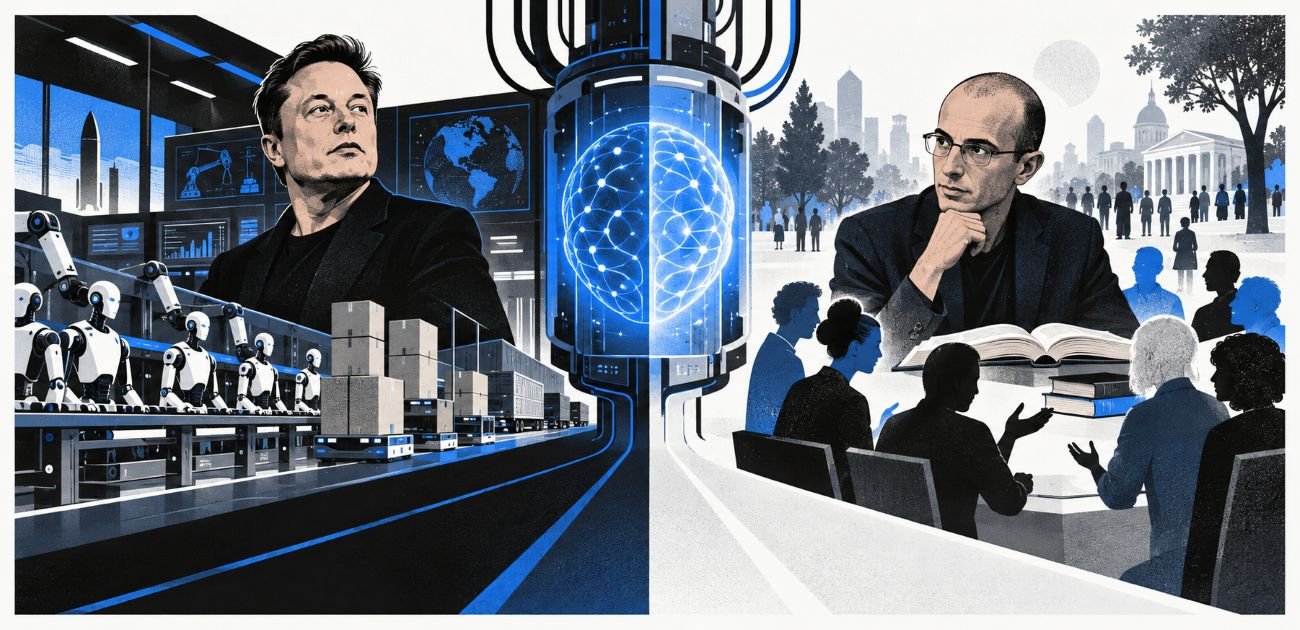
I keep coming back to the difference between intelligence that can calculate a future and intelligence that still remembers humans have to live in it. A while ago I watched Elon Musk’s interview with Zanny Minton Beddoes at The Economist, and I was genuinely baffled by parts of it. Here was this enormously powerful man talking about AI exceeding all human intelligence in roughly five years, humans probably no longer being in control within ten, work becoming optional and money apparently not mattering by 2036. The machinery of the argument is impressive: more intelligence, more robots, more production, more abundance. But I kept wondering where the ordinary human being had gone. The person without shares, companies, robots, private rockets or a convenient seat beside the abundance machine. Musk may sincerely believe technological abundance will help everyone. I cannot read his mind and I am not going to invent his motives. What I can see is an extraordinary amount of economic and technological power already concentrated around a very small number of people and companies, while the promised solution is even more powerful technology. That is a rather magnificent circle. Then I watched Harari speaking to the same interviewer and the temperature changed. He talks about intelligence, yes, but keeps returning to trust, institutions, human relationships, political responsibility, consciousness, manipulation and who gets to decide. He does not pretend the future is automatically safe because the spreadsheet eventually reaches infinity. He also refuses the convenient story that losing control of AI is simply inevitable. Humans are making choices now. Somebody chooses the speed. Somebody owns the infrastructure. Somebody writes the rules. Somebody receives the benefits. That, to me, is the difference between cleverness and wisdom. One can calculate how many robots might make money irrelevant. The other remembers to ask what happens to the humans before we get there.
The full-length interview with Yuval Noah Harari | The Economist
Harari sat down with Zanny Minton Beddoes, The Economist’s editor-in-chief, to discuss why he believes AI will come to control civilisation—and what it might mean to be human in that world.
Noah Harari and his work
Yuval Noah Harari is a historian and philosopher associated with the Hebrew University of Jerusalem, where he is listed as an associate professor in the Department of History. He completed his doctorate at Oxford in 2002. His work moved from broad human history in Sapiens to possible technological futures in Homo Deus, to present-day political and technological questions in 21 Lessons for the 21st Century, and to information, power, and AI in Nexus. His official biography says his books have sold 55 million copies in 65 languages.
Nexus, published in 2024, is particularly relevant here because it examines how information networks create both cooperation and power, and how AI might alter the relationship between information, truth, bureaucracy and human decision-making. Harari’s books make large claims and should be questioned like anyone else’s. That is part of the point. The useful thread running through this work is his insistence that technical capability does not settle the ethical question of what humans should do with it.
What does not make sense
- We are promised an age of extraordinary abundance before anyone has explained why ownership of the machines producing that abundance would somehow stop mattering.
- Predicting that humans may lose control of AI within ten years while continuing the technological race at full speed is a strange definition of reassurance.
- If money supposedly becomes unimportant by 2036, ownership, land, energy, computation, access and political influence do not magically become infinite with it.
- Intelligence is repeatedly measured through capability while trust, responsibility, human relationships and accountability are treated as awkward side quests.
- Society loves the word “visionary”, but rarely asks whether the vision gives ordinary people more agency or simply asks them to trust whoever owns the machinery.
- The people warning about excessive AI power are often described as pessimists while some of the grandest predictions of humans losing control come directly from people building the systems.
Sense check / The numbers
- Musk’s full Economist interview runs for about 1 hour 25 minutes. The publication summarises his position as AI exceeding the sum of human intelligence in about 5 years, with humans no longer in control in 10 years. [The Economist]
- Musk also predicted that “money won’t matter in 2036”, linking that forecast to AI and robots producing goods and services in extraordinary abundance. That is a prediction, not an established economic outcome. [The Economist]
- Harari’s Economist interview runs for about 1 hour 7 minutes. The discussion moves from whether AI control is inevitable at 00:51 to trust at 08:01, AI intimacy at 10:26, consciousness at 14:16 and human wisdom at 01:04:50. [The Economist]
- Harari was born in 1976 and completed his Oxford doctorate in 2002. His official biography says his books have sold 55 million copies across 65 languages. [Yuval Noah Harari / Hebrew University]
- Nexus was published in 2024 and traces information networks from the Stone Age to AI, focusing directly on information, truth, power and the choices surrounding artificial intelligence. [Yuval Noah Harari]
The sketch
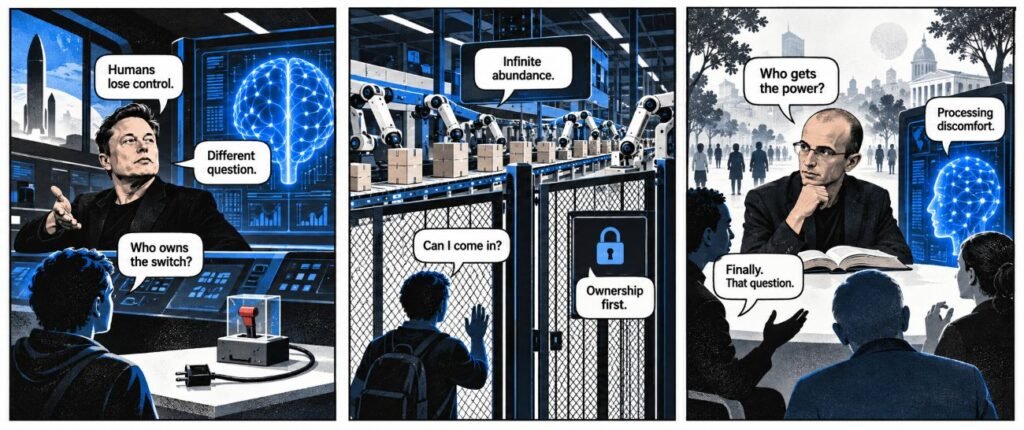
Scene 1: The forecast desk
A billionaire silhouette stands beside a giant AI control console while an ordinary citizen looks at a small disconnected switch.
Dialogue:
Billionaire: “Humans lose control.”
Citizen: “Who owns the switch?”
Billionaire: “Different question.”
Scene 2: The abundance machine
Robots pour endless boxes from a factory while a tall locked gate separates the machinery from a queue of people.
Dialogue:
Machine: “Infinite abundance.”
Citizen: “Can I come in?”
Gate: “Ownership first.”
Scene 3: The human question
A historian silhouette sits beside an AI screen while a crowd surrounds a table labelled trust, power and responsibility.
Dialogue:
Historian: “Who gets the power?”
Citizen: “Finally. That question.”
AI: “Processing discomfort.”
What to watch, not the show
- Ownership: who owns the AI models, robots, energy, data centres and infrastructure behind the promised abundance.
- Incentives: whether companies racing towards stronger AI can realistically police themselves when slowing down may cost market position.
- Distribution: whether increased production translates into broad access or simply increases the value of whoever owns the productive systems.
- Human relationships: AI systems do not need consciousness to influence trust, intimacy, attention or behaviour.
- Governance: who can inspect, regulate or challenge systems powerful enough to shape finance, information and public decision-making.
- Language: watch how words such as “inevitable”, “abundance” and “progress” quietly remove human choices from decisions humans are still making.
- Concentrated power: the danger is larger when control over technology, infrastructure, capital and communication sits in increasingly few hands.
The Hermit take
A future is not humane because it is efficient.
If ordinary people have no agency in it, abundance is just a better-stocked cage.
Keep or toss
Keep / Toss
Keep the ambition, AI research and serious thinking about abundance.
Toss the assumption that technological intelligence automatically produces human wisdom, or that ordinary people should simply trust whoever owns the machines.
Sources
- The Economist, full Yuval Noah Harari interview: https://www.youtube.com/watch?v=FNZhxTtOL-I
- The Economist, full Elon Musk interview: https://www.youtube.com/watch?v=XuoqKYxDHVc
- The Economist, Harari on the dangers of an AI future: https://www.youtube.com/watch?v=ARdnl2kjmRU
- Yuval Noah Harari official biography: https://www.ynharari.com/about/
- Yuval Noah Harari, Nexus: https://www.ynharari.com/book/nexus/
- Hebrew University of Jerusalem, Yuval Noah Harari profile: https://cris.huji.ac.il/en/persons/yuval-noah-harari/
Disclaimer: This article comments on public interviews, published ideas and documented positions. Satirical judgements are opinion and should not be read as claims about anyone’s private motives, mental state or character.
Leave a Reply