Lede
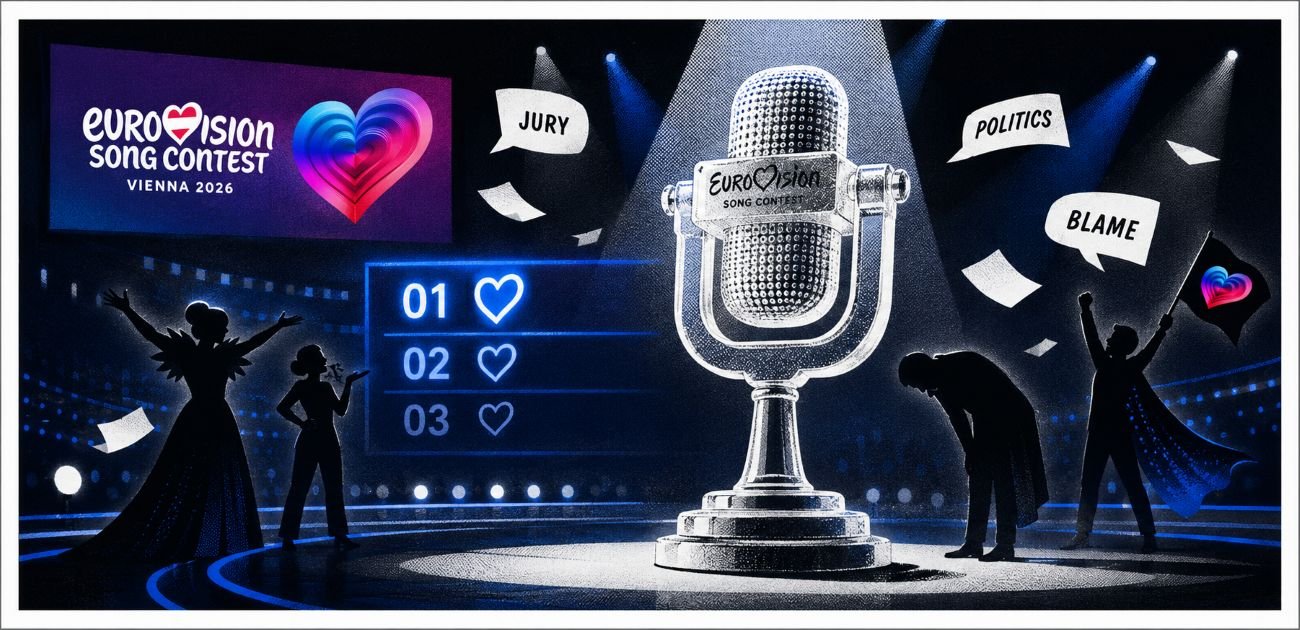
Eurovision 2026 had enough talent for several winners, then still managed to prove that losing is now a full-time communications department.
Hermit Off Script
Eurovision 2026 first deserves the honest congratulations. All the participants went there with sweat, nerves, ambition and the little madness needed to stand in front of Europe and say: this is my voice, this is my country, please judge me in three minutes. Sometimes the contest is won by a voice the public does not fully love. Sometimes it is won by a performance that makes more sense to juries than to normal people with ears and tea. But most of the time it gets close enough to merit, public taste, or the strange middle point where glitter, politics, staging and one dangerous hook share the same taxi. What I always find interesting is that everyone wants to win, but when they do not win, suddenly the problem is everything else. The voting. The neighbours. The diaspora. The running order. The politics. The moon. Rarely the poor choice of representation. This year had some of the most interesting songs in the competition, one pushing the other, and you could see how contestants learn every year from what made noise before. Mix the languages. Dare with the costume. Bring a message. Bring a warning label if necessary. Bring a club beat, a folk pulse, a rock scream, a soft emotional hook. Eurovision has become a laboratory where every country tries to bottle last year’s thunder and sell it back with feathers. And this year did not fail. From Alexandra Capitanescu’s “Choke Me”, a song so loaded that the conversation arrived before the chorus had finished breathing, to DARA’s colourful “Bangaranga”, which sounded like the club door finally kicked open. From Satoshi’s “Viva, Moldova!”, mixing languages and national flavour into a proper Eurovision cocktail, to Noam Bettan’s “Michelle”, which used French, Hebrew and English with a sweet emotional line that worked because it did not shout over itself. The first 3 could all argue for the crown. If public adoption and raw scoreboard force are the test, “Bangaranga” deserved the win. If language, feeling and melodic control are the test, “Michelle” had a proper claim. If rock power, vocal inflection and theatrical risk are the test, “Choke Me” had its own podium fire, even with the ambiguous message walking behind it with a clipboard. Of course I wanted the UK to do better. Even first place, why not? I live here, not in a cave with no kettle. But let us be fair. Looking at some of the UK press complaints after the result, the problem was not only Europe being Europe. There was no strong message, or at least not one sharp enough to cut through the noise. The UK has huge talent, but it rarely sends the act most suited to this strange circus. Eurovision is not just a song contest. It is national theatre with three minutes of oxygen. If you waste the oxygen, do not blame the continent for needing to breathe. From my point of view, if the contest rewarded representation and localised sound above everything else, Satoshi could have won because “Viva, Moldova!” carried language, humour, culture and that sweet Romanian-popular nuance in the melody. If the contest rewarded using language as emotion, Noam had the trophy in one hand. If it rewarded a voice that blows your mind and ears with rock pressure and almost operatic spots, Alexandra had it. If it rewarded the need for a “Bangaranga” in our life, DARA was the real winner. That is the problem and the beauty. If you judge properly by technical strength, emotion, identity, risk and public effect, choosing one winner becomes almost rude. Maybe in the future there will be a third jury represented by AI. Not because AI is holy or magically neutral. It is not. But an AI jury could at least be forced to explain, line by line, what it scored: vocal control, language use, staging, national identity, originality, public effect. No vague “vibe”. No politics hidden in a smile. Just a visible scorecard. I would also impose one simple rule: every country should include at least a little of its local language in the song. A few words, a line, a chorus, something. If it is a country representation, let the country breathe. And if Eurovision wants to become anything else, fine, open the gates properly. South Korea is already in the new Eurovision Asia plan, and as an idea, not a prediction, if BTS ever walked into this format, Europe would need a recovery room. Until then, Eurovision remains what it is: a beautiful contest where everyone sings unity, then checks the scoreboard like a tax bill.
Eurovision 2026: All 35 Songs
Who was predicted to win the Eurovision Song Contest 2026
Before the final, Finland was predicted to win, with Australia close behind and Greece, Israel and Romania also high in the odds. Bulgaria was not the obvious favourite, sitting further back before DARA turned “Bangaranga” into the winning song with 516 points. So the lesson is simple: betting odds gave Eurovision a map, but the stage burned it politely. [Oddschecker] [Eurovisionworld] [AP]
What does not make sense
- Countries enter a contest of national representation, then panic and send songs that sound as if they were assembled in an airport duty-free shop.
- Everyone wants “authenticity” until an act actually brings local language, folk flavour or cultural identity, then half the room asks whether it is “accessible enough”.
- The UK keeps acting shocked when Europe does not fall in love with a confusing entry, as if confusion becomes strategy when sung loudly.
- The public vote is treated like pure democracy, but it still needs caps, payment methods, voting windows, juries and enough rules to make a small constitution jealous.
- An AI jury could be useful only if its criteria are public. Otherwise it becomes the same old black box, just wearing a cleaner suit.
Sense check / The numbers
- Bulgaria won Eurovision 2026 with 516 points, ahead of Israel on 343 and Romania on 296. [Euronews]
- The 2026 contest was the 70th Eurovision Song Contest and the grand final took place in Vienna on 16 May 2026. [EBU]
- The official participant list included DARA with “Bangaranga” for Bulgaria, Noam Bettan with “Michelle” for Israel, Satoshi with “Viva, Moldova!” for Moldova, Alexandra Capitanescu with “Choke Me” for Romania, and Look Mum No Computer with “Eins, Zwei, Drei” for the UK. [Eurovision]
- The EBU reduced the maximum number of votes per payment method from 20 to 10 for 2026. [EBU]
- The UK finished 25th out of 25 in the grand final with 1 point and zero audience vote points. [Eurovisionworld]
Eurovision history and yearly winners
Eurovision started in Lugano, Switzerland, in May 1956, with 7 participating broadcasters each sending 2 songs. The first winner was Lys Assia for Switzerland with “Refrain”. The contest has been broadcast every year since 1956, except in 2020, when it was cancelled during the global pandemic. By 2026, it had reached its 70th edition, with Bulgaria winning for the first time through DARA and “Bangaranga”. The winner list below follows Eurovisionworld’s year-by-year winner table, cross-checked against official Eurovision pages for the 1956 origin and the 2026 result.
| Year | Winning country | Winning song | Artist |
|---|---|---|---|
| 1956 | Switzerland | Refrain | Lys Assia |
| 1957 | Netherlands | Net als toen | Corry Brokken |
| 1958 | France | Dors mon amour | Andre Claveau |
| 1959 | Netherlands | Een beetje | Teddy Scholten |
| 1960 | France | Tom Pillibi | Jacqueline Boyer |
| 1961 | Luxembourg | Nous les amoureux | Jean-Claude Pascal |
| 1962 | France | Un premier amour | Isabelle Aubret |
| 1963 | Denmark | Dansevise | Grethe and Jorgen Ingmann |
| 1964 | Italy | Non ho l’eta | Gigliola Cinquetti |
| 1965 | Luxembourg | Poupee de cire, poupee de son | France Gall |
| 1966 | Austria | Merci Cherie | Udo Jurgens |
| 1967 | United Kingdom | Puppet on a String | Sandie Shaw |
| 1968 | Spain | La, la, la | Massiel |
| 1969 | France | Un jour, un enfant | Frida Boccara |
| 1969 | Netherlands | De troubadour | Lenny Kuhr |
| 1969 | Spain | Vivo cantando | Salome |
| 1969 | United Kingdom | Boom Bang-a-Bang | Lulu |
| 1970 | Ireland | All Kinds of Everything | Dana |
| 1971 | Monaco | Un banc, un arbre, une rue | Severine |
| 1972 | Luxembourg | Apres toi | Vicky Leandros |
| 1973 | Luxembourg | Tu te reconnaitras | Anne-Marie David |
| 1974 | Sweden | Waterloo | ABBA |
| 1975 | Netherlands | Ding-a-dong | Teach-In |
| 1976 | United Kingdom | Save Your Kisses for Me | Brotherhood of Man |
| 1977 | France | L’Oiseau et l’Enfant | Marie Myriam |
| 1978 | Israel | A-ba-ni-bi | Izhar Cohen and the Alphabeta |
| 1979 | Israel | Hallelujah | Milk and Honey |
| 1980 | Ireland | What’s Another Year | Johnny Logan |
| 1981 | United Kingdom | Making Your Mind Up | Bucks Fizz |
| 1982 | Germany | Ein bisschen Frieden | Nicole |
| 1983 | Luxembourg | Si la vie est cadeau | Corinne Hermes |
| 1984 | Sweden | Diggi-loo Diggy-ley | Herreys |
| 1985 | Norway | La det swinge | Bobbysocks |
| 1986 | Belgium | J’aime la vie | Sandra Kim |
| 1987 | Ireland | Hold Me Now | Johnny Logan |
| 1988 | Switzerland | Ne partez pas sans moi | Celine Dion |
| 1989 | Yugoslavia | Rock Me | Riva |
| 1990 | Italy | Insieme: 1992 | Toto Cutugno |
| 1991 | Sweden | Fangad av en stormvind | Carola |
| 1992 | Ireland | Why Me? | Linda Martin |
| 1993 | Ireland | In Your Eyes | Niamh Kavanagh |
| 1994 | Ireland | Rock ‘n’ Roll Kids | Paul Harrington and Charlie McGettigan |
| 1995 | Norway | Nocturne | Secret Garden |
| 1996 | Ireland | The Voice | Eimear Quinn |
| 1997 | United Kingdom | Love Shine a Light | Katrina and The Waves |
| 1998 | Israel | Diva | Dana International |
| 1999 | Sweden | Take Me to Your Heaven | Charlotte Nilsson |
| 2000 | Denmark | Fly on the Wings of Love | Olsen Brothers |
| 2001 | Estonia | Everybody | Tanel Padar, Dave Benton and 2XL |
| 2002 | Latvia | I Wanna | Marie N |
| 2003 | Turkey | Everyway That I Can | Sertab Erener |
| 2004 | Ukraine | Wild Dances | Ruslana |
| 2005 | Greece | My Number One | Helena Paparizou |
| 2006 | Finland | Hard Rock Hallelujah | Lordi |
| 2007 | Serbia | Molitva | Marija Serifovic |
| 2008 | Russia | Believe | Dima Bilan |
| 2009 | Norway | Fairytale | Alexander Rybak |
| 2010 | Germany | Satellite | Lena |
| 2011 | Azerbaijan | Running Scared | Ell and Nikki |
| 2012 | Sweden | Euphoria | Loreen |
| 2013 | Denmark | Only Teardrops | Emmelie de Forest |
| 2014 | Austria | Rise Like a Phoenix | Conchita Wurst |
| 2015 | Sweden | Heroes | Mans Zelmerlow |
| 2016 | Ukraine | 1944 | Jamala |
| 2017 | Portugal | Amar pelos dois | Salvador Sobral |
| 2018 | Israel | Toy | Netta |
| 2019 | Netherlands | Arcade | Duncan Laurence |
| 2020 | Cancelled | No contest | No winner |
| 2021 | Italy | Zitti e buoni | Maneskin |
| 2022 | Ukraine | Stefania | Kalush Orchestra |
| 2023 | Sweden | Tattoo | Loreen |
| 2024 | Switzerland | The Code | Nemo |
| 2025 | Austria | Wasted Love | JJ |
| 2026 | Bulgaria | Bangaranga | DARA |
A small history note: the 1969 contest had 4 winners because the rules at the time did not settle the tie properly. That is very Eurovision: even the chaos has choreography.
The sketch
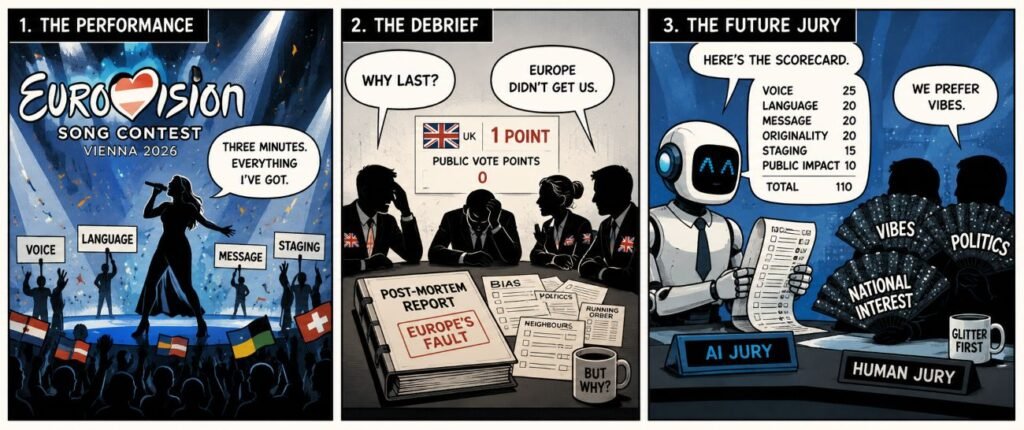
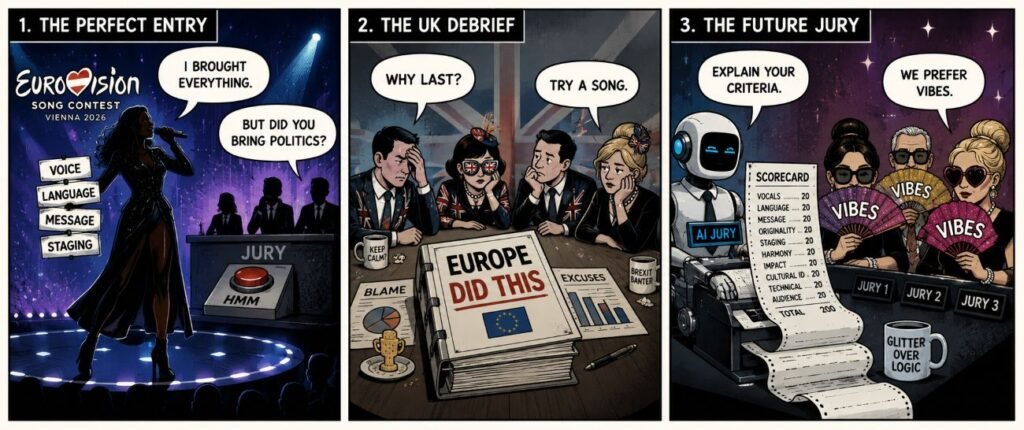
Scene 1: The perfect entry
Panel description. A singer stands on stage holding 4 labels: “voice”, “language”, “message” and “staging”. A jury desk has only 1 button marked “hmm”.
Dialogue:
Singer: “I brought everything.”
Jury: “But did you bring politics?”
Scene 2: The UK debrief
Panel description. A UK delegation sits around a table with a tiny trophy-shaped biscuit and a giant report labelled “Europe did this”.
Dialogue:
UK: “Why last?”
Europe: “Try a song.”
Scene 3: The future jury
Panel description. A robot jury prints a long scorecard while human jurors hide their notes behind glitter fans.
Dialogue:
AI jury: “Explain your criteria.”
Human jury: “We prefer vibes.”
What to watch, not the show
- Whether Eurovision keeps rewarding songs with real local identity or pushes everyone into safer international pop paste.
- How far voting reform can go before fans feel treated like suspects rather than participants.
- Whether political pressure keeps turning the scoreboard into a diplomatic weather map.
- Whether the UK keeps blaming Europe instead of fixing the selection process.
- Whether Eurovision Asia changes the whole argument by making “country representation” louder, broader and harder to fake.
The Hermit take
Eurovision 2026 had a rightful winner and several almost-winners.
The real loser was the habit of mistaking excuses for analysis.
Keep or toss
Keep / Toss.
Keep the talent, language mixing and cultural nerve.
Toss the post-result blame theatre.
Sources
- Eurovision official participant list: https://www.eurovision.com/eurovision-song-contest/vienna-2026/all-participants/
- Eurovision official winner story: https://www.eurovision.com/stories/dara-wins-the-eurovision-song-contest-2026-for-bulgaria/
- Euronews final results live coverage: https://www.euronews.com/culture/2026/05/17/eurovision-2026-follow-our-coverage-of-the-worlds-greatest-song-contest
- Reuters report on Bulgaria’s win and boycotts: https://www.reuters.com/world/asia-pacific/eurovision-song-contest-final-takes-stage-amid-gaza-boycott-2026-05-16/
- Guardian report on Eurovision 2026: https://www.theguardian.com/world/2026/may/17/bulgaria-wins-70th-eurovision-contest-dara-bangaranga
- EBU voting rule changes for 2026: https://www.ebu.ch/news/2025/11/ebu-announces-changes-to-eurovision-song-contest-voting-rules-to-strengthen-trust-and-transparency
- Eurovision Asia official page: https://www.eurovision.com/asia/
- Eurovisionworld UK 2026 result: https://eurovisionworld.com/eurovision/2026/united-kingdom
- Guardian report on “Choke Me” controversy: https://www.theguardian.com/tv-and-radio/2026/mar/13/romania-eurovision-song-choke-me-criticised-glamorising-sexual-strangulation
- Eurovisionworld 2026 betting odds: https://eurovisionworld.com/odds/eurovision
- Eurovoix betting odds, 16 May 2026: https://eurovoix.com/2026/05/16/eurovision-betting-oddsmay-16-morning/
- Eurovoix betting odds, 15 May 2026: https://eurovoix.com/2026/05/15/eurovision-betting-odds-may-15/
- AP Eurovision 2026 final result: https://apnews.com/article/eb9d219d95b4754d47c6df85b74bacdf
- Eurovision official 1956 contest page: https://www.eurovision.com/eurovision-song-contest/lugano-1956/
- Eurovisionworld full winners list, 1956 to 2026: https://eurovisionworld.com/eurovision
- Eurovisionworld 1956 results and facts: https://eurovisionworld.com/eurovision/1956
- Eurovisionworld 1969 four-winner result: https://eurovisionworld.com/eurovision/1969
- Eurovision official 2026 winner story: https://www.eurovision.com/stories/dara-wins-the-eurovision-song-contest-2026-for-bulgaria/
- AP Eurovision 2026 result: https://apnews.com/article/eb9d219d95b4754d47c6df85b74bacdf
- Guardian Eurovision 2026 result report: https://www.theguardian.com/world/2026/may/17/bulgaria-wins-70th-eurovision-contest-dara-bangaranga