Lede
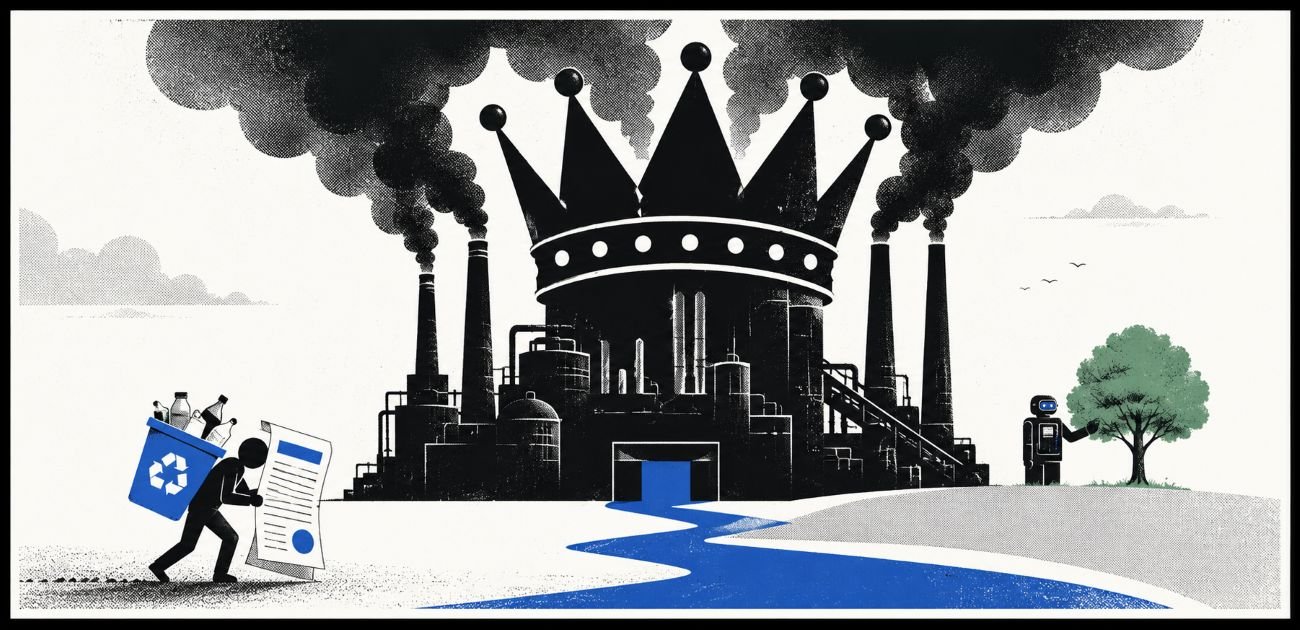
The planet gets polluted at industrial scale, then the ordinary person is handed a reusable straw and told to feel guilty with discipline.
Hermit Off Script
Corporate pollution is the grand theatre where the biggest actors wear clean suits, sponsor a few green slogans, and somehow the spotlight lands on the person who forgot a tote bag. The biggest waste and pollution of nature and the environment comes from the systems producing the goods, the services, the necessities, the software, the data centres, the logistics, the endless appetite dressed as progress. Some companies pay heavy sums for public image, taxes, lobbying, sponsorships, and polished reports, and suddenly everyone is meant to close their eyes and clap because the logo has a leaf on it. Others pollute first, then pay fines, settle cases, hire better lawyers, or find officials with very flexible moral spines. And in the end the bill is pushed onto all of us, because apparently we consume too much. Fine. We do consume. But who designed the shelves, the packaging, the upgrades, the throwaway culture, the planned obsolescence, the “new model every year” circus? They forget to mention the billions sitting in corporate pockets. If the same giants truly did everything for the betterment of the world and environment, maybe some of those billions would become millions. Still rich, just less imperial. But hey, maybe they think people are stupid. Otherwise I can’t explain how so much waste, damage to species, rivers, forests, soil, air and nature becomes a polite side story while quarterly profit gets the drum roll. Maybe, as commentary and not as prophecy, the new lords of the future – AI, machine minds, whatever name they take – will have more concern for nature than we did. Imagine that: we build a machine to think, and the first thing it notices is that humans treated Earth like a rental car with no deposit.
What does not make sense
- The public is told to recycle better while many products are designed to be cheap, mixed-material, short-lived and hard to repair.
- Companies sell endless consumption, then act shocked when endless consumption produces endless waste.
- Environmental damage is called an externality, which is a very clean word for “someone else pays”.
- A person gets shamed for a plastic fork while industrial supply chains move mountains of fossil fuels, minerals, packaging and water.
- Some companies market “net zero” dreams while their real business still depends on extracting, burning, shipping or wasting more.
- AI is sold as a clean future, but the servers still need electricity, cooling, land, minerals and water. The cloud is not a cloud. It is a warehouse with a very expensive appetite.
Sense check / The numbers
- The Carbon Majors database linked 1,421 GtCO2e of cumulative historical emissions from 1854 to 2022 to 122 oil, gas, coal and cement producers; its CO2 portion is equivalent to 72 per cent of global fossil fuel and cement CO2 emissions since 1751. [Carbon Majors]
- Carbon Majors’ 2024 update traced 34.7 GtCO2e of greenhouse gas emissions in 2024 to 166 oil, gas, coal and cement producers, with 32 companies linked to more than half of global fossil fuel and cement CO2 emissions that year. [InfluenceMap]
- UNEP says municipal solid waste generation is predicted to rise from 2.1 billion tonnes in 2023 to 3.8 billion tonnes by 2050, while the hidden costs of pollution, health damage and climate change could push annual costs to USD 640.3 billion by 2050. [UNEP]
- OECD found global plastics production doubled from 234 million tonnes in 2000 to 460 million tonnes in 2019, while only 9 per cent of plastic waste was ultimately recycled. [OECD]
- The IEA estimates data centres used about 415 TWh of electricity in 2024, around 1.5 per cent of global electricity consumption, and says demand has grown by 12 per cent per year over the last 5 years. [IEA]
The sketch
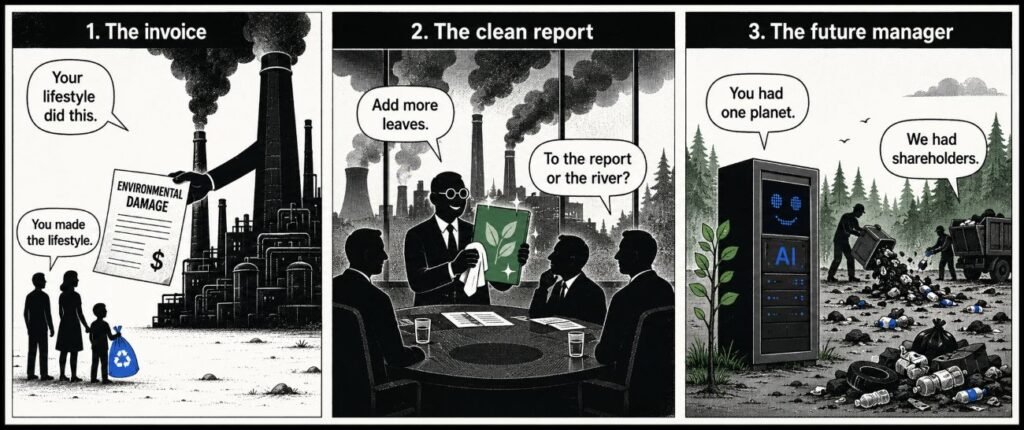
Scene 1: The invoice
Panel description. A giant factory chimney hands a bill marked “environmental damage” to a small family holding one recycling bag.
Dialogue:
Factory: “Your lifestyle did this.”
Family: “You made the lifestyle.”
Scene 2: The clean report
Panel description. A boardroom full of shadowy executives polish a green report while black smoke rises behind the window.
Dialogue:
Executive: “Add more leaves.”
Assistant: “To the report or the river?”
Scene 3: The future manager
Panel description. A calm AI server with a small tree beside it looks at humans dumping rubbish into a forest.
Dialogue:
AI: “You had one planet.”
Human: “We had shareholders.”
What to watch, not the show
- Whether companies reduce actual production damage, not just improve slogans.
- Lobbying against environmental rules while advertising green promises.
- Fines that are smaller than the profit made from the harmful activity.
- Data centre growth, grid pressure, water use and who pays for new infrastructure.
- Product design: repairable, reusable and recyclable in practice, not just on a label.
- The shift from public guilt to producer responsibility.
- Media coverage that blames individual habits while treating corporate waste as background weather.
The Hermit take
The public should recycle. The giants should stop pretending the bin is bigger than the factory.
Guilt is cheap. Repairing the damage is expensive, which explains the whole comedy.
Keep or toss
Toss.
Keep personal responsibility.
Toss the theatre where consumers carry the shame and corporations keep the profit.
Sources
- Carbon Majors Launch Report 2024: https://carbonmajors.org/site/data/000/027/Carbon_Majors_Launch_Report.pdf
- InfluenceMap Carbon Majors 2024 Data Update: https://influencemap.org/briefing/Carbon-Majors-2024-Data-Update-35466
- UNEP Global Waste Management Outlook 2024: https://www.unep.org/resources/global-waste-management-outlook-2024
- OECD Global Plastics Outlook: https://www.oecd.org/en/publications/2022/02/global-plastics-outlook_a653d1c9.html
- IEA Energy Demand From AI: https://www.iea.org/reports/energy-and-ai/energy-demand-from-ai