

Lede
Respect is printed on the office wall and quietly removed from the meeting room.
Hermit Off Script
I have noticed that the word respect becomes very popular whenever management orders another poster. Respect for everyone, diversity for everyone, a cheerful little workshop for everyone. Then the meeting starts, somebody mocks a colleague’s accent, the loudest person gets promoted and the quiet worker who actually understands the problem is told to be more of a team player. What a wonderful use of ink. I am not interested in a manager’s ethnicity, surname or accent, and neither should anybody else be. Competence does not arrive with a particular face or a louder voice. Yet workplaces still find ways of confusing authority with character, and volume with ability. The worst part is how unevenly the rules can be applied. A junior employee who pushes back against a bully may be labelled difficult; a senior employee who behaves badly gets called demanding. Some workplaces will run a training course on inclusion while treating the person who reports the problem as the inconvenience. That is how slogans become camouflage. I would like to see what happens without the camera, the presentation or the annual awareness week. Who gets heard? Who is given credit? Who is allowed to make a mistake? Who is protected when the offender signs the pay cheques? The law matters, but human decency should not need a slide deck to announce its arrival. Respect is not the title on your badge. It is the treatment you give someone who cannot improve your career.
What does not make sense
- The person who reports bullying may face more scrutiny than the person accused of it.
- Workplace promotions can reward confidence while neglecting competence.
- An inclusion poster is treated as proof of an inclusive culture.
- Rules that bind junior staff are excused when a senior employee breaks them.
Sense check
Updated 4 November 2026: This rewrite follows the article first published in 2025. Figures refer to their stated source periods.
- Section 26 of the Equality Act 2010 defines harassment linked to protected characteristics and unwanted conduct of a sexual nature. [Legislation.gov.uk]
- Section 13 of the Equality Act 2010 addresses direct discrimination, making the legal test more specific than a generic “be nice” poster. [Legislation.gov.uk]
- Acas distinguishes bullying from harassment and explains that bullying is not automatically unlawful, while harassment can fall under the Equality Act 2010. [Acas]
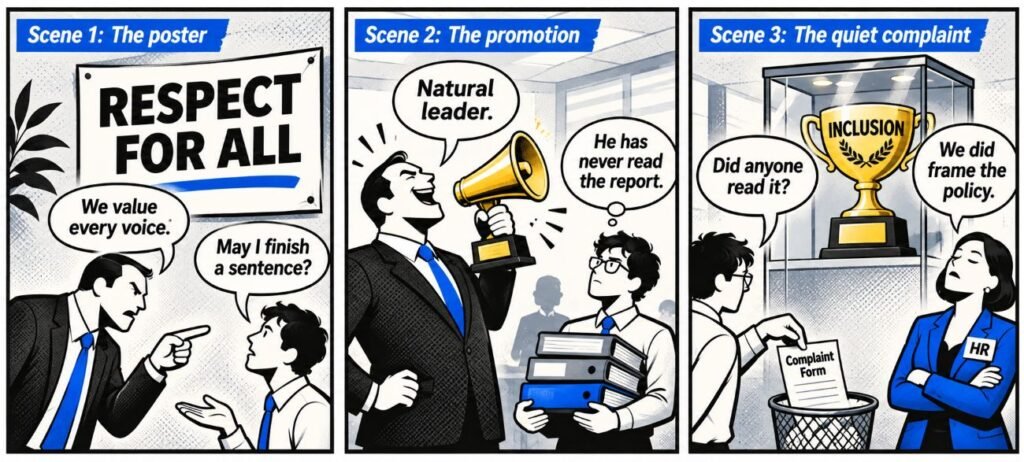
The sketch
Scene 1: The poster
A huge “RESPECT FOR ALL” poster fills an office wall. A manager under it points a finger at a junior employee.
Dialogue:
Manager: “We value every voice.”
Worker: “May I finish a sentence?”
Scene 2: The promotion
A loud manager receives a golden megaphone while a skilled worker carries a stack of completed projects.
Dialogue:
Executive: “Natural leader.”
Worker: “He has never read the report.”
Scene 3: The quiet complaint
A tiny complaint form sits in a bin beneath a glass cabinet displaying an enormous inclusion trophy.
Dialogue:
Worker: “Did anyone read it?”
HR: “We did frame the policy.”
What to watch, not the show
- How complaints are investigated and whether retaliation is prevented.
- Promotion criteria that reward actual work, not theatrical confidence.
- Whether training changes decisions and behaviour after the presentation ends.
- Read more on workplace conditions in Modern handbooks, medieval work conditions.
The Hermit take
Respect is visible in actions, not posters.
If a title excuses contempt, the culture has already failed.
Keep or toss
Keep / Toss
Keep fair processes and genuine dignity.
Toss the decorative respect campaign.
Disclaimer: This article is satire and commentary. Factual statements are attributed to the sources listed below.
Sources
- Equality Act 2010 section 26: https://www.legislation.gov.uk/ukpga/2010/15/section/26
- Equality Act 2010 section 13: https://www.legislation.gov.uk/ukpga/2010/15/section/13
- Acas on bullying at work: https://www.acas.org.uk/bullying-at-work
- Acas on discrimination and the law: https://www.acas.org.uk/discrimination-and-the-law