
Lede
The world has enough money to sell salvation as a brand package, but somehow not enough will to stop children living inside the fire.
Hermit Off Script
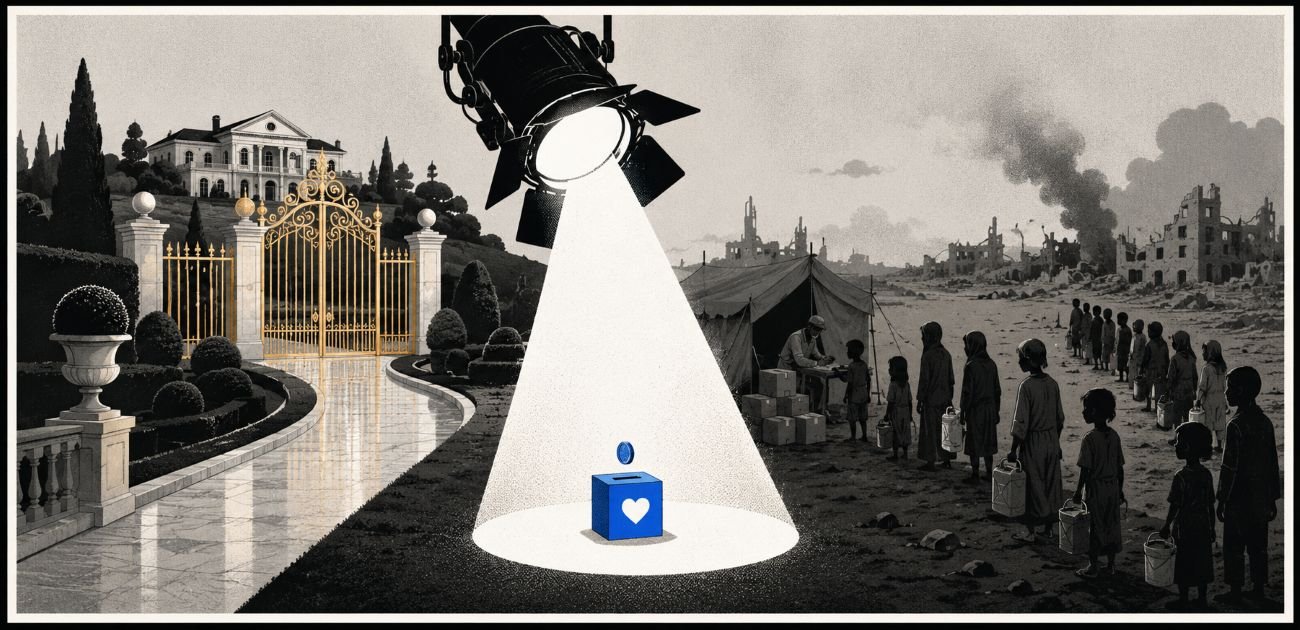
A video about AI and global power made me think about people who actually help the world with actions, not applause. There are unknown people in poor countries, war zones, broken neighbourhoods and forgotten villages who live quietly for the betterment of others. Some help vulnerable children. Some bring food, medicine, shelter, schoolbooks or simply a safe hand in places where war is not a headline. War is the weather. War is the morning. War is the thing children learn before grammar. And then we have the louder species: people and companies who make a grand theatre out of a little help because the help is not the point. The image is the point. The halo must be polished. The press release must glow. The brand must look like it has a soul, preferably one with good lighting. I don’t deny that some donations help. Of course they do. But when wealth becomes so large that charity turns into reputation insurance, we should stop clapping like seals at a yacht show. If the richest people and the most powerful governments did even a fraction of what they could do – not only with money, but with pressure, law, diplomacy, tax, trade and public will – this planet would look less like a divine waiting room and more like a place humans are trying to repair. Maybe that is the real scandal. Some people already live in heaven on Earth, behind gates, guards and investment portfolios. Others live in hell on Earth, told to wait for the promised one while ancient scripts, political excuses and modern greed explain why their suffering must continue. A child does not need a theory of civilisation. A child needs peace, food, water and someone powerful to finally stop posing beside the bucket.
AI & The Race for Global Power: China vs US | William MacAskill
Could artificial intelligence hand the US or China 99% of global economic and military power? What happens when millions of autonomous weapons systems are controlled by a single commander-in-chief? Has effective altruism’s influence in Silicon Valley accelerated or slowed the race for artificial general intelligence?
Rory Stewart and Alastair Campbell, hosts of Britain’s biggest podcast, are joined by William MacAskill to discuss all this and more.
What does not make sense
- Companies spend fortunes making tiny acts look huge, then call it purpose.
- Governments find billions for weapons, then become accountants when children need food.
- Billionaires can move markets before breakfast, but poverty is treated like weather.
- Charity is praised when it is voluntary, while justice is feared because it requires rules.
- We applaud donors for giving crumbs from tables built on tax gaps, cheap labour and political access.
- War children are described as tragic, then placed gently into the drawer labelled “complex situation”.
- Religious language is often used to comfort the wounded, while power uses it to avoid stopping the wound.
Sense check / The numbers
- UNICEF said over 473 million children lived in areas affected by conflict, and conflict drives about 80 per cent of humanitarian needs worldwide. [UNICEF]
- The World Bank said almost 700 million people, or 8.5 per cent of the global population, lived in extreme poverty on less than $2.15 a day. [World Bank]
- UNHCR reported 123.2 million people forcibly displaced at the end of 2024 because of persecution, conflict, violence, human rights violations and events seriously disturbing public order. [UNHCR]
- SIPRI said world military expenditure reached $2887 billion in 2025, rising 2.9 per cent in real terms over 2024. The USA, China and Russia spent $1480 billion combined. [SIPRI]
- Forbes said the 2026 billionaire list contained 3,428 billionaires worth a combined $20.1 trillion, up from $16.1 trillion in 2025. [Forbes]
The sketch
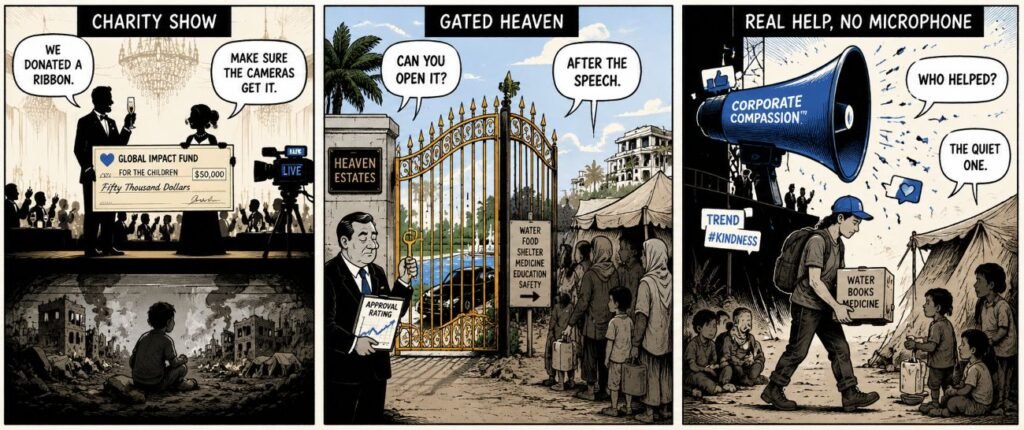
Scene 1: Charity show
Panel description. A banquet hall floats above a dark map of war zones. A giant cheque is held up under stage lights while a child is visible through the floor below.
Dialogue: “We donated a ribbon.” “Make sure the cameras get it.”
Scene 2: Gated heaven
Panel description. A golden gate marked “Heaven” separates a luxury district from tents, queues and aid boxes. A politician holds a key but looks at a polling chart.
Dialogue: “Can you open it?” “After the speech.”
Scene 3: Real help, no microphone
Panel description. A tired volunteer carries water and schoolbooks past a giant megaphone shaped like a corporate logo. The megaphone is louder than the aid.
Dialogue: “Who helped?” “The quiet one.”
What to watch, not the show
- Whether aid is used to fix suffering or polish reputations.
- Whether governments fund humanitarian work with the same urgency they fund defence.
- Whether billionaires ask for better systems or just better headlines.
- Whether tax policy does more for poor children than charity galas ever could.
- Whether war is treated as a political failure or as permanent background noise.
- Whether religious comfort becomes an excuse for earthly neglect.
- Whether platforms reward actual help or the best-lit performance of compassion.
The Hermit take
Charity is good when it feeds the hungry.
It becomes theatre when it protects the powerful from being asked why the hunger exists.
Keep or toss
Verdict: Keep / Toss.
Keep real help. Toss the halo business model.
Sources
- Inspired video: https://www.youtube.com/watch?v=KVbw4j__FOc
- Episode notes on AI and global power: https://podfollow.com/1665265193/episode/ee2f1010336bafa27115611524bff07e49ea7ca6/view
- UNICEF children in conflict: https://www.unicef.org/press-releases/not-new-normal-2024-one-worst-years-unicefs-history-children-conflict
- World Bank Poverty, Prosperity, and Planet Report 2024: https://www.worldbank.org/en/publication/poverty-prosperity-and-planet
- UNHCR Global Trends 2024: https://www.unhcr.org/global-trends-report-2024
- SIPRI global military spending 2025: https://www.sipri.org/media/press-release/2026/global-military-spending-rise-continues-european-and-asian-expenditures-surge
- Forbes 2026 billionaires list release: https://www.businesswire.com/news/home/20260310629058/en/Forbes-40th-Annual-Worlds-Billionaires-List
- Oxfam wealth and development finance analysis: https://www.oxfam.org/en/press-releases/new-wealth-top-1-surges-over-339-trillion-2015-enough-end-poverty-22-times-over
