
Lede
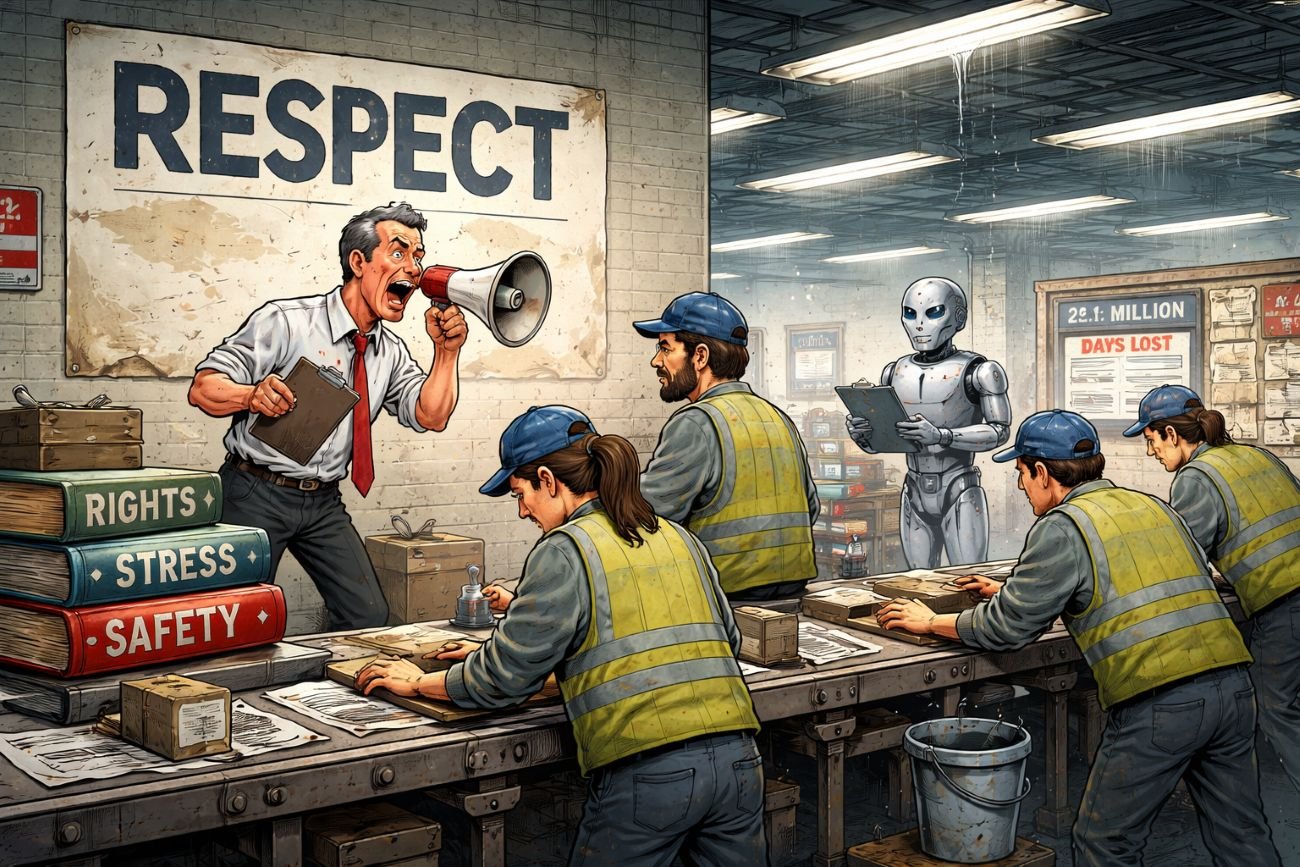
Britain likes to talk like a modern workplace nation, but too many production floors still run like respect is a luxury item.
Hermit Off Script
In Britain, and to me especially since Brexit, it feels like shouting at workers and disrespecting the people who keep production running has become too normal in some places. Managers and team leaders talk down to people as if the ones doing the actual work matter less, when without them the whole line would stop. That is the absurdity. Companies cannot wait for robots, but barely seem to think that once AI becomes strong enough, many white-collar jobs and management layers may be hit before everything on the factory floor is replaced. My own view is that office roles could be smashed first within a few years, while many physical jobs may take longer. The people barking orders today may be much closer to redundancy than they imagine. What I see is not one simple cause but a rotten habit fed from different directions. Some of it comes from old authoritarian reflexes, the idea that the boss stands above the worker and fear is somehow a leadership tool. Some of it comes from the ugly habit of treating immigrants and outsiders as if they should endure more, complain less and be grateful for whatever they get. It is not everyone, but it does not need to be everyone. It only takes enough of that mindset to turn a workplace toxic. What makes it worse is that many workers do not fully know their rights, are not used to British workplace protections, or stay quiet because they think speaking up will cost them the job that pays the rent. And that is where the whole theatre becomes pathetic. The protections are already there on paper. Acas gives free and impartial advice on employment rights and workplace conflict. HSE says employers have a legal duty to protect workers from stress by doing a risk assessment and acting on it. The GLAA exists to stop worker exploitation and investigate abuse, forced labour and illegal labour provision. Poor working environments, excessive stress, low control, discrimination and insecurity are recognised risks to mental health, not signs that a worker is somehow weak. So when government wonders why people are worn down, burnt out, quiet and anxious, the answer is often right under its nose. Too many workers stay silent, too many companies get comfortable, and too many managers mistake intimidation for leadership. That is why more investigations, more audits and tougher penalties start to look less like overreaction and more like basic hygiene.
What does not make sense
- Calling people “the team” while treating them like replaceable machine parts.
- Pretending stress is just personal weakness when employers already have a legal duty to assess and act on stress risks.
- Pretending complaints systems work perfectly when Acas says workplace conflict is rising and CIPD found only 36 per cent of employees who experienced conflict felt it had been fully resolved.
- Acting shocked that people stay quiet when fear of losing the job is exactly what keeps bad cultures alive.
- Blaming whole nationalities for toxic culture when the real constant is weak management plus power without consequence.
- Dreaming about robots saving the business while human conflict is already costing employers billions.
- Claiming the workplace is professional while shouting, intimidation and casual contempt are treated like normal shop-floor weather.
- Boasting about compliance while workers still do not know which door to knock on when things go wrong.
Sense check / The numbers
- Acas says it gives employees and employers free, impartial advice on workplace rights, rules, best practice and resolving workplace conflict. [Acas]
- HSE says employers have a legal duty to protect workers from stress at work by doing a risk assessment and acting on it. [HSE]
- In Great Britain in 2024/25, 964,000 workers were suffering work-related stress, depression or anxiety, and those conditions accounted for 22.1 million working days lost. [HSE]
- Acas says workplace conflict costs British businesses GBP 28.5 billion per year. [Acas]
- WHO says 15 per cent of working-age adults were estimated to have a mental disorder in 2019, and poor working environments including discrimination, excessive workloads, low job control and job insecurity pose a risk to mental health. [WHO]
- The GLAA says its role is to protect vulnerable and exploited workers and investigate exploitation, forced labour and illegal labour provision. [GLAA]
- The AI warning is not fantasy, but the timetable is not settled. The IMF says almost 40 per cent of global employment is exposed to AI, with about 60 per cent exposed in advanced economies, while the OECD says many of the most exposed roles are white-collar occupations such as managers, IT professionals and other highly trained staff. [IMF] [OECD]
- The World Economic Forum says job disruption is expected to affect 22 per cent of jobs by 2030, with 170 million roles created and 92 million displaced. [WEF]
The sketch
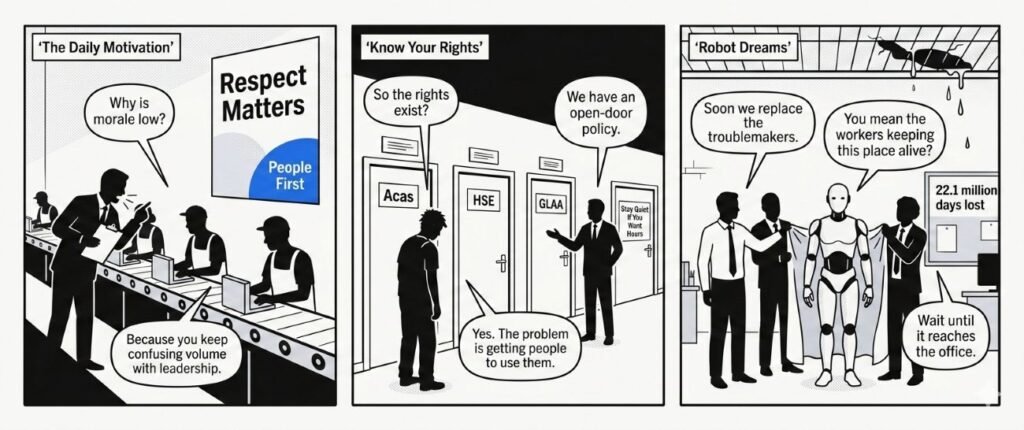
Scene 1: “The Daily Motivation”
Panel description: A production line is running at full speed while a manager with a clipboard leans over workers and shouts under a giant poster that says “Respect Matters”.
Dialogue:
Manager: “Why is morale low?”
Worker: “Because you keep confusing volume with leadership.”
Poster: “People First”
Scene 2: “Know Your Rights”
Panel description: A tired worker stands in front of three doors labelled “Acas”, “HSE” and “GLAA”, while another door behind the manager says “Stay Quiet If You Want Hours”.
Dialogue:
Worker: “So the rights exist?”
Second worker: “Yes. The problem is getting people to use them.”
Manager: “We have an open-door policy.”
Scene 3: “Robot Dreams”
Panel description: Executives in clean office clothes unveil a shiny robot while the leaking factory roof drips onto a noticeboard reading “22.1 million days lost”.
Dialogue:
Executive: “Soon we replace the troublemakers.”
Robot: “You mean the workers keeping this place alive?”
Worker: “Wait until it reaches the office.”
What to watch, not the show
- Managers rewarded for output this week, not for damage done to people six months later.
- Workers staying silent because rent, visas, hours and references feel more immediate than a formal complaint.
- Authoritarian habits dressed up as “high standards” and prejudice dressed up as “shop-floor culture”.
- Companies relying on paperwork and posters instead of changing how supervisors behave.
- Stress being treated as an attitude problem instead of a workplace risk.
- AI being sold as the future while basic human management is still failing in the present.
The Hermit take
The line runs on workers, not on shouting.
Respect is cheaper than burnout and wiser than a robot fantasy.
Keep or toss
Keep / Toss
Keep the rights, the reporting routes and the legal duties.
Toss the little-dictator culture that still thinks fear is efficient and silence is consent.
Sources
- Acas main guidance and workplace rights advice: https://www.acas.org.uk/
- HSE guidance on work-related stress and legal duties: https://www.hse.gov.uk/stress/risk-assessment.htm
- HSE 2024/25 workplace health and safety statistics: https://www.hse.gov.uk/statistics/overview.htm
- Acas workplace conflict cost research: https://www.acas.org.uk/research-and-commentary/workplace-conflict/prevalence-of-conflict-at-work/report
- GLAA mission and role in stopping exploitation: https://www.gla.gov.uk/who-we-are/what-we-do
- WHO mental health at work fact sheet: https://www.who.int/news-room/fact-sheets/detail/mental-health-at-work
- IMF analysis of AI exposure across employment: https://www.imf.org/en/blogs/articles/2024/01/14/ai-will-transform-the-global-economy-lets-make-sure-it-benefits-humanity
- OECD report on workers most exposed to AI: https://www.oecd.org/en/publications/who-will-be-the-workers-most-affected-by-ai_14dc6f89-en.html
- World Economic Forum Future of Jobs 2025: https://www.weforum.org/press/2025/01/future-of-jobs-report-2025-78-million-new-job-opportunities-by-2030-but-urgent-upskilling-needed-to-prepare-workforces/
- UK government timeline for the Fair Work Agency: https://www.gov.uk/government/publications/implementing-the-plan-to-make-work-pay-and-employment-rights-act/plan-to-make-work-pay-and-employment-rights-act-timeline-update
- CIPD press release on unresolved workplace conflict: https://www.cipd.org/uk/about/press-releases/third-employees-workplace-conflict-not-resolved/

Leave a Reply