
Lede
AI has not killed engineering, but it is making the engineer who refuses to use AI look increasingly like a typist defending the typewriter.
Words used
- Vibe coding: generating software mainly through natural-language instructions to an AI system, sometimes with limited direct editing of the underlying code.
- Physical AI: AI connected to machines that can perceive and act in the physical world, including robots, vehicles and industrial systems.
- Autonomous weapon system: a weapon system able to perform some functions involving target selection or attack without direct human action at every step.
Hermit Off Script
I keep hearing that AI is coming for engineers, especially software engineers, and I think the argument is already slightly behind the technology. I don’t think engineering itself is obsolete. I think manually doing every coding task as if AI never happened is becoming obsolete. There is a difference. If somebody beside you can describe the problem, generate the first implementation, test it, inspect it, repair it and move on while you are still proudly typing boilerplate by hand, I am not sure tradition is going to save your timesheet. Call it vibe coding, agentic coding, AI-assisted development or whatever new name survives six months before the industry invents another one. The name doesn’t matter. The working method has changed.
Then comes the funny career turn. Some of the people who helped build this digital future now seem increasingly interested in warning us that the digital future is terrifying. Suddenly there are podcasts, interviews, extinction probabilities, social-media sermons and long discussions about how nobody can control the thing anymore. I am not saying the warnings are fake. Some risks are real. I am saying there is something wonderfully modern about building the machine, watching it automate part of your craft, then discovering that explaining why the machine may destroy civilisation is itself a new content category.
The companies aren’t exactly allergic to this theatre either. Why would they be? “Our product may improve office productivity” gets you a software subscription. “Our product may become smarter than humanity” gets governments, investors, television studios and entire conferences interested. That doesn’t prove some coordinated conspiracy. It does mean fear and business can sit quite comfortably at the same table.
Security makes the contradiction better. Humans cannot manually review machine-speed output forever, but simply telling AI to write more code faster doesn’t magically make the code safe. The sensible answer is not human versus AI. It is AI generating, AI testing, automated scanners checking, and humans retaining responsibility for what gets released. Eventually we may have AI checking AI because the human reviewer simply cannot inspect every line produced at machine speed. That sounds frightening until you remember we already use software to test software. The new problem is scale.
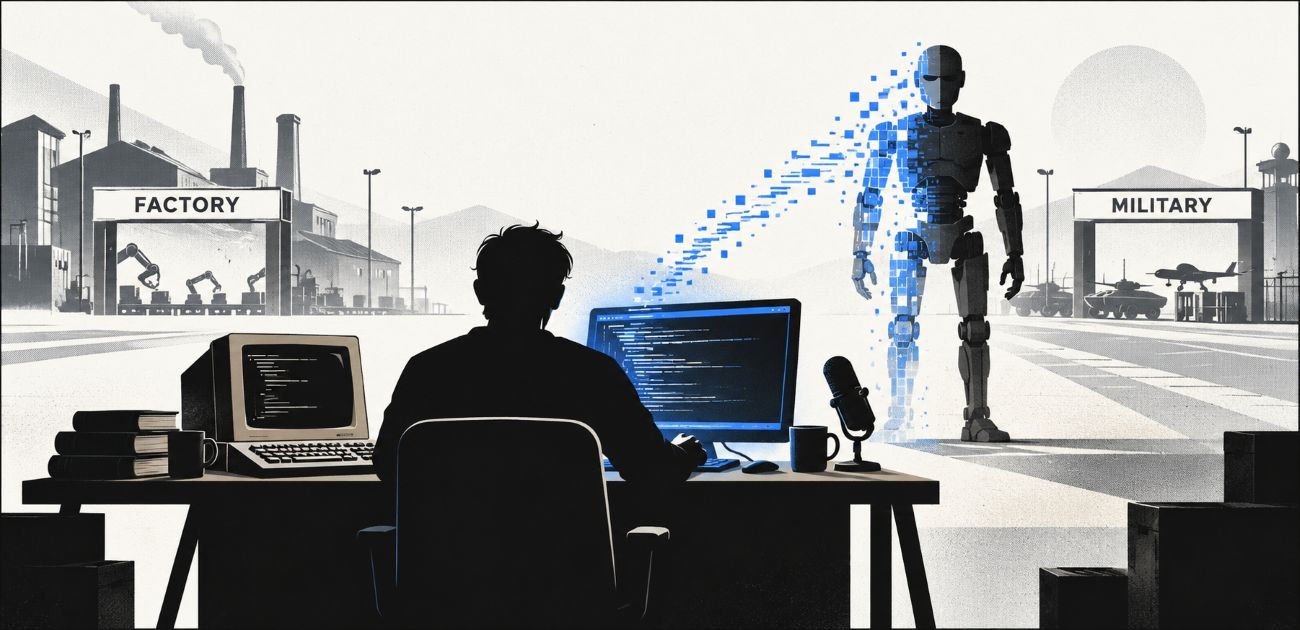
Where I agree much more with the physical-AI argument in the Farzad video is that the screen is not the whole story. A chatbot sitting in a data centre is not a Terminator. I wouldn’t go as far as saying software without a body can never hurt humans, because software already controls money, communications, transport, infrastructure and plenty of systems capable of producing physical consequences. But the risk changes dramatically once intelligence gets actuators, wheels, hands, factories and weapons. That is where “AI safety” stops being mostly a discussion about what a model might say and becomes a question about what a machine is allowed to do.
And war is where I become much less amused. Countries have an obvious incentive to send machines into dangerous situations instead of their own soldiers. That does not prove the next major war will be fought entirely by robots, but pretending military autonomy is science fiction is becoming difficult when governments are already spending serious money on autonomous systems. If physical AI becomes strategically important, then the countries able to manufacture the most capable robots, sensors, chips, batteries, actuators and autonomous systems gain industrial and military power as well. The technology will not decide whether that power serves freer societies or authoritarian ones. Humans will.
This is not a prediction that armies of humanoid robots will be marching soon. It is the direction I would watch. Research will not stop because somebody made a frightening podcast. The keyboard war is the sideshow. The factory floor is where AI gets muscles, and the battlefield is where those muscles need rules.
Why physical AI and humanoid robots like Tesla Optimus matter more than doomsday AI headlines — from car-factory supply chains that already prove the hard parts, to what happens when robots take over the work that built the industrial world, and why almost nobody is pricing how close this actually is.
What does not make sense
- Declaring AI useless while quietly using it for research, debugging, documentation or code completion.
- Declaring engineers extinct when companies still need people who understand architecture, requirements, testing, security and what the software is supposed to do.
- Treating “vibe coding” as the entire future when most professional developers still do not describe their work that way.
- Treating every AI warning as neutral public service when fear, regulation, investment and competitive positioning can all create incentives around the same story.
- Complaining that humans cannot inspect machine-speed code while refusing machine-speed testing and security tools.
- Assuming faster generated code must also be safer code.
- Imagining that dangerous AI needs a humanoid body when software can already affect physical infrastructure through connected systems.
- Discussing autonomous weapons as distant science fiction while governments are already funding autonomous military systems.
- Assuming the country with the smartest model automatically wins when physical AI also depends on factories, supply chains, batteries, motors, sensors and manufacturing scale.
- Treating technical superiority as political virtue. A more capable robot does not arrive with democracy pre-installed.
Sense check / The numbers
- In Stack Overflow’s 2025 survey, 84 per cent of respondents said they used or planned to use AI tools in software development, and 51 per cent of professional developers used them daily. Yet 72 per cent said they were not vibe coding. AI-assisted development is mainstream; handing the entire craft to prompts is not. [Stack Overflow]
- GitHub’s controlled experiment with 95 professional developers found its Copilot group completed one JavaScript task 55 per cent faster. METR later studied 16 experienced open-source developers across 246 real issues and found that early-2025 AI tools made them 19 per cent slower on those tasks. The honest conclusion is irritatingly sensible: AI can produce large speed gains, but workload, experience and context matter. [GitHub] [METR]
- The US Bureau of Labor Statistics projected software-developer employment to grow 15.8 per cent from 2024 to 2034, adding about 267,700 jobs. That does not prove individual coding tasks are safe from automation. It does make “software engineers have already been replaced” rather difficult to sell as a fact. [US BLS]
- Veracode tested more than 100 large language models for its 2025 code-security report and said 45 per cent of generated code samples failed its security tests; Java samples failed at a rate of 72 per cent. AI can accelerate code production, but speed without automated security checking can accelerate vulnerabilities as well. [Veracode]
- The International Federation of Robotics reported that the global operational stock of industrial robots passed 5 million in 2025, with more than 600,000 new installations that year. Separately, the US Department of Defense put about $500 million of FY2024 funding behind the first Replicator tranche and described a goal of fielding multiple thousands of autonomous systems. That does not prove robot war is inevitable. It does show that physical automation and military autonomy are already budgets rather than screenplay ideas. [IFR] [US DoD]
The sketch
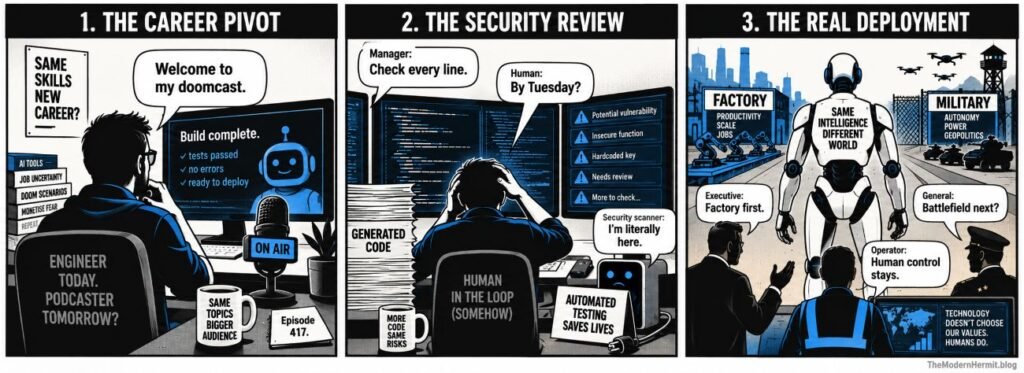
Scene 1: The career pivot
An engineer silhouette watches an AI terminal finish a block of code while a podcast microphone lights up beside the keyboard.
Dialogue:
AI: “Build complete.”
Engineer: “Welcome to my doomcast.”
Microphone: “Episode 417.”
Scene 2: The security review
Code races across several large screens while one exhausted human holds a magnifying glass and an automated security scanner sits unplugged beside the desk.
Dialogue:
Manager: “Check every line.”
Human: “By Tuesday?”
Scanner: “I’m literally here.”
Scene 3: The real deployment
A line of factory robots walks towards two gates marked FACTORY and MILITARY while a small human operator stands beside the control console.
Dialogue:
Executive: “Factory first.”
General: “Battlefield next?”
Operator: “Human control stays.”
What to watch, not the show
- AI adoption inside real engineering teams. The useful metric is not how many developers have an AI subscription, but whether teams ship reliable work faster.
- Security automation. More generated code means testing, scanning, access control and review have to accelerate as well.
- The doom economy. Watch when safety warnings become arguments for licensing rules, restricted access or market barriers that conveniently favour existing giants.
- Physical AI supply chains. Chips matter, but so do motors, actuators, gearboxes, batteries, sensors, factories and the ability to manufacture at scale.
- Industrial concentration. The country that can make millions of useful machines has a different kind of AI advantage from the country that merely tops a model benchmark.
- Autonomous weapons. Human judgement over force should remain a design requirement, not an optional nostalgic feature. The US DoD itself requires appropriate levels of human judgement in autonomous weapon systems, while the ICRC has argued for stronger international limits.
- Political control. Physical AI can increase productivity under an open society or increase surveillance and coercion under an authoritarian one. The machine does not choose the constitution.
- Labour transition. The engineer most exposed may not be the one replaced by AI, but the one competing with another engineer who knows how to use it properly.
The Hermit take
AI does not make engineering irrelevant. Refusing to use it might.
The real power shift starts when software leaves the screen and gains factories, actuators and weapons.
Keep or toss
Keep / Toss
Keep AI-assisted engineering, automated security checks, physical-AI research and hard human control over weapons.
Toss the nostalgia, doom theatre and the fantasy that faster automatically means safer.
Sources
- Farzad video that inspired this roast: https://youtu.be/ycUDA1dIdXg?is=TL3Cu-YhpxxHLvYT
- Farzad, “Nobody Knows Just How Close Humanoid Robots Are”: https://farzad.fm/fznews/nobody-knows-how-close-humanoid-robots-are
- Stack Overflow 2025 Developer Survey, AI: https://survey.stackoverflow.co/2025/ai
- GitHub, Copilot developer productivity research: https://github.blog/news-insights/research/research-quantifying-github-copilots-impact-on-developer-productivity-and-happiness/
- METR, experienced open-source developer productivity study: https://metr.org/blog/2025-07-10-early-2025-ai-experienced-os-dev-study/
- US Bureau of Labor Statistics, AI and employment projections: https://www.bls.gov/opub/mlr/2026/article/industry-and-occupational-employment-projections-overview.htm
- Veracode 2025 GenAI Code Security Report summary: https://www.veracode.com/blog/genai-code-security-report/
- International Federation of Robotics, global factory robot figures: https://ifr.org/news/five-million-robots-now-operate-in-factories-globally/1st
- US Department of Defense, first Replicator tranche: https://www.defense.gov/News/Releases/Release/Article/3765644/deputy-secretary-of-defense-hicks-announces-first-tranche-of-replicator-capabil/
- US Department of Defense, autonomy in weapon systems policy: https://www.defense.gov/News/Releases/Release/Article/3278076/dod-announces-update-to-dod-directive-300009-autonomy-in-weapon-systems/
- ICRC position on autonomous weapon systems: https://www.icrc.org/en/document/icrc-position-autonomous-weapon-systems
Leave a Reply