
Lede
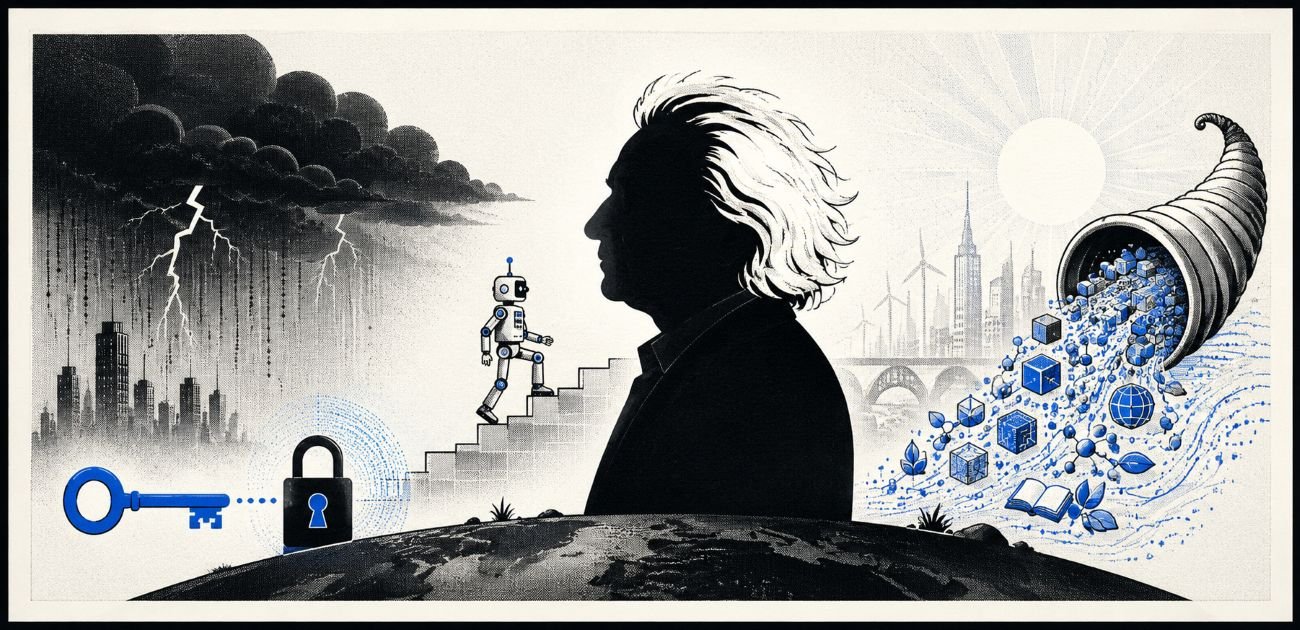
Between AI extinction prophets and abundance evangelists, Michio Kaku offers something almost suspiciously unfashionable: a future that can be extraordinary without arriving by next Tuesday.
Words used
- Superintelligence – a hypothetical AI that exceeds human capability across most or all cognitive domains.
- Embodied intelligence – the ability of a system to perceive, decide and act reliably in the physical world.
- Post-quantum cryptography – encryption designed to resist attacks from future large-scale quantum computers.
Hermit Off Script
You listen to most doomers and wishers in the AI era and the future seems to have only two settings. Either superintelligence arrives, takes the keys and makes humans optional, or it creates such abundance that work, scarcity and apparently every boring problem in civilisation politely disappear. Then Michio Kaku comes along and sounds like a scientist who has remembered to keep both feet on Earth. That does not mean his future is small. Quite the opposite. He talks about AI becoming more capable, robots eventually moving through stages of intelligence, quantum computers changing science and medicine, current encryption facing new threats, and humans possibly merging with machines rather than simply being replaced by them. But the important difference for me is the timescale and the uncertainty. Today’s language models can look astonishing in one task while a robot still has to survive the much less glamorous exam of moving, planning and acting reliably in the physical world. Kaku’s bug-to-mouse-to-monkey comparison is an analogy, not a scientific measuring stick, but it makes the point better than another graph promising either heaven or extinction. Intelligence is not one switch. Software capability, physical autonomy, creativity, self-awareness and human judgement do not necessarily arrive together. Maybe superintelligence and robots really will live amongst us. Maybe we will connect ourselves to them and become something partly biological and partly machine. I can imagine that future. I just trust it more when nobody pretends to know the exact Tuesday on which it begins.
Michio Kaku offers a grounded view of AI, robotics and humanity’s future – from the limits of today’s machines and quantum computing to human-machine merging, free will, God and simulation theory.
Chapters:
00:00 – The future of AI, jobs and automation
05:36 – Can machines become more intelligent than humans?
07:24 – Quantum computers and the end of Moore’s Law
15:41 – Could quantum computers break global encryption?
23:17 – Is AI more dangerous than nuclear weapons?
24:42 – Will robots become a new species?
31:01 – Human enhancement and merging with machines
34:55 – Science, God and the nature of the universe
37:44 – Why Michio Kaku rejects simulation theory
42:15 – Free will: are humans just biological machines?
What does not make sense
- The AI debate keeps selling certainty about a future that is mostly made of forecasts.
- A language model doing expert-level tasks does not mean a humanoid robot can reliably operate in an open physical environment.
- Treating intelligence as one ladder from bug to mouse to monkey to human is memorable, but it is not a scientific unit of measurement.
- A quantum computer threatening today’s public-key cryptography does not mean “encryption ends”. Cryptography is already being replaced with quantum-resistant standards.
- “AI will replace jobs” and “AI will create abundance” are both too neat. Jobs contain tasks, and those tasks can be automated, changed, added or redistributed.
- Human-machine merging may become technically possible in deeper forms, but access, consent, ownership and inequality will matter as much as the hardware.
Sense check / The numbers
- The International Labour Organization estimated in 2025 that 1 in 4 jobs worldwide had some exposure to generative AI, while saying transformation of jobs was more likely than outright replacement. [ILO]
- The International Federation of Robotics recorded 542,000 industrial robots installed in 2024 and 4,664,000 in operational use worldwide, up 9 per cent from the previous year. That is a lot of robots, but mostly not humanoid general intelligence walking around asking existential questions. [IFR]
- NIST finalised 3 principal post-quantum cryptography standards on 13 August 2024 and urged organisations to begin migrating immediately. The quantum threat is real enough for engineers to act on, but “all encryption dies” is not the whole story. [NIST]
- On 21 May 2026, Kaku said a quantum computer capable of breaking much existing digital encryption could exist within 3 years, while an IonQ executive at the same event pointed to a 2028-2029 window for challenging RSA-2048. Those are forecasts, not a demonstrated cryptographically relevant machine. [Broadband Breakfast]
- City College of New York’s faculty page, updated 1 July 2026, lists Kaku as Semat Professor of Physics. The appeal here is not that futurism suddenly becomes fact because a physicist says it, but that his claims can be separated into physics, engineering limits and speculation. [CCNY]
The sketch
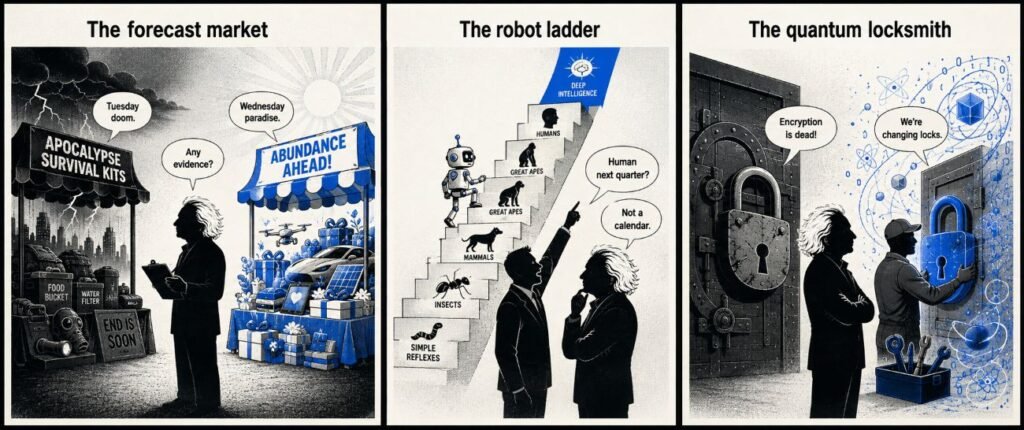
Scene 1: The forecast market
Two giant stalls face each other. One sells apocalypse survival kits. The other gives away overflowing baskets labelled “ABUNDANCE AHEAD!”. A scientist stands between them holding a clipboard.
Dialogue:
Doomer: “Tuesday doom.”
Wisher: “Wednesday paradise.”
Scientist: “Any evidence?”
Scene 2: The robot ladder
A small robot stands on the first rung of a long ladder marked with animal silhouettes rising from insect to mouse, rabbit, dog and monkey. An investor points impatiently towards the top.
Dialogue:
Investor: “Human next quarter?”
Scientist: “Not a calendar.”
Scene 3: The quantum locksmith
A huge quantum machine faces an old vault while a technician replaces the lock on a second vault with a new one.
Dialogue:
Commentator: “Encryption is dead!”
Technician: “We’re changing locks.”
What to watch, not the show
- Money behind short timelines. A dramatic date sells investment, fear, policy attention and headlines better than “we do not know”.
- Robotics outside demonstrations. Reliability, dexterity, energy use, repair costs and safe operation matter more than a polished two-minute video.
- Job ownership. If AI raises productivity, who receives the gain – workers, customers, shareholders or a small group controlling the models?
- Post-quantum migration. The practical story is whether governments, banks and companies replace vulnerable cryptography before powerful quantum machines arrive.
- Military autonomy. Systems do not need human-level intelligence to become dangerous if they can identify, track and attack targets.
- Human enhancement. Brain interfaces and machine augmentation raise questions about consent, security, affordability and who controls the connection.
- Definitions. “AGI”, “superintelligence”, “human level” and even “intelligence” are often used as though everyone means the same thing.
The Hermit take
Kaku’s future is strange enough without pretending it arrives next Tuesday.
The useful question is not when AI becomes a god, but what we build while it is still becoming something.
Keep or toss
Keep / Toss.
Keep the long view, the separation between software intelligence and physical robots, and the willingness to admit uncertainty.
Toss the fake precision, whether it predicts extinction, abundance or a machine messiah with a product launch date.
Sources
- Original Michio Kaku interview supplied for this article: https://www.youtube.com/watch?v=7p4jIBuWAiA
- International Labour Organization, 2025 GenAI jobs index: https://www.ilo.org/resource/news/one-four-jobs-risk-being-transformed-genai-new-ilo%E2%80%93nask-global-index-shows
- International Federation of Robotics, World Robotics 2025: https://ifr.org/ifr-press-releases/news/global-robot-demand-in-factories-doubles-over-10-years
- NIST, first 3 finalised post-quantum encryption standards: https://www.nist.gov/news-events/news/2024/08/nist-releases-first-3-finalized-post-quantum-encryption-standards
- Broadband Breakfast, Kaku at Fiber Connect 2026: https://broadbandbreakfast.com/quantum-physicist-at-fiber-connect-fiber-optics-is-the-nervous-system-that-carries-it/
- City College of New York, physics faculty: https://www.ccny.cuny.edu/physics/physics-faculty
2 responses
[…] the podcast because access matters. Without that kind of platform, many people would never stop and listen to Dr Michio Kaku at all. Most of us are not reading physics papers with our morning coffee, unless breakfast has […]
[…] whole “smarter” claim a joke. And then both sides of the debate do the same theatre: doomers scream superintelligence will end us, boosters sell utopia, and both are scared of something they cannot control. My problem is not superintelligence – […]