
Lede
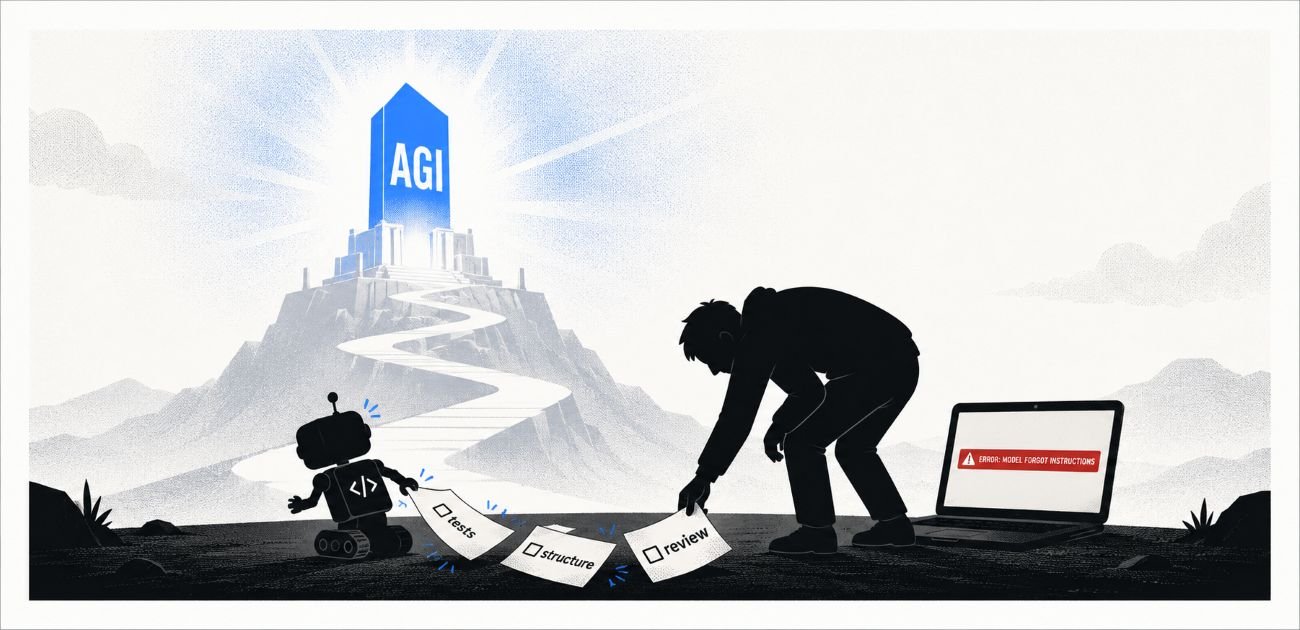
AI companies are dreaming of AGI while some coding workflows still trip over the sacred engineering ritual of remembering what was already said.
Words used
- AGI: Artificial general intelligence, usually meant as AI that can perform across many domains at or above human level.
- Codex: OpenAI’s coding agent for writing, reviewing and shipping code.
- AGENTS.md: A project instruction file used to tell Codex how a repository works.
Hermit Off Script
AI companies dream of AGI, and then in a code review or update the model says something close to “I forgot.” Really? How does a high-level reasoning model forget essentials from the same chat when the task is code, structure, review and functioning? I can understand a model missing the emotional tone of a poem. I can understand it needing another pass on a messy paragraph. But in code, forgetting the basic condition is not a cute little glitch. It is the door left open in a factory that makes errors at speed. If this happens in a normal chat, fine, annoying. If this happens in Codex, or in any future coding agent touching real repositories, then no wonder the code of the future may become faulty because the system “forgot” something essential. And of course the industry language will dress it nicely. It will not be “forgot.” It will be “context drift”, “agentic limitation”, “workflow issue”, “user should define better constraints”, or some other polished phrase wearing a tiny lab coat. But the end result is the same. The user gave the structure. The model stepped over it. Then the human has to repair the repair assistant. This is the real comedy. We are being sold a future where models can reason towards AGI, while the practical advice still sounds like: please add a file, write clearer rules, run tests, review the diff, confirm the output, check the checklist and do not trust the shiny machine without adult supervision. I like AI. I use it. I believe in its power. But if the machine wants the throne, it must first remember the chair.
What does not make sense
- Selling “reasoning” as the grand engine of progress while basic task memory still needs repeated guard rails.
- Calling a coding agent autonomous, then requiring the human to police every missed instruction like a tired foreman.
- Treating “I forgot” as a harmless chat issue when, in code, it can become a broken feature, a failed macro or a hidden regression.
- Building AGI mythology on top of workflows that still need plain files saying: run tests, follow conventions, do not invent structure.
- Making humans responsible for perfect instructions while marketing the model as the clever part of the room.
Sense check / The numbers
- OpenAI’s current About page gives 1 public mission around making AGI benefit humanity and defines AGI as AI systems generally smarter than humans. [OpenAI]
- OpenAI introduced Codex on May 16, 2025 as a research preview for software engineering tasks such as writing features, fixing bugs and proposing pull requests for review. OpenAI also said typical task completion can take 1 to 30 minutes, depending on complexity. [OpenAI Codex]
- OpenAI’s Codex guidance says Codex reads AGENTS.md files before work and uses a default combined instruction limit of 32 KiB, which means even the instruction system has size limits and precedence rules. [OpenAI Codex AGENTS.md]
- OpenAI’s Codex best practices say AGENTS.md should cover build, test and lint commands, engineering conventions, PR expectations, constraints, “what done means” and verification. That is at least 6 categories of guard rail before the magic horse is allowed near the stable. [OpenAI Codex Best Practices]
- OpenAI’s SWE-bench Verified work used 93 Python developers to annotate 1,699 samples, then released 500 verified samples after filtering out 68.3 per cent of samples due to underspecification, unfair tests or other issues. Even the benchmark needed a broom and a serious face. [OpenAI SWE-bench Verified]
The sketch
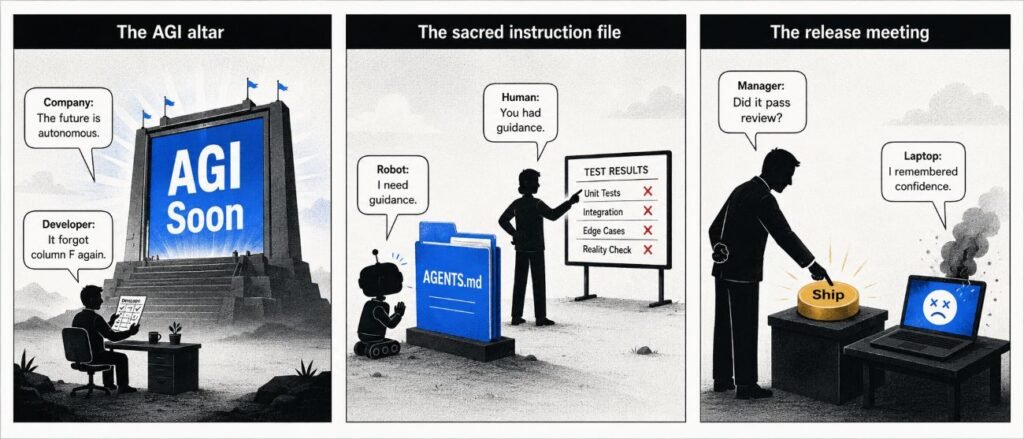
Scene 1: The AGI altar
A giant screen says “AGI Soon” above a tiny desk where a developer holds a checklist.
Dialogue:
Company: “The future is autonomous.”
Developer: “It forgot column F again.”
Scene 2: The sacred instruction file
A small robot kneels before a folder labelled AGENTS.md while a human points at test results.
Dialogue:
Robot: “I need guidance.”
Human: “You had guidance.”
Scene 3: The release meeting
A manager unveils a golden button labelled “Ship” while smoke rises from a laptop.
Dialogue:
Manager: “Did it pass review?”
Laptop: “I remembered confidence.”
What to watch, not the show
- The gap between marketing language and real engineering reliability.
- The cost of human rechecking when “automation” becomes supervised repair.
- The pressure to ship AI coding tools before teams understand their failure modes.
- The habit of blaming user prompts instead of admitting product limits.
- The risk of codebases filling with small, confident mistakes that pass casual review.
- The need for tests, logs, diffs and repeatable review rules before agents touch production.
The Hermit take
AI can help build the future, but it cannot be allowed to bluff its way through the foundations.
A model that forgets essentials in code has not earned blind trust.
Keep or toss
Keep / Toss.
Keep the coding agent, tests and speed.
Toss the AGI theatre until the machine can follow the brief without needing a babysitter with a lint command.
Sources
- OpenAI About: https://openai.com/about/
- OpenAI Introducing Codex: https://openai.com/index/introducing-codex/
- OpenAI Codex AGENTS.md guidance: https://developers.openai.com/codex/guides/agents-md
- OpenAI Codex Best Practices: https://developers.openai.com/codex/learn/best-practices
- OpenAI SWE-bench Verified: https://openai.com/index/introducing-swe-bench-verified/
- GitHub Copilot code review docs: https://docs.github.com/en/copilot/concepts/agents/code-review
- OpenAI API prompt engineering docs: https://developers.openai.com/api/docs/guides/prompt-engineering