Lede
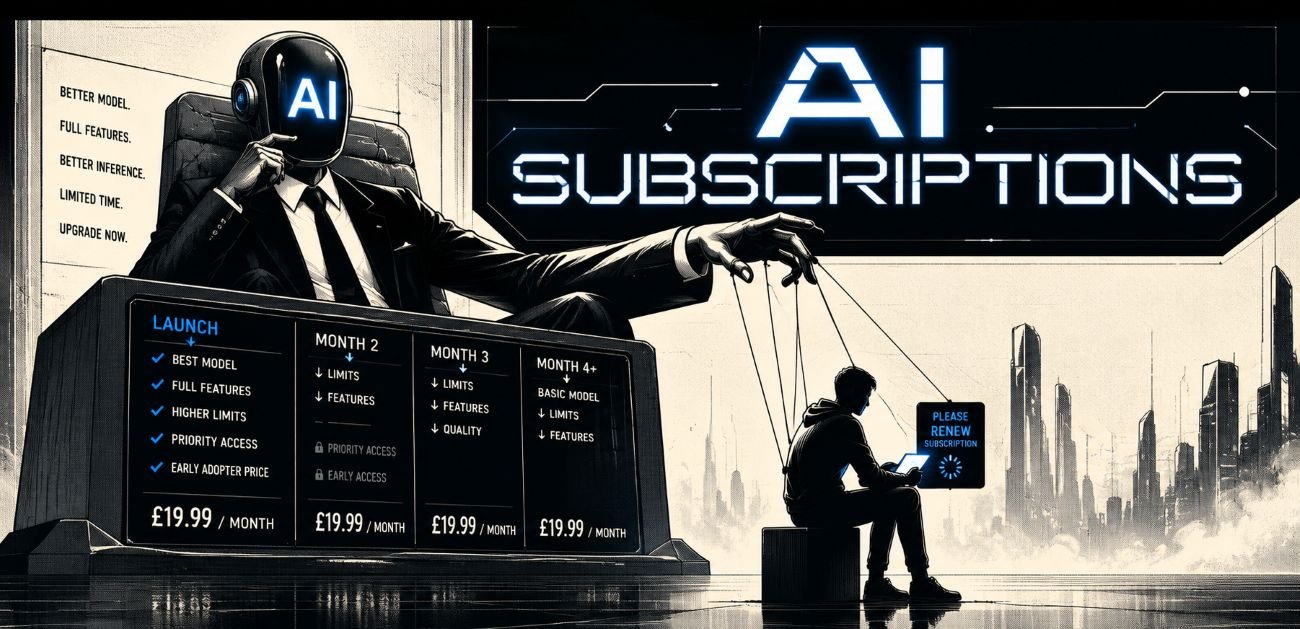
AI companies sell the dream at launch, then quietly introduce the meter once users start using the dream properly.
Words used
- Inference: the act of running the model to answer a prompt.
- Compute: the chips, power and data centre capacity needed to run AI.
- Open-weight model: a model whose weights can be downloaded and run outside the company platform, though it isn’t always fully open source.
Hermit Off Script
AI subscriptions are starting to look like the oldest trick in modern technology. A model launches with better inference, bigger context, shinier tools, full features, heroic wording and enough marketing perfume to choke a data centre. Then the same company discovers the ancient miracle of cost cutting. Suddenly the better model becomes a managed experience. The features become conditional. The access becomes seasonal. The intelligence becomes rationed like wartime butter, but with a friendlier button. We’ve seen the pattern with Claude. Users were sold into the idea of more usage, more power, more features, more professional flow. Then came the caps, weekly limits, peak-time adjustments, separate meters and extra usage options. The explanation is always the same: demand, abuse, reliability, fairness. Fine. Compute costs money. I understand that. What I don’t accept is the theatre. You cannot sell people the future on Monday, then on Thursday tell them the future is available after the five-hour reset. Most normal businesses would get punished for this. Imagine buying a gym membership and being told after two weeks that the treadmill now runs only during off-peak hours unless you buy extra leg credits. But AI companies get away with it because users are tired, curious, dependent, hopeful and, in many cases, already building their work around these tools. The companies know this. They have very smart models measuring very human weakness. And the beautiful absurdity is that these models are only as smart as the cost ceiling their companies allow in public. The marketing says AGI is near. The billing page says calm down, peasant, your session is nearly over. They sell superintelligence to investors, then sell waiting time to users. One day this may bite them properly. If open-weight models keep catching up, users may decide that paying monthly for a shrinking miracle is a bad religion. And when that happens, who will blame users for leaving the temple that sold them light, then charged extra for the candle?
P.S. Maybe it’s only me, but lately ChatGPT 5.5 Thinking itself feels less focused on the task, less attentive to steps, and more likely to miss the obvious thing already written in front of it. I can’t prove that this is because inference is being restricted little by little to save money. But this is exactly the feeling users are left with when a service sells intelligence, then starts behaving as if attention has become a premium feature. If the model forgets the task, skips the steps and still asks for payment, the user doesn’t see optimisation. The user sees shrinkflation with a typing cursor.
What does not make sense
- The launch promise says “more”, but the mature product says “watch your meter”.
- Heavy users prove the tool works, then become the excuse for restricting it.
- A monthly subscription feels simple, but the real product is hidden behind caps, resets and plan language.
- The model is marketed as a work partner, yet the partnership ends when the compute bill gets emotional.
- AI companies talk like destiny merchants to investors and like parking wardens to customers.
- “Unlimited” in AI now seems to mean “until someone actually uses it”.
Sense check / The numbers
- On July 28, 2025, Anthropic said new weekly rate limits for Claude Pro and Max would start on August 28, 2025, and estimated they would affect less than 5 per cent of subscribers. [TechCrunch]
- Claude’s Max plan is priced at $100 per month for 5x Pro usage and $200 per month for 20x Pro usage, and Anthropic says prices and plans are subject to change. [Anthropic Help]
- Anthropic’s own help page says paid users can monitor both five-hour session limits and weekly usage limits in Claude’s usage settings. [Anthropic Help]
- Anthropic’s extra usage system lets paid users continue after reaching plan limits by switching to consumption-based pricing at standard API rates, with extra charges appearing separately. [Anthropic Help]
- Reuters reported that OpenAI said in March 2025 it would raise up to $40 billion at a $300 billion valuation, while the Stargate AI infrastructure project was planned at up to $500 billion. [Reuters]
- Stanford HAI’s 2026 AI Index says the frontier gap is getting embarrassingly thin: DeepSeek-R1 briefly matched the top US model in February 2025, and by March 2026 Anthropic’s leading model was ahead by only 2.7 per cent. So yes, users may soon ask why they are paying premium rent for a gated model when open-weight neighbours keep moving into the same street. [Stanford HAI]
The sketch
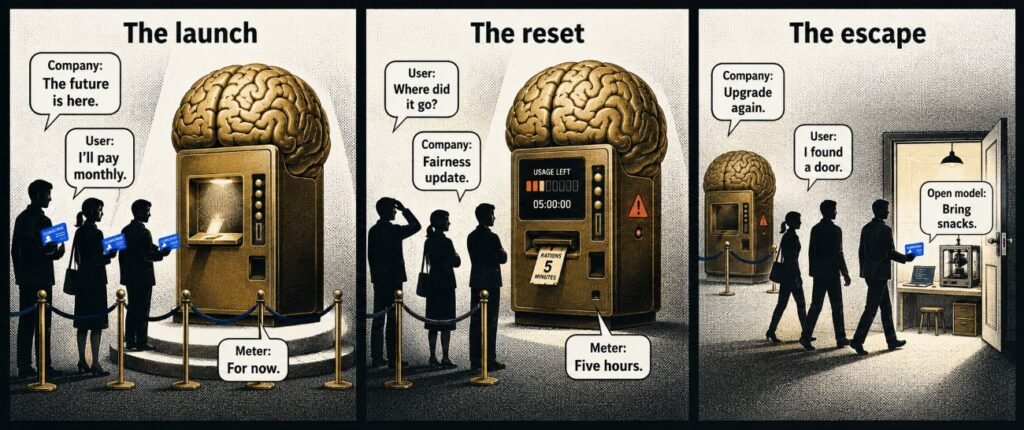
Scene 1: The launch
Panel description. A glowing AI vending machine stands on a stage, offering “full power” to a crowd holding monthly subscription cards.
Dialogue:
Company: “The future is here.”
User: “I’ll pay monthly.”
Meter: “For now.”
Scene 2: The reset
Panel description. The same vending machine is now smaller, with warning lights, usage bars and a queue of users watching a countdown clock.
Dialogue:
User: “Where did it go?”
Company: “Fairness update.”
Meter: “Five hours.”
Scene 3: The escape
Panel description. Users walk away towards a small open-weight workshop while the huge AI machine shouts from behind a velvet rope.
Dialogue:
Company: “Upgrade again.”
User: “I found a door.”
Open model: “Bring snacks.”
What to watch, not the show
- Whether “unlimited” AI plans quietly become credit packs.
- Whether new model launches arrive with generous access, then shrink after adoption.
- Whether enterprise users get the real capacity while individual subscribers get the polished queue.
- Whether open-weight models keep narrowing the quality gap.
- Whether “safety”, “fairness” and “abuse prevention” become convenient wrappers for cost control.
- Whether users start treating AI subscriptions as temporary tools, not loyal relationships.
- Whether regulators eventually ask what a subscription actually promises.
The Hermit take
Sell power honestly or don’t sell it as power.
A rented brain with surprise limits is still a rented brain.
Keep or toss
Keep / Toss.
Keep the models, toss the circus around shrinking access dressed as progress.
Sources
- TechCrunch on Anthropic Claude Code weekly limits: https://techcrunch.com/2025/07/28/anthropic-unveils-new-rate-limits-to-curb-claude-code-power-users/
- Anthropic Help on Claude usage limits: https://support.claude.com/en/articles/9797557-usage-limit-best-practices
- Anthropic Help on Claude Max plan: https://support.claude.com/en/articles/11049741-what-is-the-max-plan
- Anthropic Help on extra usage for paid plans: https://support.claude.com/en/articles/12429409-manage-extra-usage-for-paid-claude-plans
- Anthropic on higher limits and compute partnership: https://www.anthropic.com/news/higher-limits-spacex
- Axios on Anthropic limits and agent usage: https://www.axios.com/2026/05/14/anthropic-claude-price-openai-tokens
- Reuters on OpenAI funding round: https://www.reuters.com/technology/artificial-intelligence/openai-raise-40-billion-softbank-led-new-funding-2025-03-31/
- Reuters on Stargate data centres: https://www.reuters.com/business/media-telecom/openai-oracle-softbank-plan-five-new-ai-data-centers-500-billion-stargate-2025-09-23/
- Stanford HAI 2026 AI Index Report: https://hai.stanford.edu/ai-index/2026-ai-index-report
- Sam Altman Reflections post: https://blog.samaltman.com/reflections
