Lede
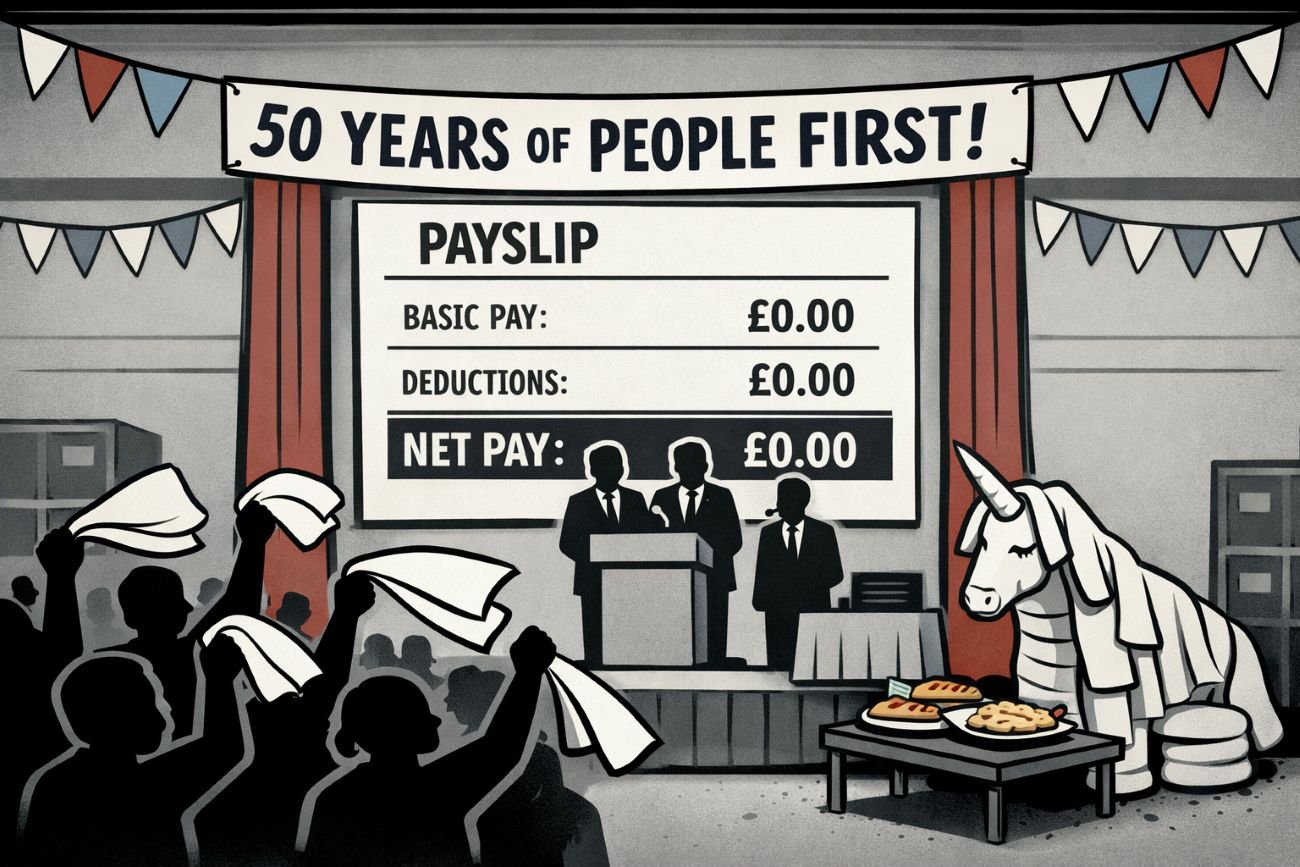
Nothing says “people first” quite like waving celebratory towels while pay, dignity and working conditions are left to fend for themselves.
Hermit Off Script
I have seen enough in fifty years on this Earth to know that companies love a stage, a slogan and a round of applause, but I did not expect to see half a century of towel history turned into a morale prop as if fabric in the air is proof that people are thriving. That is the bit that sticks in my throat. Marketing can be as thin as the pay rise. If a company truly puts people first, it does not merely meet the minimum and call itself generous. It makes life easier. It pays properly because that is why most people drag themselves to work in the first place, not for a speech, not for a branded towel, and not for the warm spiritual glow of management saying “family” with a microphone in hand. I am not asking a towel firm to pretend it invented the future like Silicon Valley does. Most firms are not changing the world. Fine. But then spare me the unicorn perfume. A unicorn is not a mood, a memory or a fifty year scrapbook. It is a company worth serious money. So yes, fair play for surviving fifty years of struggle, graft and industrial reality, but survival alone is not sainthood. If leadership wants real respect, it starts with good salaries, decent conditions and a working environment that does not need a party to briefly impersonate joy. The successful companies people are proud to work for understand one simple thing: when they celebrate, they celebrate properly, because even the event itself reveals what they think of the people in the room. A cheap celebration usually means a cheap mindset. In the end, profit matters, leadership matters, and workers matter. The towel is the least impressive thing in that equation.
P.S. And let us not forget the grand finale: roughly two hours of speeches on chairs designed, apparently, by enemies of the human spine. If you are going to trap people in a celebration they did not ask for, at least provide proper chairs. Then came the cold food, served after rather than before, which gave the whole thing the atmosphere of mild punishment rather than gratitude. It was certainly not a happy two hours away from work. Frankly, many of us would probably have preferred simply doing our jobs instead of sitting through this gimmick disguised as celebration.
P.P.S. A little bird chirped in my ear that the shifts spared the live performance got the better bargain: only half the pain instead of the full two-hour sermon. By that standard, for a few colleagues at least, it almost counted as a mild celebration.
What does not make sense
- Calling workers “people first” while treating legal minimums like a moral triumph.
- Mistaking a prop for morale.
- Using “unicorn” as a compliment when it has an actual financial meaning.
- Asking employees to perform joy instead of giving them reasons to feel it.
- Expecting loyalty to be woven from speeches rather than salaries.
- Throwing an anniversary celebration that tells people more about budget caution than gratitude.
Sense check / The numbers
- From 1 April 2026, the UK National Living Wage for workers aged 21 and over is GBP12.71 an hour, after a 4.1 per cent rise. That is the legal floor, not proof of exceptional generosity. [Gov.uk]
- A “unicorn” is not corporate poetry. It is generally defined as a company valued at more than USD1 billion. [Tech Nation] [Investopedia]
- In Great Britain in 2024 to 2025, 964,000 workers were suffering from work-related stress, depression or anxiety. [HSE]
- HSE also says work-related stress, depression and anxiety accounted for 22.1 million working days lost in 2024 to 2025. So yes, “working environment” is not fluffy language. It lands in bodies, minds and balance sheets. [HSE]
The sketch
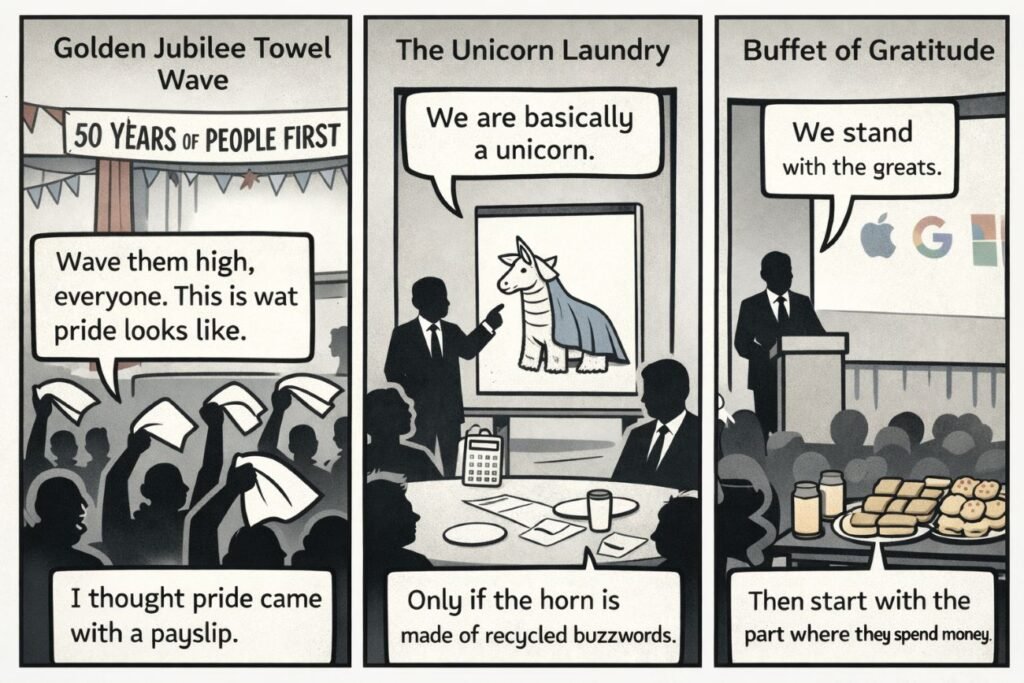
Scene 1: “Golden Jubilee Towel Wave”
Panel description + dialogue: A factory floor has been dressed up with bunting, a cheap stage and boxes of commemorative towels. Workers hold them like they are at a sports final, while management beams beside a banner saying “50 Years of People First”.
Manager: “Wave them high, everyone. This is what pride looks like.”
Worker: “I thought pride came with a payslip.”
Scene 2: “The Unicorn Laundry”
Panel description + dialogue: A senior executive points at a flipchart with a badly drawn unicorn wearing a towel as a cape. Staff stare in silence while one calculator on the table shows a very ordinary number.
Executive: “We are basically a unicorn.”
Worker: “Only if the horn is made of recycled buzzwords.”
Scene 3: “Buffet of Gratitude”
Panel description + dialogue: The celebration spread is a tray of beige sandwiches and warm fizzy drinks while a slideshow flashes Apple, Google and Microsoft behind the speaker.
Speaker: “We stand with the greats.”
Worker: “Then start with the part where they spend money.”
What to watch, not the show
- Wage floors becoming wage ceilings.
- Anniversary theatre used to paper over ordinary pay and conditions.
- Leaders borrowing Silicon Valley language without Silicon Valley rewards.
- One-off celebrations replacing year-round respect.
- Staff morale being staged instead of measured honestly.
- Retention, sickness and disengagement quietly rising while the photos look cheerful.
The Hermit take
Respect is not a towel, a slogan or a speech.
If a company wants applause, it should first make work worth applauding.
Keep or toss
Toss
Keep the history.
Toss the self-congratulation until pay, conditions and respect stop being decorative.
Sources
- UK National Living Wage rates and 2026 increase: https://www.gov.uk/government/news/national-living-wage-increases-to-1271-per-hour
- National Minimum Wage in 2026 guidance: https://www.gov.uk/government/publications/the-national-minimum-wage-in-2026/the-national-minimum-wage-in-2026
- Tech Nation definition of a unicorn: https://technation.io/wp-content/uploads/2021/10/H1-data-2021.pdf
- Investopedia definition of a unicorn company: https://www.investopedia.com/terms/u/unicorn.asp
- HSE key figures for Great Britain 2024 to 2025: https://www.hse.gov.uk/statistics/overview.htm
- HSE working days lost statistics: https://www.hse.gov.uk/statistics/dayslost.htm
