
Lede
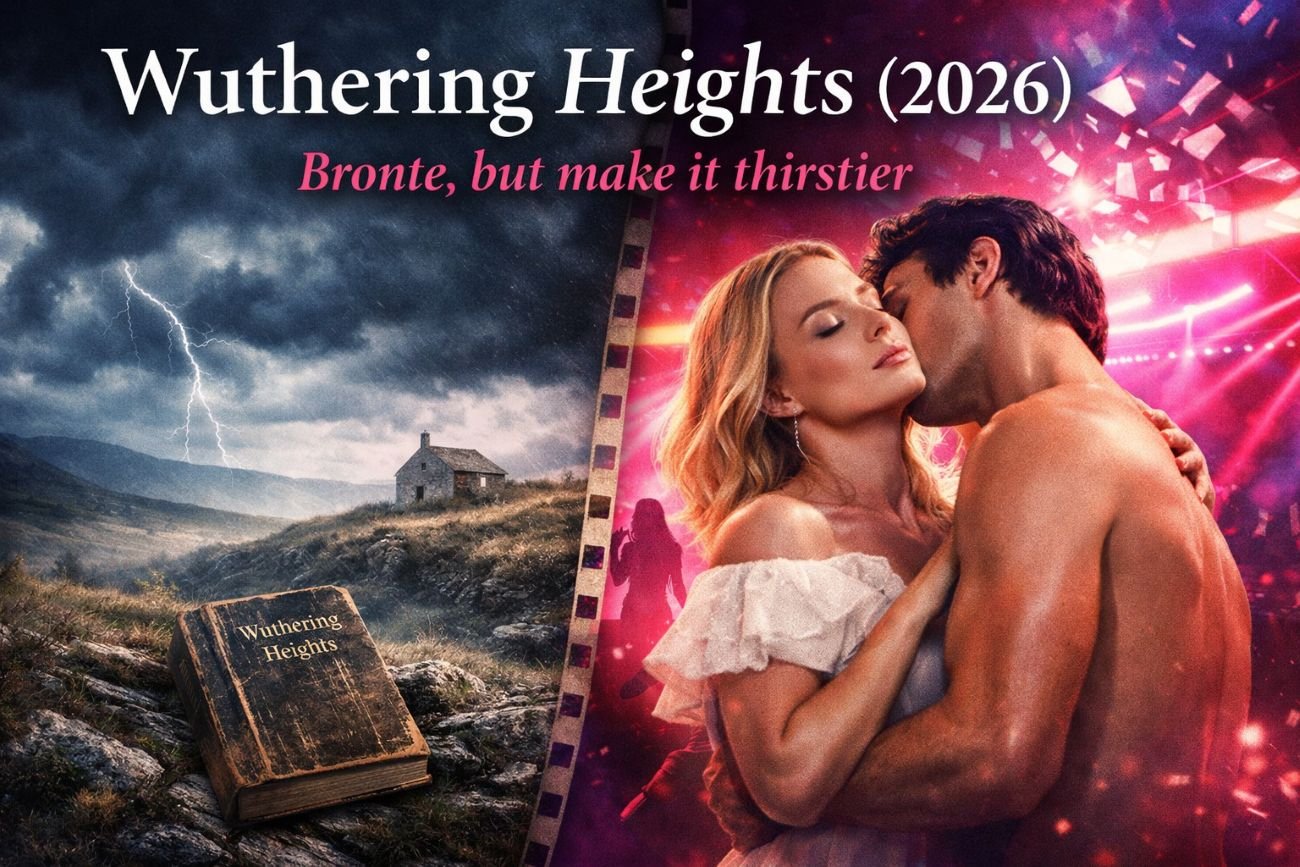
A Gothic novel about obsession gets rebooted as a premium lust brochure, then sold back to you as literature.
Hermit Off Script
Wuthering Heights (2026) left me stunned, and not in the good way. I went in for Margot Robbie and because I wanted to see how the book would be translated into film, but what I got felt like the book put through a modern filter where desire does all the talking and love barely gets a line. The music leans hard into that modern mood, like the moors have been fitted with a nightclub sound system, and if that is the point then fine, but call it what it is. There are a couple of images that genuinely land: the drunk father dead beside the pile of empty bottles, and that wedding dress veil lifting and flying in the bright white landscape. Those images understand Bronte: beauty with teeth. But most of the film sells passion as desire, not love, and in this story that matters. And the rest of it keeps insisting it is passionate love while showing me mostly appetite, and I do not buy that as love, not the kind of love that drags you to the grave and keeps tapping on the coffin lid. I even found the younger versions of the characters more convincing and more emotional than the older ones, and I think that is because the film is more comfortable filming bodies than souls. Real love in human form, to me, still wants to be together, but it is not ruled by carnal hunger. When the emotion is raw and untrained, you feel the wound. When the film moves into adult sexuality as the main language, it starts replacing soul with sweat. And the casting choice did not help my belief. I like Margot Robbie in plenty of things, but here the role felt misaligned, like the production wanted the star power more than the right temperature of the character. I kept thinking Emily Brontë would watch this and wonder what happened to her doom. By the time Heathcliff returns, the spell had already thinned out for me, and if I had been watching at home on streaming, I honestly think I would have bailed right there. IMAX and the cinematography did a lot of heavy lifting, which is not the same thing as the film earning it. My advice is simple: read the book, then come back if you want to see how far a modern adaptation can drift before it snaps.
“Wuthering Heights” (2026) | Official Trailer
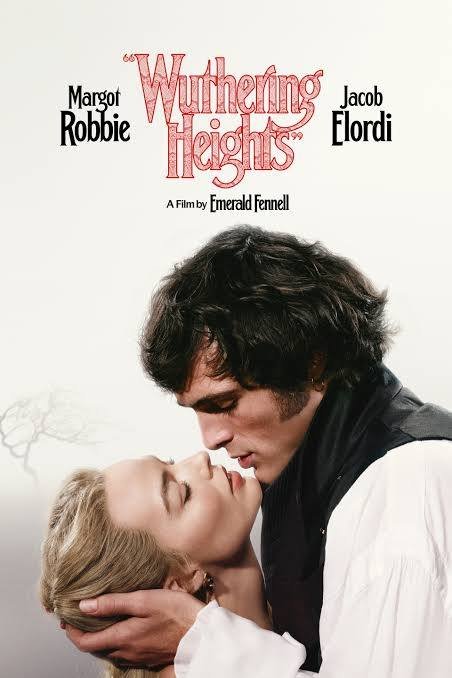
Wuthering Heights (2026) | Movie synopsis
On the Yorkshire moors, Catherine Earnshaw bonds fiercely with Heathcliff, an orphan brought home by her father. As they grow up, class, pride, and pressure pull them apart, and their attachment curdles into something brutal enough to scorch everyone nearby.
Emerald Fennell’s adaptation narrows Bronte’s sprawling tragedy into a single, feverish core: Cathy and Heathcliff. As children, they become a feral pair, inseparable in the open wild of the moors. But adulthood brings the machinery of society: status, money, and the hard limit of who can marry whom. Enter the neighbours, Edgar Linton and his sister Isabella, and the story snaps into its central dilemma. Cathy is pushed towards Edgar, while Heathcliff is left on the wrong side of the door, turning love into grievance and grievance into a plan.
Heathcliff disappears, then returns years later with wealth and a sharpened appetite for retribution. His renewed involvement with Cathy detonates the household, and his marriage to Isabella becomes another blade in the drawer. The film keeps the focus on this adult collision and trims away major chunks of the novel’s wider family saga, aiming for a concentrated, romantic doom rather than a multi-generational curse.
What reviews say this version feels like
Critics describe it as heightened and sensual, with lush, dialled-up production design and a deliberate collision of sex and death, plus a prominent modern pop presence via Charli XCX’s songs. The BBFC notes also flag extreme moments (including an execution by hanging and a harrowing pregnancy loss) that set the film’s appetite for shock and melodrama.
Bronte’s brutal moorland tragedy gets shrink-wrapped into glossy desire and sold as “love”, so read the book and let the film keep its IMAX hormones.
Cast and credits
Director: Emerald Fennell
Writers: Emerald Fennell (screenplay), Emily Bronte (novel)
Genre: Period romantic drama
Main cast: Margot Robbie, Jacob Elordi, Hong Chau, Shazad Latif, Alison Oliver, Martin Clunes, Ewan Mitchell
Composer: Anthony Willis (score); songs associated with Charli XCX
Production company/studio: LuckyChap Entertainment, MRC (plus listed partners)
Runtime: 136 minutes
Release year and platform: 2026, theatrical release
What does not make sense
- The novel’s power is longing and spite, but the film keeps trying to solve it with skin.
- A story set in the moors gets scored like a nightclub memory.
- It wants to be a period drama and a modern provocation at the same time, so it pleases neither camp for long.
- Catherine is written young, but the casting choice asks you to ignore biology, timeline, and plot consequence.
- The marketing sells romance, but the material is a cautionary tale with a body count.
Sense check / The numbers
- The film’s wide UK and US release date is 13 February 2026, with international release beginning 11 February 2026. [Warner Bros]
- Runtime is listed as 136 minutes, with a reported budget of $80 million. [Wikipedia]
- Opening weekend global gross reported at about $76.8 million, with mixed audience signals including a Rotten Tomatoes audience score around 63 per cent. [Guardian]
- The pop-forward music angle is not accidental: Charli XCX is tied to the film’s music campaign alongside the score. [Entertainment Weekly]
The sketch
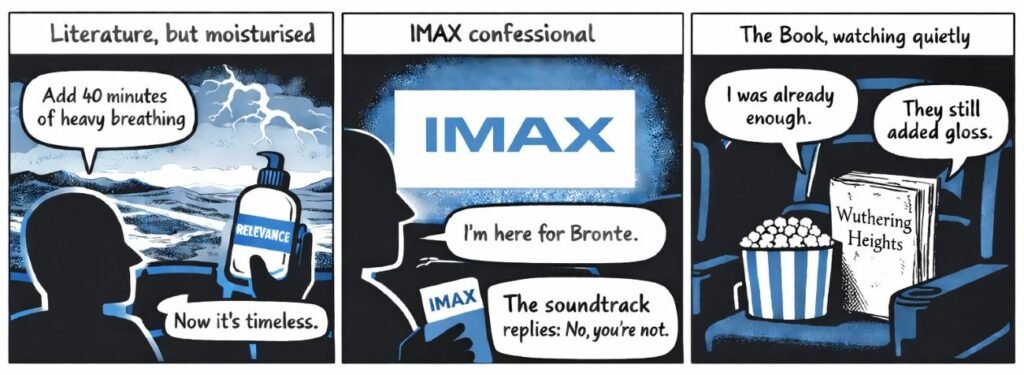
Scene 1: “Literature, but moisturised”
Panel: A cinema screen shows a stormy moor. A studio executive holds a bottle labelled “Relevance”.
Dialogue: “Add 40 minutes of heavy breathing.”
Dialogue: “Now it’s timeless.”
Scene 2: “IMAX confessional”
Panel: You clutch a ticket. The IMAX logo glows like a halo.
Dialogue: “I’m here for Bronte.”
Dialogue: “The soundtrack replies: No, you’re not.”
Scene 3: “The Book, watching quietly”
Panel: A battered paperback sits in the aisle seat, untouched popcorn beside it.
Dialogue: “I was already enough.”
Dialogue: “They still added gloss.”
What to watch, not the show
- IP economics: recognisable titles reduce marketing risk.
- Modern taste: sex sells faster than metaphysics.
- Prestige laundering: a classic label makes anything look clever.
- Audience split: romance buyers meet Gothic tragedy and both complain.
- The long-term risk: adaptations replace the book in the public mind.
The Hermit take
If you want Bronte’s kind of love, you want the page, not the projection.
If you want a glossy fever dream, the cinema will happily take your money.
Keep or toss
Toss
Keep the visuals and a couple of brutally good images.
Toss the idea that lust automatically equals depth.
Sources
- Warner Bros official film site: https://www.wutheringheightsfilm.com/
- IMDb title page: https://www.imdb.com/title/tt32897959/
- IMDb full cast and crew: https://www.imdb.com/title/tt32897959/fullcredits/
- The Guardian review (Peter Bradshaw): https://www.theguardian.com/film/2026/feb/09/wuthering-heights-review-emerald-fennell-margot-robbie-jacob-elordi
- The Guardian box office report (16 Feb 2026): https://www.theguardian.com/film/2026/feb/16/wuthering-heights-box-office-opening-weekend
- Entertainment Weekly box office and music mention: https://ew.com/wuthering-heights-tops-weekend-box-office-with-76-million-dollar-global-debut-11907132
- Wikipedia film page (for consolidated credits): https://en.wikipedia.org/wiki/Wuthering_Heights_(2026_film)

Leave a Reply to Wuthering Heights the book: love, obsession, and revenge – The Modern Hermit Cancel reply