

Lede
A regime that hears a woman singing and reaches for 74 lashes is not defending morality, it is advertising fear.
Words used
- Corporal punishment: physical punishment by the state, including flogging.
- Mandatory hijab: a legal requirement forcing women and girls to cover their hair or body.
- Theocracy: a state where religious authority shapes civil law and public punishment.
- Consent: the line between private choice and public abuse.
Hermit Off Script
This case is about a woman singing without a hijab and a regime deciding that the correct answer is a whip. I know there are people all over the world who freely choose pain, domination or submission as part of private pleasure, especially in the Western world where law protects different views, beliefs and passions. Fine. Adults can choose their own strange little theatre, as long as consent is present and nobody is forced. But even those people would reject this, because the first rule is choice. Pleasure without consent is abuse. Faith without consent is control. Law without mercy is just a machine with a religious costume on. This is not the first case and it will not be the last while fanatical regimes keep confusing obedience with virtue. The same disease appears wherever power wants to enter the body, the home, the voice, the dress, the song and finally the soul. It can wear religious clothes, nationalist clothes, revolutionary clothes or moral clothes. The uniform changes. The appetite stays the same. And yes, I think there is danger in the Western world too, not because ordinary believers are the enemy, but because every faith has fanatics and wiser people inside it. The wiser ones understand that belief should be lived from the heart, not imposed by the police. They know that literal belief does not mean beating everyone else into compliance. The fanatics want the opposite. They want religious law, political law or mob law to become one big hand around everybody’s throat. Today it is one woman. Tomorrow it is one group. Then the circle grows until everyone discovers the boot has no favourite child. Extremism is rising because people forget pain. They forget war. They forget the long, boring, bloody road that gave us rights, courts, speech, privacy and the luxury of disagreeing without being dragged into a public square. In the UK, when I see crowds gathering around anger and simple slogans, I see people handing over their critical thinking to false prophets who sell rage as clarity. Protest is a right. Hate is not wisdom. Once you accept taking liberty from one category of people, you have already trained the system how to take it from you later. More than that, it is always money and power waiting behind the curtain. If this kind of extremism grows in a developed country like the UK, the shame is not only moral. It is intellectual. People are being sold lies to make them feel clean while somebody else collects influence, attention, votes, donations or control. And soon AI will join the queue of public fears. It may become the next enemy people blame for everything. The difference is that if the promised abundance becomes another trick, at least the villains will be easier to name: the billionaires, future trillionaires and platform kings who promised freedom while building a toll gate around it.
The song is not the danger. The danger is the person who hears a song and starts counting lashes.
The case in brief

According to the Guardian, Iranian singer Parastoo Ahmadi and 8 members of her production team were reportedly sentenced by a court in Qom to 74 lashes, a 2-year travel ban and a 2-year ban on artistic activity after an online concert in which she appeared without a hijab. Authorities treated the performance as an offence against public decency. In plain language, a woman sang, the state panicked, and the punishment was written for everyone watching.
Source: The Guardian
What does not make sense
- Calling a woman’s uncovered hair “public indecency” while treating state violence as public order.
- Saying faith is sacred, then needing police, courts and flogging to keep it alive.
- Pretending morality is protected by humiliating artists.
- Defending freedom in the UK while cheering movements that would restrict freedom for the next disliked group.
- Blaming migrants, women, artists or machines while ignoring the people who profit from public panic.
- Treating AI as the coming monster while leaving ownership, labour rights and wealth concentration politely untouched.
Sense check / The numbers
- Parastoo Ahmadi and 8 members of her production team were reportedly sentenced to 74 lashes after a 2024 livestreamed performance without hijab; the reported punishment also includes a 2-year travel ban and a 2-year ban on artistic activity. [Guardian]
- RFE/RL reported that Ahmadi’s YouTube performance had reached 2.9 million views and that the sentence also applied to 8 musicians and crew connected to the performance. [RFE/RL]
- Article 638 of Iran’s Islamic Penal Code allows imprisonment from 10 days to 2 months or up to 74 lashes for acts treated as public moral offences, with specific penalties for women appearing without religious hijab. [Immigration and Refugee Board of Canada]
- In England and Wales, Prevent recorded 8,778 referrals in the year ending 31 March 2025, up 27 per cent from the previous year; “Extreme Right-Wing” concerns accounted for 21 per cent of referrals and “Islamist Extremism” for 10 per cent. [Home Office]
- Reuters reported that around 110,000 people attended the “Unite the Kingdom” anti-immigration march in London on 13 September 2025, with 25 arrests and 26 police officers injured. [Reuters]
- The IMF has estimated that almost 40 per cent of global employment is exposed to AI, rising to about 60 per cent in advanced economies, while Oxfam reported global billionaire wealth at $18.3 trillion in 2025. [IMF] [Oxfam]
The long receipt: morality law with a whip
This is not a complete global archive, because the archive would become a book and nobody should have to read that much legalised cruelty before breakfast. But these are major documented cases over the years where states, courts or morality systems turned dress, song, belief, sex, protest or private life into punishment.
- 2002, northern Nigeria – Amina Lawal. A Sharia court in Katsina State sentenced Amina Lawal to death by stoning for adultery. The case became one of the clearest warnings that once religious morality becomes criminal law, women carry the heaviest part of the sentence.
- 2007, Saudi Arabia – the Qatif rape survivor. A Saudi woman who survived gang rape was sentenced to 200 lashes and 6 months in prison after being accused of being alone with a man who was not a relative. The original crime was violence against her. The system still found a way to punish her body.
- 2009, Sudan – Lubna Hussein and the trousers case. Sudanese journalist Lubna Hussein was prosecuted for wearing trousers under a public decency law carrying up to 40 lashes. Ten other women arrested in the same raid were reportedly fined and flogged. A pair of trousers became a court file because the state could not survive fabric with legs.
- 2011, Saudi Arabia – Shaima Jastaina. A Saudi woman was sentenced to 10 lashes for driving while women were still banned from driving. The state called it order. The rest of the world called it what it was: punishment for moving without permission.
- 2014, Sudan – Meriam Yehya Ibrahim. A pregnant Christian woman was sentenced to death for apostasy and to flogging for adultery, because the state refused to recognise her marriage in the way she lived it. Faith became a prison document.
- 2015, Saudi Arabia – Raif Badawi. The blogger and activist was sentenced to 10 years in prison, 1,000 lashes and a large fine for creating an online forum and being accused of insulting Islam. He received the first 50 lashes in public. Apparently discussion was so dangerous that it needed a whip as a moderator.
- 2017, Aceh, Indonesia – two men caned for consensual gay sex. Two men in Aceh were publicly caned 83 times each under the province’s Islamic criminal code. Amnesty said more than 1,000 spectators watched. The punishment was not only pain. It was theatre designed to make privacy impossible.
- 2018 to 2019, Iran – Nasrin Sotoudeh. The human rights lawyer who defended women protesting forced hijab laws was sentenced to 38 years in prison and 148 lashes after grossly unfair trials, according to Amnesty. When a lawyer defending women becomes the target, the message is simple: even the defence of rights is treated as a crime.
- 2020, northern Nigeria – Yahaya Sharif-Aminu. A 22-year-old singer was sentenced to death by hanging by an Upper Sharia Court in Kano State over a song circulated on WhatsApp and considered blasphemous. A song travelled through a phone. The punishment tried to drag it to the gallows.
- 2010 to 2018, Pakistan – Asia Bibi. A Christian woman was sentenced to death for blasphemy in 2010 and spent years on death row before Pakistan’s Supreme Court overturned the conviction in 2018. Her release triggered protests by hardline groups. The court corrected the sentence, but the mob still wanted ownership of the ending.
- 2022, Iran – Mahsa Amini. Mahsa, also known by her Kurdish name Jina, died after being detained by Iran’s morality police over alleged “improper” hijab. UN human rights officials called for an independent investigation. A dress-code arrest became a national wound.
- 2022, Taliban Afghanistan – public flogging and execution return. After taking power again in 2021, the Taliban resumed public punishments. In December 2022, 27 people, including women, were publicly lashed in Parwan province after alleged offences including adultery, theft and drug offences. The same month, the Taliban carried out its first confirmed public execution since returning to power.
- 2024, Taliban Afghanistan – women ordered into silence. Taliban “vice and virtue” laws required women to conceal their faces, bodies and voices in public. Women were also barred from singing or reading aloud where they could be heard. A regime that fears a woman’s voice is not strong. It is brittle.
- 2024, Iran – Roya Heshmati. Iranian woman Roya Heshmati was reportedly given 74 lashes for appearing without mandatory hijab. Her case sits beside Ahmadi’s like a repeated stamp: the same number, the same logic, the same state obsession with controlling women’s bodies.
- 2024, Iran – Shervin Hajipour. The singer behind “Baraye”, an anthem of the Women, Life, Freedom protests, was sentenced to more than 3 years in prison. This one was not flogging, but it belongs in the same pattern: art treated as national security damage.
- 2025, Iran – Mehdi Yarrahi. Iranian protest singer Mehdi Yarrahi was given 74 lashes over a song criticising Iran’s strict dress code for women. The crime was music. The evidence was a headscarf. The punishment was medieval paperwork.
- 2025, Aceh, Indonesia – two men caned again for same-sex relations. Reuters reported that two young men in Aceh were publicly caned, receiving 77 and 82 lashes respectively, after a Sharia court case over a same-sex relationship. This is the machine repeating itself because it was never dismantled.
- 2026, Aceh, Indonesia – 140 lashes for sex and alcohol. A man and woman were publicly caned 140 times each for sex outside marriage and drinking alcohol. The woman reportedly collapsed and was taken away by ambulance. When punishment has to pause for medical collapse, the law has already confessed.
- 2019, Brunei – the penal code that kept the threat alive. Brunei brought into force a Sharia penal code allowing death by stoning for extramarital sex and anal sex, amputation for stealing and whipping for lesbian sex. After global backlash, the death penalty moratorium remained, but the law still showed the intent: private life placed under a stone.
The pattern is not complicated. First the law selects a target: women, artists, minorities, unbelievers, dissidents, lovers. Then it calls control “morality”. Then it calls punishment “order”. Then it asks the public to watch, so everyone learns the lesson before they need a trial of their own.
This is why Parastoo Ahmadi’s case matters. It is not only 74 lashes for one singer. It is one more page in a long manual of state fear.
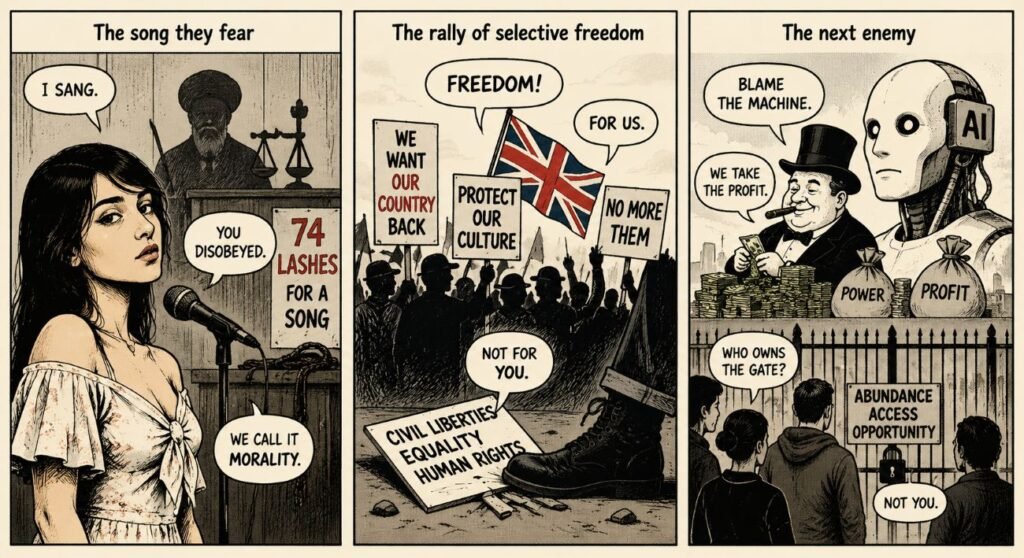
The sketch
Scene 1: The song they fear
A singer stands at a microphone while a judge sits behind her in shadow. A sign beside the court reads “74 lashes for a song”, making the punishment look more absurd than the performance.
Dialogue:
Singer: “I sang.”
Court: “You disobeyed.”
State: “We call it morality.”
Scene 2: The rally of selective freedom
A crowd waves flags and protest signs while a board marked “Civil liberties, equality, human rights” lies on the ground under a boot.
Dialogue:
Crowd: “Freedom!”
Speaker: “For us.”
Civil Liberty: “Not for you.”
Scene 3: The next enemy
A rich profiteer counts money beside a large AI machine while ordinary people stand outside a locked gate marked “Abundance, access, opportunity”.
Dialogue:
Profiteer: “Blame the machine.”
Profiteer: “We take the profit.”
Worker: “Who owns the gate?”
Gate: “Not you.”
What to watch, not the show
- Religious law used as state punishment rather than private belief.
- Courts turning morality language into control over women, artists and dissent.
- Political movements that start by targeting one group and end by shrinking rights for everyone.
- Protest movements funded, amplified or exploited by people seeking votes, money or influence.
- Media and platform systems that reward anger because calm thought is bad for engagement.
- AI panic being used to distract from ownership, wages, labour rights and tax.
- The gap between promised abundance and who actually owns the machines.
The Hermit take
If a regime needs 74 lashes to answer one song, the regime has already lost the argument.
Freedom dies first as an exception, then as a habit.
Keep or toss
Verdict: Keep / Toss
Keep faith, protest, disagreement and adult choice.
Toss forced morality, state violence, mob politics and every prophet selling fear for power.
Sources
- Guardian report on Parastoo Ahmadi: https://www.theguardian.com/world/2026/jun/18/iran-parastoo-ahmadi-74-lashes-singing-without-hijab
- RFE/RL report on Ahmadi sentence: https://www.rferl.org/a/iran-singer-sentence-flogging-morality-police-ban-women-life-freedom-hijab-concert-youtube/33783873.html
- Jerusalem Post report on Qom court sentence: https://www.jpost.com/middle-east/iran-news/article-899858
- Immigration and Refugee Board of Canada on Iran dress code law: https://www.irb-cisr.gc.ca/en/country-information/rir/Pages/index.aspx?doc=459015&pls=1
- UN Geneva on Iran’s strict hijab law: https://www.ungeneva.org/en/news-media/news/2024/12/101372/iran-un-experts-call-strict-new-hijab-law-be-repealed
- Amnesty International UK on Iran crackdown and flogging: https://www.amnesty.org.uk/press-releases/iran-authorities-continue-crush-womens-rights-activists-arbitrary-arrest-flogging
- Home Office Prevent statistics, April 2024 to March 2025: https://www.gov.uk/government/statistics/individuals-referred-to-prevent-to-march-2025/individuals-referred-to-and-supported-through-the-prevent-programme-april-2024-to-march-2025
- Reuters on London anti-immigration protest: https://www.reuters.com/world/uk/police-protesters-scuffle-110000-join-anti-migrant-london-protest-2025-09-13/
- IMF on AI and global jobs: https://www.imf.org/en/Blogs/Articles/2024/01/14/ai-will-transform-the-global-economy-lets-make-sure-it-benefits-humanity
- Oxfam on billionaire wealth in 2025: https://www.oxfam.org/en/press-releases/billionaire-wealth-jumps-three-times-faster-2025-highest-peak-ever-sparking
- UN/OHCHR on Mahsa Amini: https://www.ohchr.org/en/press-releases/2022/09/mahsa-amini-acting-un-human-rights-chief-urges-impartial-probe-death-iran
- Amnesty on Nasrin Sotoudeh: https://www.amnesty.org/en/latest/press-release/2019/03/iran-shocking-33-year-prison-term-and-148-lashes-for-womens-rights-defender-nasrin-sotoudeh/
- Guardian on Mehdi Yarrahi: https://www.theguardian.com/world/2025/mar/05/iranian-singer-mehdi-yarrahi-given-74-lashes-over-protest-song
- Guardian on Shervin Hajipour: https://www.theguardian.com/world/2024/mar/01/iranian-singer-given-three-years-in-jail-for-song-about-mahsa-amini-protests
- Amnesty on Raif Badawi: https://www.amnesty.org/en/latest/news/2015/01/flogging-raif-badawi-saudi-arabia-vicious-act-cruelty/
- Guardian on the Qatif rape survivor: https://www.theguardian.com/world/2007/nov/17/saudiarabia.international
- Amnesty on Saudi woman sentenced for driving: https://www.amnesty.org/en/latest/news/2011/09/flogging-sentence-saudi-arabian-woman-after-driving-beggars-belief/
- Guardian on Taliban public execution: https://www.theguardian.com/world/2022/dec/07/taliban-carry-out-first-public-execution-since-taking-over-afghanistan-last-year
- The Diplomat on Taliban public lashings: https://thediplomat.com/2022/12/taliban-official-27-people-publicly-lashed-in-afghanistan/
- Guardian on Taliban voice ban: https://www.theguardian.com/global-development/article/2024/aug/26/taliban-bar-on-afghan-women-speaking-in-public-un-afghanistan
- Amnesty on Sudan trousers law: https://www.amnesty.org/en/latest/press-release/2009/09/sudan-amnesty-international-calls-government-repeal-law-penalizing-women/
- Amnesty on Meriam Yehya Ibrahim: https://www.amnesty.org/en/latest/press-release/2014/05/sudan-abhorrent-death-sentence-woman-grounds-her-religion/
- Amnesty on Amina Lawal: https://www.amnesty.org.uk/press-releases/nigeria-amina-lawal-must-not-face-death-stoning-0
- Amnesty on Yahaya Sharif-Aminu: https://www.amnesty.org/en/documents/afr44/2968/2020/en/
- Guardian on Asia Bibi: https://www.theguardian.com/world/2018/oct/31/asia-bibi-verdict-pakistan-court-overturns-blasphemy-death-sentence
- Amnesty on Aceh caning of two men: https://www.amnesty.org/en/latest/press-release/2017/05/indonesia-caning-of-gay-men-an-outrageous-act-of-cruelty/
- Reuters on Aceh 2025 caning: https://www.reuters.com/world/asia-pacific/indonesias-aceh-province-publicly-canes-two-men-same-sex-relationship-2025-02-27/
- South China Morning Post on Aceh 140 lashes: https://www.scmp.com/week-asia/people/article/3342042/indonesian-woman-collapses-after-140-lashes-sex-and-alcohol
- Human Rights Watch on Brunei penal code: https://www.hrw.org/news/2019/04/03/brunei-new-penal-code-imposes-maiming-stoning