Lede
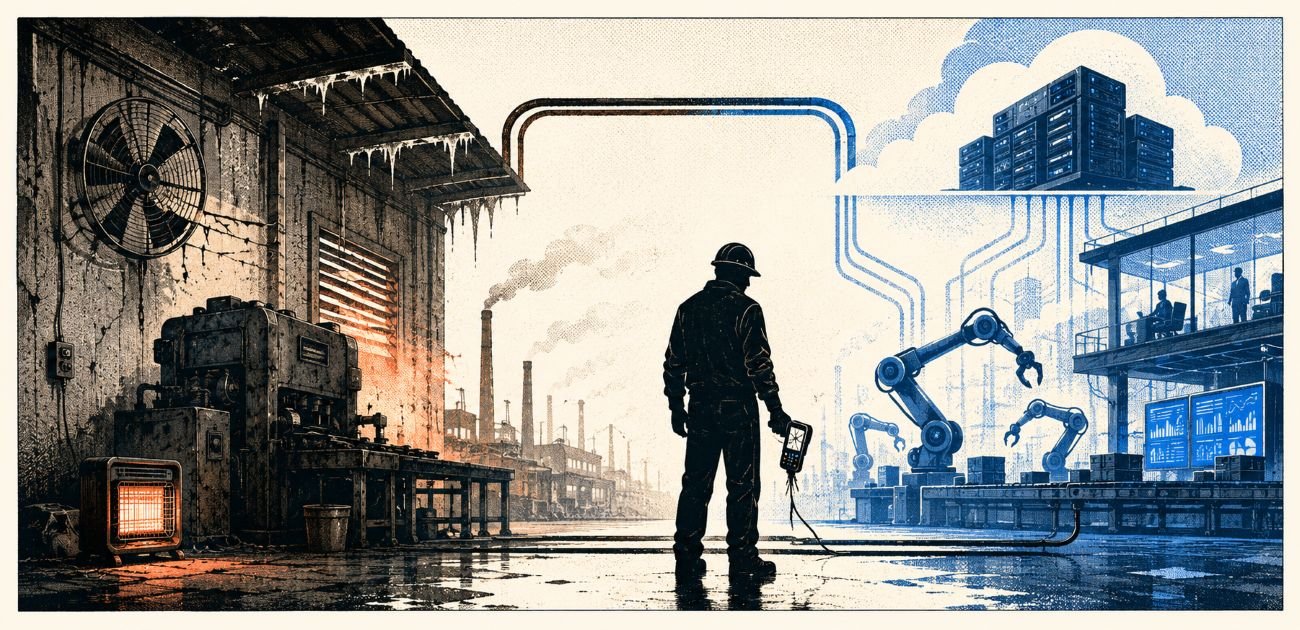
Some companies cannot afford a fan, a heater, a proper sensor or fair night pay, but somehow the future will arrive with robots, AI, and everyone peacefully living on magic money.
Words used
- UBI means universal basic income, a regular payment made to people regardless of employment status.
- Health surveillance means repeated work-related health checks used to spot illness caused by work.
Hermit Off Script
Some companies don’t invest properly in better working conditions during summer or winter because, apparently, profit is always too shy when workers need something. If the building is too hot, too cold, too badly ventilated, too badly equipped, suddenly the company becomes a tragic poet of limited budgets. But that same profit often comes from wages not rising properly, from night shifts that drain people without enough reward, from taking advantage of mistakes and pressure, from waiting until a problem becomes serious before admitting there was a problem at all. There are only a few extreme months here and there, they say. Yes, and a few months are enough to hurt bodies, sleep, concentration and health. The machine gets serviced. The worker gets a leaflet.
Then come the health checks. Every 6 months, or however often the policy says, the company appears with a clipboard and a concerned face. Health surveillance has a real legal place when risk remains, but it should not become corporate holy water sprinkled over bad conditions. If the workplace is still too hot, too cold, understaffed, underpaid and badly tooled, checking the worker’s blood pressure does not fix the room. It only gives the company a folder for later.
The same disease appears with technology. Companies need more data, less waste, fewer errors, cleaner checks and faster reactions. Fine. Then invest in proper sensors, cameras, networks, software and training. Instead, some keep old systems limping along until they collapse, then rely on extra human checks, then blame the human for missing what the system should have caught. The worker becomes the missing sensor, the missing camera, the missing software update and the missing manager, then gets told to be grateful for having a job. Wonderful. The future has arrived, and it is a spreadsheet with a cough.
Then I look at big tech selling the dream. AI and robots will do everything. People will lose their jobs, then somehow nobody will need to work, then UBI or some invented cushion will keep everyone calm. Maybe. During the pandemic, paying people to stay home helped protect jobs and probably saved lives, but that was an emergency measure, not a permanent social contract written by billionaires on a whiteboard. My question is simple: if many middle and small companies cannot afford decent tools now, how will they compete in a future where the richest firms own the AI, the data, the platforms, the cloud, the robots and the invoice? Maybe the worker will not be replaced by AI first. Maybe the worker will be squeezed between old machines below and rented intelligence above. That is not paradise. That is feudalism with software updates.
What does not make sense
- A company can call temperature a temporary problem, while expecting a permanent worker to survive it.
- Health checks can become a shield for management instead of a warning bell for change.
- Human error gets punished, while system failure gets renamed as “cost control”.
- Old tools are treated as loyal servants until they fail, then workers are blamed for not being clairvoyant.
- AI is sold as the end of work by people who still expect humans to cover every gap in the present.
- Small firms are told to digitise, automate and compete, while big firms buy the ladder and rent out the rungs.
- “Be grateful you have a job” is not management. It is a sentence wearing a cheap tie.
Sense check / The numbers
- HSE says there is no legal maximum workplace temperature in Great Britain, but employers must assess temperature risks, control them, and treat heat as a workplace hazard. Indoor workrooms should normally be at least 16 C, or 13 C where rigorous physical effort is involved. [HSE]
- ONS says the UK sickness absence rate in 2025 was 2.0 per cent, with 148.8 million working days lost through sickness or injury. Process, plant and machine operatives had a 3.3 per cent sickness absence rate, while managers, directors and senior officials had 1.0 per cent. [ONS]
- Acas says night workers must not work more than 48 hours a week or 8 hours in a 24-hour period on average, and employers must keep night-working records for 2 years. Employers must also offer health assessments to night workers. [Acas]
- The UK furlough scheme supported 1.3 million employers and 11.7 million employments, with claims totalling GBP 70 billion. It allowed employers to claim up to 80 per cent of wages during Covid disruption. [GOV.UK]
- The IMF says almost 40 per cent of global employment is exposed to AI, rising to about 60 per cent in advanced economies. The UK government says SMEs account for 5.5 million businesses, 99.8 per cent of the UK business population, and 16.6 million jobs. [IMF, GOV.UK]
The sketch
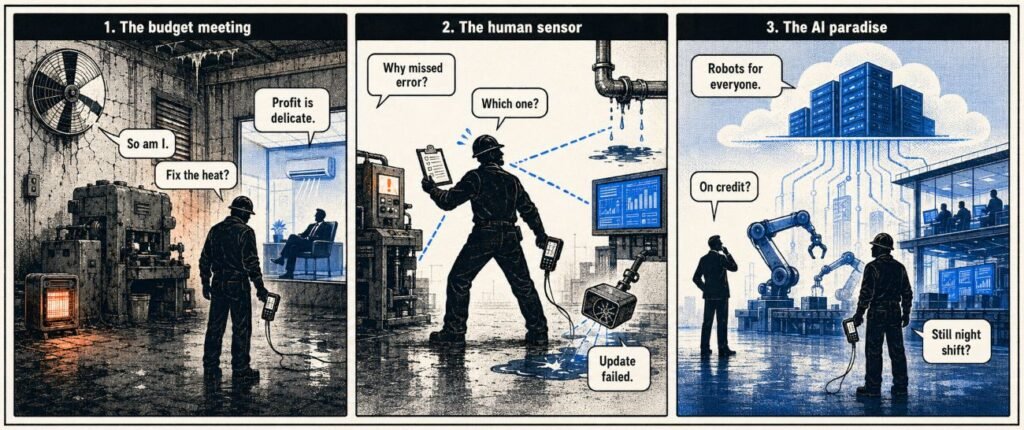
Scene 1: The budget meeting
Three executives sit under an air conditioner. A worker stands in a hot warehouse beside an old fan with one missing blade.
Dialogue:
Worker: “Fix the heat?”
Boss: “Profit is delicate.”
Fan: “So am I.”
Scene 2: The human sensor
A worker checks a machine, a clipboard, a screen and a leaking pipe at the same time while a broken camera points at the floor.
Dialogue:
Manager: “Why missed error?”
Worker: “Which one?”
System: “Update failed.”
Scene 3: The AI paradise
A giant cloud server sells tickets labelled “Future” while small factories queue outside with empty wallets.
Dialogue:
Big Tech: “Robots for everyone.”
Small Firm: “On credit?”
Worker: “Still night shift?”
What to watch, not the show
- Whether health checks are followed by real changes or just filed as legal padding.
- Whether temperature, ventilation, lighting and tools are treated as safety needs or optional comforts.
- Whether night shift pay matches the cost to health, sleep and family life.
- Whether old systems create errors that management then blames on workers.
- Whether AI investment helps frontline staff or only cuts headcount.
- Whether small and medium firms can buy useful technology without becoming dependent on bigger platforms.
- Whether UBI talk becomes a serious democratic policy or a polite cage for people priced out of work.
The Hermit take
If the future is real, start with the fan, the heater and the broken scanner.
AI can help, but it should replace excuses before it replaces workers.
Keep or toss
Verdict: Keep / Toss.
Keep better tools, safer conditions, fair pay and useful automation.
Toss the cheap sermon that workers should be grateful while carrying broken systems on their backs.
Sources
- HSE workplace temperature law: https://www.hse.gov.uk/temperature/employer/the-law.htm
- HSE workplace temperature guidance: https://www.hse.gov.uk/temperature/employer/index.htm
- HSE health surveillance overview: https://www.hse.gov.uk/health-surveillance/overview.htm
- ONS sickness absence in the UK labour market 2025: https://www.ons.gov.uk/employmentandlabourmarket/peopleinwork/labourproductivity/articles/sicknessabsenceinthelabourmarket/2025
- Acas night workers rules: https://www.acas.org.uk/working-time-rules/night-workers
- GOV.UK Coronavirus Job Retention Scheme final evaluation: https://www.gov.uk/government/publications/coronavirus-job-retention-scheme-final-evaluation-july-2023/the-coronavirus-job-retention-scheme-cjrs-final-evaluation-july-2023-html
- IMF AI and global employment analysis: https://www.imf.org/en/blogs/articles/2024/01/14/ai-will-transform-the-global-economy-lets-make-sure-it-benefits-humanity
- GOV.UK small and medium-sized business plan: https://www.gov.uk/government/publications/backing-your-business-our-plan-for-small-and-medium-sized-businesses/backing-your-business-our-plan-for-small-and-medium-sized-businesses-web-version
- OECD SME technology adoption in the United Kingdom: https://www.oecd.org/en/publications/sme-technology-adoption-in-the-united-kingdom_5f25ce2a-en.html