
Lede
An erotic thriller that walks in wearing “love story” perfume, then reveals it is actually possession with better lighting.
Hermit Off Script
The whole rant about this film is simple: actions have consequences, and confusing love with ownership is how control gets dressed as romance. This is a story about trust being used as a lock, intimacy becoming leverage and wealth giving cruelty better furniture. It could happen in any relationship where “I love you” quietly means “I own you”. While watching it, my mind kept returning to The Handmaiden (2016), where desire changes the balance of power and becomes part of the story’s machinery. Here, some of the erotic material feels less necessary, as though the adaptation is ticking the genre box because the book arrived with one already printed on the cover. Heat should reveal character, sharpen danger or alter power. Otherwise, it is expensive wallpaper. I watched it through Cineworld Unlimited, which softened the financial insult. Without a subscription, I would have waited for streaming. That is not a death sentence for the film, but it says something about the cinema experience: a theatrical release should offer more than a large screen displaying material that already feels designed for the sofa.
P.S. Update – 9 April 2026
The film later became a major box office success. Fair enough. My screening still felt almost empty, and that is honestly what I saw.
The Handmaiden (2016) – Official Trailer
The Housemaid (2025) Official Trailer
The Housemaid (2025) | Movie synopsis roast
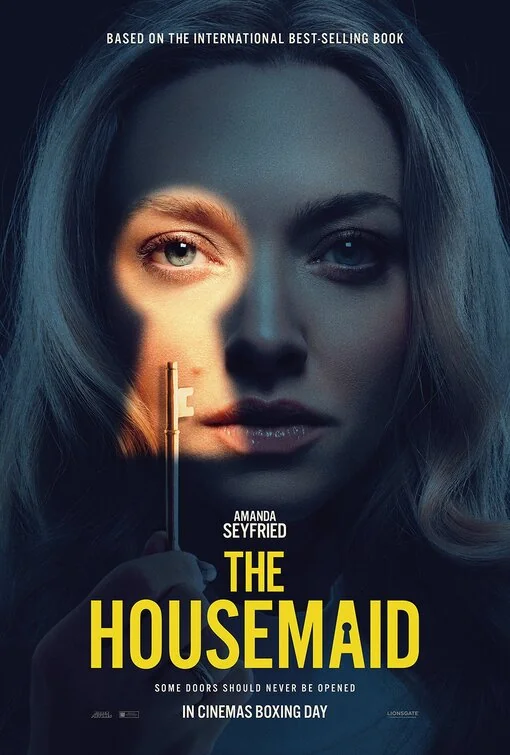
A young woman called Millie, trying to outrun a messy past, takes the dream job that only exists in thrillers: live-in housemaid for a glossy, wealthy couple, Nina and Andrew Winchester, in a house so perfect it practically has a PR team. Then the film does what it promised on the tin: it peels the “perfect life” label off like cheap wallpaper and reveals a home built on secrets, mood swings, and the kind of polite cruelty that always comes with nice upholstery. Millie is placed in a live-in setup that feels less “fresh start” and more “soft captivity”, and Nina keeps setting traps that look like requests but behave like punishments, the emotional equivalent of being told to smile while someone moves the floor under your feet.
The plot engine is simple and nasty: class power plus proximity plus confusion masquerading as desire. Everyone is performing a role, and the house itself is the director – doors, rules, and routines turning intimacy into leverage. The film keeps whispering “nothing is as it seems”, and it means it, because the real romance here is between control and convenience. Millie wants stability; the Winchesters want someone to absorb their chaos without making a mess on the marble.
Cast and credits
Director: Paul Feig
Writers: Rebecca Sonnenshine (screenplay)
Genre: Erotic psychological thriller / mystery and thriller, drama
Main cast: Sydney Sweeney; Amanda Seyfried; Brandon Sklenar; Michele Morrone; Elizabeth Perkins
Composer: Theodore Shapiro
Production company/studio: Hidden Pictures; Pretty Dangerous Pictures (listed); distributor Lionsgate
Runtime: 131 minutes
Release year and platform: 2025 – theatrical release (and later at-home listings in the US)
Book roast: “The Housemaid” by Freida McFadden
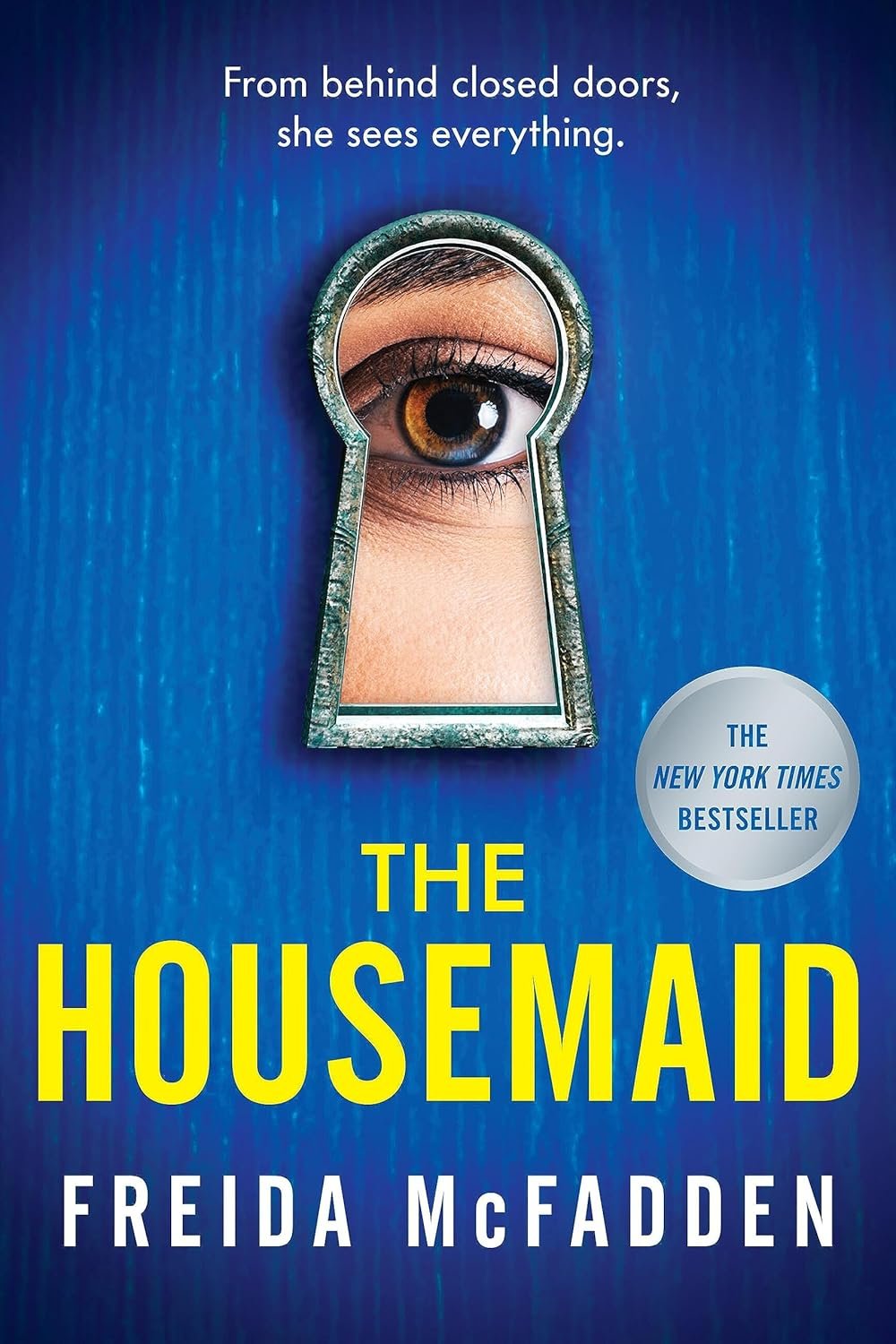
The Housemaid takes one simple fear and keeps tightening it: being trapped in somebody else’s home, living on somebody else’s money and surviving beneath somebody else’s smile. Millie arrives for a fresh start. The Winchesters offer “welcome to the family” warmth. The house quietly replies: “Welcome to the experiment.”
The prose is built for speed. Short chapters, abrupt turns and endings designed to drag the reader into one more page. It is less interested in literary elegance than forward motion, and that bargain clearly worked. The book became a huge commercial success and grew into a series.
Its strength is momentum. Its weakness is also momentum. The machinery moves so quickly that character can sometimes feel like cargo being carried towards the next twist.
Author roast: Freida McFadden

Freida McFadden built a thriller career with the efficiency of someone who understands both brains and deadlines. She worked as a physician specialising in brain injury while publishing fast, twist-heavy novels under a pseudonym.
Her strength is control of pace. Chapters finish where sleep begins negotiating badly. The generous reading is that she understands exactly what thriller readers want. The harsher reading is that suspense has been turned into an assembly line. Both can be true.
Update – 9 April 2026
McFadden revealed that her real name is Sara Cohen, explaining that she used a pseudonym to separate her medical and writing careers. She will continue publishing under the Freida McFadden name.
The biography changed. The books did not. The finest twist was discovering that the thriller factory had also been running a medical career.
What does not make sense
- A story about coercion keeps borrowing the visual language of romance, then expects glossy lighting to settle the moral argument.
- It sells “sexy and seductive” danger, although the central relationship runs on control, dependence and concealed violence.
- Intimate scenes should change the balance of power, but some merely remind us that the marketing department found the genre label.
- The adaptation keeps many of the book’s turns while struggling to give them a distinct cinematic identity.
- A cinema subscription makes the film worth trying, which is useful for audiences but not exactly a standing ovation.
Sense check / The numbers
- The Housemaid was released in the United States on 19 December 2025, runs for 131 minutes and carries an R rating. [Box Office Mojo]
- The film earned approximately USD 400.5 million worldwide, including USD 126.4 million in the United States and Canada and USD 274.1 million internationally. [Box Office Mojo]
- Its reported production budget was about USD 35 million, meaning the film earned more than 11 times that amount in worldwide ticket sales before cinema shares and marketing costs. [AP] [Box Office Mojo]
- The film adapts Freida McFadden’s 2022 novel and was directed by Paul Feig from a screenplay by Rebecca Sonnenshine. [Lionsgate] [Box Office Mojo]
- Lionsgate announced a sequel after the first film passed USD 133 million worldwide in only 17 days. [AP]
The sketch
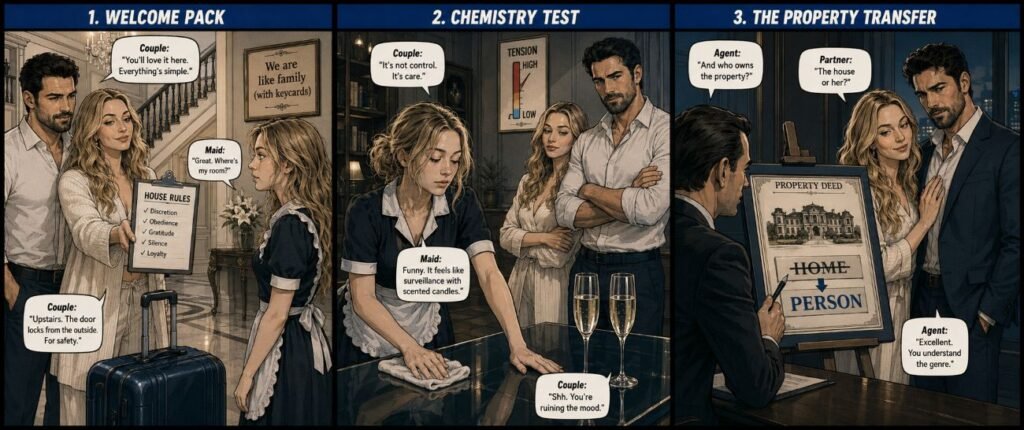
Scene 1: Welcome Pack
A spotless mansion foyer. A smiling couple hold out a clipboard labelled “House Rules”. The maid stands with a suitcase and a hopeful face. A tiny sign on the wall reads: “We are like family (with keycards)”.
Dialogue:
Couple: “You’ll love it here. Everything’s simple.”
Maid: “Great. Where’s my room?”
Couple: “Upstairs. The door locks from the outside. For safety.”
Scene 2: Chemistry Test
Panel: A designer living room. The maid is wiping a perfectly clean surface while two champagne glasses sit untouched. The couple watch like it’s a performance review. A thermometer on the wall is labelled “Tension”.
Dialogue:
Couple: “It’s not control. It’s care.”
Maid: “Funny. It feels like surveillance with scented candles.”
Couple: “Shh. You’re ruining the mood.”
Scene 3: The Property Transfer
An estate agent stands beside a romantic couple while changing the label on a house deed from “Home” to “Person”.
Dialogue:
Agent: “And who owns the property?”
Partner: “The house or her?”
Agent: “Excellent. You understand the genre.”
What to watch, not the show
- The genre incentive: “erotic thriller” as a marketing wrapper that can excuse lazy psychology.
- Class theatre: wealth as a shortcut for menace, because power imbalance is cheaper than character work.
- Adaptation checkbox culture: faithfulness to beats over meaning, especially when a book already did the heavy lifting.
- Cinema economics: subscriptions and discount schemes propping up “maybe” visits that would otherwise become “wait for streaming”.
- Name adjacency: titles engineered to echo familiar hits, then living off the confusion like it is a strategy, not a symptom.
The Hermit take
Erotic thrillers work when the sex scenes change the power balance and the danger escalates because of them, not alongside them.
Here, the setup is slick and the performances keep it watchable, but the “heat” often feels bolted on, and the suspense runs on familiar rich-house, trapped-employee rhythms that never quite become inevitable.
Keep or toss
Keep / Toss
Keep the central power-game and the brisk, pulp-thriller pace that makes it worth an Unlimited punt.
Toss the soft-focus “romance” framing, the prestige posturing, and any intimate scene that repeats the point instead of sharpening it.
Sources
- Box Office Mojo film release, runtime and worldwide gross: https://www.boxofficemojo.com/release/rl1512275969/
- Lionsgate official trailer and release information: https://www.youtube.com/watch?v=48CtX6OgU3s
- AP report on the sequel, production budget and early box-office performance: https://apnews.com/article/157a777a7fa309f1418ffe9a504d1df8
- Le Monde review and reporting on the novel’s sales and adaptation: https://www.lemonde.fr/en/culture/article/2025/12/25/from-a-best-seller-director-paul-feig-turns-the-housemaid-into-a-run-of-the-mill-film_6748821_30.html
- BBC News on Freida McFadden’s identity reveal: https://www.bbc.co.uk/news/articles/ckgelr2pk0lo
- The Guardian on Freida McFadden’s identity reveal: https://www.theguardian.com/books/2026/apr/09/the-housemaid-author-freida-mcfadden-true-identity-sara-cohen