Lede
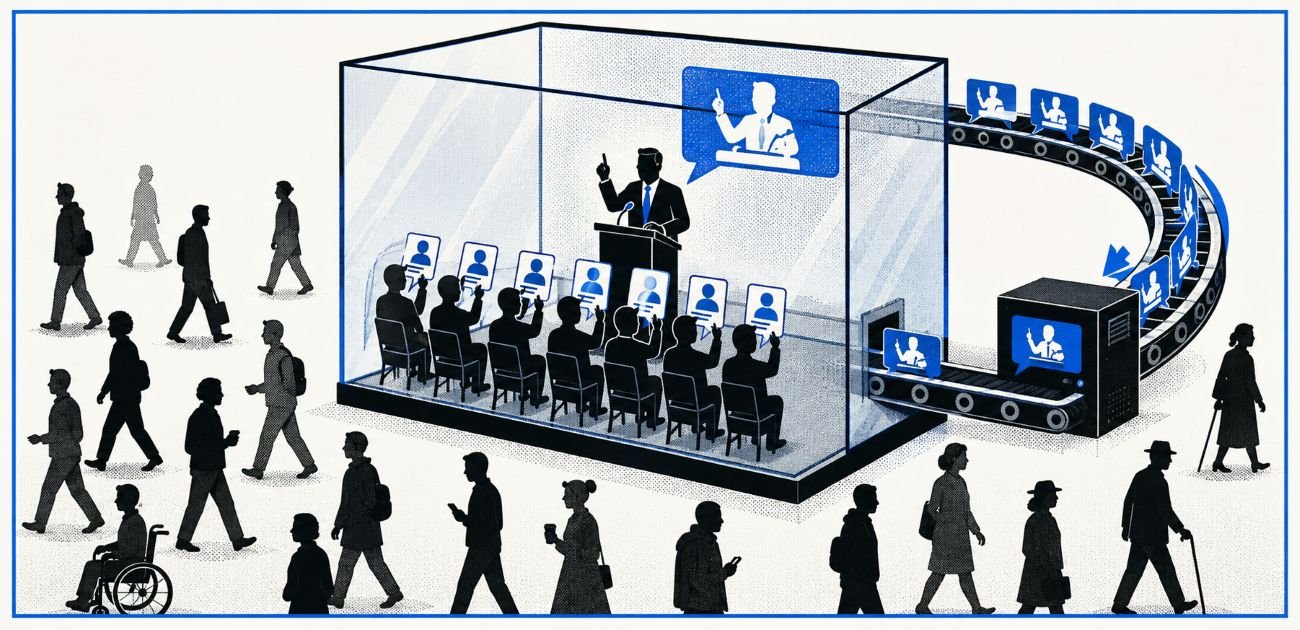
Political creators keep shouting at their own choir, then act shocked when the congregation outside the building votes differently.
Hermit Off Script
The pattern of political creators is the same as every other content creator. They speak to people with the same passions, the same affinities, the same point of view, or the same political mindset. Then they look outside their little circle and question why other people have different views, or why they seem stupid to them, when those people never read, watched, or heard the argument in the first place. That is the absurdity. If someone really wants to change or adapt another group’s mindset, they need to speak directly to that group, in the specific places where that group actually exists. Otherwise, the only people left to reach are the uninterested and the undecided, and even they are often drifting through feeds built to avoid hard thinking.
Most readers are already interested, already aligned, already warmed up. So in elections or popular reactions, it is no wonder that radical circles remain radicalised and unchanged. Nothing reached them. The filters and algorithms served them the same views, the same conversations, the same little theatre of certainty. What changed? Almost nothing. Maybe the group became better connected inside itself. Maybe the applause got louder. Maybe the illusion of majority became more comfortable. But that doesn’t mean change happened en masse. It means localised agreement got polished until it looked like victory. If the group is large enough, fine, it wins. If it isn’t larger than the other group, the whole feed becomes a beautiful rehearsal for losing. That is why so many creators and political voices expect one result from their feeds, then wake up to another one from the ballot box.
If a group wants to change another group’s mind, it needs content built for that group, not for itself. Debunk the lie where the lie lives. Answer the altered truth where it spreads. Deal with the gossip before it becomes common sense. Create attention around the subject in a language the other group recognises, even if that means understanding the conspiracy theory before trying to break it. Otherwise, politics becomes a mirror factory. Everyone sees themselves everywhere, then calls it reality.
What does not make sense
- Creators claim they want to persuade opponents while designing content for people who already agree.
- Algorithms reward engagement, so the loudest internal applause can look like public conversion.
- A political feed can make a minority feel like a nation if it never shows the rooms where it is losing.
- Calling outsiders stupid is easier than checking whether the argument ever reached them.
- Debunking a lie inside a loyal audience is comfort work. Debunking it where believers gather is politics.
- The undecided are treated like an afterthought, then blamed for deciding late or badly.
- Creators measure mood inside the feed, then act surprised when elections measure people outside it.
Sense check / The numbers
- Ofcom’s 2025 work says 71 per cent of UK adults access news online and 51 per cent rely on social media for news; among 16 to 24-year-olds, those figures rise to 80 per cent and 75 per cent. [Ofcom]
- Ofcom’s 2026 adults’ media report says 78 per cent of social media users see news on these apps, 30 per cent share it, and only 23 per cent of sharers always check unfamiliar sources before sharing. [Ofcom]
- Reuters Institute reported that social video news consumption across its markets rose from 52 per cent in 2020 to 65 per cent in 2025, with platform strategies pushing video harder inside algorithms. [Reuters Institute]
- Pew found that 21 per cent of US adults regularly get news from social media news influencers in 2025, rising to 38 per cent among 18 to 29-year-olds. Among regular influencer-news users, 69 per cent say they mostly happen to come across it rather than seek it out. [Pew]
- A 2026 Nature study of X found that 76 per cent of participants were initially using the algorithmic feed, and switching from chronological to algorithmic feed increased engagement and shifted some political opinions in the context studied. [Nature]
The sketch
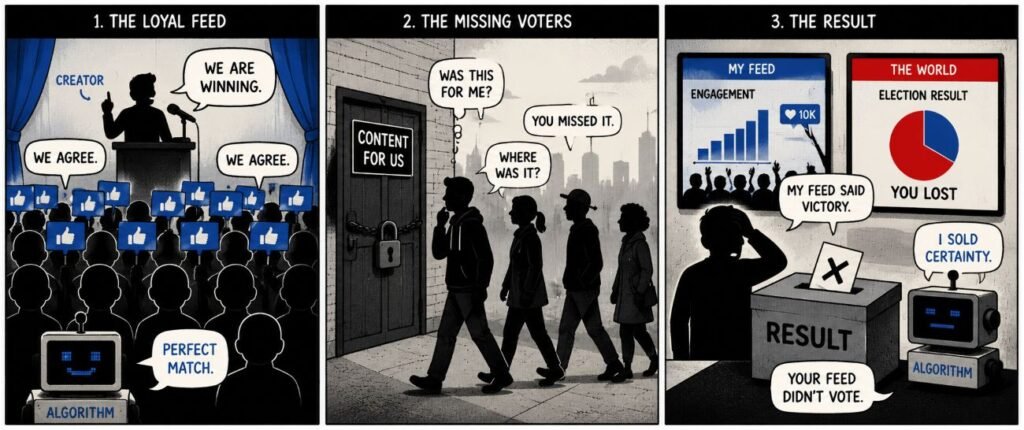
Scene 1: The loyal feed
Panel description. A creator stands on a stage facing rows of identical profile silhouettes, all holding matching signs.
Dialogue:
Creator: “We are winning.”
Audience: “We agree.”
Algorithm: “Perfect match.”
Scene 2: The missing voters
Panel description. Outside the room, undecided voters walk past a closed door labelled “content for us”. Nobody is inside.
Dialogue:
Voter: “Was this for me?”
Creator: “You missed it.”
Voter: “Where was it?”
Scene 3: The result
Panel description. A ballot box sits between 2 separate screens. One screen shows applause, the other shows a different result.
Dialogue:
Creator: “My feed said victory.”
Ballot box: “Your feed didn’t vote.”
Algorithm: “I sold certainty.”
What to watch, not the show
- Platform incentives that reward loyalty over persuasion.
- Political creators confusing engagement with conversion.
- Campaigns that speak fluent supporter language and broken outsider language.
- Misinformation travelling faster than corrections because it knows its audience.
- Comment sections becoming fake focus groups.
- News avoidance leaving more room for personality-led politics.
- Parties outsourcing public persuasion to creators who mainly entertain the base.
- Algorithmic feeds turning political strategy into emotional weather reports.
The Hermit take
Preaching to believers builds applause, not movement.
Change begins where the feed feels uncomfortable.
Keep or toss
Keep / Toss.
Keep political creators who can explain clearly.
Toss the lazy ritual of performing persuasion inside a locked room.
Sources
- Ofcom, Helping Users to Assess Content Online: https://www.ofcom.org.uk/siteassets/resources/documents/research-and-data/media-literacy-research/online-safety/helping-users-to-assess-content-online-discussion-paper.pdf?v=412849
- Ofcom, Adults’ Media Use and Attitudes 2026 Report: https://www.ofcom.org.uk/siteassets/resources/documents/research-and-data/media-literacy-research/adults/adults-media-use-and-attitudes-2026/adults-media-use-and-attitudes-2026-report.pdf?v=415430
- Reuters Institute, Digital News Report 2025 Executive Summary: https://reutersinstitute.politics.ox.ac.uk/digital-news-report/2025/dnr-executive-summary
- Pew Research Center, News Influencers Fact Sheet: https://www.pewresearch.org/journalism/fact-sheet/news-influencers-fact-sheet/
- Nature, The political effects of X’s feed algorithm: https://www.nature.com/articles/s41586-026-10098-2
- PNAS, The echo chamber effect on social media: https://pmc.ncbi.nlm.nih.gov/articles/PMC7936330/