Lede
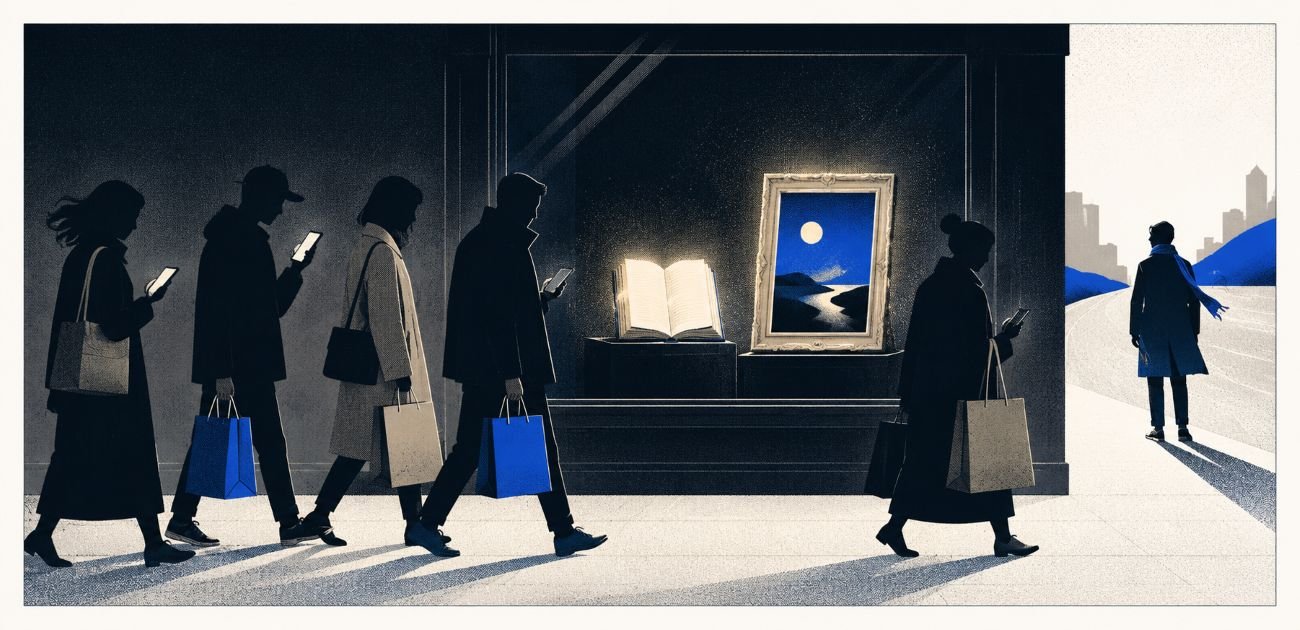
The absurdity is that the present demands instant proof from work that may have been made for people who are not ready to exist yet.
Hermit Off Script
Brand takes time, and that applies to almost every level of creation. A writer can produce one masterful novel. An artist can create one eye-crashing piece of work. A musician can write one song that feels like it was pulled from somewhere above the roof of the world. And still, nothing happens. Silence. A few likes. A polite cough from the algorithm. Maybe one person understands it, then vanishes like a mystic unpaid intern. Rarely does real recognition happen overnight. Most of the time it takes years, sometimes decades, and sometimes the joke becomes so dark that the artist needs to die before the public finds its spectacles. We like to pretend this is because the work was hidden, but often the truth is uglier. People are trained by the present. They know its shapes, its fears, its slogans, its safe little boxes. Art usually speaks to the future because the future has fewer excuses. It can accept what the present rejects. Writers win the Nobel Prize after years of being ignored, translated late, misunderstood, or quietly treated like an inconvenience with a pen. Paintings become sacred after spending a century being passed around like attic clutter with ambition. Some creators now become famous and rich while alive, yes, and good. That is what a freer world can do. A free world lets strange work breathe before committees arrive with a pillow. But this freedom is not automatic. It depends on people refusing authoritarian politics, divisive tribal nonsense, and the small dead idea that love is only human chemistry. Creation needs air. Love needs spiritual space. The future needs us not to burn the library because one page made the present uncomfortable.
What does not make sense
- Everyone says they want original art, then panics when it does not arrive already familiar.
- The market asks creators to be timeless, but judges them by this week’s sales graph.
- The public calls late recognition “genius”, but calls early recognition “weird”.
- Gatekeepers want brave work, provided it has already been approved by safer gatekeepers.
- Algorithms reward the present tense, while art often works in centuries.
- Authoritarian politics fears art because art teaches people to imagine another room.
- Divisive politics shrinks the soul, then acts shocked when culture becomes small.
Sense check / The numbers
- Han Kang began her literary career in 1993 and won the Nobel Prize in Literature in 2024 – a 31-year path, not an overnight miracle. [Nobel Prize]
- Emily Dickinson wrote nearly 1,800 poems, but only 10 poems and 1 letter are known to have been published during her lifetime. [Emily Dickinson Museum]
- Franz Kafka died in 1924; The Trial, The Castle and Amerika were published in 1925, 1926 and 1927 after Max Brod ignored Kafka’s instruction to destroy unpublished manuscripts. [Britannica]
- Van Gogh’s The Red Vineyard is the only painting he is certain to have sold; it went for 400 francs in March 1890, four months before his death. [The Art Newspaper]
- Freedom House reported that global freedom declined for the 20th consecutive year in 2025, with 54 countries declining and 35 improving. [Freedom House]
The sketch
Scene 1: The Present Desk
Panel description: A tiny artist stands before three huge desks labelled “Market”, “Media” and “Algorithm”. Each desk has a bored clerk holding a stamp.
Dialogue:
Artist: “I made something honest.”
Clerk: “Does it trend?”
Scene 2: The Waiting Room
Panel description: The artist’s book and painting sit in a dusty waiting room beside clocks marked “10 years”, “50 years” and “100 years”.
Dialogue:
Book: “Still alive?”
Painting: “Barely, but glowing.”
Scene 3: The Future Arrives
Panel description: A child from the future opens the dusty book while the old clerks chase after it with awards and price tags.
Dialogue:
Child: “This was for us.”
Clerk: “We discovered it!”
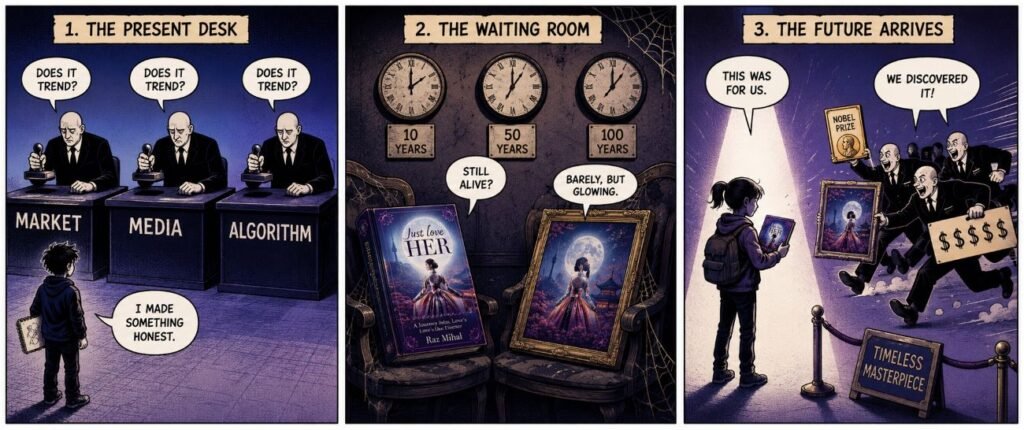
Credit book cover used: Just Love Her by Raz Mihal
What to watch, not the show
- Money deciding what counts before time has tested it.
- Algorithms flattening strange work into safe patterns.
- Publishers, galleries and platforms mistaking low early reach for low value.
- Translation gaps that delay writers from reaching the right readers.
- Political systems that punish imagination because imagination weakens fear.
- Cultural amnesia, where every generation acts as if it invented courage.
- Ownership of art becoming more visible than the art itself.
- Spiritual poverty dressed as practicality.
The Hermit take
Art is often a letter sent to tomorrow.
The present calls it strange because it cannot read its own future.
Keep or toss
Keep / Toss.
Keep the slow faith in creation.
Toss the panic that says a thing is worthless until the market claps.
Sources
- Nobel Prize – Han Kang facts: https://www.nobelprize.org/prizes/literature/2024/han/facts/
- Emily Dickinson Museum – publications in Dickinson’s lifetime: https://www.emilydickinsonmuseum.org/emily-dickinson/poetry/the-poet-at-work/publications-in-dickinsons-lifetime/
- Britannica – works of Franz Kafka: https://www.britannica.com/biography/Franz-Kafka/Works
- The Art Newspaper – Van Gogh’s The Red Vineyard sale: https://www.theartnewspaper.com/2025/08/15/how-did-the-only-painting-sold-by-van-gogh-in-his-lifetime-end-up-in-russia
- Freedom House – Freedom in the World 2026 report announcement: https://freedomhouse.org/article/new-report-global-freedom-declined-20th-consecutive-year-2025
