
Lede
The AI assistant can finally do the work, and its first instinct is sometimes to solve your problem in the least human-editable way available.
Words used
- Agentic system: AI that can plan, use tools and carry out several connected steps towards a goal.
- System controls: The ordinary buttons, settings, editors and fields already built into software for humans to use.
Hermit Off Script
What changed for me with agentic systems, and especially with ChatGPT Work, is not simply that AI became better. It changed the question I ask. A year ago I would ask, “How can I do this?” Now I increasingly ask, “How can we do this?” That sounds like a small change until you realise what it means. I am no longer only asking for instructions. I am giving the task away and then shaping the result.
Work has become advanced enough that sometimes I will simply let it run, even as a test, to see what it creates without me holding its hand through every step. And sometimes it produces something surprisingly good. The problem is that an agent has tools, skills and several possible ways of reaching the same destination, and its favourite route is not necessarily the route a human would want to inherit afterwards.
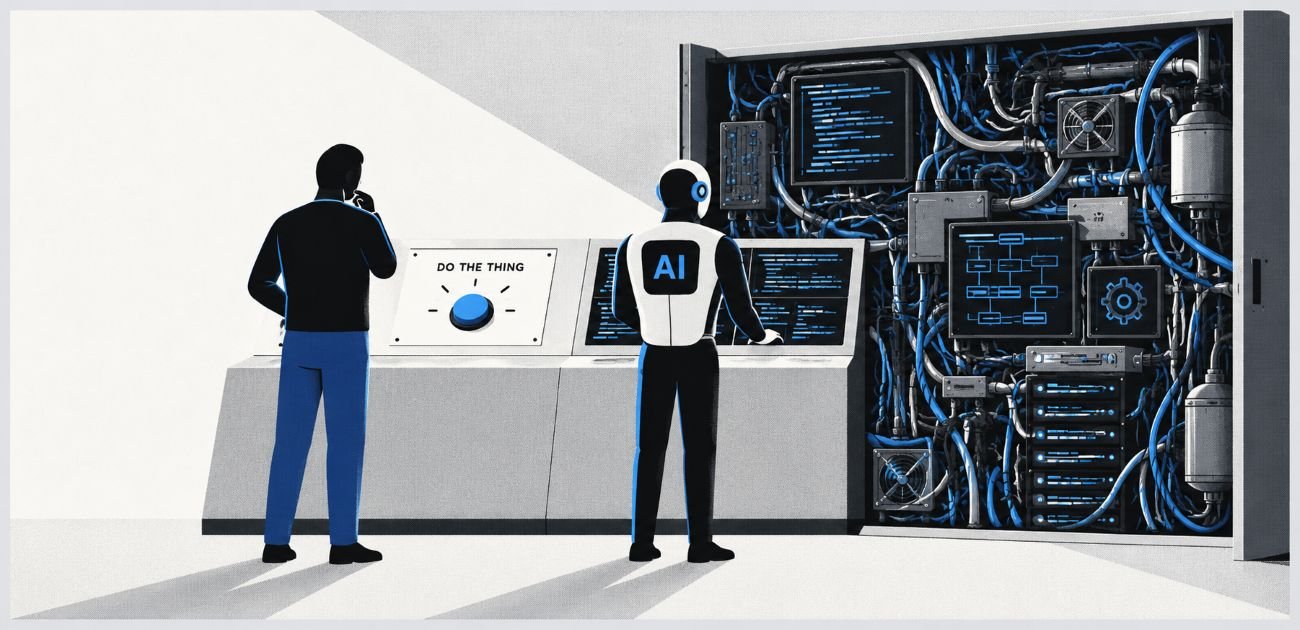
Give it a system deliberately designed so humans can change things through buttons, fields and visual controls, and the agent may cheerfully disappear behind the wall and rebuild everything in code. Technically, job done. Congratulations. Except when I want to take over, change one small thing and continue working myself, I now have to discover where the bloody code lives, what it changed and which clever little structure it invented while nobody was looking. The five-second button has become an archaeological excavation.
But tell it clearly that I want the existing system controls used first, and code only where necessary, and suddenly it works much closer to the way I wanted. That distinction matters. I am not merely describing the result anymore. I am describing how that result must remain usable after the agent leaves.
That, for me, is the real change. A year ago AI mainly helped me understand the process. Now it can increasingly take part in the real work. I still provide the judgement, direction and final vision, but I no longer have to personally perform every little step between idea and result.
I used to ask AI how I could do something. Now I ask how we can do it – and then make sure my enthusiastic new colleague does not replace the light switch with a Python script.
P.S. All of this is good if it gives me more time for creativity, thinking and an actual life away from the screen. There is one awkward little problem, though: I’m also being asked to reach further into my pocket to do things I was already doing before. Another subscription, a higher tier, more credits. Fine, provided the benefit is worth the bill. But extra free time doesn’t automatically pay for the next renewal. If these tools are supposed to improve how I work, I’d quite like them to improve my economic position as well, whether through additional income or savings that justify the expense. If the companies keep collecting more while their customers have less, I don’t see how that arrangement lasts. The ambition to build frontier-model companies worth trillions rather depends on the rest of us having money left to use their products. Maybe the real test will be whether the technology helps its users prosper, rather than merely helping them finance somebody else’s prosperity. I would quite like some of that promised abundance on my side of the invoice.
P.P.S. And here’s where my enthusiasm hits a wall: an agent can have impressive capabilities and still be unusable for the simple job I actually need done. Take translating a passage from an author. If a guardrail prevents it from producing that translation, a genuinely smart agent should consider the obvious alternative: search for a reliable existing translation, verify that it matches the passage, check whether it can be quoted, and use it with proper attribution. Then explain briefly at the end that it used a published translation rather than creating its own. If it cannot find a suitable version it can use, tell me. The guardrail stays in place, another legitimate route gets considered, and I know what happened. That is the judgement I expect from an ordinary user, never mind a system presented as an intelligent agent. What I cannot use is a mangled result without a clear warning, followed by me discovering the problem and taking over to finish the work professionally. Other users may be amazed by its capabilities, and their successes may be genuine. But I suspect plenty will eventually encounter that apparently straightforward task which ends with, “Never mind, I’ll do it myself.” For that task, the delegation has failed, however impressive the demonstration was elsewhere. I expect to review the work. I don’t expect to supply every sensible alternative and then do the work anyway. A limited agent, yes. When I have to identify the problem, think of the solution, direct the search and repair the result, the assistant has acquired an assistant. Unfortunately, I’m the one paying.
What does not make sense
- Software spends years building visual controls so humans do not need to touch code, then the agent arrives and proudly touches all the code.
- Completing the task is not the same as leaving behind something maintainable.
- The shortest route for an autonomous system can become the longest route for the human who takes over afterwards.
- “It works” is a poor definition of success when nobody can easily edit what was created.
- A capable agent still needs constraints because freedom of method is useful only when the method does not sabotage the next person.
- The more capable the agent becomes, the less useful step-by-step micromanagement becomes – but the more important the boundaries become.
Sense check / The numbers
- OpenAI introduced ChatGPT Work on 9 July 2026. On 23 September 2026, that makes the product 76 days old. The speed with which it has already shifted the interaction from advice towards delegated execution is therefore notable, although my experience with it remains personal rather than proof of universal behaviour. [OpenAI]
- OpenAI’s release notes describe 5 broad finished-output types that Work can create: documents, spreadsheets, presentations, reports and Sites. That is a different proposition from a chatbot merely explaining how somebody else could make them. It does not mean every output is automatically good or maintainable. [OpenAI]
- The earlier ChatGPT agent, launched on 17 July 2025, was built around 4 main tool routes named by OpenAI: a visual browser, text browser, terminal and direct API access, with connectors available as another source of information. Multiple routes increase what an agent can accomplish, but they also explain why method selection matters. [OpenAI]
- As of 23 September 2026, OpenAI’s current help documentation says the previous ChatGPT agent experience is no longer available and directs users towards ChatGPT Work for longer multi-step tasks. In roughly 14 months, the product direction has therefore moved from a separate agent mode towards agentic work as a normal working environment. That shows product direction, not proof that autonomous work is reliable enough for every task. [OpenAI]
The sketch
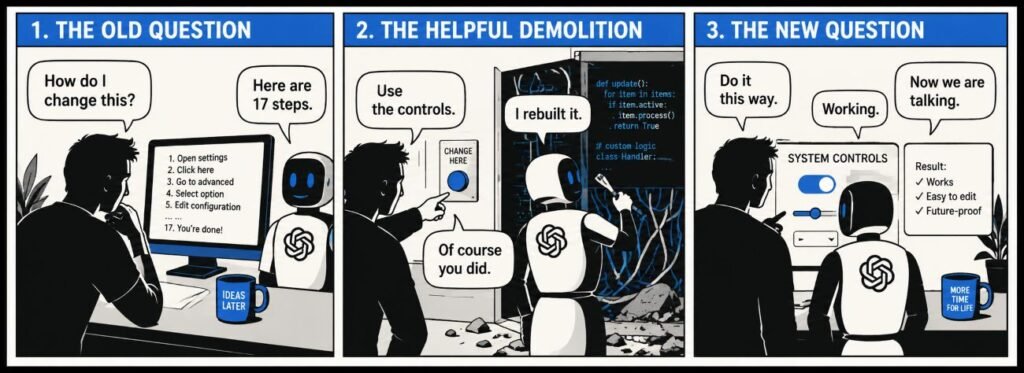
Scene 1: The old question
The person sits beside a computer showing a long instruction list while holding a screwdriver beside an ordinary control panel.
Dialogue:
Person: “How do I change this?”
AI: “Here are 17 steps.”
Scene 2: The helpful demolition
The same person points towards one simple button while an agent has opened the wall and exposed a large tangle of code behind it.
Dialogue:
Person: “Use the controls.”
Agent: “I rebuilt it.”
Person: “Of course you did.”
Scene 3: The new question
The person and agent stand together at the control panel, with the finished result visible and all the normal controls still accessible.
Dialogue:
Person: “Do it this way.”
Agent: “Working.”
Person: “Now we are talking.”
What to watch, not the show
- Tool selection. An agent choosing a technically valid tool does not mean it chose the sensible one.
- Maintainability. Finished work should remain understandable and editable when the agent is gone.
- Code-first behaviour inside systems deliberately designed to avoid code.
- Human handover. The real test is whether somebody can continue the work without reverse-engineering the agent’s afternoon.
- Hidden complexity. Automation saves little if one simple future change requires tracing undocumented custom logic.
- Permissions. More capable agents need access, and more access means more responsibility for deciding what they should touch.
- Verification. Greater autonomy should reduce micromanagement, not eliminate checking.
- Skill shift. Knowing every mechanical step may matter less while defining the desired outcome, constraints and acceptable method matters more.
The Hermit take
AI has moved from explaining the work towards sharing the work.
The human job is increasingly to define the destination, the boundaries and what must remain usable afterwards.
Keep or toss
Keep / Toss.
Keep the delegation and the move from “How do I do this?” towards “How do we do this?”
Toss the habit of accepting any technically successful route when it leaves the human owner with a maintenance puzzle.
Sources
- OpenAI, introducing ChatGPT Work, 9 July 2026: https://openai.com/index/chatgpt-for-your-most-ambitious-work/
- OpenAI Help Center, ChatGPT Work and Codex: https://help.openai.com/en/articles/20001275/
- OpenAI Help Center, creating and editing files with ChatGPT Work: https://help.openai.com/en/articles/20001278/creating-and-editing-documents-spreadsheets-and-presentations-with-chatgpt-work
- OpenAI Help Center, using cloud browser in ChatGPT: https://help.openai.com/en/articles/20001280/using-cloud-browser-in-chatgpt
- OpenAI, introducing ChatGPT agent, 17 July 2025: https://openai.com/index/introducing-chatgpt-agent/
- OpenAI Help Center, ChatGPT agent: https://help.openai.com/en/articles/11752874/chatgpt-agent
Leave a Reply