Lede
Foundation did not reach television because Hollywood suddenly became wise, but because technology finally became expensive enough to fake a future worthy of Asimov’s ego-sized imagination.
Hermit Off Script
Foundation was never simply “hard to adapt”. It was structurally rude to television for most of its life. Isaac Asimov was born in 1920 in Petrovichi, came to the United States at age 3, grew up in Brooklyn, graduated from Columbia in 1939, worked during the Second World War at the Naval Aviation Experimental Station, took a PhD in chemistry in 1948, joined Boston University, then proceeded to write or edit about 500 volumes as if paper had personally wronged him. His Foundation stories were written between 1942 and 1949 and collected as Foundation in 1951, Foundation and Empire in 1952, and Second Foundation in 1953, with the trilogy later winning the special Hugo Award in 1966. He also helped reshape robot fiction, wrote science books for lay readers for decades, was named Humanist of the Year in 1984, and even turned up in the world of light opera with Asimov’s Annotated Gilbert & Sullivan in 1988. So yes, the man had range. He could do galactic decline, robot ethics, public science, and operetta notes, which is frankly rude to everyone else who struggles to finish one decent email. The real problem was never whether Foundation was important enough for the screen. The problem was that Asimov wrote civilisational scale, time jumps, abstract power, recorded prophecy, and systems thinking. Television wants returning faces, emotional continuity, and a reason for the audience to remember who anyone is after the century skips. David S. Goyer admitted that a feature film did not seem big enough, and Apple pitched the 2021 series as the first on-screen adaptation and “over 50 years in the making”. That checks out. The books could build an empire with ideas, but the series needed streaming money, mature CG pipelines, huge design teams, and thousands of VFX shots just to make Trantor look like more than a posh corridor with delusions of grandeur. Season 1 ran to about 3,900 VFX shots, season 2 to 3,215, and one season 2 vendor alone handled 223 shots including a 1.5 km mothership. The show also had to cheat intelligently. It made the Cleonic clone dynasty central, giving viewers recurring human anchors that the books do not supply in the same way, and Goyer openly said he wanted characters vivid enough that viewers care who lives and who dies. Lee Pace was even blunter: his version of Brother Day is largely an expansion, not a straight lift. That is the whole adaptation in miniature. The books are colder, cleaner and bigger in idea. The series is warmer, louder and bigger in image. One asks you to admire history behaving like mathematics. The other asks you to admire history while Lee Pace stalks through imperial lighting like the sun owes him rent. The novel built a galaxy out of thought. The series needs a render farm and a choir. Same skeleton, different religion.
P.S. Asimov has been my favourite writer since childhood, and Foundation was one of those worlds that stayed with me long before screens had the courage to touch it. So the roast comes with respect. The empire was already in my head years ago.
What does not make sense
- Pretending Foundation was just waiting for bravery, when it was plainly waiting for render farms, streaming budgets, and an industry arrogant enough to visualise psychohistory without turning it into a PowerPoint in robes.
- Complaining that the show uses recurring human anchors when the books gleefully throw characters into history’s skip every few chapters.
- Expecting strict page fidelity from a medium that hates time jumps unless somebody is cloned, frozen, digitised, or all three before lunch.
- Acting shocked that the series leans into spectacle when Asimov’s raw material involves a 12,000-year-old empire collapsing across thousands of worlds.
- Demanding the books’ austere chill and the show’s emotional continuity at the same time, as though television can survive indefinitely on trade policy, recorded messages and very intelligent frowns.
- Calling the books and the series the same meal when one is a cold, perfect theorem and the other is an expensive imperial banquet with better lighting and more feelings.
Sense check / The numbers
- Isaac Asimov was born on 2 January 1920, came to the United States at age 3, graduated from Columbia in 1939, took his PhD in chemistry in 1948, joined Boston University, and wrote or edited about 500 volumes. [Britannica]
- The original Foundation stories were written between 1942 and 1949, then collected as Foundation (1951), Foundation and Empire (1952), and Second Foundation (1953). The trilogy won a special Hugo Award in 1966 for best science-fiction series of all time. [Britannica]
- Asimov later returned with Foundation’s Edge (1982), which won the Hugo Award for best novel, followed by Foundation and Earth (1986), Prelude to Foundation (1988), and Forward the Foundation (1993). [Britannica]
- Apple’s Foundation season 1 premiered on 24 September 2021 as a 10-episode season, and Apple called it the first-ever on-screen adaptation and “over 50 years in the making”. [Apple]
- Goyer said a feature film “didn’t seem big enough” for the material. That is not marketing fluff. That is the cleanest diagnosis of the adaptation problem. [Apple]
- Season 2 launched on 14 July 2023, more than a century after the season 1 finale, with the Cleons unravelling, the Church of Seldon spreading through the Outer Reach, and the Second Crisis brewing into war with Empire. [Apple]
- Season 3 premiered on 11 July 2025, set 152 years after season 2, with the Foundation stronger, Empire weaker, and the Mule arriving as a military and psychic wrecking ball. [Apple]
- Season 1 used about 3,900 VFX shots, season 2 used 3,215, and Image Engine alone handled 223 season 2 shots, including work on a 1.5 km mothership. [fxguide] [AWN] [Image Engine]
Isaac Asimov: the man behind the machine
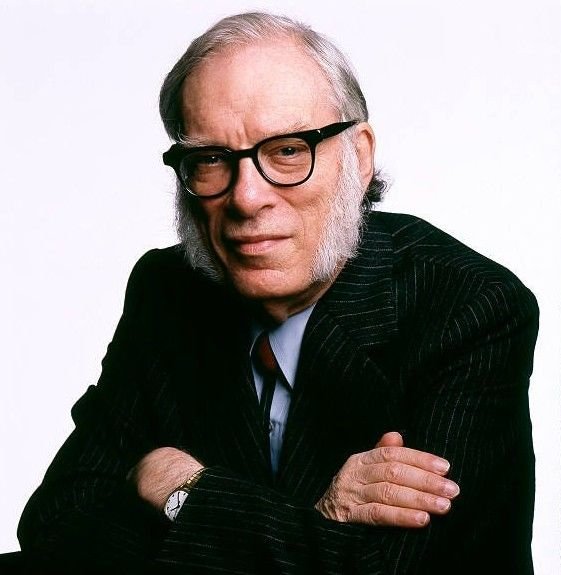
Isaac Asimov was not merely a science fiction writer. He was a one-man publishing weather system. He sold his first story in 1939, broke through with “Nightfall” in 1941, began the robot stories in 1940, and then built a career that ranged from Foundation and I, Robot to popular science, autobiography and literary annotation. Britannica’s summary is brutally efficient: he was an American author and biochemist who wrote or edited about 500 volumes, with the Foundation and robot series at the centre of his fame. That is a body of work so large it stops looking like productivity and starts looking like a municipal service.
His public role mattered too. The American Humanist Association lists him as its Humanist of the Year for 1984, and his nonfiction output helped make science feel legible to general readers rather than fenced off behind academic self-importance. He also published Asimov’s Annotated Gilbert & Sullivan in 1988, because apparently writing future history, robot ethics and popular science was not enough and he still had time left to annotate operetta.
Light roast: most people dabble; Asimov annexed hobbies like they were neighbouring planets.
Isaac Asimov was born on 2 January 1920 in Petrovichi, in what was then Soviet Russia, and was brought to the United States at the age of 3. He grew up in Brooklyn, graduated from Columbia University in 1939, worked during the Second World War at the Naval Aviation Experimental Station in Philadelphia, completed a PhD in chemistry at Columbia in 1948, and then joined the faculty of Boston University in 1949. In other words, before he became the patron saint of cerebral science fiction, he had already built the sort of respectable scientific CV that lets a writer invent galactic empires without sounding like he got lost on the way to a comic shop.
His writing career began absurdly early. Asimov started contributing stories to science fiction magazines in 1939, and his first sale, “Marooned off Vesta”, appeared in Amazing Stories in March 1939. “Nightfall” in 1941 pushed him into the front rank of science fiction writers, while his robot stories began in 1940 and led to the famous Three Laws of Robotics, introduced in “Runaround” in 1942. That alone would have been a respectable career for most people. Asimov, naturally, treated it as a warm-up lap. He wrote as if sleep were a malicious rumour spread by less organised authors.
He is best known for two linked achievements. First, the Foundation stories, written between 1942 and 1949 and later collected as Foundation, Foundation and Empire, and Second Foundation, turned the decline of empire into grand-scale speculative history. The trilogy won the special Hugo Award in 1966 for best science fiction series of all time. Second, his robot fiction helped redefine what robots could be in literature: not simply metal villains stomping about like angry wardrobes, but thinking machines governed by logic, ethics, and unintended consequences. He later expanded the same fictional universe through books such as The Caves of Steel, The Naked Sun, Foundation’s Edge, Robots and Empire, Prelude to Foundation, and Forward the Foundation, binding robot, Empire, and Foundation strands into one huge future history.
What makes Asimov especially ridiculous, in the best possible way, is the scale of the oeuvre. Britannica notes that he wrote or edited about 500 volumes, while other longstanding Asimov references describe a body of work of over 500 books, alongside a mountain of letters and postcards. He was not confined to science fiction either. From the late 1950s onward he poured enormous energy into nonfiction, writing lucidly for general readers about chemistry, physics, biology, history, Shakespeare, and the Bible, and he also wrote a monthly science column for The Magazine of Fantasy and Science Fiction from 1958 to 1991. Most writers have a shelf. Asimov requires zoning permission.
The man himself was more interesting than the stereotype of “prolific genius in glasses”. He was deeply involved in public humanism, receiving the American Humanist Association’s Humanist of the Year award in 1984, and later serving as honorary president of the organisation until his death. He also had a lively affection for Gilbert and Sullivan, joining the Gilbert and Sullivan Society in 1970, which may be the neatest proof that the same mind could happily contain galactic sociology, robot ethics, Sherlockian gamesmanship, and comic opera. That breadth matters. Asimov was not simply a novelist who happened to know science. He was one of the twentieth century’s great explainers, a bridge between laboratory thinking and ordinary readers, with just enough wit to stop the bridge becoming a lecture hall.
Asimov died in New York on 6 April 1992, aged 72. His death was publicly reported at the time as heart and kidney failure, and it was later disclosed by Janet Asimov that the underlying cause was complications from HIV infection contracted through a blood transfusion during bypass surgery in 1983. The end was sad, but the legacy is not. He left behind one of the great intellectual architectures in modern literature: Foundation for historical scale, the robot stories for ethical imagination, and a vast body of nonfiction that taught generations to love science without being bullied by it. Light roast aside, he was the sort of writer who makes whole genres stand up straighter.
Foundation books in order: light-roast reviews for every novel
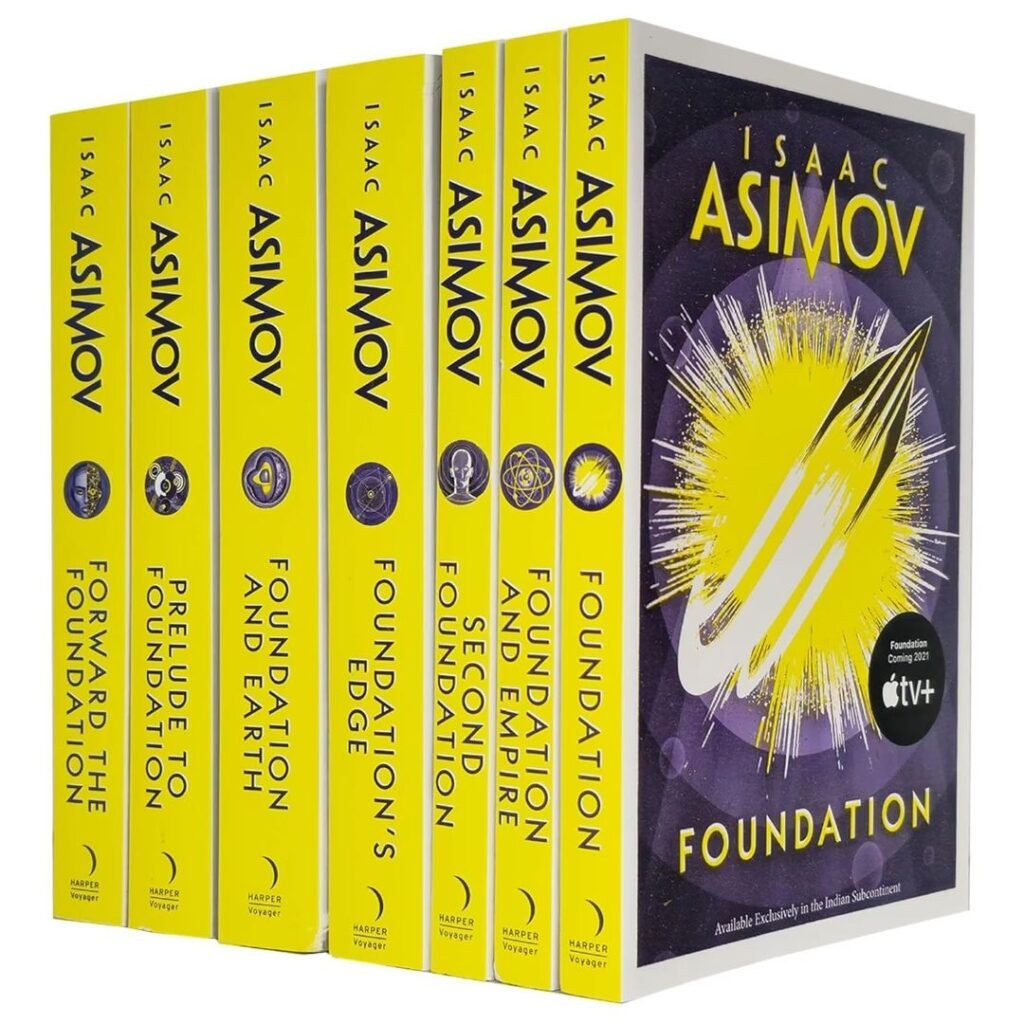
If you want the Foundation series to make sense without your brain filing a formal complaint, read it in publication order, not internal chronology. That means starting with the original trilogy, then moving into the later sequels, then finishing with the prequels. The core seven novels are Foundation (1951), Foundation and Empire (1952), Second Foundation (1953), Foundation’s Edge (1982), Foundation and Earth (1986), Prelude to Foundation (1988), and Forward the Foundation (1993). The original trilogy later won the special Hugo Award in 1966 for best all-time science fiction series, which is a polite way of saying Asimov turned “history lecture in space” into canon.
The best Foundation reading order for an easy read
Read the books in this order:
- Foundation
- Foundation and Empire
- Second Foundation
- Foundation’s Edge
- Foundation and Earth
- Prelude to Foundation
- Forward the Foundation
This is the smoothest route because the ideas expand naturally, the mysteries land better, and the prequels actually mean more once Hari Seldon is already half myth in your mind. Starting with the prequels is possible, but it is a bit like reading the notes on a magic trick before seeing the trick. Technically valid, spiritually annoying.
1. Foundation review
Foundation is where the machine starts. Hari Seldon predicts the collapse of the Galactic Empire and creates the Foundation to reduce the coming dark age from 30,000 years to 1,000. The book is made from linked stories rather than one continuous novel, and that structure gives it a grand, historical rhythm. It is less interested in personal angst than in political pressure, trade, religion, knowledge, and the quiet terror of large systems failing in slow motion.
What makes it brilliant is the sheer confidence. Asimov barely bothers with flashy prose or emotional theatrics. He simply puts ideas on the table and lets them win by intelligence.
Light roast: if you came looking for lush character intimacy, this book will hand you a crisis chart and ask you to admire the efficiency. That said, it remains one of the sharpest openings in science fiction because it trusts the reader to keep up. No spoon-feeding, no melodramatic fog machine, just civilisational chess.
2. Foundation and Empire review
This is where the series grows teeth. The book follows the Foundation as it faces the dying remnants of the Empire, then introduces the Mule, one of Asimov’s smartest disruptions to his own neat design. Up to this point, psychohistory feels almost divine in its confidence. Then the Mule arrives and smashes the furniture.
It is a stronger dramatic read than Foundation for many people because it has more pressure, more momentum, and a proper sense that the plan can go wrong. The Mule is the book’s great gift because he injects unpredictability into a universe that had looked almost too tidy.
Light roast: Asimov builds a galaxy on mathematics, then has to invent one emotionally chaotic menace just to remind himself that people are, in fact, a problem. It works beautifully. For many readers, this is the best book in the series.
3. Second Foundation review
Second Foundation completes the original trilogy and shifts the mood from political expansion to intellectual paranoia. Now the focus falls on the hidden Second Foundation, guardians of the mental sciences and custodians of the Seldon Plan, especially after the damage caused by the Mule. That makes this book more mysterious, more strategic, and slightly more unnerving than the previous two.
It is a clever book, sometimes almost too clever for its own good. People search, deceive, infer, manipulate, and generally behave like a galaxy-sized intelligence test. The reward is that the trilogy ends not with brute force, but with the unsettling idea that history may be guided by minds you never see.
Light roast: by this point Asimov has fully committed to the proposition that the most dangerous people in the universe are calm academics with a plan. Frankly, he may have had a point.
4. Foundation’s Edge review
After a long gap, Asimov returned with Foundation’s Edge, and you can feel the difference at once. It is more modern in shape, more expansive in character work, and more openly novelistic than the earlier fix-up trilogy. The book follows Golan Trevize and Janov Pelorat as they investigate whether the Second Foundation is truly gone and whether the future of the galaxy may lie elsewhere entirely. It also won the Hugo Award for Best Novel, which tells you the comeback was not exactly a quiet one.
This is a strong, thoughtful continuation, though it can be gloriously talkative. Asimov has never met an interesting idea he was willing to leave unexplored, and here he lets conversations carry enormous conceptual weight. That is either a delight or a crime depending on your patience.
Light roast: most writers would stage a grand action sequence to sell galactic stakes, but Asimov is still perfectly happy to let a few intelligent people sit down and out-think the future over several pages. Annoyingly, he often makes it gripping.
5. Foundation and Earth review
Foundation and Earth continues directly from Foundation’s Edge and sends Trevize, Pelorat, and Bliss on a search for Earth itself. That gives the book a quest structure, but also a reflective mood, because the real issue is not just where Earth is, but whether Trevize made the right choice about humanity’s future. It is also one of the books that more clearly links the Foundation saga to Asimov’s wider robot universe.
This novel is fascinating, but it is not as surgically sharp as the original trilogy. It is more exploratory, more explanatory, and at times you can feel Asimov enjoying the architecture of his universe perhaps a little more than the immediate pace of the story. Still, if you care about the larger design of the series, it matters a great deal.
Light roast: it occasionally feels like Asimov has invited you into the boiler room of his fictional cosmos and is pointing proudly at every pipe. The good news is that the pipes are impressive.
6. Prelude to Foundation review
Prelude to Foundation is the first prequel and follows a younger Hari Seldon during the reign of Cleon I, before psychohistory has properly become the force readers know from the earlier books. It is one of the two prequels that move the spotlight directly onto Seldon and the early development of the Plan. That makes it more grounded in immediate danger and more personal in focus than parts of the original series.
Read after the main sequence, it works well as a return to the roots of the myth. Read first, it loses some of its magic. The appeal here is not just the plot, but the pleasure of seeing Seldon before he hardens into legend. Trantor also feels more vivid as a lived-in imperial world rather than a distant symbol.
Light roast: the future’s greatest mathematician spends a surprising amount of time running from people who have decided his unfinished theory is already politically useful. Which, to be fair, is a very realistic introduction to power.
7. Forward the Foundation review
Forward the Foundation is the last book to read and the right one to end on. Published in 1993 and described by Britannica as Asimov’s final novel, it continues following Hari Seldon and the development of psychohistory, but it carries an unmistakable farewell feeling. By this stage, the series is not just about ideas and empire, but about legacy, sacrifice, ageing, and the loneliness of building a future you will never live to see.
It is one of the most emotionally satisfying entries in the series because it gives Seldon gravity as a person, not just as a mechanism in history. The book is quieter than some readers expect, but that is part of its strength. It closes the circle with melancholy and intelligence rather than noise.
Light roast: after all the scale, all the maths, and all the grand historical engineering, Asimov still leaves you with the awkward truth that saving civilisation mostly involves paperwork, patience, and other people getting in the way.
Which Foundation book is the best?
If I had to rank them for most readers, I would put them in this order:
- Foundation and Empire (Rating: 5 out of 5)
- Foundation (Rating: 4.5 out of 5)
- Second Foundation (Rating: 4.5 out of 5)
- Forward the Foundation (Rating: 4.5 out of 5)
- Foundation’s Edge (Rating: 4.25 out of 5)
- Foundation and Earth (Rating: 4 out of 5)
- Prelude to Foundation (Rating: 4 out of 5)
That ranking is not a dismissal of the later books. It is simply that the original trilogy has a colder, cleaner force that is very hard to beat. The sequels and prequels add richness, but the early books have the ruthless clarity of first principles. They are lean, strange, and absurdly influential. They also helped define what modern space opera and big-idea science fiction could look like, even when Asimov wrote them with all the decorative warmth of a brilliant filing cabinet.
Final verdict
Read Foundation in publication order if you want the easiest and most rewarding path through the series. The original trilogy is the essential core, Foundation’s Edge is the best expansion, Foundation and Earth is worthwhile if you want the larger universe stitched together, and the two prequels are best saved for dessert. Or, in Asimov terms, for the carefully calculated after-effects of dessert.
Foundation TV series seasons explained with a light roast
Apple TV+’s Foundation began in 2021, returned for season 2 in 2023, and season 3 premiered on 11 July 2025. Across those 3 seasons, the series has kept the same broad spine: Hari Seldon’s long game, the decay of the Cleonic Empire, and a galaxy trying to pretend mathematics is less frightening than politics. Apple describes the series as the story of exiles trying to save humanity and rebuild civilisation amid imperial collapse. That is the noble version. The less noble version is that everyone keeps making history harder than it needs to be.
Foundation — Official Trailer | Apple TV
Season 1 synopsis
Season 1 starts with Dr Hari Seldon predicting the fall of the Galactic Empire and the coming dark age. He and his followers are pushed to the edge of the galaxy to establish the Foundation, while the ruling Cleons, a dynasty of cloned emperors, begin to realise that their apparently eternal power may not be quite as eternal as the branding promised. The season lays out the show’s central tension: can psychohistory really guide humanity through collapse, or are people too vain, violent and melodramatic to follow the script? It premiered on 24 September 2021.
What works in season 1 is scale. The series sells Trantor, the dynasty, and the sense of a civilisation so enormous that even its decline feels architecturally expensive. It also makes one very shrewd choice that helps television enormously: the Cleon clone line gives the show a repeating human anchor that Asimov’s more time-jumping structure did not naturally provide.
Light roast: season 1 is what happens when a grand theory of civilisational collapse is forced to share screen time with emperors who are basically luxury packaging having an identity crisis. It is beautiful, serious, and occasionally so solemn it feels as if the furniture itself has signed a loyalty oath.
Foundation — Season 2 Official Trailer | Apple TV
Season 2 synopsis
Season 2 jumps more than a century after the season 1 finale. By then, tension is rising across the galaxy: the Cleons are unravelling, a queen is plotting to destroy Empire from within, Hari, Gaal and Salvor encounter Mentalics whose psionic abilities threaten psychohistory itself, and the Foundation has entered its religious phase through the Church of Seldon, pushing the galaxy toward the Second Crisis and open war with Empire. The season premiered on 14 July 2023, and Apple billed it as a 10-episode run.
This is the season where the series looks more confident in its own weirdness. The politics sharpen, the faith-versus-calculation tension becomes more interesting, and the show stops merely building a universe and starts properly playing with it. The result is more fun, more dangerous, and less like an extremely expensive orientation video for future collapse.
Light roast: season 2 basically announces that one collapsing clone empire was not enough, so now we also need psychic complications, religious branding, and even more galactic dysfunction. It is the narrative equivalent of saying, “This spreadsheet was too tidy, let’s set part of it on fire.”
Foundation — Season 3 Official Trailer | Apple TV
Season 3 synopsis
Season 3 is set 152 years after the events of season 2. By now, the Foundation is far more established, while the Cleonic Empire has weakened. The two powers form an uneasy alliance just as a new threat rises in the form of the Mule, a warlord using military force and mind control to try to dominate the galaxy. Apple framed the season as a deadly intergalactic chess game involving Hari Seldon, Gaal Dornick, the Cleons and Demerzel. It premiered on 11 July 2025 and ran for 10 episodes through 12 September 2025.
On paper, this is the season where Foundation becomes most like itself: long-range history, unstable power, and one terrifying wildcard who does not care about anyone’s elegant predictive model. The Mule is the sort of problem the series needs, because he turns all those careful structures into panic material. Once you add a figure who can muscle both politics and minds, the galaxy stops feeling grandly inevitable and starts feeling vulnerable again.
Light roast: after two seasons of saying “trust the plan”, season 3 effectively says, “terrific idea, but unfortunately a maniac has arrived with mind control and absolutely no respect for your equations”. Which, to be fair, is one way to test whether your empire was actually robust or just wearing very expensive robes.
Which season is best?
For spectacle and world-building, season 1 does the heavy imperial lifting. For momentum and sharper drama, season 2 is probably the strongest watch. For pure Foundation-style menace, season 3 has the best raw premise because the Mule finally brings the sort of historical disruption that makes psychohistory sweat. The broad pattern is simple: season 1 builds the palace, season 2 rattles it, and season 3 invites a monster inside. That sequence lines up with Apple’s own season descriptions, which show the series moving from imperial decline, to Second Crisis, to alliance under threat from the Mule.
Final verdict
The Foundation TV series works best when it stops trying to be merely respectable science fiction and fully embraces being a grand, slightly mad civilisational opera in space. Each season raises the stakes in a sensible order: collapse, escalation, then outright existential disruption. The light roast is that everyone in this universe speaks as if destiny is in the room, and somehow the show often earns it.
Foundation Season 4 Trailer & First Look
Cast and credits
Director: Various directors across the seasons
Writers: Created by David S. Goyer and Josh Friedman
Genre: Science fiction drama
Main cast: Jared Harris, Lee Pace, Lou Llobell, Leah Harvey, Laura Birn, Terrence Mann, Cassian Bilton
Composer: Bear McCreary
Production company/studio: Skydance Television for Apple TV+
Runtime: Roughly hour-long episodes
Release year and platform: 2021, 2023 and 2025 on Apple TV+
Books vs TV series: what Foundation changes
The books and the TV series share the same grand skeleton: Hari Seldon, the fall of Empire, the Foundation, and the attempt to shorten a 30,000-year dark age to 1,000 years. But they do not tell that story in the same way at all. Asimov’s original trilogy is built from linked stories and novellas that jump forward across decades and centuries, often letting history itself be the main character. Apple’s series keeps the century-spanning scale, but it reshapes the material into a more continuous character drama with recurring faces, heavier emotional arcs, and far more palace intrigue.
- The books are colder, cleaner, and more historical.
In the novels, the Foundation story moves from one era to another with big leaps in time. Seldon often appears only through prerecorded messages after his death, and entire generations rise and vanish as the Plan unfolds. That gives the books their strange power: they feel less like a conventional saga and more like reading future history after the fact. The light roast is that Asimov sometimes treats individual characters like temporary office furniture in a very large archive. - The TV series desperately wants you to stay attached to actual people.
David S. Goyer has said one of the key adaptation goals was to make the characters vivid and to make viewers care who lives and who dies, rather than just admire grand ideas from a distance. By season 2, he was openly talking about adding more internal life, more action, more humour, and more mess because human beings are messy. That is the central television move right there: less abstract destiny, more blood in the carpet. - The Cleon clone dynasty is the show’s biggest invention and its cleverest cheat code.
Apple made the Cleonic dynasty central to the series, with Brother Dawn, Brother Day and Brother Dusk giving the show a recurring imperial spine. That solves one of the hardest adaptation problems: how do you make a time-jumping saga feel emotionally continuous on screen? Lee Pace has flatly said his version of Cleon does not really exist in the novels in this form and is something Goyer expanded from the books. In plain English, the show invented a beautifully twisted bit of dynastic theatre because television likes recognisable faces more than it likes historical inevitability. - The books trust politics, trade, religion and ideas more than spectacle.
In Asimov’s early Foundation stories, the Foundation extends its influence over neighbouring worlds through strategy, leverage, knowledge and belief systems, with crises resolved by intellect more often than brute force. The TV series still uses those themes, but it wraps them in visual grandeur, battles, erotic tension, psychic menace and enough imperial pageantry to upholster a cathedral on Trantor. The roast writes itself: the novels win arguments, while the series occasionally arrives in full ceremonial armour just to explain one. - Hari Seldon functions differently in each version.
In the books, Seldon is closer to an architect of history whose influence echoes through recordings and long-range planning. In the series, he remains much more actively present through ongoing character threads, which helps television maintain emotional continuity but also changes the flavour of the story. The novels make Seldon feel like a ghost in the machinery of civilisation. The show keeps dragging him back into the room because prestige television does not like letting its prophet stay politely dead. - The TV version is more intimate, but also less austere.
Goyer has been clear that he wanted the adaptation to be more approachable for viewers who had never read Asimov. That means more visible emotion, more direct conflict, and more attention to relationships and identity. The books, by contrast, often gain their force from restraint. They do not beg to be loved. They simply sit there, mathematically judging civilisation.
The clean verdict is this: the books feel bigger in idea, the series feels bigger in image. Asimov gives you a galaxy as historical logic. Apple gives you a galaxy as high-budget opera with cloning, robes, trauma, and spectacular ceilings. Both can work. One asks you to think across centuries. The other asks you to think across centuries while admiring Lee Pace walking through imperial lighting like he personally owns the sun.
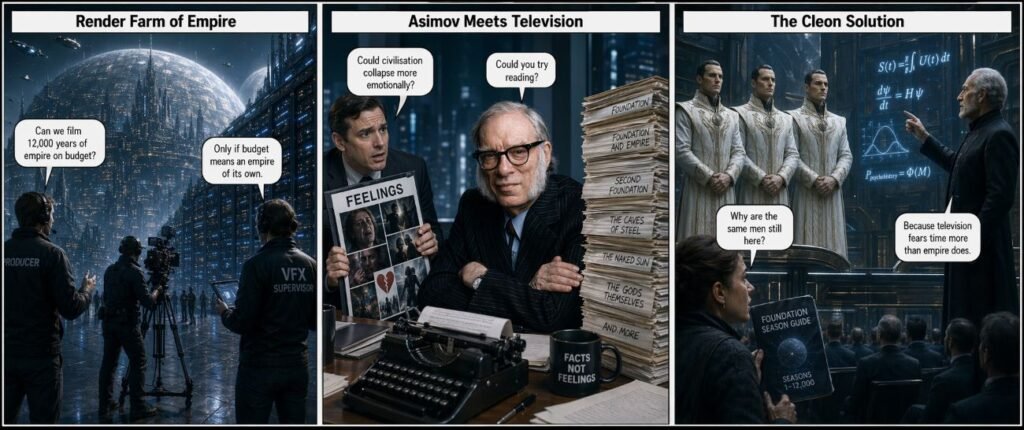
The sketch
Scene 1: “Render Farm of Empire”
Panel description + dialogue:
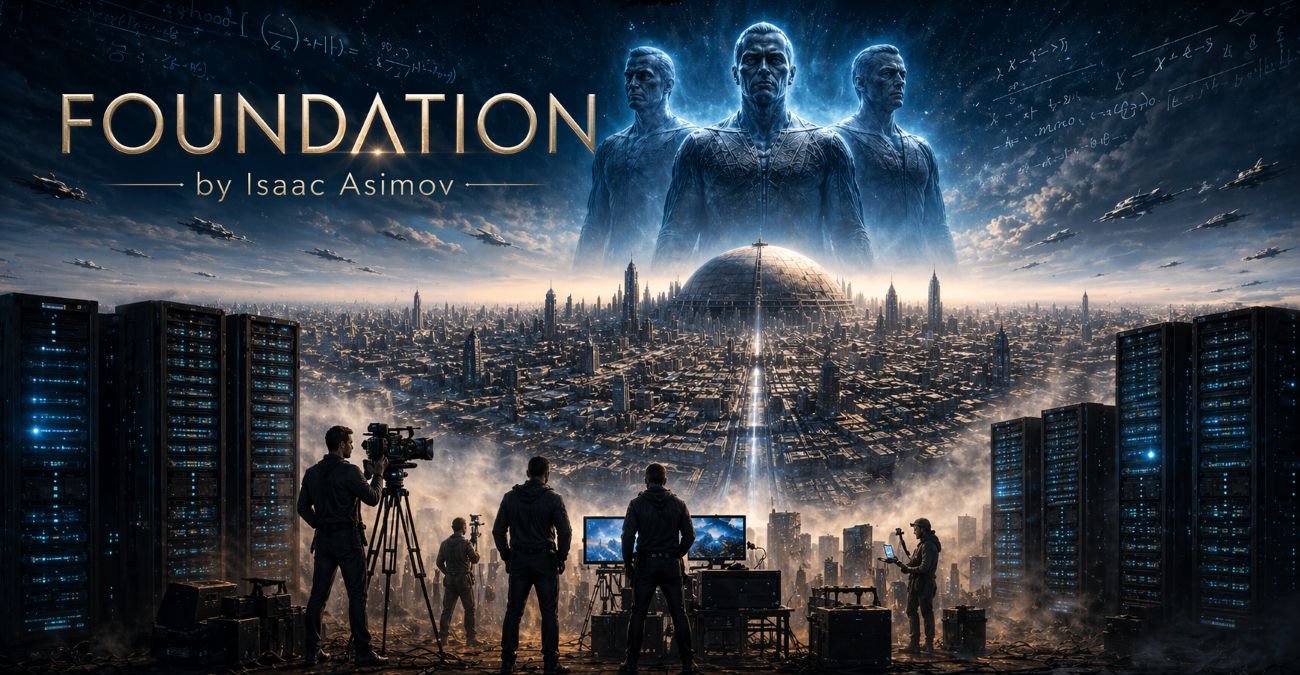
A tiny TV crew stands before a planet-sized city while rows of servers hum behind them like a second religion.
Producer: “Can we film 12,000 years of empire on budget?”
VFX supervisor: “Only if budget means an empire of its own.”
Scene 2: “Asimov Meets Television”
Panel description + dialogue:
Isaac Asimov sits with a stack of manuscripts taller than a person while a streaming executive clutches a mood board marked “feelings”.
Executive: “Could civilisation collapse more emotionally?”
Asimov: “Could you try reading?”
Scene 3: “The Cleon Solution”
Panel description + dialogue:
Three clone emperors pose in immaculate robes while Hari Seldon points at equations in the air and a worried audience clings to a season guide.
Audience member: “Why are the same men still here?”
Hari: “Because television fears time more than empire does.”
What to watch, not the show
- Streaming economics that reward prestige universes with recognisable IP and enough budget to look “important”.
- Visual effects maturity, because this adaptation only became plausible once world-building could look expensive without looking silly.
- Audience habits that demand recurring characters, which pushes abstract future history toward dynasties, clones and emotional through-lines.
- The quiet conversion of science fiction from speculative literature into prestige brand architecture.
- The long-term risk that spectacle starts impersonating depth, and viewers confuse expensive scale with conceptual scale.
- The deeper irony that Asimov’s core question was always about systems, while modern television keeps dragging everything back to the individual face.
The Hermit take
Asimov built the galaxy with thought.
Apple built the wallpaper, then hired clones to keep you watching.
Keep or toss
Keep / Toss
Keep the ambition, the time scale, the Cleon invention, and the sheer nerve of trying to visualise psychohistory without making it look ridiculous.
Toss the fantasy that this was ever going to be a neat, faithful transfer from page to screen. The books are a theorem. The show is imperial theatre with better processors.
Sources
- Apple TV Press, season 1 premiere announcement: https://www.apple.com/tv-pr/news/2021/06/apple-tv-releases-gripping-new-sneak-peek-at-foundation-and-sets-highly-anticipated-global-premiere-for-friday-september-24-2021/
- Apple TV Press, season 2 announcement: https://www.apple.com/tv-pr/news/2023/05/apple-tv-shares-glimpse-at-the-highly-anticipated-second-season-of-hit-epic-saga-foundation-and-sets-global-premiere-for-friday-july-14/
- Apple TV Press UK, season 3 announcement: https://www.apple.com/uk/tv-pr/news/2025/05/apples-epic-hit-saga-foundation-to-return-for-season-three-on-friday-july-11/
- Apple TV Press UK, Foundation cast and crew: https://www.apple.com/uk/tv-pr/originals/foundation/cast-crew/
- Britannica, Isaac Asimov biography: https://www.britannica.com/biography/Isaac-Asimov
- Encyclopedia.com, Isaac Asimov entry: https://www.encyclopedia.com/arts/educational-magazines/asimov-isaac-1920-1992
- Encyclopedia.com, Isaac Asimov biography: https://www.encyclopedia.com/people/literature-and-arts/american-literature-biographies/isaac-asimov
- Britannica, Foundation series overview: https://www.britannica.com/topic/Foundation-by-Asimov
- Britannica, Foundation and Empire overview: https://www.britannica.com/topic/Foundation-and-Empire
- American Humanist Association, annual awardees: https://americanhumanist.org/awardees/
- Gilbert and Sullivan Society library listing: https://www.gilbertandsullivansociety.org.uk/pages/alphabetical-library-listing
- Internet Archive, Asimov’s Annotated Gilbert & Sullivan: https://archive.org/details/asimovsannotated00sull
- HarperCollins, Prelude to Foundation: https://harpercollins.co.uk/products/prelude-to-foundation-the-foundation-series-prequels-book-1-isaac-asimov
- HarperCollins, Foundation’s Edge: https://harpercollins.co.uk/products/foundations-edge-the-foundation-series-sequels-book-1-isaac-asimov
- HarperCollins, Foundation and Earth: https://harpercollins.co.uk/products/foundation-and-earth-the-foundation-series-sequels-book-2-isaac-asimov
- HarperCollins, Forward the Foundation: https://harpercollins.co.uk/products/forward-the-foundation-the-foundation-series-prequels-book-2-isaac-asimov
- David S. Goyer project page: https://www.davidsgoyer.com/portfolio-item/foundation/
- SciFiNow, David Goyer and cast interview: https://www.scifinow.co.uk/tv/its-got-to-work-without-the-spaceships-david-goyer-and-the-cast-of-foundation-on-season-two/
- Rotten Tomatoes, David S. Goyer season 2 interview: https://editorial.rottentomatoes.com/article/foundation-executive-producer-david-s-goyer-on-season-2-the-powers-of-the-mind-and-the-future-of-superhero-media/
- SYFY Wire, Lee Pace interview: https://www.syfy.com/syfy-wire/foundation-lee-pace-brother-day-interview
- fxguide, season 1 VFX: https://www.fxguide.com/fxfeatured/foundational-visual-effects/
- AWN, season 2 VFX: https://www.awn.com/node/1062724
- Image Engine, season 2 case study: https://image-engine.com/case-studies/foundation-season-2-case-study/
- Bear McCreary, Foundation score notes: https://bearmccreary.com/foundation/