David Hockney got the rare artistic miracle: he was seen, paid, argued with, honoured and loved before the obituary department put on its sensible shoes.
Words used
Posthumous: recognition, fame or praise that arrives after death.
Canon: the official shelf where culture stores the people it finally admits mattered.
Hermit Off Script
Most of the time, especially in the past, renowned artists became a serious public thing after they were long gone. Sometimes decades later. Sometimes centuries later. The living person struggled, painted, wrote, argued, froze, starved, failed, tried again, and then some polished institution arrived late with a plaque and a catalogue. Very generous. Bring flowers after the body has left the room and call it civilisation. But from time to time, in our own age, we catch the full life of a recognised artist while he is still here. David Hockney, painter, 1937 to 2026, was one of those rare cases. He was a master of colour, an icon of British art, and a man who lived with spirit against the old furniture of tradition and conservatism. Britain changed around him, slowly, awkwardly. Hockney lived through decades where different views, different ways of loving, and different sexual orientations moved from scandal to public recognition. That matters. It is not a small footnote in a polite art book. He had a lifetime of work, achievement, celebrity and money. That is not vulgar. That is justice arriving before the final curtain. We live in a society that can sometimes accept and reward real artists while they are alive, not only when they are safely dead and unable to ask for royalties. Of course, not everyone gets this fate. Many artists still disappear under poverty, censorship, bad timing, bad luck, or the small-minded gatekeepers who confuse silence with taste. But in a democratic country, at least there is a chance. A real one. Hockney brought colour into public memory with force. Pools, rooms, portraits, bodies, trees, flowers, friends, lovers, dogs, screens – all made visible through a mind that refused to paint life as beige punishment. He painted for the future, but he also made the present look harder at itself. That is the real win. Some artists are discovered by death. Hockney made death queue behind the work.
David Hockney was born in Bradford, Yorkshire, in 1937. The Royal Academy records that he studied at Bradford School of Art from 1953 to 1957, then at the Royal College of Art from 1959 to 1962, where he won the RCA gold medal in 1962. The same Royal Academy profile notes his work across painting, printmaking, photography and theatre design.
Hockney’s early work challenged polite Britain before polite Britain had finished pretending it had no private life. Reuters reports that, as a Bradford art student, he gave works titles such as “Going to be a Queen for Tonight” and “Doll Boy” at a time when homosexuality could still be punished by prison. The Guardian notes that his 1961 painting “We Two Boys Together Clinging” and later works depicted gay life before male homosexuality was decriminalised in England and Wales in 1967.
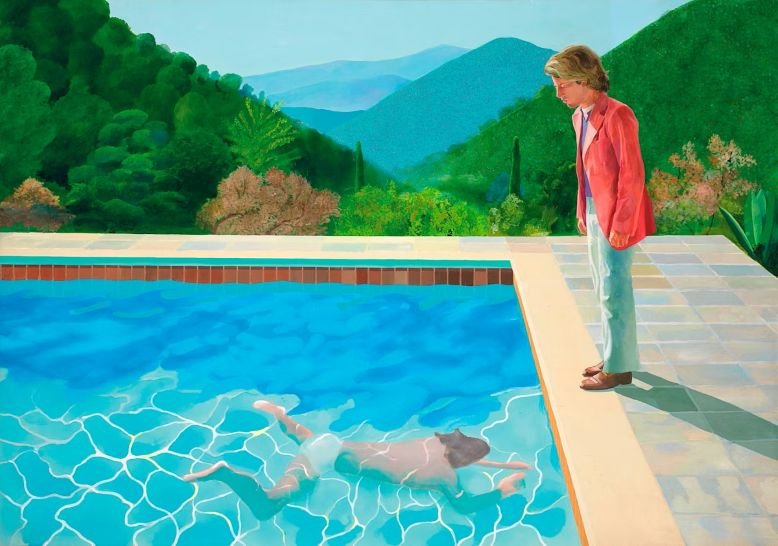
Then came Los Angeles, swimming pools, bright acrylics, clean surfaces and the unnerving silence of sunlit desire. The Guardian names “A Bigger Splash” and “Portrait of an Artist (Pool With Two Figures)” among the works that helped define his public image, while also noting that his six-decade career moved through photocollage, 3D work and iPad pictures. Reuters reports that “Portrait of an Artist (Pool with Two Figures)” sold for $90.3 million in 2018, then the auction record for a living artist.
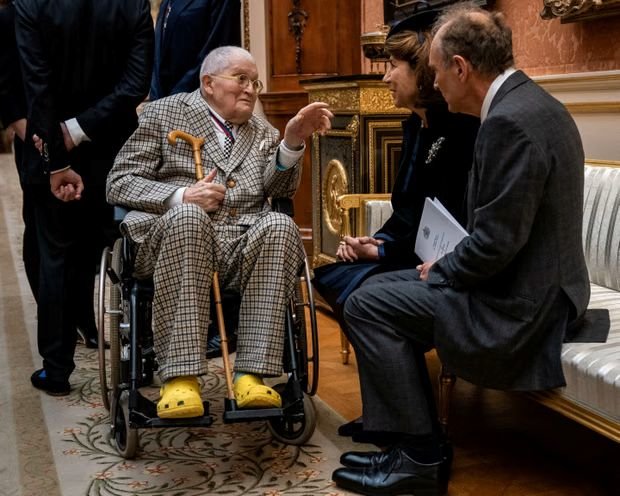
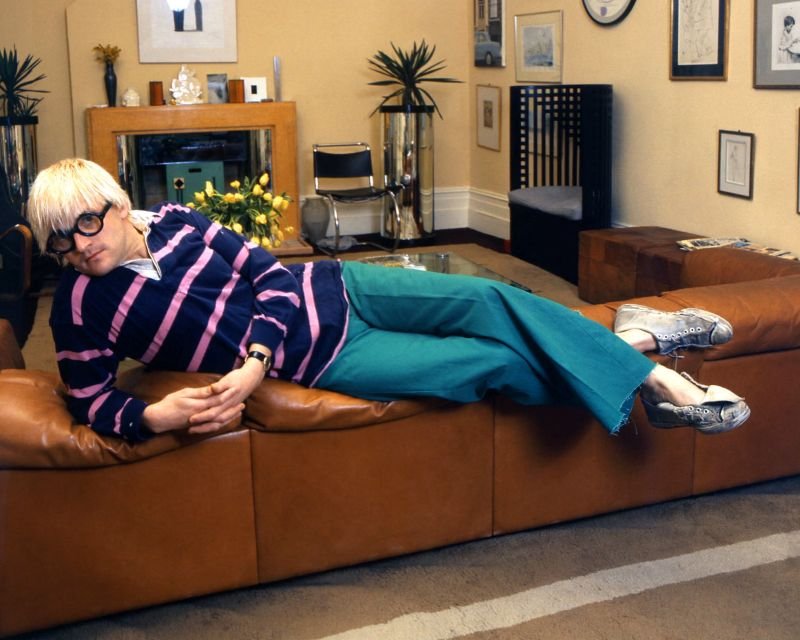
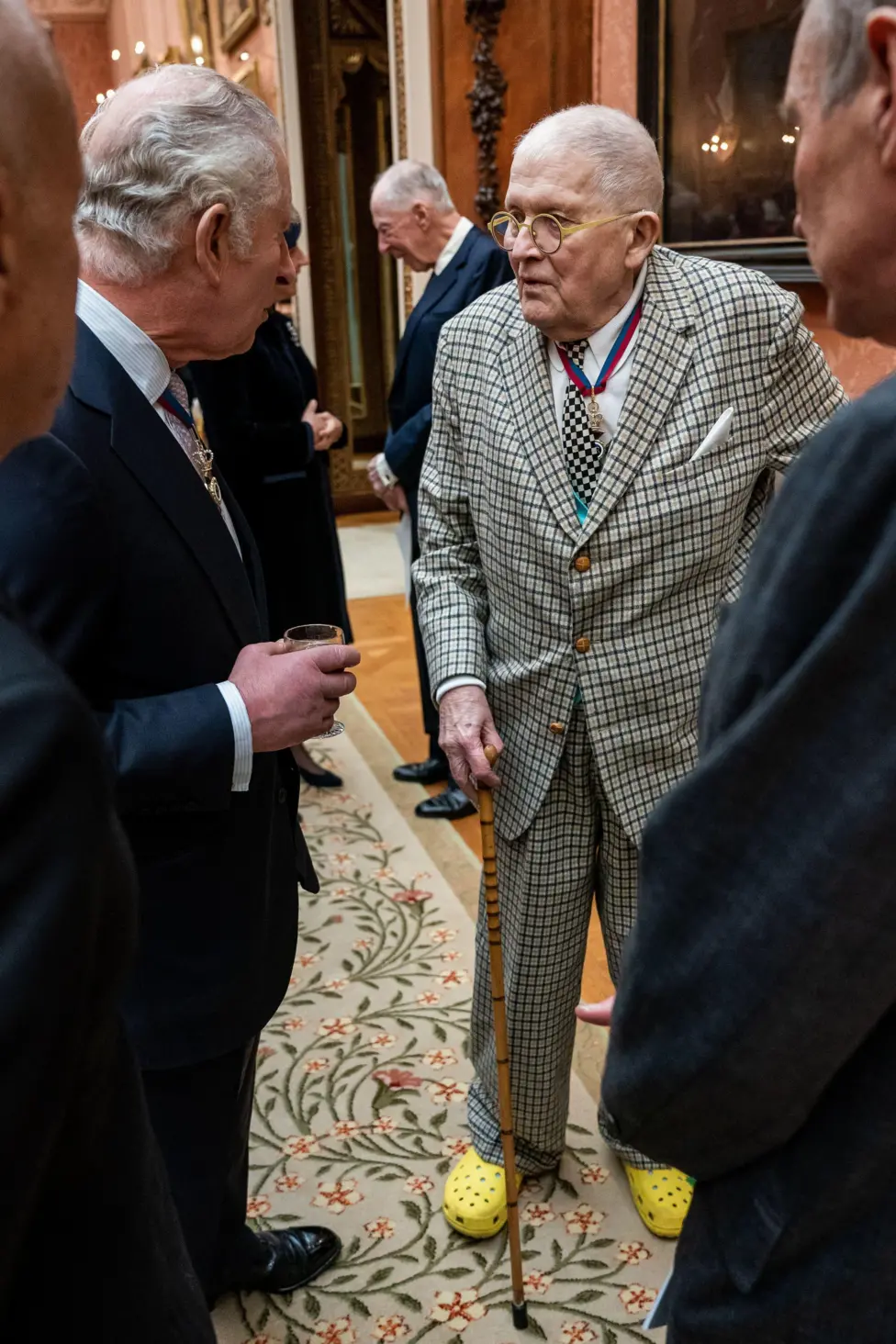
The funny thing is that Hockney never looked like a man begging the academy to approve him. He looked like he had already approved himself. The Guardian’s fashion piece points to the glasses, rugby shirts, suits, paint smudges and those yellow Crocs at a Buckingham Palace Order of Merit luncheon in 2022. That sounds unserious until you realise the serious people are often the ones most terrified of colour.
His later years were not a soft fade. Reuters reports that he kept working through Yorkshire, Normandy, iPads and the 90-metre “A Year in Normandie” frieze. His own working rule, quoted by Reuters, was simple: “I do.” That is a very Yorkshire way of telling mortality to wait outside.
The Hockney echo in Just Love Her
In Just Love Her, Hockney appears where colour becomes inner vision, not gallery furniture. The chapter “When The Divine Love Reflection Is Beating Through Your Heart” describes a vision beside the Han River and says it resembles a work by David Hockney “on an absolute scale”, linking Hockney’s art to dream, colour, emotional intensity and impossible closeness.
The clearer chapter connection is “Her Soul Image Is A Blessing To My Heart”, dated 19 Nov 2019. Raz writes about the feeling of looking at a Hockney painting and being “lost in that moment”, then turns that sensation inward: the loved soul image becomes an artwork on the walls of the heart. The point is not art criticism in the dry museum sense. It is art as a spiritual measurement: a picture strong enough to make the viewer forget the self, then remember love more sharply.
That is where Hockney fits Raz’s world. Hockney paints colour outside. Raz reads colour inside. Both reject the dead grey little kingdom where feeling must apologise before entering the room.
What does not make sense
The culture industry loves calling artists difficult, then sells that difficulty later as authenticity.
A living artist is often treated as a problem with invoices. A dead artist becomes a national asset with lighting.
Hockney’s colour was allowed to be joyful, queer, domestic, playful and serious. The committee still looks slightly winded.
The market can pay $90.3 million for one painting and still pretend money has nothing to do with canon formation.
Britain needed decades to move from punishment to public honour. The paint arrived faster than the morals.
The yellow Crocs at Buckingham Palace did more for honest style than several warehouses of sponsored elegance.
Sense check / The numbers
Hockney died aged 88 on 11 June 2026, one month short of his 89th birthday, according to statements reported by Reuters and the Guardian. [Reuters]
His formal art training ran from Bradford School of Art, 1953 to 1957, to the Royal College of Art, 1959 to 1962; he won the RCA gold medal in 1962. [Royal Academy]
The Royal Academy dates his move to Los Angeles to 1963; Reuters says he moved to California three years after his 1961 New York visit. Either way, the pools won. [Royal Academy, Reuters]
“Portrait of an Artist (Pool with Two Figures)” sold for $90.3 million in 2018, then the highest auction price for a living artist’s work. [Reuters]
The David Hockney Foundation now lists him as “David Hockney 1937 – 2026”, making the dates official without needing the coffin to explain the colour. [David Hockney Foundation]
The sketch
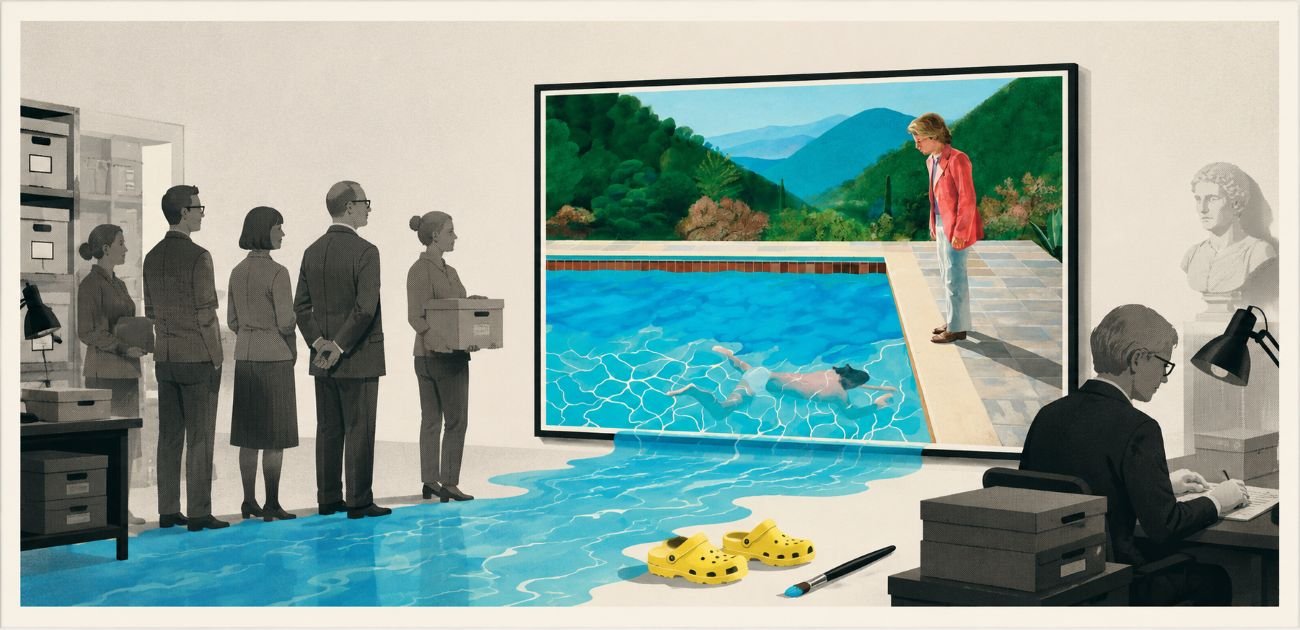
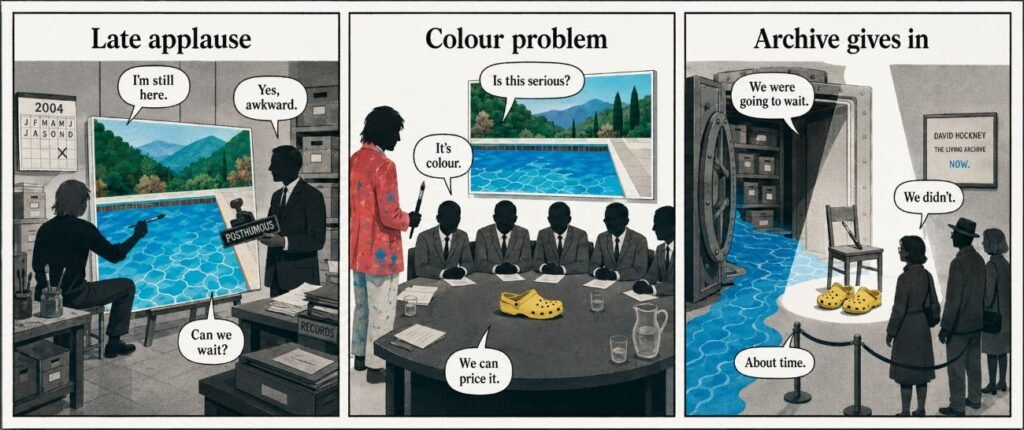
Scene 1: The late applause office An artist paints a large blue pool while a clerk holds a stamp marked “Posthumous”. A calendar on the wall is stuck twenty years behind. Dialogue: Artist: “I’m still here.” Clerk: “Yes, awkward.” Auction House: “Can we wait?”
Scene 2: The living colour problem A bright painter silhouette stands beside a grey committee table. The committee members wear identical black suits and stare at a yellow shoe. Dialogue: Committee: “Is this serious?” Painter: “It’s colour.” Gallery: “We can price it.”
Scene 3: The archive gives in A museum shelf opens while a living chair, paintbrush and pair of yellow shoes sit under a spotlight. Dialogue: Archive: “We were going to wait.” Public: “We didn’t.” Colour: “About time.”
The system wanted posthumous. The artist stayed inconveniently alive.
What to watch, not the show
How living artists are priced, protected, ignored or flattened by the market.
How museums turn rebellion into safe heritage after the danger has passed.
How fashion absorbs the image of an artist faster than readers absorb the work.
How democratic societies can change enough to honour people they once punished.
How the art market confuses high prices with deep seeing.
How public memory edits messy lives into clean labels.
The Hermit take
Hockney’s best trick was not colour. It was refusing to ask permission to see. The system should copy the lesson, not the cardigan.
Keep or toss
Keep / Toss. Keep the living recognition, the courage, the colour and the work. Toss the habit of treating artists properly only when they can no longer answer back.
Royal Academy artist profile: https://www.royalacademy.org.uk/art-artists/name/david-hockney-ra
David Hockney Foundation: https://www.thedavidhockneyfoundation.org/
Raz Mihal, Just Love Her, pages 71-72 and 109-110: https://razmihal.com/books/just-love-her/
Book Source: Just Love Her by Raz Mihal
Raz Mihal, Just Love Her (2024 Edition), Chapters: WHEN THE DIVINE LOVE REFLECTION IS BEATING THROUGH YOUR HEART, pages 71-72 and HER SOUL IMAGE IS A BLESSING TO MY HEART, pages 109-110:
WHEN THE DIVINE LOVE REFLECTION IS BEATING THROUGH YOUR HEART
14 Oct 2019
The heart is the best instrument for testing the feeling of divine love reflection. The main difference besides human love is the awareness and consciousness of living it; the source is the same. Knowing and feeling that love from your heart is of divine roots, your heart will become a shrine dedicated to love. A new world will open in front of your inner eyes, a world as magical as you have never seen before. Sometimes, I feel my heart cool and refreshed as I rest after numerous intense feelings. Other times, it’s burning like a fire, melting any thoughts and impurities inside. It burns to feel Her inside, like a connection beyond my physical self. I let myself loose on this feeling, staying in this kind of meditation of senses that is unstoppable inside. I can’t think of anything else in the meantime. The image of her soul image rises like a flag fluttering in the rhythms of the wind of love. It happens while I write about it, and I must stop due to intensity and continue writing after when it will allow my mind to think. A few hours later … Again, I felt Her beside the Han River, close to a bridge. I was hugging her close to my chest, feeling her heart beating in sync with mine and touching her hair – so close to me. I thought I had lost connection with Her since this kind of vision was paused for a while. It resembles a work of art by David Hockney on an absolute scale, happening in a dream of visions. I don’t know if it’s from past lives, future destiny, or alternate reality … I love it when my mind is troubled by love feelings inside. It can’t concede the connection of our souls beyond time and space, and it can’t believe that Her at least knows about me, my soul vision, and so on. How can my soul trust these beliefs when there is no real reason? If I hadn’t opened my heart to words my mind could understand and others could read, no future is possible for the divine love reflection message in this reality, not now or never. Also, it wouldn’t have been a burden for my mind if I only practised meditation with no thoughts allowed at all. The message is my destiny on this Earth since I was born with or without my choice. So, my soul doesn’t need any proof or actions because the belief is inside my heart, not outside of it. Sometimes, I wish to have been silent because if words were spoken, fates could be influenced. Her is the soul image chosen by divine love reflection inside my heart, and I can’t do anything about it. It wasn’t an option. Maybe it was a blessing for my soul, not my mind. Not for any reason that will try to understand it in the future of now.
HER SOUL IMAGE IS A BLESSING TO MY HEART
19 Nov 2019
Do you know that feeling when you look at a painting by a great artist, let’s say David Hockney, and you are lost in that moment and forget about your existence? Before divine love revealed Her to my heart, I tried to picture who would settle in my heart for aeons. Amazingly, the main features I can see now in her soul image are exposed in my heart artwork. Seeing her soul image repeatedly, I lose myself in her eyes. I forget about everything and anything. I am lost in Her. The greatest gift from Her was her soul image with her eyes uncovered. It’s way easier to look at Her on the walls of my heart and see her soul image so clearly on my mind screen. It seems closer to the reality of Her. That’s how lovers can resist being apart for a long time – always keeping a picture of the loved one close to their hearts. Nothing beats reality, though. The only dilemma is that my mind – ‘The Thinker’ – is boiling. It’s like her soul image perceived so clearly opened a new chapter in its existence. Is there too much information to process? Or, because of the thin line between coincidence and certainty, it seems so confusing. Once, twice … and three times, coincidence is too much to account for. Fate moves with quick steps ahead of anything. It’s the feeling that starts from the beginning – the first time I look into her eyes, when I fall in love with Her, when I express my feelings for her in words. That’s the power of divine love, and you can’t ever get bored living human love this way. You are constantly feeling like new beginnings with your beloved soul. Every beginning seems to have stronger feelings as your human heart expands the limits imposed for its protection. The moment you choose divine love over everything else in your life, the magic world inside opens its gates to know your soul. If both souls chosen by divine love revealed onto their hearts accept the gift of holy love, knowing the source of their feelings, a new type of human being would be born out of their infinite and absolute love.
No spam. No motivational soup. Just the latest receipt when it is ready.
Manage Consent
To provide the best experiences, we use technologies like cookies to store and/or access device information. Consenting to these technologies will allow us to process data such as browsing behaviour or unique IDs on this site. Not consenting or withdrawing consent, may adversely affect certain features and functions.
Functional
Always active
The technical storage or access is strictly necessary for the legitimate purpose of enabling the use of a specific service explicitly requested by the subscriber or user, or for the sole purpose of carrying out the transmission of a communication over an electronic communications network.
Preferences
The technical storage or access is necessary for the legitimate purpose of storing preferences that are not requested by the subscriber or user.
Statistics
The technical storage or access that is used exclusively for statistical purposes.The technical storage or access that is used exclusively for anonymous statistical purposes. Without a subpoena, voluntary compliance on the part of your Internet Service Provider, or additional records from a third party, information stored or retrieved for this purpose alone cannot usually be used to identify you.
Marketing
The technical storage or access is required to create user profiles to send advertising, or to track the user on a website or across several websites for similar marketing purposes.