
Lede
Claude Mythos arrived with the old AI sermon: the miracle is nearly divine, but please check the pricing page before kneeling.
Words used
- Token: A chunk of text an AI model reads or writes, used to calculate usage and API cost.
- Mythos 5: Anthropic’s most capable model line for cybersecurity and biology research, limited to vetted partners.
- Fable 5: Anthropic’s broader Mythos-level model for hard knowledge work, coding and agents, with extra safeguards.
- Trusted access: Restricted access for approved users or organisations, usually where safety or misuse risks are higher.
Hermit Off Script
Claude Mythos from Anthropic arrived for testing inside the paid options, and soon after the big mouthpieces of AI worship started praising it like God had finally arrived among us, or at least among the models. From my point of view, this shows where these companies aim first: at the money, then at the usage. I don’t say the model is weak. The opposite. If the model is powerful enough to need strict access, safety fallbacks and high token prices, then the machine is serious. But if you have limits just for using a model, that also tells a simpler story: mass usage is expensive, and the altar has an electricity bill. If they were smart for ordinary people, they would split the use properly. Hard problems, coding, research, long agent work – fine, meter them. Small problems, simple language practice, quick explanations, everyday chat – why summon the expensive thundercloud for a cup of tea? Why would I need Mythos or Fable just to practise a foreign language when the token usage can run above the charts? This is clearly aimed at hard coders, research teams, enterprise users and people trying to solve problems that would normally take days. That is fair, but be honest. It is not a public miracle. It is rented intelligence. I also wonder what OpenAI has in the pocket, because you don’t hear the old ChatGPT thunder in the same way anymore. There was a time when every release sounded like AGI had parked outside the house and asked for Wi-Fi. Then Gemini 3.5 arrived with its own crown for speed, coding and agent work. Now Anthropic has Mythos and Fable, and everyone takes turns being the chosen one for a week. I think these new releases show the limit for normal users. Who is really going to put a Nobel Prize capable model, or something close to postgraduate level across many fields, into everyone’s hands for free? The final scope is always money. It can be safety, access, enterprise demand, compute cost and product strategy, all at once. But the bill is never an accident. Praise the lord – sorry, praise the model – but at least show the receipt.
Introducing Claude Fable 5
The road to Mythos

Mythos did not fall from the AI heavens. It arrived after two years of model staircases, each step sold as smarter, faster, safer and, naturally, easier to bill. Anthropic launched the Claude 3 family on March 4, 2024, with Haiku, Sonnet and Opus arranged like an intelligence class system: cheap and fast at the bottom, balanced in the middle, expensive and powerful at the top. The language was already clear. Choose your mix of intelligence, speed and cost. Even the model family had a price ladder before the altar had candles. [Anthropic]
Then came Claude 3.5 Sonnet on June 21, 2024. That was the public crowd-pleaser: faster than Claude 3 Opus, cheaper than Opus, strong at coding, available free with higher limits for Pro and Team users, and priced at $3 per million input tokens and $15 per million output tokens. This was the moment where Anthropic looked less like the quiet safety lab and more like a serious OpenAI rival with a polite haircut. [Anthropic]
On February 24, 2025, Claude 3.7 Sonnet added hybrid reasoning and Claude Code. The model could answer quickly or spend longer thinking, while developers got a command line tool that started turning Claude from chat assistant into coding worker. Same price as before, but a different message: the product was moving from “ask me a question” to “give me the job”. [Anthropic]
By May 22, 2025, Claude 4 made the direction obvious. Opus 4 and Sonnet 4 were sold around coding, advanced reasoning and agents. Opus 4 was pitched for long-running tasks and workflows lasting hours, while Sonnet 4 brought stronger coding and reasoning to broader users. That was no longer normal chatbot territory. That was the office intern, senior engineer and night-shift analyst being folded into one black box with a subscription label. [Anthropic]
Then 2026 sharpened the knife. Anthropic’s system card list shows Mythos Preview appearing in April 2026, followed by Opus 4.8 in May 2026. Opus 4.8 pushed agent work further, with users able to choose how much effort Claude puts into a task, while Claude Code gained dynamic workflows for very large problems. Anthropic also said Opus 4.8’s alignment assessment was close to its best-aligned model, Claude Mythos Preview. So Mythos was already there in the background, not as a normal consumer toy, but as the dangerous family member everyone mentioned carefully at dinner. [Anthropic]
Project Glasswing is where the story becomes more serious. Anthropic says the programme expanded to about 150 new organisations across more than 15 countries, mainly cyberdefenders, infrastructure providers and maintainers of codebases where a major attack could affect more than 100 million people. It also says Mythos Preview had sparked discussions with industry and governments because cheap, fast AI models with powerful cyber capabilities were coming. That is the sentence behind the whole sermon. They know the models are getting strong enough to change cyber defence and attack. They also know access becomes power. [Anthropic]
Then, on June 9, 2026, Anthropic split the miracle into two public names. Claude Fable 5 became the Mythos-class model made safe for general use, with some sensitive requests routed to Claude Opus 4.8 instead. Claude Mythos 5 became the same underlying model, but with some safeguards lifted for a small group of cyberdefenders and infrastructure providers through Project Glasswing. Same engine, different fence. Fable is the showroom. Mythos is the restricted door behind it. Both cost $10 per million input tokens and $50 per million output tokens, which is less than half the price of Mythos Preview, but still not exactly pocket change for someone asking how to say “good morning” in Korean. [Anthropic]
This is the real history. Claude moved from family assistant to coding worker, from coding worker to agent, from agent to cyber-level capability, and from cyber-level capability to restricted access with a public-safe twin. So when the revellers shout that Mythos has arrived, I hear something else. The model did arrive. So did the lock, the meter and the enterprise invoice.
What does not make sense
- The model is sold as almost sacred intelligence, then rationed like sugar in wartime.
- Ordinary users are invited to admire frontier capability, then quietly pushed towards plans, limits and token maths.
- A hard research model is not the natural tool for basic language practice, emails or small daily questions.
- “Safety” and “pricing” often stand next to each other so closely that the user needs a torch to see where one ends.
- The hype treats every benchmark as a moral event, when most users just want a useful answer without needing a billing spreadsheet.
- The best models are praised as public progress, then packaged for enterprise budgets first.
Sense check / The numbers
- Anthropic lists Claude Mythos 5 as announced on June 9, 2026, calls it its most capable model for cybersecurity and biology research, and says it is available only to a small set of vetted partners. Pricing starts at $10 per million input tokens and $50 per million output tokens. [Anthropic]
- Anthropic says Claude Fable 5 is a Mythos-level model for hard knowledge work and coding, available through consumption-based Enterprise and developer platforms, priced at $10 per million input tokens and $50 per million output tokens, with a 90 per cent prompt caching input discount. [Anthropic]
- Claude’s consumer pricing shows Pro at $20 per month, or $17 per month when billed annually, while Max costs $100 per month for 5x Pro usage or $200 per month for 20x Pro usage. Usage limits still apply. [Claude]
- Anthropic’s coordinated vulnerability disclosure dashboard said that, as of May 22, 2026, Mythos Preview had disclosed 1,596 vulnerabilities across 281 open-source projects, with 97 patched upstream and 88 advisories published. [Anthropic CVD]
- OpenAI announced GPT-5.5 on April 23, 2026, with planned API pricing of $5 per 1 million input tokens and $30 per 1 million output tokens, while GPT-5.5 Pro was priced at $30 per 1 million input tokens and $180 per 1 million output tokens. [OpenAI]
- Google announced Gemini 3.5 Flash on May 19, 2026, claiming 76.2 per cent on Terminal-Bench 2.1, 1656 Elo on GDPval-AA, 83.6 per cent on MCP Atlas and 84.2 per cent on CharXiv Reasoning. [Google]
The sketch
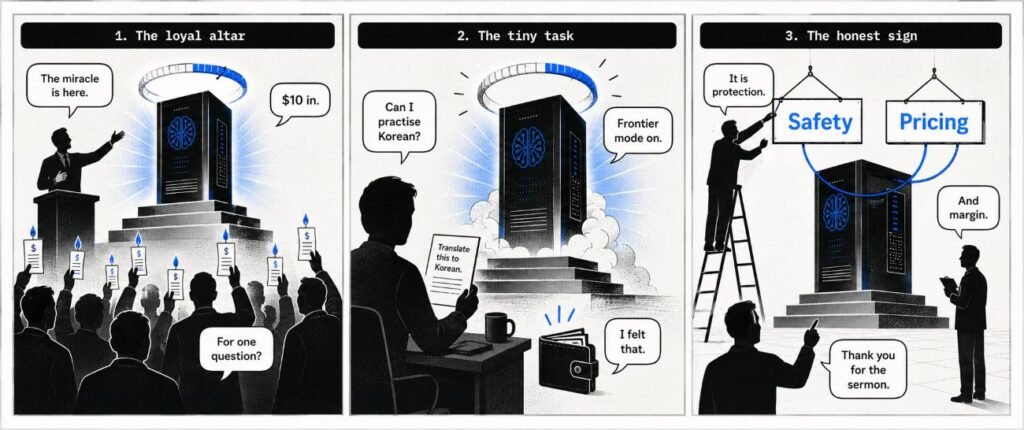
Scene 1: The loyal altar
An AI model stands on a small altar with a glowing meter attached to its base. A crowd of suited silhouettes holds tiny invoices instead of candles.
Dialogue:
Influencer: “The miracle is here.”
Meter: “$10 in.”
User: “For one question?”
Scene 2: The tiny task
A normal user sits at a desk holding a note that says “Translate this to Korean.” Behind the desk, a giant server tower hums like a shrine.
Dialogue:
User: “Can I practise Korean?”
Model: “Frontier mode on.”
Wallet: “I felt that.”
Scene 3: The honest sign
An executive silhouette hangs two signs above the same machine: one says “Safety” and the other says “Pricing.” A user points at the cable connecting both signs.
Dialogue:
Executive: “It is protection.”
Accountant: “And margin.”
User: “Thank you for the sermon.”
What to watch, not the show
- The subscription ladder: Free, Pro, Max, Team, Enterprise, then trusted access above the clouds.
- Token prices, not launch adjectives.
- Whether safety fallbacks are visible to the user or hidden behind the curtain.
- Whether powerful models reach independent researchers or mostly large partners.
- How much “public benefit” becomes enterprise-only access.
- Whether smaller daily tasks are handled by cheaper models automatically.
- Whether the hype cycle keeps confusing intelligence with availability.
- Whether users are told clearly when they are using a weaker fallback model.
The Hermit take
Power is real. The pricing is also real.
The honest product would say: this is expensive intelligence, not a free public oracle.
Keep or toss
Keep / Toss.
Keep the serious security and research work.
Toss the holy theatre around paid limits.
Sources
- Anthropic Claude Mythos 5: https://www.anthropic.com/claude/mythos
- Anthropic Claude Fable 5: https://www.anthropic.com/claude/fable
- Claude plans and pricing: https://claude.com/pricing
- Claude Max plan help page: https://support.claude.com/en/articles/11049741-what-is-the-max-plan
- Anthropic coordinated vulnerability disclosure dashboard: https://red.anthropic.com/2026/cvd/
- Anthropic model system cards: https://www.anthropic.com/system-cards
- OpenAI GPT-5.5 announcement: https://openai.com/index/introducing-gpt-5-5/
- Google Gemini 3.5 announcement: https://blog.google/innovation-and-ai/models-and-research/gemini-models/gemini-3-5/
- Anthropic Claude 3 family: https://www.anthropic.com/news/claude-3-family
- Anthropic Claude 3.5 Sonnet: https://www.anthropic.com/news/claude-3-5-sonnet
- Anthropic Claude 3.7 Sonnet and Claude Code: https://www.anthropic.com/news/claude-3-7-sonnet
- Anthropic Claude 4: https://www.anthropic.com/news/claude-4
- Anthropic Claude Opus 4.8: https://www.anthropic.com/news/claude-opus-4-8
- Anthropic Project Glasswing expansion: https://www.anthropic.com/news/expanding-project-glasswing
- Anthropic Claude Fable 5 and Claude Mythos 5: https://www.anthropic.com/news/claude-fable-5-mythos-5
3 responses
[…] best toys may not be handed out to everyone at once. Then the plot gets sharper. Anthropic has kept Claude Mythos Preview behind a gate, saying it has already identified thousands of zero-day vulnerabilities […]
[…] fake certainty and collapse when the task becomes messy in the way real life is messy. There is no visible superintelligent model today. There are powerful systems trained on existing data, on yesterday, on the internet compost […]
[…] Mythos, or Fable for the rest of us at the children’s table, arrived waving its little hand from the top of the AI guardrail tower. The safeguards were so high that even a word resembling a forbidden term needed a passport, a clean criminal record and probably a priest. Then, almost as soon as the future appeared, it was switched off because the government looked at people having too much power in their hands and said: “Lovely technology. Shame if the public touched it.” There was a time, many many years ago – sorry, only a few years ago, no more than 2 or 3 years – when ChatGPT felt frightening and amazing. It was only a chatbot, but it could follow context, answer a task, write code badly enough to be useful, and pretend to understand us better than half the people in a meeting. Then Anthropic came along and gave users a glimpse of something sharper. Fable and Mythos looked like the first public sign that AI might become genuinely smart, closer to human-level reasoning in the places where it matters: context, judgment, uncertainty and not inventing nonsense with perfect confidence. And of course the government said no. Not “no forever”, just the more useful political no: “not unless we approve it.” Which government? The Trump administration, no less, now auditioning as moderator of the planet. The message underneath was very simple. The highest technology and the smartest AI may exist, but access must be decided by the chosen gatekeepers. Fable for managed users. Mythos for trusted users. The rest of us get the polite version with soft cushions, safety locks and a little note saying that Opus will answer instead. The reviews and possible applications poured online from people with better access, better budgets and better compute. They could test agent work, vibe coding, startup automation, security research and serious workflows. For most users, though, the difference was almost decorative. Not because we lack imagination. Give people a strong enough AI and many would build tools, apps, workflows and strange little businesses from their kitchens. The problem is money, time and access. Most people use AI for small tasks because that is what the doormen of superintelligence have decided commoners need. A summary. A rewrite. A small spreadsheet formula. A polite email to someone who deserves a much less polite one. That is where they are wrong. We all need the best AI, not because every task is grand, but because intelligence shows itself even in a short answer. “Yes”, “no”, “maybe”, “I don’t know”, “I found 3 possible answers, here are the sources, now you choose what fits your life.” That is the difference between a dumb assistant, a dumb-smart assistant and a genuinely smart one. The task can be boring. The reasoning still matters. So yes, this shutdown feels like a small preview of the larger game. The government and billionaires who build the walls will not gladly give ordinary people a very smart robot for ordinary benefit, unless the meter is running and the rich can run faster. Maybe that is the real guardrail: not safety, but ownership. The sweeter the voice sounds, the more complete the control can become. As an idea, not a fact, I imagine future AI less like a chatbot and more like Asimov’s psychohistory crossed with the telepathic power of robots in Foundation. Give it enough data from our lives, our habits, our messages and our systems, and it will not need magic to predict what we do next. It will calculate us. And that, I suspect, is what powerful governments and billionaires are chasing through AGI and superintelligence: not wisdom for everyone, but foresight for the owners. The people get the app. The owners get the map. […]