

Lede
The modern CEO wants a budget AI model to replace a trained human, then looks surprised when the chatbot needs instructions, limits, context, money and occasionally reality.
Words used
- AGI: A possible future system that could perform most human-level work across many domains, not just one narrow task.
- Guardrail: A rule or technical limit that stops an AI system from going outside its assigned behaviour.
- Reasoning model: An AI model designed to spend more compute on harder tasks before answering.
Hermit Off Script
What many CEOs seem not to understand now is that AI still cannot replace all humans. It can help automate repetitive tasks, shorten boring work, sort information, draft routine text, answer basic questions and reduce the number of clicks needed to do something dull. That is useful. That is not the same as replacing judgement, experience, responsibility and a person who can look at a strange situation and say, “Wait, this does not make sense.” The model that reaches the mass market is usually not the most expensive one. It is the cheaper, faster, narrower version that can be sold at scale without burning the company account in public. Then businesses tailor it for one workflow, put guardrails around it, connect it to a few tools and announce that they have created a digital worker. No, they have created a very polite intern trapped inside a filing cabinet. If it is trained or configured to do only one thing, it may become more useful for that one thing, but it also becomes less able to adapt when the real world walks in wearing muddy boots. And reasoning? Please. Reasoning models can be good, but good reasoning takes compute, and compute costs money and time. If the task is new, messy or full of missing details, the model may need longer to read, think and answer. That is fine for research. It is not fine when a customer is waiting for a simple answer and the AI is silently composing a small PhD on refund policy. Customer service needs speed, clarity and escalation. It does not need an agent staring into the digital abyss because someone asked about a parcel. This is why the human factor is not gone yet. The danger grows when reasoning becomes cheap, fast and reliable enough for normal business use. It grows again when the leading models are available on the lowest plans, not locked behind expensive tiers, usage caps and enterprise contracts. Until then, jobs with less repetition and more judgement are safer than the panic merchants pretend. Not perfectly safe, but not dead by Thursday. Maybe this is only 1 to 3 years away in some areas. Compute is being built. Data centres are expanding. The pace of AI research is not static, because technology does not sit on a chair and retire politely. But the biggest barrier to replacing most jobs is still the physical world. Robotics remains expensive, uneven and behind the speed of LLM progress. A chatbot can write a reply. It cannot cheaply fix a boiler, care for a confused patient, unload a lorry in a cramped yard, calm an angry human being and take legal responsibility for the result. If real AGI arrives, not the imagined or press-release version, then the crisis warned about by the AI godfathers and godmothers becomes possible. Until then, much of the noise is promotion for funding the dreams of labs and the nightmares of doomers. The machine is coming, yes – but right now it still needs a human to explain the job, check the mess and pay the electricity bill.
What does not make sense
- Companies want human-level work from models they buy because they are cheap, capped and fast.
- They ask for adaptability, then lock the AI inside guardrails and complain when it cannot improvise.
- They want reasoning, but also instant answers, low cost and no waiting customers.
- They treat “task exposure” as “job replacement”, as if a job is only one button being pressed forever.
- They talk about AGI like it has arrived, then deploy a narrow support bot that still needs an escalation queue.
- They forget that most work happens inside messy systems, old software, broken data and human exceptions.
- They imagine automation without counting integration, liability, maintenance, oversight and training.
Sense check / The numbers
- OpenAI’s current ChatGPT pricing separates fast mainstream access from higher reasoning tiers: Free and Go include GPT-5.5 Instant access, while GPT-5.5 Thinking is not included on Free or Go, and GPT-5.5 Pro is listed for Pro access. [OpenAI]
- OpenAI’s API pricing shows the cost gap clearly: GPT-5 nano is listed at $0.05 input and $0.40 output per 1 million tokens, while GPT-5 pro is listed at $15 input and $120 output per 1 million tokens. [OpenAI API]
- OpenAI’s GPT-5.5 Pro API page lists $30 input and $180 output per 1 million tokens, and says some requests may take several minutes. That is not a magic customer-service button. [OpenAI Developers]
- The ILO said in 2023 that generative AI is more likely to augment than destroy jobs, because many jobs are partly exposed rather than fully replaceable. [ILO]
- The World Economic Forum’s 2025 jobs report projected 170 million new roles and 92 million displaced roles by 2030, with 22 per cent of jobs facing disruption. It also said 77 per cent of employers planned to upskill workers, while 41 per cent planned workforce reductions where AI automates tasks. [WEF]
- The International Federation of Robotics reported 542,000 industrial robots installed in 2024, with 4.66 million in operation worldwide. UK installations fell 35 per cent to 2,500 units, which is not exactly “robots replacing Britain by breakfast”. [IFR]
- The IEA projected global data-centre electricity use to double to around 945 TWh by 2030, with data centres taking just under 3 per cent of global electricity demand. AI may be software, but the bill arrives through a wall socket. [IEA]
The sketch
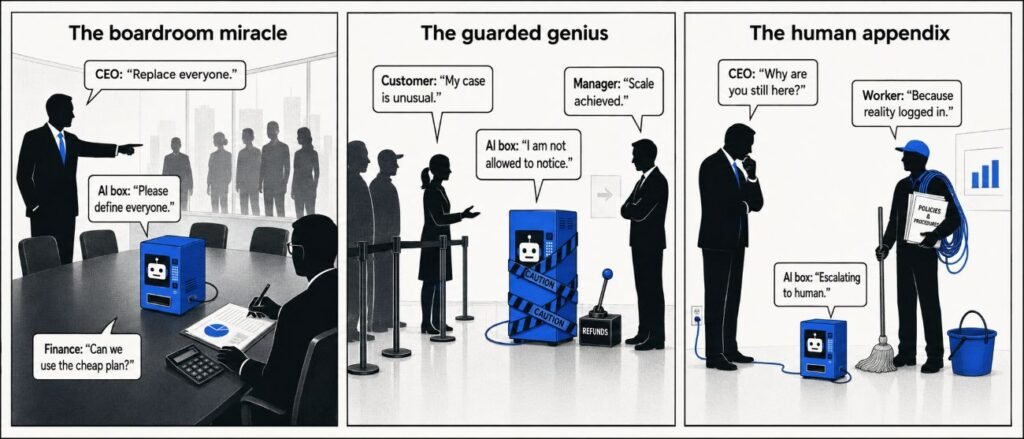
Scene 1: The boardroom miracle
Panel description. A CEO silhouette points at a small chatbot box on a conference table while workers stand outside the glass wall.
Dialogue:
CEO: “Replace everyone.”
AI box: “Please define everyone.”
Finance: “Can we use the cheap plan?”
Scene 2: The guarded genius
Panel description. The AI box is wrapped in caution tape and connected to one tiny lever labelled “refunds”. A queue of customers waits.
Dialogue:
Customer: “My case is unusual.”
AI box: “I am not allowed to notice.”
Manager: “Scale achieved.”
Scene 3: The human appendix
Panel description. A human worker stands beside the AI box, holding cables, policy documents and a mop. The CEO looks puzzled.
Dialogue:
CEO: “Why are you still here?”
Worker: “Because reality logged in.”
AI box: “Escalating to human.”
What to watch, not the show
- The price gap between cheap models and frontier reasoning models.
- Latency: how long good answers take when the task is new or messy.
- Guardrails that improve safety but reduce flexibility.
- Data quality inside companies, because bad inputs still produce bad automation.
- Human escalation queues hiding behind “AI support”.
- Robotics costs and deployment speed outside warehouses and factories.
- Energy, chips and data-centre capacity as limits on cheap mass automation.
- Labour law, liability and who signs off when the AI gets it wrong.
- The difference between replacing a task and replacing a job.
The Hermit take
AI is a tool, not a payroll guillotine.
The real danger starts when cheap reasoning meets cheap robotics.
Keep or toss
Verdict: Keep / Toss.
Keep automation that removes dull repetition.
Toss the fantasy that a budget chatbot can replace judgement, hands, responsibility and patience.
Sources
- OpenAI ChatGPT pricing: https://chatgpt.com/pricing/
- OpenAI API pricing: https://platform.openai.com/docs/pricing/
- OpenAI GPT-5.5 Pro model page: https://developers.openai.com/api/docs/models/gpt-5.5-pro
- ILO on generative AI and jobs: https://www.ilo.org/resource/news/generative-ai-likely-augment-rather-destroy-jobs
- World Economic Forum Future of Jobs Report 2025: https://www.weforum.org/press/2025/01/future-of-jobs-report-2025-78-million-new-job-opportunities-by-2030-but-urgent-upskilling-needed-to-prepare-workforces//
- International Federation of Robotics World Robotics 2025: https://ifr.org/worldrobotics/report-2025
- IEA Energy and AI: https://www.iea.org/reports/energy-and-ai/energy-demand-from-ai

Leave a Reply