
Lede
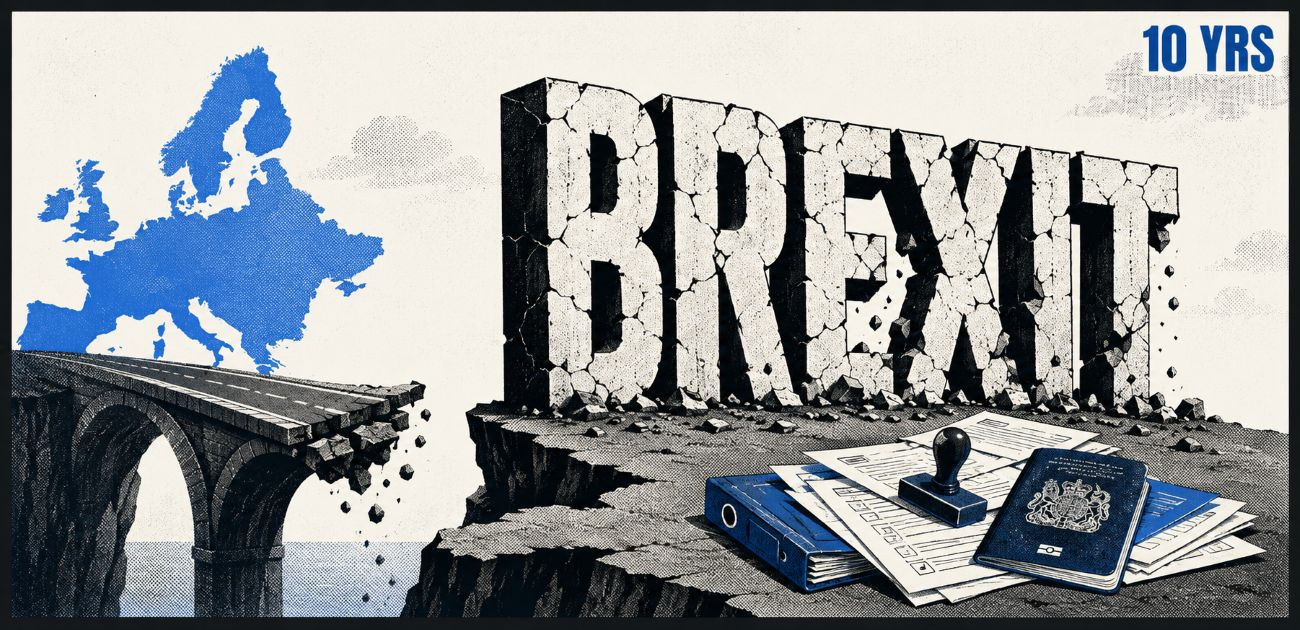
Brexit promised control, then delivered a country with more forms, more friction and a political class still pretending the bruise is a crown.
Hermit Off Script
Brexit is 10 years old from the referendum date of 23 June 2016, and somehow the argument is still walking around with a bandage on its forehead saying the wall is the problem. Most serious people warned that Britain would be poorer outside the EU than inside it. Year by year, the numbers keep giving the same awkward cough. Yet some people keep banging their heads against denial because admitting the mistake would mean admitting that slogans do not fill supermarket shelves, fix wages or replace easy trade with your nearest market. And who gained? Usually the people who already had enough money to treat rules as small weather. The people who never liked workers having options, wages having pressure, or ordinary citizens moving too freely across Europe. Before, people could go back and forth, work, study, live, love, build a life, and return without needing a small funeral of paperwork. Now the same freedom is sold back in pieces, with conditions attached and a queue included for emotional support. The great trick was pretending that fewer rules would make everyone richer. Look at the United States, they say, where regulation is treated like an insult and money runs like it has diplomatic immunity. But the lesson there is not that ordinary people become richer when controls vanish. The lesson is that the rich collect the gains first, then ask the poor to be patient forever. Prices rise. Restrictions move downward. Freedom becomes something capital enjoys more than people. Billionaire used to sound like the peak. Now it sounds like the starter salary for old rich men practising how to become trillionaires. Brexit did not make Britain stronger against that world. It made the UK weaker, and it made the EU weaker too, because both were stronger together. A divided Europe is useful to Russia, China, North Korea, Iran, and every political project that prefers democracies tired, split and busy arguing with customs forms. I still hate that I have to mention the United States in that sentence. Not the American people, but the Trump political machine, which keeps treating democratic allies like annoying tenants and harder regimes like tough men worth admiring. And yes, America complained for years that Europe did not pay enough, did not do enough, did not toughen up enough. There is truth buried there. The EU made a heavy mistake by trusting US protection too much instead of building its own power earlier, together, with a clearer voice and harder choices. Europe gave loyalty, money, markets and people to the Atlantic order, and then looked shocked when Washington started asking for rent on the umbrella. Now the EU is at a crossroads: AI power, military power, one clear voice – not enough. The UK is standing in the same weather, pretending its coat is special because it left the wardrobe. Maybe one day Britain will realise that the argument is not nostalgia for Brussels, but strength in a harder world. Maybe the UK and the EU will come together again, not with begging, but with spine, values and respect. The old continent should not be treated like a museum by the new worlds it helped shape.
What Brexit actually changed
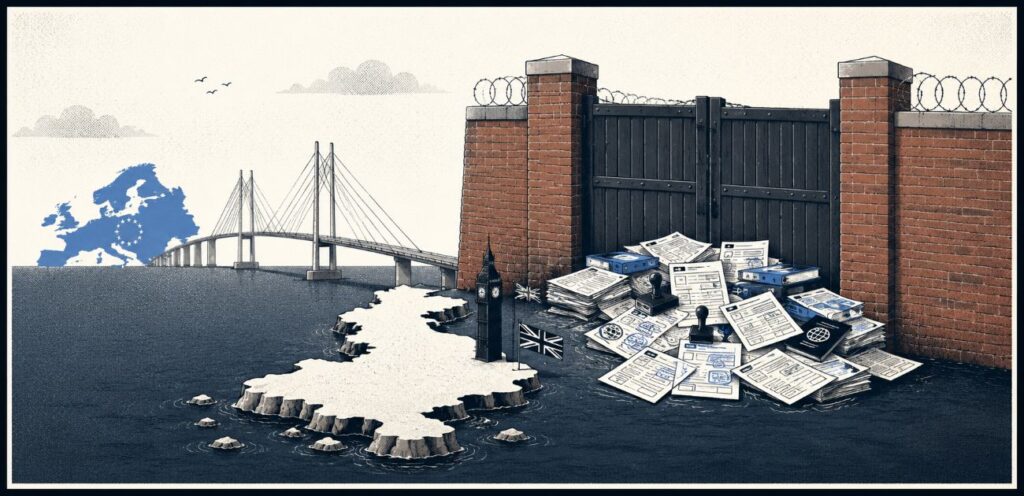
- It made trade with the UK’s nearest and largest market harder. The OBR still assumes Brexit will leave UK imports and exports 15 per cent lower in the long run than if the UK had stayed in the EU, with potential productivity 4 per cent lower after 15 years. That is not a slogan. That is the bill arriving in slow motion. [OBR]
- It damaged goods trade more than services. The OBR found that by late 2023 UK goods trade was about 10 per cent below 2019 levels, while goods trade in the rest of the G7 was about 5 per cent higher. Services did better, partly because the UK is strong there and services can move through screens more easily than cheese, cars or shellfish. [OBR]
- It did not remove bureaucracy. It moved it. Around half of exporting firms and two thirds of importing firms reported extra costs from post-transition regulatory changes in early 2024. The promised bonfire of red tape became a border desk with a stamp collection. [OBR]
- It widened the everyday trade headache. In the 3 months to April 2026, the UK had a total trade deficit of GBP 9.9 billion. The goods deficit alone was GBP 62.5 billion, partly offset by a GBP 52.6 billion services surplus. So yes, services are still carrying bags while goods are stuck explaining themselves at the door. [ONS]
- It raised food prices. LSE Centre for Economic Performance research found that Brexit-related non-tariff barriers raised food prices by 6 per cent. The same research estimated household losses of GBP 5.84 billion from higher food bills, while domestic producers gained GBP 4.78 billion. Translation: households paid, some producers gained, and efficiency was taken outside for a quiet word. [LSE/CEP]
- It ended free movement for ordinary people. Free movement ended at 11pm on 31 December 2020, with the points-based immigration system starting from 1 January 2021. Before, a UK citizen could build a life across Europe with far fewer barriers. After Brexit, movement became a form, a threshold, a visa route and a reminder that freedom was never removed equally. [GOV.UK]
- It did not stop immigration. It changed its shape. ONS figures for the year ending December 2025 put long-term net migration at 171,000. EU+ net migration was negative 42,000, while non-EU+ net migration was positive 350,000. So the old promise of “control” did not mean less movement. It meant different movement, with more paperwork and more politics attached. [ONS]
- It chilled investment and growth. A 2025 NBER working paper using almost a decade of data estimated that by 2025 Brexit had reduced UK GDP by 6 per cent to 8 per cent, investment by 12 per cent to 18 per cent, employment by 3 per cent to 4 per cent, and productivity by 3 per cent to 4 per cent. The economy did not fall off a cliff. It was asked to walk uphill with stones in its pockets. [NBER]
- It weakened Britain’s position in a harder world. The UK kept sovereignty on paper, but lost scale in practice. Alone, it has less weight against the US, China, Russia, global corporations, energy shocks and supply-chain pressure. The EU lost a major member too. Both sides became thinner, and the larger powers did not exactly weep into their flags. [Reuters]
What does not make sense
- Brexit promised fewer rules, then gave small exporters, travellers and workers more barriers to cross.
- It sold freedom, then removed freedom of movement from ordinary people while money kept moving with fewer manners.
- It said Britain would take back control, then left the country more exposed to bigger powers with larger markets.
- It attacked Brussels bureaucracy, then built its own paperwork shrine at the border.
- It blamed Europe for holding Britain back, then spent years discovering that geography does not resign.
- It claimed sovereignty would make everyone richer, yet the strongest economic receipts point to weaker trade and lower productivity.
- It treated cooperation as weakness, then rediscovered defence, food checks and youth mobility when reality came back with a clipboard.
Sense check / The numbers
- On 23 June 2016, Leave won with 17,410,742 votes, Remain had 16,141,241, and turnout was 72.2 per cent. That is a 51.9 per cent to 48.1 per cent result, not a divine tablet brought down from a mountain. [Electoral Commission]
- The UK triggered Article 50 on 29 March 2017, left the EU at 11pm on 31 January 2020, and left the EU single market and customs union at 11pm on 31 December 2020. The divorce had stages because even reality needed a transition period. [Commons Library]
- Free movement ended at 11pm on 31 December 2020, and the UK’s points-based immigration system began from 1 January 2021. Ordinary movement became a policy maze with patriotic wallpaper. [GOV.UK]
- The OBR still assumes UK imports and exports will both be 15 per cent lower in the long run than if the UK had remained in the EU, reducing potential productivity by 4 per cent after 15 years. That is the receipt under the souvenir mug. [OBR]
- In the 3 months to April 2026, the UK total goods and services trade deficit widened to GBP 9.9 billion, with a goods deficit of GBP 62.5 billion and a services surplus of GBP 52.6 billion. The paperwork did not turn into gold overnight. [ONS]
The sketch
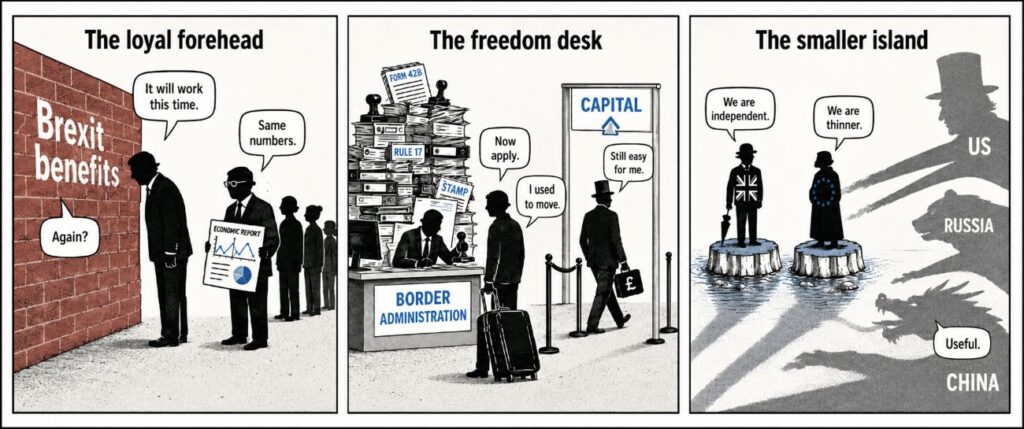
Scene 1: The loyal forehead
A suited silhouette stands before a brick wall labelled “Brexit benefits” while an economist holds a report and a queue forms behind them.
Dialogue:
Politician: “It will work this time.”
Wall: “Again?”
Economist: “Same numbers.”
Scene 2: The freedom desk
A worker with a suitcase stands at a border desk under a pile of forms while a rich investor walks through a side gate marked “capital”.
Dialogue:
Worker: “I used to move.”
Desk: “Now apply.”
Investor: “Still easy for me.”
Scene 3: The smaller island
The UK and EU stand on separate small platforms while larger shadows labelled “US”, “Russia” and “China” stretch across the floor.
Dialogue:
UK: “We are independent.”
EU: “We are thinner.”
Shadow: “Useful.”
What to watch, not the show
- Who profits from weaker labour mobility and fewer worker choices.
- Which companies gain from deregulation while households carry higher prices and fewer protections.
- How much border friction still hits small exporters harder than large firms with legal teams.
- Whether UK-EU defence cooperation grows because the US security guarantee feels less automatic.
- Whether youth mobility returns slowly under another name while politicians pretend it is not free movement’s cousin.
- How media figures keep selling anger long after the economic bill has arrived.
- Whether Britain treats rejoining the European project as humiliation, or as adult repair.
The Hermit take
Brexit sold control, then made ordinary life more controlled.
The cure is boring and brave: count the cost, rebuild the bridge, stop worshipping the wall.
Keep or toss
Keep / Toss.
Keep the demand for accountable politics.
Toss the fantasy that making your nearest market harder to reach makes you richer.
Sources
- Electoral Commission referendum report: https://www.electoralcommission.org.uk/research-reports-and-data/our-reports-and-data-past-elections-and-referendums/report-23-june-2016-referendum-uks-membership-european-union
- Commons Library Brexit timeline: https://commonslibrary.parliament.uk/research-briefings/cbp-7960/
- OBR Brexit trade assumptions: https://obr.uk/box/how-are-our-brexit-trade-forecast-assumptions-performing/
- ONS UK trade April 2026: https://www.ons.gov.uk/economy/nationalaccounts/balanceofpayments/bulletins/uktrade/april2026
- GOV.UK end of free movement: https://www.gov.uk/government/news/immigration-act-receives-royal-assent-free-movement-to-end-on-31-december-2020
- Reuters Brexit economic scars: https://www.reuters.com/world/uk/scars-mark-britains-economy-10-years-after-brexit-vote-2026-06-23/
- Reuters UK-EU reconciliation report: https://www.reuters.com/world/uk/ten-years-brexit-disputes-still-hold-back-britains-reconciliation-with-eu-2026-06-22/
- UK-EU security and defence partnership: https://www.gov.uk/government/publications/uk-eu-security-and-defence-partnership
- Guardian Brexit promises check: https://www.theguardian.com/uk-news/2026/jun/23/from-bendy-bananas-to-350m-for-the-nhs-how-many-brexit-promises-actually-came-true

Leave a Reply