

Lede
The AI apocalypse arrives by PowerPoint, while the small business owner still has to pay the integration bill.
Editorial update (4 November 2026): Originally published on 18 October 2025. The 2023 and 2025 ONS figures remain as historical benchmarks; this revision adds the September 2026 figures and newer evidence on business size, training and jobs.
Hermit Off Script
I keep hearing two versions of the AI future, depending on who is in the room. Tell investors and apparently everything will be faster, cheaper and wonderfully productive. Tell workers and their jobs are already halfway to the scrapheap. Meanwhile, the small business owner is trying to work out whether the new software can talk to the old till, whether anyone has time to learn it and who pays when the whole thing stops working. I am not against AI, and I am certainly not pretending that it has stood still. The latest UK figures show adoption rising from 9 per cent of businesses in September 2023 to 23 per cent in September 2025 and 30 per cent in September 2026. That is real growth. But ticking a survey box because a business uses one AI tool is not the same as transforming the business. Half the boardroom seems to have confused an account registration with the Industrial Revolution. Bigger companies can employ specialists, pay for integration, buy training and absorb mistakes. Smaller ones get the same sales pitch with a less forgiving invoice. Then come the robots. I would like to see more useful automation, too, but physical machines involve maintenance, safety, downtime and capital, not just a smiling demonstration at a technology conference. Office tasks can change much faster than a factory floor. Jobs will change, and some will disappear, but that deserves honest evidence rather than a countdown to universal unemployment. If employers want the productivity gains, I want to know who receives them: customers, shareholders or the people learning new systems on their own time. Training needs paid hours and a plan, not a paragraph in a press release. Let us count what businesses actually deploy, how deeply they use it, what it costs and what happens to wages. The promise moves at the speed of a headline. The bill arrives at the speed of reality.
What does not make sense
- Selling investors effortless growth while selling workers an imminent extinction event.
- Calling a single AI tool a transformation when the rest of the business still relies on manual workarounds.
- Offering enterprise-sized promises to firms without enterprise-sized budgets or specialist staff.
- Declaring robots ready to replace everyone while ignoring installation, safety, maintenance and downtime.
- Treating a forecast for 2030 as though it records redundancies that have already happened.
- Praising productivity but forgetting paid training, job quality and the question of who receives the gains.
Sense check / The numbers
- Adoption is growing, but it is not universal. In the same ONS Business Insights and Conditions Survey series, UK businesses reporting use of at least one AI technology rose from 9 per cent in September 2023 to 23 per cent in September 2025 and 30 per cent in September 2026. The September 2026 figure was broadly stable compared with June 2026. [ONS BICS, October 2025 and October 2026]
- The size gap remains. In September 2026, 51 per cent of UK businesses with 250 or more employees reported using AI, against 29 per cent of those with fewer than 10 employees. One market, very different resources. [ONS BICS, October 2026]
- Use is often shallow. In June 2026, only 10 per cent of AI-adopting UK businesses with at least 10 employees said they used AI extensively. Among adopters of that size, the average number of AI technologies used had risen only from about 1.4 in late 2023 to 1.6. Robotics was reported by 2 per cent of businesses with at least 10 employees. [ONS, July 2026]
- Employment effects need precise language. In September 2026, 6 per cent of AI-using UK businesses with at least 10 employees reported reduced headcount because of AI; fewer than 1 per cent reported increased headcount. In the June 2026 survey, only 11 per cent of businesses with at least 10 employees said more than half their workforce had received AI-related training. Neither figure describes every employer or every worker. [ONS BICS, October 2026; ONS, July 2026]
- Europe shows a similar divide. In 2025, 20 per cent of EU enterprises with at least 10 employees used AI technology. The share was 55 per cent for large enterprises and 19 per cent for SMEs. These EU figures exclude microbusinesses, so they should not be treated as directly comparable with the UK’s all-business figure. [Eurostat, Digitalisation in Europe 2026]
- A forecast is not a redundancy count. The World Economic Forum’s 2025 report estimated that, by 2030, wider economic and technological changes could create 170 million jobs and displace 92 million, for a net gain of 78 million. Those estimates cover multiple forces, not AI alone, and are expectations rather than observed outcomes. [WEF, Future of Jobs Report 2025]
The sketch
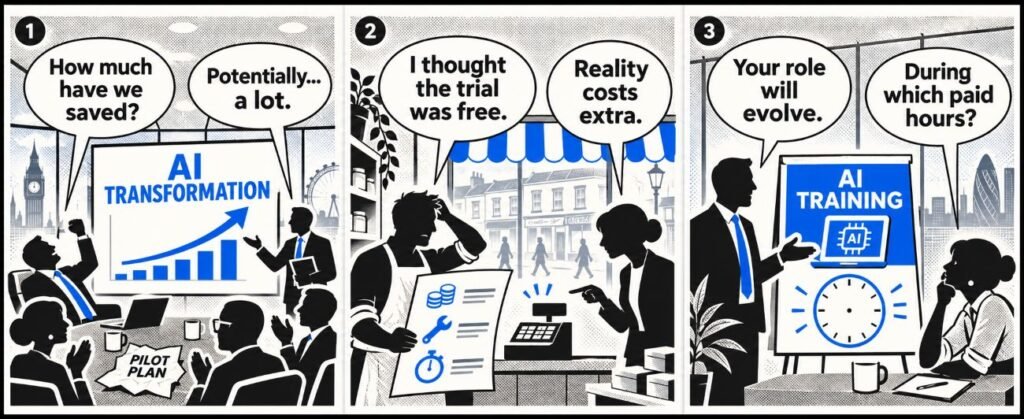
Scene 1: The boardroom miracle
Executives celebrate a presentation showing “AI TRANSFORMATION” and a sharply rising graph. A crumpled “PILOT PLAN” lies nearby, while the boardroom applauds the promised results.
Dialogue:
Director: “How much have we saved?”
Consultant: “Potentially… a lot.”
Scene 2: The high street invoice
A worried shopkeeper holds a large invoice showing the costs of money, technical work and time. A salesperson points towards the till, seemingly unconcerned about the growing bill.
Dialogue:
Owner: “I thought the trial was free.”
Salesperson: “Reality costs extra.”
Scene 3: The retraining plan
A manager presents an “AI TRAINING” poster featuring a large clock. Across the table, a worker listens sceptically, wondering when there will be time for all this promised training.
Dialogue:
Manager: “Your role will evolve.”
Worker: “During which paid hours?”
What to watch, not the show
- The total bill: licences, data preparation, integration, cybersecurity, maintenance, downtime and support.
- The incentives: whether suppliers earn from useful results or from selling another subscription and another pilot.
- The size and sector gaps: a text tool in an office is not the same investment as automation on a production line.
- Paid skills: the UK SME Digital Adoption Taskforce identified costs, expertise and unsuitable products as obstacles for smaller firms. Watch whether training is funded and given time during work.
- Wages and job quality: who receives productivity gains, and whether reduced headcount reflects AI or wider business conditions.
- The evidence: compare like-for-like surveys, distinguish light use from deep deployment and revisit forecasts when outcomes can actually be measured.
The Hermit take
Panic is free. Integration isn’t.
Count useful deployments, not dramatic announcements.
Keep or toss
Keep / Toss.
Keep practical AI that saves time, supports workers and proves its value.
Toss the apocalypse marketing and the invoice hidden beneath the keynote.
Sources
- ONS BICS, 2 October 2025: https://www.ons.gov.uk/businessindustryandtrade/business/businessservices/bulletins/businessinsightsandimpactontheukeconomy/2october2025
- ONS BICS, 8 October 2026: https://www.ons.gov.uk/businessindustryandtrade/business/businessservices/bulletins/businessinsightsandimpactontheukeconomy/8october2026
- ONS, Artificial intelligence in UK businesses, 20 July 2026: https://www.ons.gov.uk/businessindustryandtrade/business/businessservices/articles/artificialintelligenceinukbusinesses/2023to2026
- Eurostat, Digitalisation in Europe 2026: https://ec.europa.eu/eurostat/en/web/interactive-publications/digitalisation-2026
- World Economic Forum, Future of Jobs 2025, jobs outlook: https://www.weforum.org/publications/the-future-of-jobs-report-2025/2-jobs-outlook
- UK Government, SME Digital Adoption Taskforce final report, 31 July 2025: https://www.gov.uk/government/publications/sme-digital-adoption-taskforce-final-report/sme-digital-adoption-taskforce-final-report