
Lede
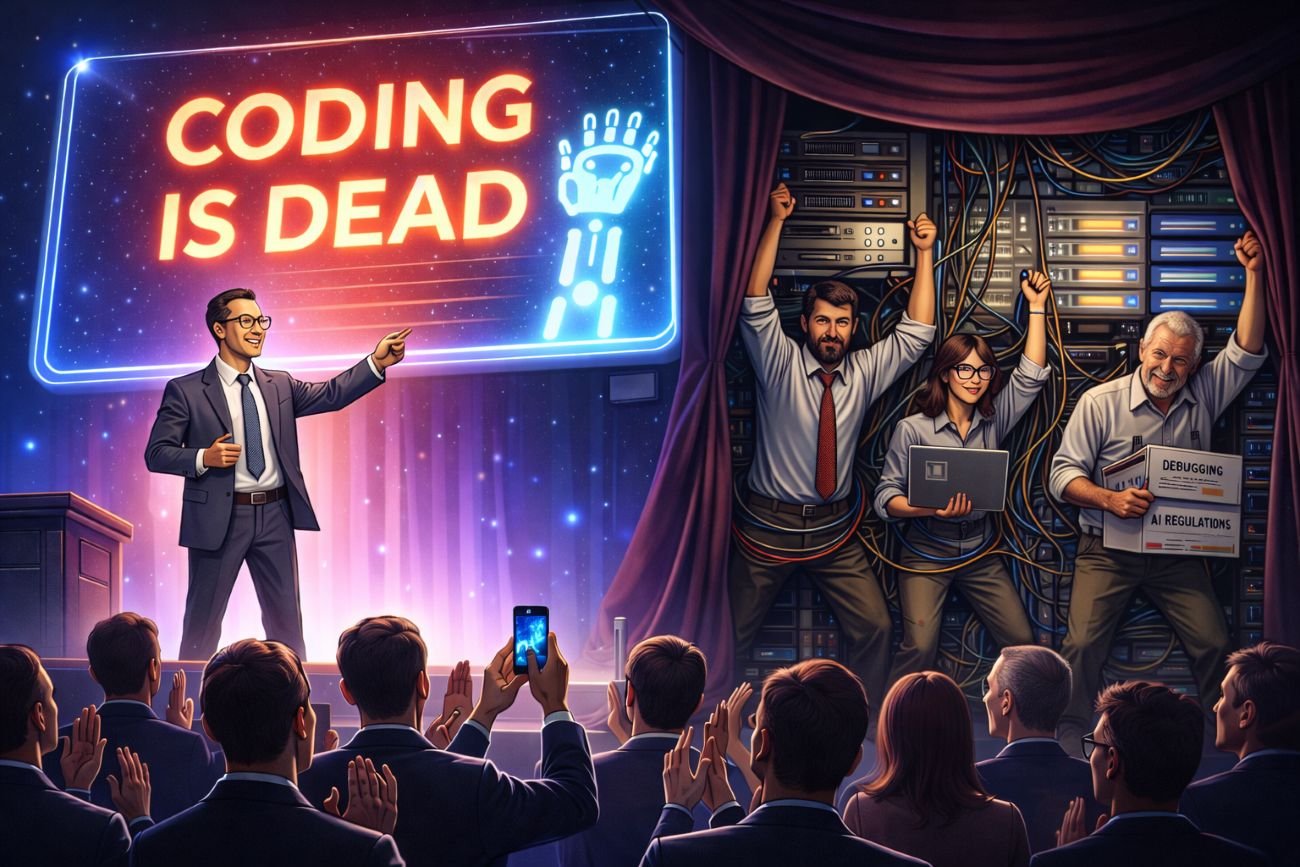
The absurdity is not that AI will change jobs, but that so many loud prophets mistake fewer workers in those roles for the disappearance of human judgement.
Hermit Off Script
This rant is about the lazy little gospel that coding is finished, developers are finished, and humans are apparently one product update away from becoming decorative pot plants in their own economy. I do not buy it. Yes, AI will reduce the number of people needed for some tasks. Yes, some jobs will shrink, split, mutate or vanish altogether. Yes, a machine will write more boring code than any caffeinated junior ever did. But that does not make human knowledge less important. It makes it more important, because the work shifts upward. The point is not that everyone will spend their days manually typing boilerplate forever. The point is that someone still has to understand the architecture, the logic, the constraints, the failure modes, the security holes, the model drift, the compliance risks, the hidden rubbish inside the output, and the difference between “it runs” and “it should exist”. That is where the prophets become clowns. They confuse reduced headcount with reduced human necessity. They confuse generated code with understood code. They confuse a machine producing output with a machine holding judgement. In the real world, serious systems still need people who can assess what the machine is doing, challenge it, verify it, repair it, and take responsibility when it breaks something expensive. That is why computer science and programming knowledge do not fade into quaint nostalgia. They become the grammar of power. The repetitive parts may shrink. The specialisation grows. The typing may be less sacred. The understanding becomes ten times more valuable. Less keyboard mule, more systems judge. Less code monkey, more technical conscience. The machine may write more lines, but the human still signs the consequences.
What does not make sense
- Saying AI can generate code, therefore humans no longer need deep coding knowledge.
- Treating fewer workers in a role as proof that no skilled humans remain necessary.
- Pretending generated output explains itself, audits itself and fixes itself.
- Confusing repetitive programming with the whole of software work.
- Acting as if decision-making, liability and system judgement can be outsourced to a confidence machine.
Sense check / The numbers
- The World Economic Forum says its Future of Jobs Report 2025 draws on more than 1,000 employers representing more than 14 million workers across 55 economies, and it says AI and big data, networks and cybersecurity, and technological literacy are among the fastest-growing skills, while human skills such as creative thinking, resilience, flexibility and lifelong learning remain critical [WEF].
- The same report says labour-market disruption could affect 22 per cent of today’s jobs by 2030, with 170 million new roles created and 92 million displaced. That is not “nothing changes”, but it is also not “humans become irrelevant” [WEF].
- The U.S. Bureau of Labor Statistics projects overall employment for software developers, quality assurance analysts and testers to grow 15 per cent from 2024 to 2034, with about 129,200 openings a year. It also says demand is expected to stay strong because of continued software development for AI, IoT, robotics and automation [BLS].
- BLS also projects computer programmers to decline 6 per cent from 2024 to 2034. That matters because it shows the routine coding slice can shrink while broader software and systems work still grows [BLS].
- The ILO said on 20 May 2025 that 1 in 4 jobs worldwide is potentially exposed to GenAI, but transformation, not replacement, is the most likely outcome. In other words, the work changes shape more often than it simply disappears [ILO].
- The EU’s AI Act says high-risk AI systems must operate within a human-centric legal framework, and deployers must assign human oversight to natural persons with the competence, training and authority to do it. So even the law assumes a human still needs to understand and supervise the machine [EU].
The sketch
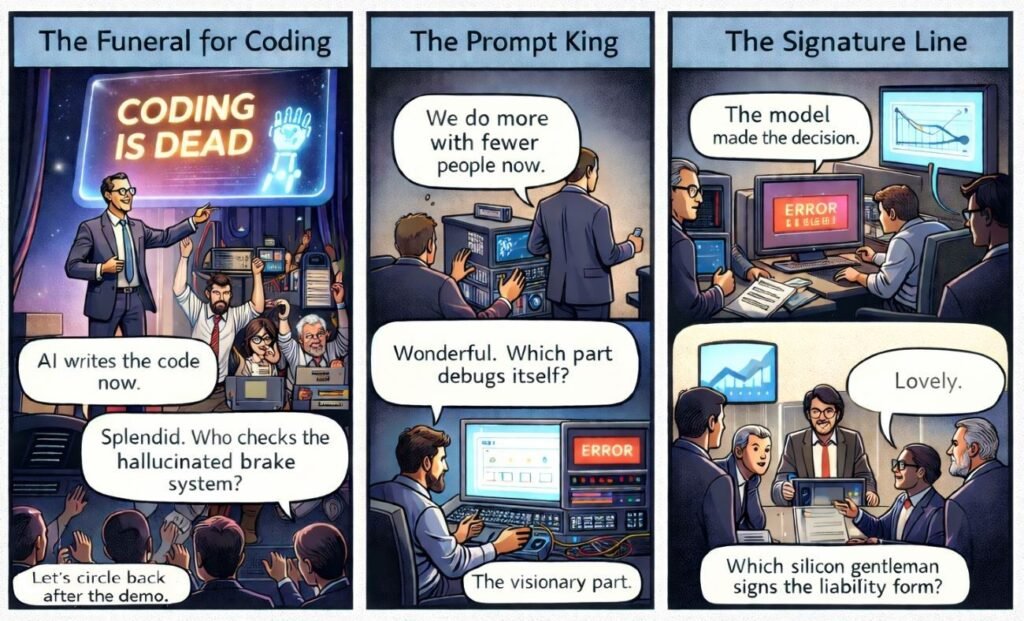
Scene 1: The Funeral for Coding
Panel description: A smug conference speaker stands in front of a giant screen reading “CODING IS DEAD”. Behind him, exhausted engineers are holding up servers, diagrams and cables to stop the whole stage going dark.
Dialogue:
“AI writes the code now.”
“Splendid. Who checks the hallucinated brake system?”
“Let’s circle back after the demo.”
Scene 2: The Prompt King
Panel description: A manager in a shiny suit fires half the dev team while pointing proudly at an AI dashboard. Two hours later, the dashboard is on fire and the one remaining engineer is staring at a wall of broken integrations.
Dialogue:
“We do more with fewer people now.”
“Wonderful. Which part debugs itself?”
“The visionary part.”
Scene 3: The Signature Line
Panel description: A boardroom after a major system failure. The AI output is framed on a screen like holy scripture. Legal, compliance and operations all stare at one blank signature box on a report.
Dialogue:
“The model made the decision.”
“Lovely.”
“Which silicon gentleman signs the liability form?”
What to watch, not the show
- Headcount cuts sold as innovation while the real problem is skill depth and reskilling pressure.
- A shift from repetitive coding into architecture, testing, QA, integration, automation and systems judgement.
- Regulation and liability pushing competent humans back into the loop where stakes are high.
- A widening gap between people who can use AI tools and people who can actually audit what those tools produce. This is an inference from the documented rise in technological skills demand and the ILO’s transformation findings.
- Non-software jobs becoming more digital without magically turning every worker into a full-time software engineer.
The Hermit take
AI may write more code, but humans still carry the consequences.
Learn less like a typist and more like an architect, auditor and mechanic.
Keep or toss
Keep / Toss
Keep the warning to learn programming, computer science and technical logic, even little by little.
Toss the stupid fantasy that generated code means human understanding no longer matters.
Sources
- World Economic Forum – The Future of Jobs Report 2025: https://www.weforum.org/publications/the-future-of-jobs-report-2025/
- World Economic Forum – Future of Jobs 2025 article: https://www.weforum.org/stories/2025/01/future-of-jobs-report-2025-jobs-of-the-future-and-the-skills-you-need-to-get-them/
- World Economic Forum – Future of Jobs 2025 press release: https://www.weforum.org/press/2025/01/future-of-jobs-report-2025-78-million-new-job-opportunities-by-2030-but-urgent-upskilling-needed-to-prepare-workforces/
- International Labour Organization – Generative AI and jobs: A 2025 update: https://www.ilo.org/publications/generative-ai-and-jobs-2025-update
- International Labour Organization – One in four jobs at risk of being transformed by GenAI: https://www.ilo.org/resource/news/one-four-jobs-risk-being-transformed-genai-new-ilo-nask-global-index-shows
- U.S. Bureau of Labor Statistics – Software Developers, Quality Assurance Analysts, and Testers: https://www.bls.gov/ooh/computer-and-information-technology/software-developers.htm
- U.S. Bureau of Labor Statistics – Computer Programmers: https://www.bls.gov/ooh/computer-and-information-technology/computer-programmers.htm
- U.S. Bureau of Labor Statistics – Plumbers, Pipefitters, and Steamfitters: https://www.bls.gov/ooh/construction-and-extraction/plumbers-pipefitters-and-steamfitters.htm
- European Commission – AI Act overview: https://digital-strategy.ec.europa.eu/en/policies/regulatory-framework-ai
- EU AI Act – Article 26, Obligations of deployers of high-risk AI systems: https://artificialintelligenceact.eu/article/26/