
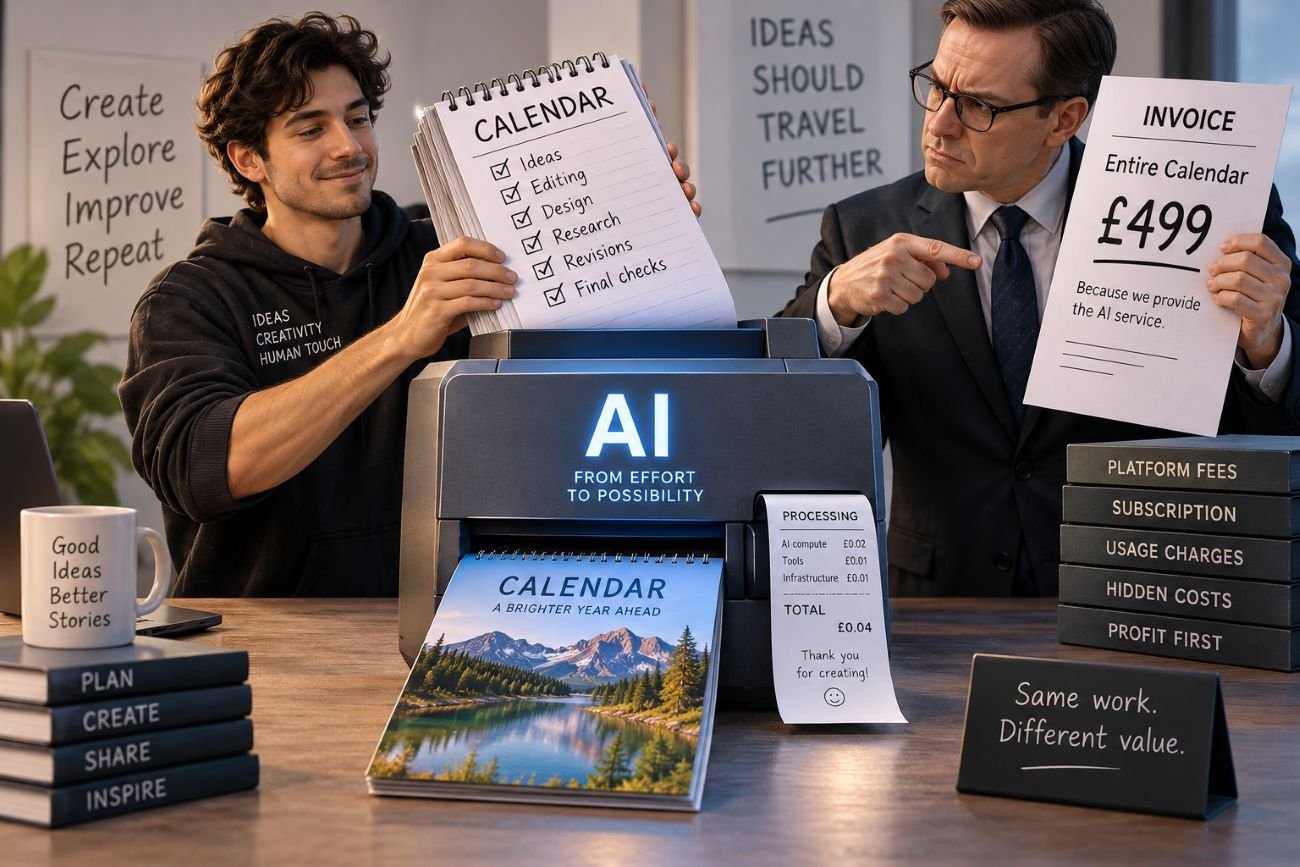
Lede
AI’s most useful trick is shortening the distance between an idea and a finished result, while the invoice department works on lengthening the receipt.
Hermit Off Script
Using AI, for me, comes down to time before anything else. How much of my life can I recover from the work standing between an idea and something I can actually use? Creating code, organising a team and delivering a product or service can swallow the time and resources that made the idea seem possible in the first place. I don’t need a machine to give a speech about changing humanity. I need it to finish the bloody task. As more of the production becomes easier, creativity, knowledge and experience matter more: knowing what to make, understanding why it matters and recognising whether the result is any good. Money and model capability still affect what I can do. Cheap access to a weak tool can become expensive if I spend the evening correcting it. That is why I want the whole bill, including the checking and repair work. Abundance doesn’t mean free. Electricity doesn’t become a charitable organisation because the software has learnt to write a function. But I find it equally ridiculous to treat yesterday’s expensive capability as though it deserves yesterday’s price forever. The useful question is how much a finished, checked result costs, and how much time it saves. Looking ahead, I imagine some work that once cost thousands becoming cheap enough to cost pennies, although I wouldn’t pretend every product or service will follow the same route. The greater prize would still be time. Something feels easy now; later, the interval between inspiration and creation might become almost negligible. If capable teams of agents become cheap enough to feel practically unlimited, I could have them build, test, adapt and prepare an idea for different markets while I decide what deserves to exist. That wouldn’t guarantee customers, but it could remove much of the waiting before I can even try. Then originality becomes more valuable, provided it offers something people actually want. Producing another copy cheaply is hardly a business achievement when everybody else has the same photocopier. I can imagine the capabilities of current frontier models becoming ordinary features on phones, glasses or devices nobody has named yet.
P.S. Perhaps the next device will connect wirelessly to whatever brain activity produces our dreams and turn an imagined thing into something usable. That’s imagination, not an announced product. I dream the invention; the company dreams the direct debit.
What does not make sense
- Celebrating faster generation without counting the time spent checking, correcting and finishing the result.
- Confusing cheaper production with free production. Someone still supplies the hardware, electricity and maintenance.
- Assuming unlimited agents would provide unlimited judgement. A bad instruction can acquire a very large workforce.
- Treating the ability to make a product as proof that anybody wants to buy it.
- Calling something valuable merely because it’s unique. A square kettle would qualify.
- Saving people time, then measuring success by how much additional work can be squeezed into it.
Sense check / The numbers
- Stanford’s 2025 AI Index reported that the price of querying models reaching roughly GPT-3.5 performance on one knowledge benchmark fell from $20 to $0.07 per million tokens between November 2022 and October 2024, a reduction of more than 280 times. Tokens are the pieces of text a model processes. This supports cheaper access to comparable capability; it doesn’t establish the cost of delivering an entire business or product. [Stanford HAI]
- A study covering 5,179 customer support workers, reported in a 2023 NBER working paper, found a 14 per cent average increase in issues resolved per hour with AI assistance. Gains varied across workers. That is evidence of useful productivity improvement in a particular setting, rather than a promise that every task becomes instant. [NBER]
- METR’s early-2025 experiment involving 16 experienced developers and 246 tasks found that AI access increased completion time by 19 per cent. Its 24 February 2026 update suggested newer tools were likely helping more, but warned that selection effects made the size of the improvement unreliable to estimate. The honest lesson is to measure the finished work and keep the date on the evidence. [METR]
- On 10 June 2024, Apple described an approximately 3 billion parameter language model designed to run on devices. Moving useful AI capability onto personal hardware is already an engineering reality. That doesn’t prove that every frontier capability will become free, or that a device can turn dreams into finished products. [Apple]
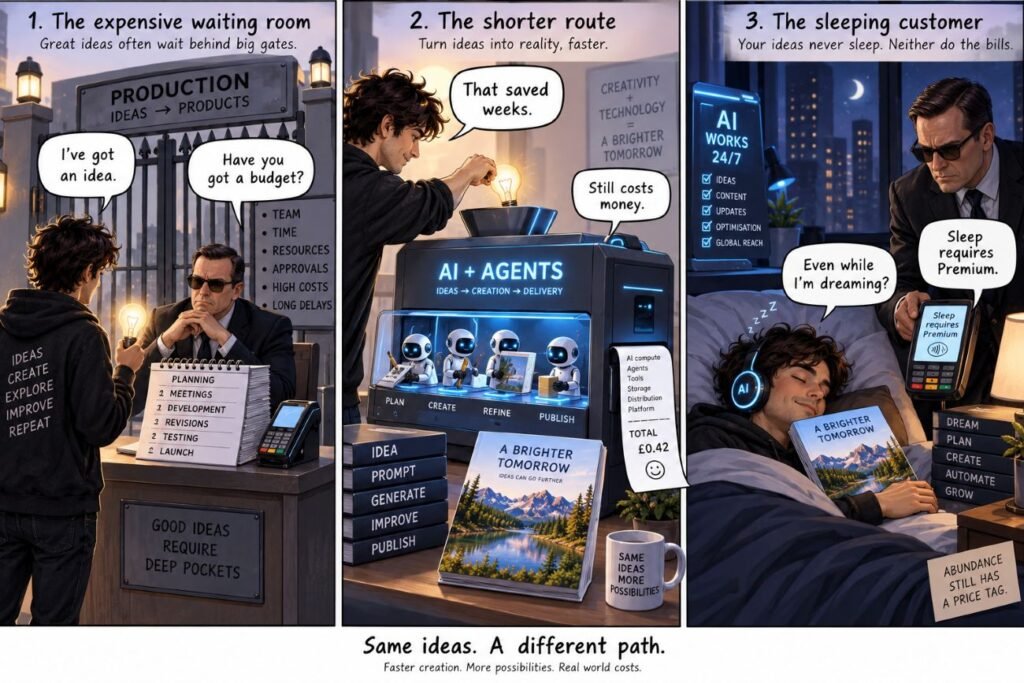
The sketch
Scene 1: The expensive waiting room
A creator silhouette holds a small light bulb outside a closed production gate. A suited gatekeeper sits beside a thick calendar and a payment terminal.
Dialogue:
Creator: “I’ve got an idea.”
Gatekeeper: “Have you got a budget?”
Scene 2: The shorter route
The same creator feeds the light bulb into a machine. Small agent silhouettes assemble a product while a receipt emerges from the side.
Dialogue:
Creator: “That saved weeks.”
Machine: “Still costs money.”
Scene 3: The sleeping customer
The creator sleeps beside the finished product. A wireless headset connects to the machine while the gatekeeper holds a payment terminal beside the pillow.
Dialogue:
Creator: “Even while I’m dreaming?”
Gatekeeper: “Sleep requires Premium.”
What to watch, not the show
- Whether the saving survives testing, corrections, deployment and maintenance.
- Whether lower unit prices reduce the total bill or encourage more agents, retries and spending.
- Whether creators can move their work between providers without rebuilding everything.
- Whether cheap production makes useful originality more valuable or merely fills markets with copies.
- Whether saved time belongs to the person doing the work or becomes another employer target.
- Whether speculative brain interfaces would protect private thoughts or create another place to sell access.
The Hermit take
I want the hours back, with something useful to show for them.
The machine can keep its acceptance speech.
Keep or toss
Keep / Toss.
Keep cheaper creation, useful agent teams and time recovered.
Toss instant-success promises and the idea that abundant output automatically deserves attention.
Sources
- Stanford HAI, historical inference prices: https://hai.stanford.edu/ai-index/2025-ai-index-report/research-and-development
- NBER, Generative AI at Work: https://www.nber.org/papers/w31161
- METR, early-2025 developer productivity experiment: https://metr.org/blog/2025-07-10-early-2025-ai-experienced-os-dev-study/
- METR, February 2026 update and measurement limitations: https://metr.org/blog/2026-02-24-uplift-update/
- Apple, on-device foundation model research: https://machinelearning.apple.com/research/introducing-apple-foundation-models
Disclaimer: This article contains satire and opinion. Pennies-priced production, practically unlimited agent teams and dream-connected devices are possibilities imagined by the author, not established outcomes. Comic dialogue is fictional.
Leave a Reply