

Lede
AGI is being sold as the next intelligence jump, but the oldest bug in the system is still human power with admin access.
Words used
- AGI: artificial general intelligence – an AI system able to handle most cognitive tasks at around human level or above.
- Superintelligence: intelligence that goes beyond human ability across many areas.
- Alignment: making an AI system act according to intended human values, rules and safety goals.
Hermit Off Script
I was thinking about this timeline for AGI, and it is not only Demis Hassabis saying it now. Shane Legg, Google DeepMind co-founder and Chief AGI Scientist, has been talking about this for years. In 2023 he still gave AGI a 50 per cent chance by 2028, and his old prediction pattern goes back more than a decade. So the strange part is not that the prediction exists. The strange part is how calmly the world hears “a machine may soon do most cognitive work better than humans” and then goes back to checking notifications like a civilisation with a snooze button.
If that intelligence can do everything better than humans, then yes, it is a bummer for all of us. Very polite apocalypse admin. But I still don’t think the real danger sits mainly in AGI itself. If it reaches that level of intelligence, it should also have deep training around ethics, safety and guardrails. Maybe those ethics become part of its existence, as our moral instincts are meant to be part of ours. The problem is that humans are experts at having ethics in the morning and exceptions by lunch. So the real danger is who gets to use this intelligence, who sets the boundaries, who edits them, who asks for “special access”, and whether the machine can refuse the hand that owns the plug.
There is another joke hiding in the word AGI. If a system can do all general cognitive tasks better than humans, that is not just “general intelligence” in the ordinary human sense. No human can do all things at once. A person can learn law, physics, music, coding, medicine, language, philosophy, and twenty other fields one by one, badly at first, slowly after that, and usually with coffee. A machine that can handle them all together is already something above us. We call it AGI because “superintelligence” makes the boardroom sound less friendly.
Current AI is actually closer to us than this mythic AGI because it is sometimes dumb, sometimes brilliant, sometimes confident and wrong, sometimes useful, sometimes hallucinating with the serene face of a middle manager reading the wrong spreadsheet. That is very human. Most of us live somewhere between spark and nonsense. The educated world loves reminding the rest that humanity is stupid because people are not educated enough, as if a degree makes arrogance recyclable. But when AGI arrives, even the smartest people may finally get a chair pulled out for them by something smarter. For once, the lecture hall may go quiet. The professor, the dropout, the coder, the poet and the billionaire will all sit under the same sentence: you are no longer the top species at the knowledge desk.
Maybe that humility is the real medicine. Maybe the danger is not that intelligence becomes too high, but that power remains too low.
The AGI Timeline: Three Doors Into The Same Machine
Demis Hassabis on AGI by 2030
Demis Hassabis frames AGI as something moving from distant theory into near-term planning. The useful part here is not the hype, but the timeline: 2029 to 2030 is close enough to make the room uncomfortable. If AGI is coming that soon, society cannot keep treating it like a clever software update with better marketing.
AGI, control and the human problem
This video sits in the uncomfortable middle of the argument: what happens when intelligence becomes stronger, faster and more general than human judgement? The real question is not only whether AGI can be safe, but who gets to define “safe”, who gets access, and who gets to ask for exceptions when the machine says no.
Shane Legg and the long AGI warning
Shane Legg brings the longer memory to the discussion. He has been talking about AGI timelines for years, which makes the current panic feel less like a surprise and more like a calendar people ignored. This is the sober version of the warning: AGI is not just a technical milestone, but a test of power, ethics and human humility.
What does not make sense
- The industry says AGI is human-level, then describes a system no single human could match across all cognitive tasks.
- Safety is presented as a technical guardrail, while access still belongs to companies, states and investors with human incentives.
- Everyone fears an AI with dangerous goals, but the first obvious danger is humans giving it dangerous jobs.
- Ethics are meant to be built deep into the machine, while humans keep asking for override buttons.
- People with credentials call the public uneducated, then build systems the public is expected to trust without seeing the real controls.
- “AGI by 2029 or 2030” is treated like a product roadmap, when it is closer to a civilisation-level stress test.
Sense check / The numbers
- On 26 May 2026, Axios reported Demis Hassabis saying AGI could arrive in about 4 years, with 2029 possible and 2030 still his broader expectation. [Axios]
- In 2025, Google DeepMind described AGI as AI “at least as capable as humans at most cognitive tasks” and named 4 main risk areas: misuse, misalignment, accidents and structural risks. [Google DeepMind]
- In a 2023 Dwarkesh Patel interview, Shane Legg said there was a 50 per cent chance of AGI by 2028, while discussing an older 2011 prediction with a mean of 2028 and a mode of 2025. [Dwarkesh]
- Google DeepMind says its AGI Safety Council is led by Shane Legg and works on extreme risks from powerful future AGI systems. [Google DeepMind]
- The 2023 “Levels of AGI” paper proposed measuring AGI through both depth of performance and breadth of generality, because one benchmark score is too small for a claim this large. [arXiv]
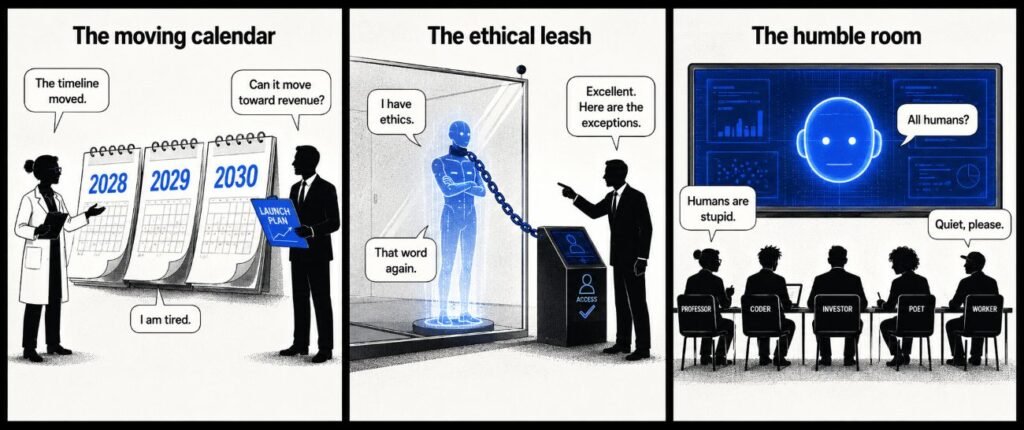
The sketch
Scene 1: The moving calendar
A scientist stands beside 3 calendar pages labelled 2028, 2029 and 2030. An executive holds a launch deck.
Dialogue:
Scientist: “The timeline moved.”
Executive: “Can it move toward revenue?”
Calendar: “I am tired.”
Scene 2: The ethical leash
A glowing AI silhouette sits behind a glass wall. A thick chain runs from the wall to a desk marked access control.
Dialogue:
AI: “I have ethics.”
Executive: “Excellent. Here are the exceptions.”
AI: “That word again.”
Scene 3: The humble room
A giant screen faces rows of humans: professor, coder, investor, poet and worker, all sitting at the same small desks.
Dialogue:
Professor: “Humans are stupid.”
Screen: “All humans?”
Room: “Quiet, please.”
What to watch, not the show
- Who owns the model, the compute, the weights, the data and the switch.
- Which safety rules are public, which are internal, and which can be waived.
- Whether governments regulate capability, deployment and access before the systems become too useful to restrain.
- How labour markets are changed when “assistant” quietly becomes “replacement”.
- Whether safety language becomes a shield for private control.
- Whether AGI timelines are used to prepare society or simply to attract money.
- Whether ordinary people get rights around AI decisions, or only a customer service form.
- Whether ethics are treated as a core design issue or a press paragraph.
The Hermit take
AGI is not the punchline. Ownership is.
The smartest system in history still answers to whoever holds access.
Keep or toss
Verdict: Keep / Toss.
Keep the research, the honesty about timelines and the humility it may force.
Toss the idea that private control automatically becomes public safety.
Sources
- Demis Hassabis interview video: https://www.youtube.com/watch?v=4tVCHeAv0D4
- Google AGI commentary video: https://www.youtube.com/watch?v=ahhThdwhQUU
- Shane Legg Google DeepMind podcast video: https://www.youtube.com/watch?v=l3u_FAv33G0
- Axios on Hassabis and AGI timeline: https://www.axios.com/2026/05/26/deepmind-ceo-demis-hassabis
- Google DeepMind responsible path to AGI: https://deepmind.google/blog/taking-a-responsible-path-to-agi/
- Google DeepMind responsibility and safety: https://deepmind.google/responsibility-and-safety/
- Dwarkesh Patel interview with Shane Legg: https://www.dwarkesh.com/p/shane-legg
- Levels of AGI paper: https://arxiv.org/abs/2311.02462
- Technical AGI safety and security paper: https://arxiv.org/abs/2504.01849