

Lede
The absurdity is simple: the world is selling AGI while too many factories still run on whiteboards, emails, Excel prayers and tired workers.
Words used
- AGI: artificial general intelligence, the idea of AI reaching broad human-level ability across many tasks.
- ERP: enterprise resource planning software, used to manage production, stock, orders and business processes.
- PPE: personal protective equipment, such as safety glasses, gloves, helmets or hearing protection.
Hermit Off Script
I keep hearing about AGI, robots, billions, trillions, and the coming age where machines will take over everything except apparently the factory whiteboard from 1995. Some companies in 2026 still write on a board what is already sitting inside the software: speed, timings, product changes, issues, stops, notes, little arrows of panic. Then the same thing goes on email, then into Excel, then through formulas held together by hope, stale coffee and one person who knows how the spreadsheet works but was never officially in charge of it. This is not digital transformation. This is paperwork wearing a USB cable. And the reason is usually very simple. Managers often don’t have the digital skills to improve the system, companies don’t want to invest in proper tools, and the digital support team is treated like a tiny emergency service chained to the mother company. One IT manager, one or two people, and a pile of infrastructure so old you could sell it as vintage and probably make more profit than using it. Meanwhile, production continues as if trees are immortal and workers are spare parts. Maybe these companies are safe from AI because AI won’t find the entrance. It will look at the process, see three boards, four spreadsheets, six email chains and one printer from the reign of the dinosaurs, then ask for a human supervisor. But maybe that safety is temporary. If AGI and robots do reach factory work properly in 10 to 20 years, or whenever the future stops asking politely, the companies that refused to modernise won’t be protected by tradition. They will be exposed by it. Sometimes I wonder how these companies still make profit. Then I remember. Low wages. Migrant labour. Fear. People staying quiet because rent, children and food do not accept moral statements as payment. Work in heat, work in cold, work faster, cover extra tasks, smile through burnout, and when somebody collapses, call them weak rather than asking who built the pressure. If a company pays modestly but gives people respect, calm conditions and a sane workload, it feels like working-class heaven. Then someone arrives with a fresh spreadsheet and asks why 3 people are on a line when 2 can suffer beautifully. Or 1. Or maybe 0, if the robot finally passes probation. The strangest part is that many of these places don’t even use the helpful technology properly. No sensors where they would prevent waste. No cameras where they would catch defects. No clean digital workflow where it would stop errors. But there is always a policy. Safety glasses all shift, 8 to 12 hours, even where the risk is unclear or the person is standing at a screen. Safety matters. Eye protection matters. But if the rule is all day, then provide proper safety eyewear that fits the person, the task and the worker’s vision. Don’t turn protection into another cheap discomfort tax.
Maybe the future will split harder than we think. Advanced countries and companies that combine robots, AI and proper production systems may become so rich that others cannot compete. The gap we see now may be only the preview: billionaires and trillionaires owning more of the Earth while old factories still ask someone to copy a software number onto a board. One side builds the future. The other laminates yesterday.
What does not make sense
- Companies pay for production software, then make workers rewrite the same information by hand like the software needs a bedtime story.
- Management wants efficiency but keeps the process dependent on fragile spreadsheets nobody owns properly.
- IT teams are expected to maintain ageing systems, fix emergencies and somehow invent the future with no time, staff or power.
- Paper is treated as reliable because it is visible, while the actual data sits somewhere else, waiting to be trusted.
- Safety rules become sacred even when the risk assessment should be specific, practical and tied to the real task.
- Workers are called the problem after the system removes support, raises speed and pretends exhaustion is a personality defect.
- The factory says robots are too expensive, then spends years paying for waste, rework, delays and human stress.
- The old mindset may protect jobs for a while, but it also protects errors, burnout and bankruptcy.
Sense check / The numbers
- Corporate AI investment reached USD 252.3 billion in 2024, while generative AI private investment reached USD 33.9 billion, according to Stanford HAI. Organisations reporting AI use rose from 55 per cent in 2023 to 78 per cent in 2024. [Stanford HAI]
- UK government AI adoption research published in 2026 found that only 1 in 6 businesses currently use AI, and among AI adopters an average of 30 per cent of staff use it. The future is here, but it has not found every factory gate. [GOV.UK]
- The International Federation of Robotics reported 4,281,585 industrial robots operating in factories worldwide in 2023, with 541,302 new installations that year. Asia took 70 per cent of new deployments, Europe 17 per cent and the Americas 10 per cent. [IFR]
- HSE figures for Great Britain in 2024/25 recorded 1.9 million working people suffering from work-related illness, including 964,000 workers with work-related stress, depression or anxiety. Work-related illness and injury caused 40.1 million working days lost. [HSE Statistics]
- HSE guidance says employers must provide PPE free of charge when a risk assessment shows it is needed. HSE temperature guidance also says indoor workplaces should normally be at least 16C, or 13C if the work involves rigorous physical effort. [HSE PPE] [HSE Temperature]
The sketch
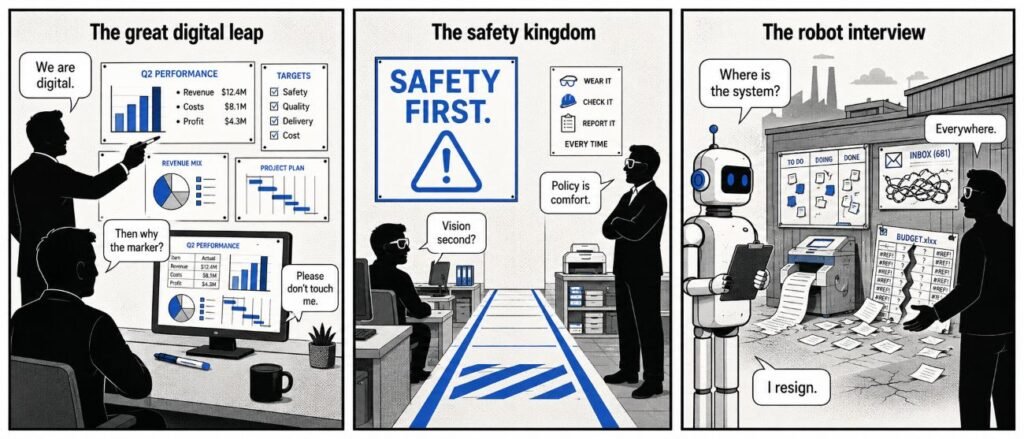
Scene 1: The great digital leap
Panel description. A manager points proudly at a wall covered with whiteboards while a computer screen beside him already shows the same numbers.
Dialogue:
Manager: “We are digital.”
Worker: “Then why the marker?”
Spreadsheet: “Please don’t touch me.”
Scene 2: The safety kingdom
Panel description. Workers in safety glasses stand at computers, printers and empty walkways while a warning poster fills half the wall.
Dialogue:
Poster: “Safety first.”
Worker: “Vision second?”
Manager: “Policy is comfort.”
Scene 3: The robot interview
Panel description. A robot stands at the factory entrance holding a clipboard, staring at a board, a printer, an email chain and a broken spreadsheet.
Dialogue:
Robot: “Where is the system?”
Worker: “Everywhere.”
Robot: “I resign.”
What to watch, not the show
- Cheap labour being used as a substitute for proper systems.
- Managers treating digital skill as a luxury rather than basic production literacy.
- Spreadsheet dependency where no named person owns accuracy, security or maintenance.
- Safety rules applied broadly instead of through clear task-based risk assessment.
- Automation introduced only to cut headcount, not to reduce waste, errors or strain.
- Older and experienced workers being pushed into faster line speeds without support.
- Small IT teams becoming permanent repair crews instead of improvement teams.
- AI wealth concentrating in countries and companies that can afford infrastructure, data and robotics.
The Hermit take
A factory that fears software will not survive robots.
A company that saves money by grinding people is already bankrupt in spirit.
Keep or toss
Keep / Toss.
Keep safety, useful software and respectful work.
Toss ritual paperwork, fake efficiency and the habit of squeezing workers until the spreadsheet smiles.
Sources
- Stanford HAI 2025 AI Index Report: https://hai.stanford.edu/ai-index/2025-ai-index-report
- Stanford HAI 2025 AI Index Economy chapter: https://hai.stanford.edu/ai-index/2025-ai-index-report/economy
- GOV.UK AI Adoption Research: https://www.gov.uk/government/publications/ai-adoption-research/ai-adoption-research
- GOV.UK SME Digital Adoption Taskforce final report: https://www.gov.uk/government/publications/sme-digital-adoption-taskforce-final-report/sme-digital-adoption-taskforce-final-report
- International Federation of Robotics World Robotics 2024 press release: https://ifr.org/ifr-press-releases/news/record-of-4-million-robots-working-in-factories-worldwide
- HSE PPE overview: https://www.hse.gov.uk/ppe/overview.htm
- HSE workplace temperature guidance: https://www.hse.gov.uk/temperature/employer/index.htm
- HSE key workplace health and safety figures 2024/25: https://www.hse.gov.uk/statistics/overview.htm

Leave a Reply