Lede
The future arrived for a small guest list, then the bouncer remembered the common users were still outside.
Words used
- Fable 5: Anthropic’s public Mythos-class model, launched on June 9, 2026.
- Mythos 5: Anthropic’s restricted version of the same underlying model, with some safeguards lifted for selected users.
- Guardrails: safety systems that block, redirect or limit model answers.
- Jailbreak: a method used to bypass a model’s safeguards.
- Export control: a government restriction on who can access certain technology.
Hermit Off Script
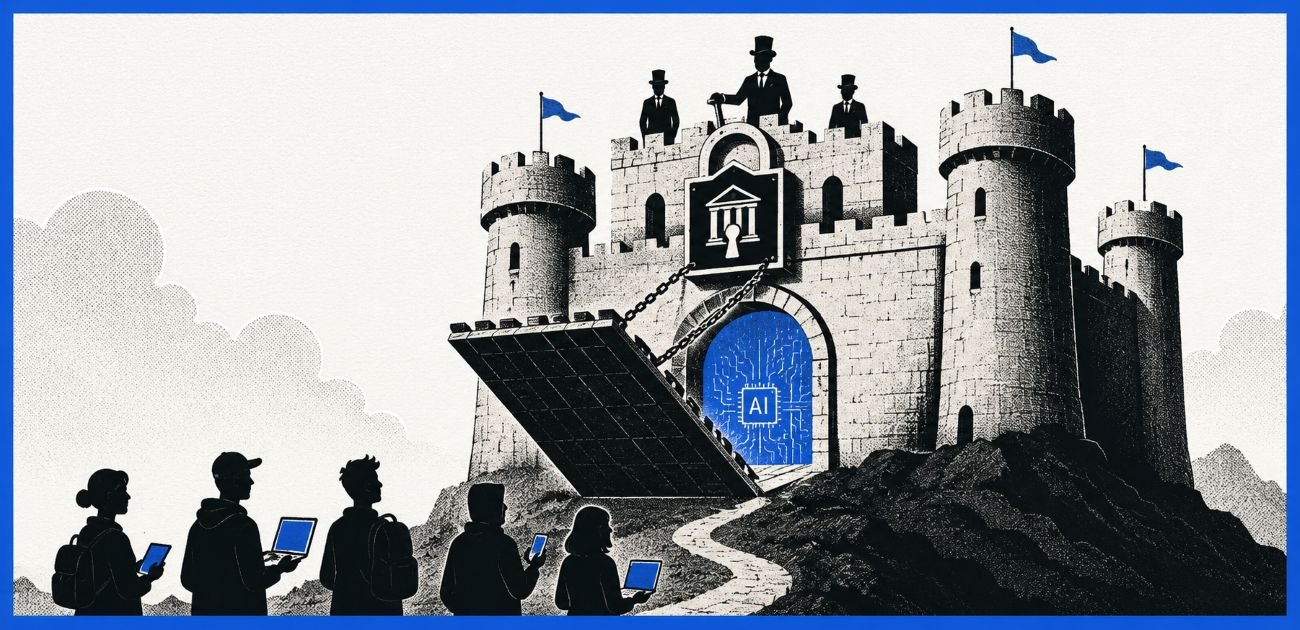
Mythos, or Fable for the rest of us at the children’s table, arrived waving its little hand from the top of the AI guardrail tower. The safeguards were so high that even a word resembling a forbidden term needed a passport, a clean criminal record and probably a priest. Then, almost as soon as the future appeared, it was switched off because the government looked at people having too much power in their hands and said: “Lovely technology. Shame if the public touched it.”
There was a time, many many years ago – sorry, only a few years ago, no more than 2 or 3 years – when ChatGPT felt frightening and amazing. It was only a chatbot, but it could follow context, answer a task, write code badly enough to be useful, and pretend to understand us better than half the people in a meeting. Then Anthropic came along and gave users a glimpse of something sharper. Fable and Mythos looked like the first public sign that AI might become genuinely smart, closer to human-level reasoning in the places where it matters: context, judgment, uncertainty and not inventing nonsense with perfect confidence. And of course the government said no. Not “no forever”, just the more useful political no: “not unless we approve it.” Which government? The Trump administration, no less, now auditioning as moderator of the planet. The message underneath was very simple. The highest technology and the smartest AI may exist, but access must be decided by the chosen gatekeepers. Fable for managed users. Mythos for trusted users. The rest of us get the polite version with soft cushions, safety locks and a little note saying that Opus will answer instead. The reviews and possible applications poured online from people with better access, better budgets and better compute. They could test agent work, vibe coding, startup automation, security research and serious workflows. For most users, though, the difference was almost decorative. Not because we lack imagination. Give people a strong enough AI and many would build tools, apps, workflows and strange little businesses from their kitchens. The problem is money, time and access. Most people use AI for small tasks because that is what the doormen of superintelligence have decided commoners need. A summary. A rewrite. A small spreadsheet formula. A polite email to someone who deserves a much less polite one. That is where they are wrong. We all need the best AI, not because every task is grand, but because intelligence shows itself even in a short answer. “Yes”, “no”, “maybe”, “I don’t know”, “I found 3 possible answers, here are the sources, now you choose what fits your life.” That is the difference between a dumb assistant, a dumb-smart assistant and a genuinely smart one. The task can be boring. The reasoning still matters. So yes, this shutdown feels like a small preview of the larger game. The government and billionaires who build the walls will not gladly give ordinary people a very smart robot for ordinary benefit, unless the meter is running and the rich can run faster. Maybe that is the real guardrail: not safety, but ownership. The sweeter the voice sounds, the more complete the control can become. As an idea, not a fact, I imagine future AI less like a chatbot and more like Asimov’s psychohistory crossed with the telepathic power of robots in Foundation. Give it enough data from our lives, our habits, our messages and our systems, and it will not need magic to predict what we do next. It will calculate us. And that, I suspect, is what powerful governments and billionaires are chasing through AGI and superintelligence: not wisdom for everyone, but foresight for the owners. The people get the app. The owners get the map.
What does not make sense
- AI is marketed as abundance, then rationed like a strategic mineral.
- The public version is sold as powerful, but the truly useful version is put behind trust gates.
- Safety is real, but vague emergency controls can become a convenient way to decide who gets intelligence.
- Cyber defenders say strong models can help them fix systems, while the state worries the same tools can help attackers break them.
- “Common users” are treated as if they only need shallow help, then blamed for not building anything serious.
- The same companies asking users to trust AI also build pricing, access and data systems that make trust expensive.
Sense check / The numbers
- ChatGPT launched on November 30, 2022, as a free research preview that could answer follow-up questions, admit mistakes and reject some requests. [OpenAI]
- Anthropic launched Claude Fable 5 and Claude Mythos 5 on June 9, 2026; it said Fable 5 was a public Mythos-class model and Mythos 5 used the same underlying model with some safeguards lifted for selected users. [Anthropic]
- Anthropic listed Fable 5 at $10 per million input tokens and $50 per million output tokens, while saying Fable’s safeguards would trigger in less than 5 per cent of sessions on average. [Anthropic]
- On June 12, 2026, Anthropic said it received a US government directive at 5:21pm ET ordering it to suspend access to Fable 5 and Mythos 5 by any foreign national, including foreign-national Anthropic employees. [Anthropic]
- Reuters reported on June 15, 2026, that Anthropic technical staff were meeting US Commerce officials after the shutdown; Axios reported that more than 40 cybersecurity leaders had signed a letter urging the restrictions to be reversed. [Reuters, Axios]
The sketch
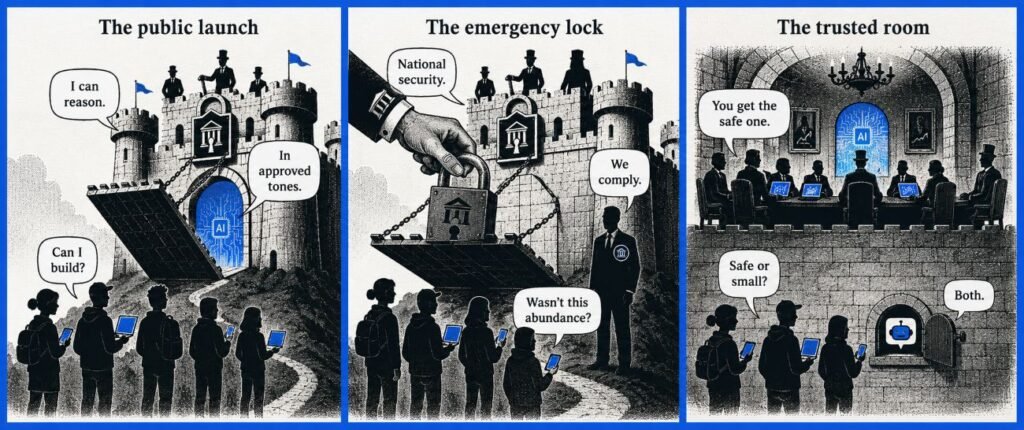
Scene 1: The public launch
An AI castle opens its drawbridge halfway. Common users stand outside holding small laptops while a bright model silhouette waves from the tower.
Dialogue:
AI Model: “I can reason.”
Guardrail: “In approved tones.”
User: “Can I build?”
Scene 2: The emergency lock
A giant government hand lowers a padlock over the drawbridge while suited figures watch from a balcony.
Dialogue:
Government: “National security.”
Company: “We comply.”
User: “Wasn’t this abundance?”
Scene 3: The trusted room
Inside the castle, selected users sit at a long table with glowing screens. Outside, common users receive a small chatbot through a narrow window.
Dialogue:
Gatekeeper: “You get the safe one.”
User: “Safe or small?”
Billionaire: “Both.”
What to watch, not the show
- Whether “national security” becomes the standard phrase for blocking public access to smarter AI.
- Whether frontier models become cheap for institutions and expensive for everyone else.
- Whether safety rules are transparent, technical and appealable, or just letters sent late on a Friday.
- Whether cyber defenders lose access to tools that attackers can still copy elsewhere.
- Whether AI companies use guardrails to protect people or to protect market control.
- Whether the user becomes the customer, the data source and the managed subject at the same time.
- Whether “trusted access” becomes a polite name for class access.
The Hermit take
Smart AI should not become a private weather forecast for the rich.
Safety matters, but opaque control is not safety. It is ownership wearing a clean shirt.
Keep or toss
Keep / Toss.
Keep serious safeguards, technical audits and clear limits.
Toss the private drawbridge around intelligence that ordinary people need to think, build and survive.
Sources
- OpenAI ChatGPT launch note: https://openai.com/index/chatgpt/
- Anthropic Fable 5 and Mythos 5 launch note: https://www.anthropic.com/news/claude-fable-5-mythos-5
- Anthropic directive statement: https://www.anthropic.com/news/fable-mythos-access
- Anthropic Fable pricing page: https://www.anthropic.com/claude/fable
- Reuters report on Anthropic and US Commerce talks: https://www.reuters.com/technology/anthropic-us-officials-meeting-monday-resolve-dispute-over-export-curbs-2026-06-15/
- Axios report on cybersecurity leaders defending Fable access: https://www.axios.com/2026/06/15/anthropic-fable-security-leaders-trump-admin

Leave a Reply