Lede
Democracy is messy, slow and annoying, but at least it writes rights into law instead of leaving them in the pocket of a tyrant.
Hermit Off Script
The EHRC guidance on single-sex spaces is exactly why I love democracy, even when some people in the western world behave as if freedom is a broken kettle. In a free country, rights are argued over, written down, tested in court, corrected by guidance and then fought over again by people who all think the other side has lost its mind. It is exhausting, yes, but it is still better than a regime where the despot and his cronies decide what you are allowed to be before breakfast. Here, basic rights and freedoms are at least placed in law, not left as a favour from the powerful.
And on this point, the common sense is not difficult. Women are women and men are men by sex at birth. What someone does with their life, name, appearance, identity or body is their choice, and that choice should be respected by law and by decent people. Trans people should not be treated as a public inconvenience. They are citizens. They have rights. But rights do not work by deleting other rights. A woman-only space cannot mean “woman-only, unless the language gets nervous”. A sex-based category cannot survive if sex becomes optional exactly at the door where sex is the reason for the category.
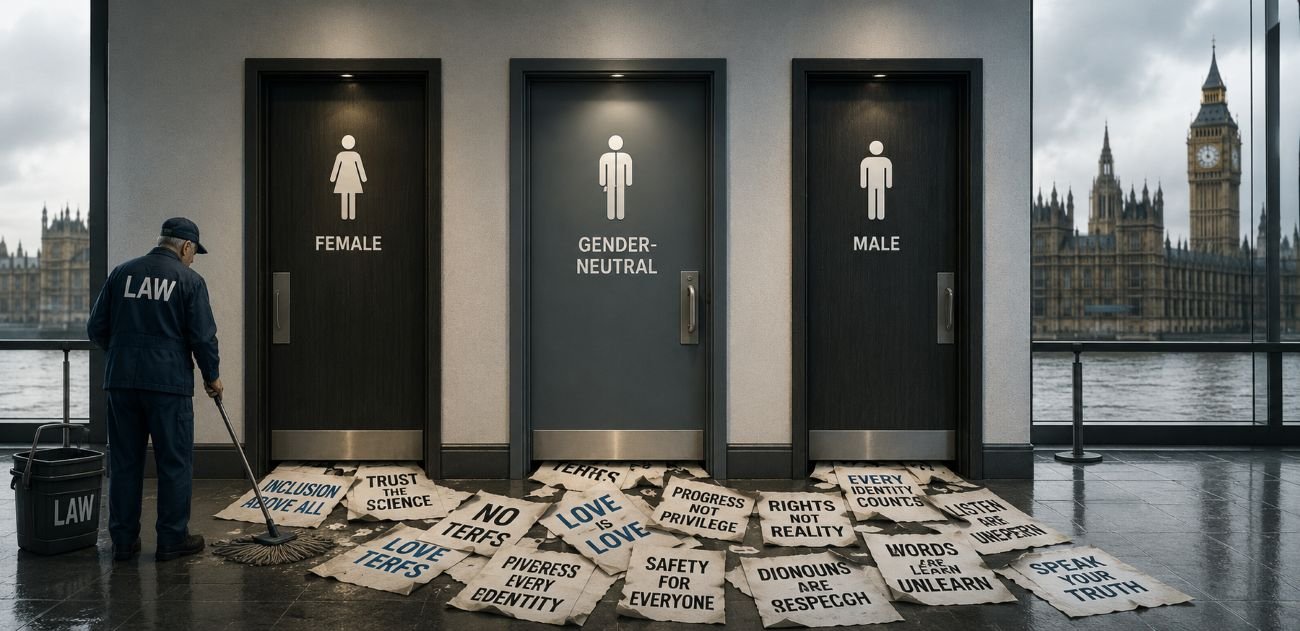
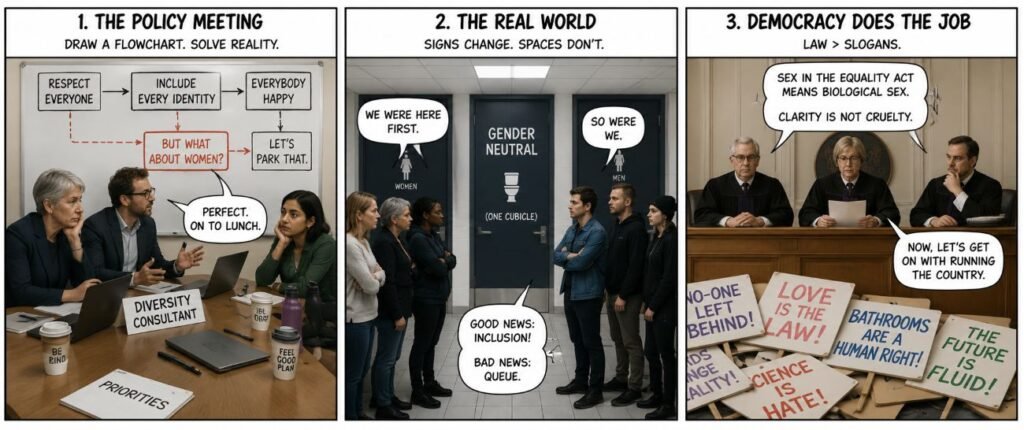
That is where the law is finally beginning to separate respect from confusion. Respecting gender identity does not require pretending that biological sex never matters. It matters in toilets, changing rooms, hospital wards, refuges and sport. Especially sport. Competing in a female category after male puberty is not brave inclusion; it is a category problem wearing a moral halo. Nature built different bodies, then modern institutions tried to solve that with slogans and laminated posters. No wonder the courts were eventually asked to bring a mop.
The sensible answer was always boring: protect women-only spaces, protect trans people from harassment, and provide proper gender-neutral spaces where needed. Not a cupboard. Not a disabled toilet used as the national apology room. A real third space, built properly, signed clearly and treated with dignity.
As for the list of gender identities, people can describe themselves as they wish. I do not need to mock anyone’s inner life. But law cannot run every building, ward, team and public service as if a form with a free-text box is the same thing as a workable policy. Maybe one day we really will have children born through labs, raised by robot nannies, and Parliament will need a new cubicle called “born of stainless steel and Wi-Fi”. Until then, democracy has to work with bodies, rights and doors that lock.
Gender identities
Gender identity language is wide and personal. Terms such as non-binary, agender, genderfluid, bigender, trigender, pangender, genderqueer and gender non-conforming help people describe themselves with dignity. But they are not all legal categories, and they do not automatically create separate rules for sport, hospital wards, refuges, changing rooms or toilets. [Medical News Today] [Stonewall]
UK law is narrower. The Equality Act 2010 protects “sex” and “gender reassignment”; the EHRC says medical treatment or surgery is not needed for gender reassignment protection. So yes, people deserve respect and legal protection. But public services still need clear, workable rules where privacy, dignity, safety and fairness are involved. [Equality Act 2010] [EHRC]
- Sex: Usually refers to biological sex, such as male or female, based on physical and reproductive characteristics. In the current UK legal debate, this is the category that matters for single-sex spaces.
- Gender: A social and personal identity connected to being male, female, both, neither, or something outside those categories. It can include roles, expression, identity and self-understanding.
- Gender identity: A person’s internal sense of their own gender. It may match their sex at birth, or it may not.
- Gender expression: How someone presents themselves outwardly, through clothing, voice, hair, behaviour or style. Expression is not always the same as identity.
- Cisgender: A person whose gender identity matches the sex they were assigned at birth.
- Transgender / trans: An umbrella term for people whose gender identity does not match, or does not sit comfortably with, the sex they were assigned at birth.
- Trans woman: A person assigned male at birth who identifies and lives as a woman.
- Trans man: A person assigned female at birth who identifies and lives as a man.
- Non-binary: A person whose gender identity does not sit strictly within male or female. Some non-binary people feel between the 2 categories, outside both, or moving between them.
- Agender: A person who identifies as having no gender, or as gender-neutral.
- Gender-neutral: A person who may not identify strongly as male or female, or who prefers neutral terms and presentation.
- Genderfluid: A person whose gender identity shifts over time.
- Bigender: A person who identifies with 2 genders, either at the same time or at different times.
- Trigender: A person who identifies with 3 genders, either at once or at different times.
- Pangender: A person who identifies with many genders or all genders within their own understanding of gender.
- Genderqueer: A broad term for someone whose gender identity or expression does not fit conventional male and female categories.
- Demigender: A person who feels a partial connection to a gender, but not a full one.
- Demiboy: A person who partially identifies as a boy or man, but not completely.
- Demigirl: A person who partially identifies as a girl or woman, but not completely.
- Androgyne: A person whose gender identity or expression blends masculine and feminine elements, or sits between them.
- Neutrois: A non-binary identity often connected with feeling neutral, null, or without a conventional gender.
- Gender non-conforming: A person whose appearance, behaviour or expression does not follow the usual expectations attached to their sex or gender. This does not automatically mean the person is trans.
- Questioning: A person still exploring their gender identity.
- Two-Spirit: A term used by some Indigenous North American people. It is culture-specific and should not be used as a general label for anyone outside those communities.
- Intersex: A person born with sex characteristics that do not fit typical definitions of male or female. Intersex is about sex characteristics, not automatically gender identity.
- Male: Usually used as a sex category, though some forms use it as a gender option.
- Female: Usually used as a sex category, though some forms use it as a gender option.
- Prefer to self-describe: A practical option on forms that lets people write their own identity instead of choosing from a fixed list. Useful for data collection, but not the same as creating a new legal category every time someone writes a word.
- Prefer not to say: A privacy option, and often the most sensible box on the whole form.
For forms, the cleanest practical list is usually: male, female, non-binary, prefer to self-describe and prefer not to say. That respects personal identity without pretending every organisation can build policy around an endless menu. The form can be kind. The law still has to be workable.
A free-text box is useful for dignity. It is not a building plan, a sports category or a hospital ward policy.
What does not make sense
- People say “respect everyone”, then act shocked when that also includes women who want single-sex spaces respected.
- Some institutions confused kindness with refusing to define anything until a court had to do it for them.
- A “third space” only works if it is real provision, not a broom cupboard with a diversity sticker.
- The public argument keeps treating toilets as philosophy seminars, when the legal problem is privacy, dignity and safety.
- Democracy is accused of oppression for doing the very democratic thing: letting citizens argue, sue, consult, appeal and correct.
- Rights become theatre when one protected group is treated as sacred and another is told to stop noticing.
Sense check / The numbers
- On 16 April 2025, the UK Supreme Court ruled in For Women Scotland Ltd v The Scottish Ministers that “sex” in the Equality Act 2010 should be read as biological sex for Equality Act purposes. [EHRC]
- On 21 May 2026, the Minister for Women and Equalities laid the updated EHRC code of practice before Parliament, which then has 40 days to review it. [EHRC]
- The Equality Act 2010 protects 9 protected characteristics, and the updated code gives guidance to service providers, associations and public bodies on applying those duties. [Guardian]
- Reuters reported on 21 May 2026 that the guidance says single-sex services can be restricted by biological sex where that is a proportionate way to protect privacy, dignity or safety. [Reuters]
- The Guardian reported that the code says admitting a trans person to a service matching lived gender means that service can no longer be described as single-sex, and providers may face legal risk. [Guardian]
The sketch
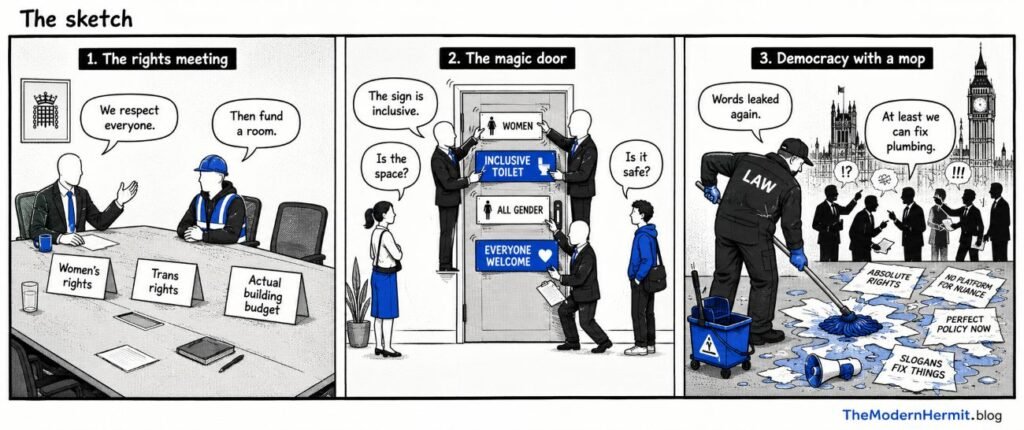
Scene 1: The rights meeting
Panel description. A long table has 3 signs: “women’s rights”, “trans rights” and “actual building budget”. The third chair is empty.
Dialogue:
Minister: “We respect everyone.”
Builder: “Then fund a room.”
Scene 2: The magic door
Panel description. A toilet door changes labels as 5 officials point at it with clipboards. A woman waits on one side and a trans person waits on the other.
Dialogue:
Official: “The sign is inclusive.”
Woman: “Is the space?”
Trans person: “Is it safe?”
Scene 3: Democracy with a mop
Panel description. A tired cleaner labelled “law” mops up spilled slogans while Parliament argues in the background.
Dialogue:
Law: “Words leaked again.”
Democracy: “At least we can fix plumbing.”
What to watch, not the show
- Whether public bodies actually build proper gender-neutral spaces, or just push the problem into accessible toilets.
- Whether women’s refuges, hospital wards, changing rooms and sport bodies receive clear lawful policies instead of nervous HR fog.
- Whether trans people are protected from harassment while single-sex rules are applied.
- Whether campaign groups on both sides keep raising money from fear after the law has already moved.
- Whether the argument becomes a media circus about toilets while the real issue is enforceable, dignified provision.
- Whether businesses follow the code carefully or hide behind “we’re waiting for clarity” until sued.
The Hermit take
Democracy did the ugly job: it turned a shouting match into a rulebook.
Now the country has to prove that dignity is not just a word on the toilet door.
Keep or toss
Keep / Toss.
Keep legal clarity and real third-space provision.
Toss the cowardly habit of pretending every conflict between rights is solved by nicer language.
Sources
- EHRC update on Supreme Court ruling and code of practice: https://www.equalityhumanrights.com/our-work/uk-supreme-court-ruling-meaning-sex-equality-act-our-work
- Reuters report on UK guidance after Supreme Court ruling: https://www.reuters.com/world/uk/britain-sets-out-rules-single-sex-spaces-following-landmark-sex-definition-2026-05-21/
- Guardian report on single-sex toilets and updated code: https://www.theguardian.com/world/2026/may/21/single-sex-toilets-exclude-transgender-people-england-wales-scotland-code-of-practice
- Guardian explainer on the updated EHRC code: https://www.theguardian.com/society/2026/may/21/what-is-the-updated-ehrc-code-of-practice-about-and-how-does-it-apply-equalities-watchdog
- Telegraph report: https://www.telegraph.co.uk/politics/2026/05/21/dont-challenge-trans-women-gender-phillipson-guidance-uk/
- BBC report: https://www.bbc.co.uk/news/articles/c0e2rj3zj02o
- Medical News Today guide on gender identity terms: https://www.medicalnewstoday.com/articles/types-of-gender-identity
- Medical News Today guide to gender identity terms: https://www.medicalnewstoday.com/articles/types-of-gender-identity
- Stonewall list of LGBTQ+ terms: https://www.stonewall.org.uk/resources/list-lgbtq-terms
- Equality Act 2010, protected characteristics, section 4: https://www.legislation.gov.uk/ukpga/2010/15/section/4
- Equality Act 2010, gender reassignment, section 7: https://www.legislation.gov.uk/ukpga/2010/15/section/7
- EHRC guidance on gender reassignment discrimination: https://www.equalityhumanrights.com/equality/equality-act-2010/your-rights-under-equality-act-2010/gender-reassignment-discrimination
- EHRC update on Supreme Court ruling and meaning of sex in the Equality Act: https://www.equalityhumanrights.com/our-work/uk-supreme-court-ruling-meaning-sex-equality-act-our-work
