
Lede
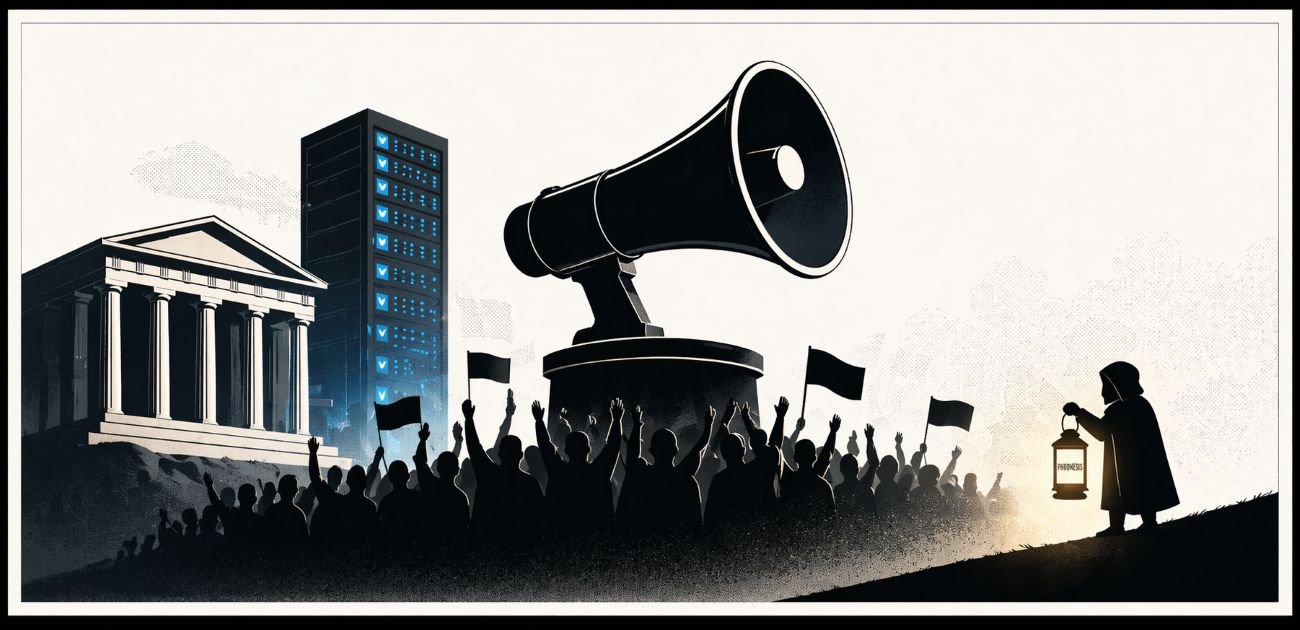
AI walked into the human realm carrying tools, while politics responded by putting a megaphone on a wooden horse and calling it destiny.
Words used
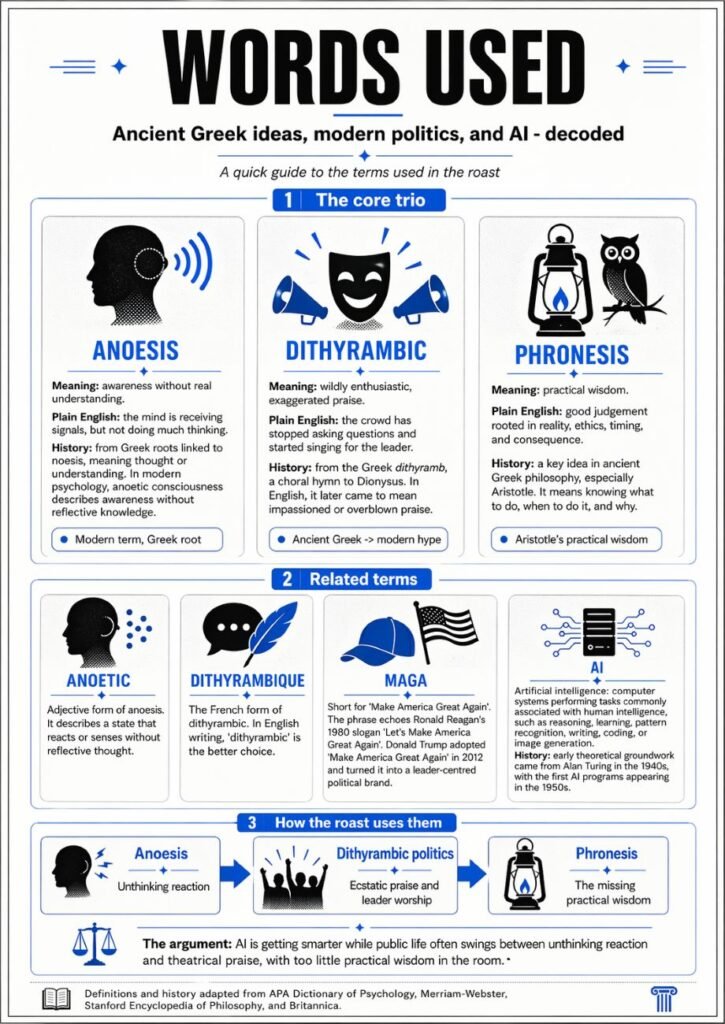
- Anoesis: a state of bare awareness or sensation without reflective thought. In plain English: the mind is receiving signals, but nobody is home with a notebook.
- Anoetic: the adjective form of anoesis. It describes thinking that reacts, feels, or senses, but does not examine itself properly.
- Dithyrambic: exaggerated, ecstatic, almost drunken praise. The word comes from ancient Greek hymns linked to Dionysus. In politics, it means the crowd has stopped asking questions and started singing for the leader.
- Dithyrambique: the French form of “dithyrambic”. For the article, “dithyrambic” is better in English.
- Phronesis: practical wisdom. Not cleverness, not book knowledge, not rhetorical gymnastics. It means judgement rooted in reality, ethics, timing, and consequence.
- MAGA: short for “Make America Great Again”, a political slogan associated with Donald Trump and his movement. In the roast, it is used as an example of leader-centred political identity, not as the only version of the problem.
- AI: artificial intelligence. Here it means modern systems able to perform tasks once treated as uniquely human, including writing, coding, image generation, research assistance, pattern recognition, and decision support.
The point is simple: anoesis is the sleeping mind, dithyrambic politics is the singing crowd, and phronesis is the wise adult nobody invited to the meeting.
Hermit Off Script
Anoesis, dithyrambic politics, and phronesis are old words, but they now feel less like dead vocabulary and more like the emergency manual nobody bothered to read. AI has reached the human realm with enough certainty to compete with us across writing, coding, reasoning, images, science, and the daily little tricks people used to call talent when they wanted to feel special. And what did humanity do? Did it become wiser? Did it slow down, examine itself, and ask what sort of civilisation it wants beside such tools? Of course not. That would require phronesis, and apparently practical wisdom now has the distribution network of a small village bakery. Instead, large parts of public life went anoetic: sensation without understanding, noise without reflection, reaction without depth. People scroll, shout, vote, believe, forget, repeat. Then comes the dithyrambic chorus, that ancient drunken hymn reborn as political branding. Not argument, not evidence, not policy, but ecstatic praise wrapped round a leader, a tribe, a slogan, a hat, a flag, a fantasy. MAGA is only one example of this modern temple, but every country has its own version: the leader as product, the crowd as unpaid marketing department, the future sold like a miracle mop on late-night television. The tragedy is that politicians do not fall from the moon wearing red ties and ambition perfume. They are elected, platformed, excused, amplified. They represent the people, yes, but they also reveal them. When voters reward theatre over judgement, they should not act shocked when government becomes theatre with invoices. Ancient societies named these states because they had already seen the disease: the mind asleep, the crowd singing, the wise few ignored. Thousands of years later, the machines are learning faster than the citizens. That is the insult. We built intelligence outside ourselves while outsourcing wisdom inside ourselves.
What does not make sense
- We have tools approaching expert performance, yet political debate is often still run like two drunk parrots fighting over a mirror.
- People fear AI replacing intelligence, while voting for leaders who treat intelligence as suspicious foreign produce.
- Everyone wants “truth”, but only after it has been filtered through their favourite tribe, influencer, channel, slogan, and emotional support conspiracy.
- The crowd demands change, then rewards the same theatrical habits that made change impossible.
- Politicians praise “the people” while quietly depending on the people not reading the small print.
- AI is tested on benchmarks. Politicians are tested on vibes. Somehow the vibes keep winning.
- The ancient Greeks gave us phronesis. We gave ourselves comment sections.
Sense check / The numbers
- Stanford’s 2026 AI Index says generative AI reached 53 per cent population adoption within 3 years, faster than the PC or the internet, with Singapore at 61 per cent, the UAE at 54 per cent, and the US at 28.3 per cent. [Stanford HAI]
- Stanford also says AI capabilities are advancing quickly, while society’s ability to measure and manage them is not keeping pace. That is the whole circus in 1 sentence: power first, wisdom later, invoice immediately. [Stanford HAI]
- Edelman’s 2026 Trust Barometer surveyed 33,938 respondents across 28 countries and found that 70 per cent were unwilling or hesitant to trust someone with different values, facts, problem-solving approaches, or cultural background. [Edelman]
- Edelman’s 2025 Trust Barometer found that 61 per cent globally had a moderate or high sense of grievance against government, business, and the rich. It also found that 4 in 10 approved of at least 1 form of hostile activism, including online attacks, disinformation, threats, violence, or property damage. [Edelman]
- Pew Research Center reported in December 2025 that only 9 per cent of Democrats and Democratic-leaning independents and 26 per cent of Republicans and Republican-leaning independents said they trusted the US federal government just about always or most of the time. [Pew]
The sketch
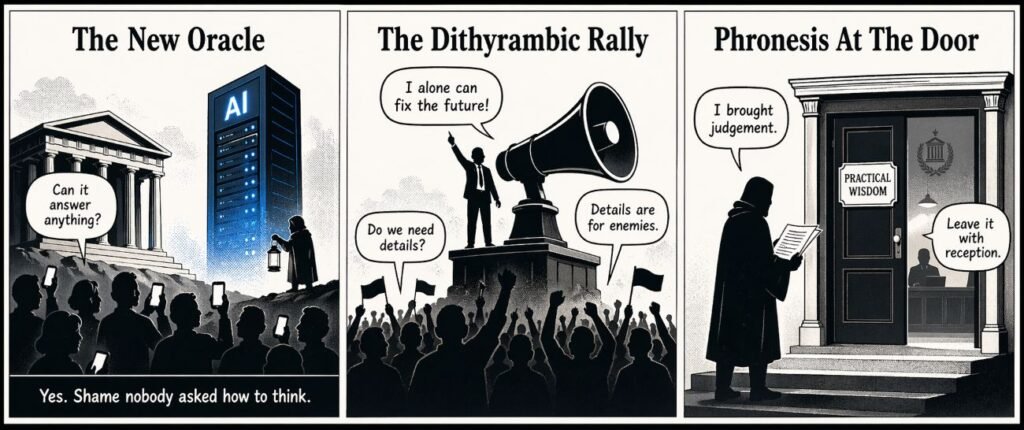
Scene 1: “The New Oracle”
Panel description + dialogue: A glowing AI terminal sits in a marble temple while citizens queue with phones in hand.
Citizen: “Can it answer anything?”
Hermit: “Yes. Shame nobody asked how to think.”
Scene 2: “The Dithyrambic Rally”
Panel description + dialogue: A politician silhouette stands on a stage shaped like a giant loudspeaker while the crowd waves blank policy papers.
Politician: “I alone can fix the future!”
Crowd: “Do we need details?”
Politician: “Details are for enemies.”
Scene 3: “Phronesis At The Door”
Panel description + dialogue: A small figure labelled “Practical Wisdom” knocks on a parliament door while everyone inside argues with screens.
Phronesis: “I brought judgement.”
Voice inside: “Leave it with reception.”
What to watch, not the show
- The incentive to reward attention over judgement.
- The transformation of politics into identity merchandise.
- AI adoption moving faster than civic education.
- Public trust collapsing into smaller tribal rooms.
- Leaders using grievance as fuel instead of solving the engine failure.
- Citizens confusing emotional certainty with truth.
- The quiet disappearance of practical wisdom from public decision-making.
The Hermit take
AI is not the main danger.
A civilisation with powerful tools and no phronesis is the danger.
Keep or toss
Keep.
Keep the ancient words because they still diagnose the patient.
Toss the theatrical stupidity pretending to be leadership while the machines quietly pass the exam.
Sources
- Stanford HAI, 2026 AI Index Report: https://hai.stanford.edu/ai-index/2026-ai-index-report
- Stanford HAI, Inside the AI Index: 12 Takeaways from the 2026 Report: https://hai.stanford.edu/news/inside-the-ai-index-12-takeaways-from-the-2026-report
- APA Dictionary of Psychology, anoetic: https://dictionary.apa.org/anoetic
- Stanford Encyclopedia of Philosophy, Aristotle’s Ethics: https://plato.stanford.edu/entries/aristotle-ethics/
- Merriam-Webster, dithyrambic: https://www.merriam-webster.com/dictionary/dithyrambic
- Edelman, 2026 Trust Barometer: https://www.edelman.com/trust/2026/trust-barometer
- Edelman, 2025 Trust Barometer: https://www.edelman.com/trust/2025/trust-barometer
- Pew Research Center, Public Trust in Government 1958-2025: https://www.pewresearch.org/politics/2025/12/04/public-trust-in-government-1958-2025/
