
Lede
A film about fate that keeps hiding its dates is basically destiny with a blindfold and a smug grin.
“When life happens, love is lost in the abyss of memories, if fate is against the happiness of being together with the only loved one.”
— Raz Mihal
Hermit Off Script
I watched it twice, partly because I wanted to see the actress again, and partly because I wanted to pin down the year when that future event kicks in – yes, I am that sentimental and that stubborn. Joking aside, its beautiful and sad at the same time, the kind of romance that leaves a bruise you keep pressing just to check it’s still real. It hit too close to home: failure, fate, the sense that things happen and you’re just lost in maktub – “it is written” – while life points the finger at your odds of ending up with the only person you actually wanted for the long run. And then there’s the bit that annoyed me: the obsession with grainy black and white for the past or the future, like misery needs a filter to be considered art. Maybe its meant to make the colourful parts feel more magical. Fine. But the timeline? I kept forgetting which year the film was pointing to in the future, not the past. Twice. I tried for the life of me, and still couldn’t properly assess the time difference. Just write the year on screen when you jump, at the start and end, job done. Colour coding would help too. I know some people love black-and-white melancholy. I just want clarity. And honestly, when I go back home, this is what I’ll miss most – not being able to see Korean films at the cinema anymore.
P.S. Content note: yes, there’s kissing involved more than once, and the film’s “drunk-cute” bit does not come within touching distance of Jun Ji-hyun’s gold-standard version. Also, I tried to book this twice before the 31 December 2025 release and it was sold out every time; when I finally got a seat the screen was packed, and it was full again on my second watch today (2 January 2026). Korean cinema still sells its own films in theatres like it means it, while UK cinemas can barely fill seats even when the poster is basically a famous face and a marketing budget.
Once We Were Us (2025) 만약에 우리 Movie Trailer | EONTALK
Once We Were Us (2025) – Movie synopsis roast
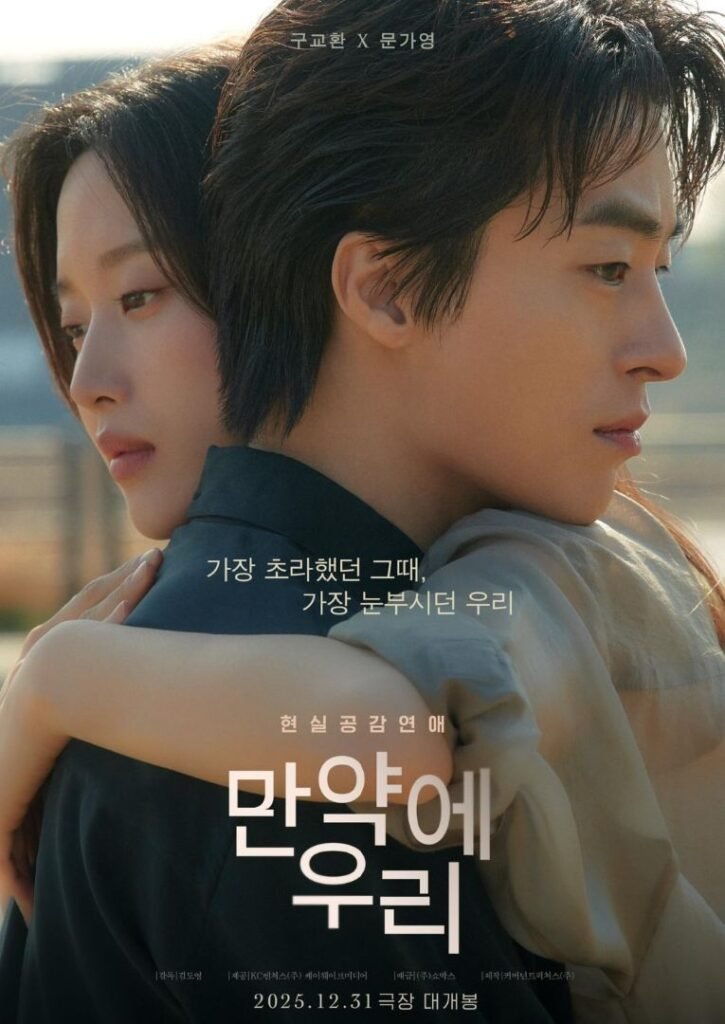
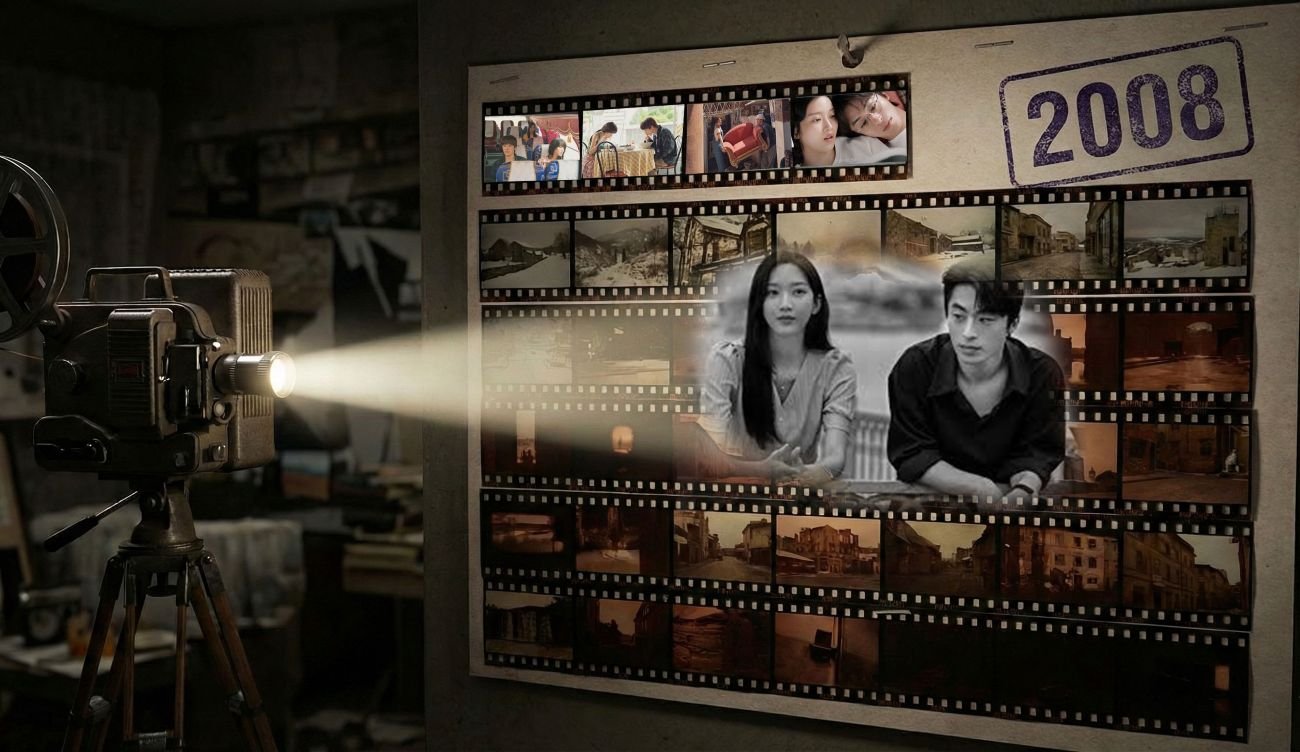
“Once We Were Us” (man-yag-e u-ri) is a bittersweet time-hop romance where two people who were once each other’s whole world meet again years later and discover that memory is both a love letter and a knife. In the present, everything is drained into grainy black-and-white, like the film is mourning its own happiness; in the past, it’s warmer and more alive, watching Koo Kyo-hwan (구교환) and Moon Ga-young (문가영) stumble from friendship into the kind of love that feels inevitable right up until real life turns up with receipts. He chases a big-dream future, she wants something steadier, and the story keeps cutting between “what we were” and “what we did to ourselves” until the reunion lands, and you realise the point is not time travel – it’s regret management.
Cast and credits
Director: Kim Do-young
Writers: Yeum Moon-keung, Kim Ha-na
Main cast: Koo Kyo Hwan (구교환), Moon Ga Young (문가영)
Production company/studio: Covenant Pictures
Distributor: Showbox
Runtime: 114 minutes (often listed 114-115)
Release year and platform: 2025, theatrical release in Korea
What does not make sense
- If the story hinges on “10 years later”, why make the audience play calendar bingo when a two-second date stamp would do.
- Black and white is treated like a universal language for “time” – but without consistent on-screen cues, it becomes a guessing game dressed as poetry.
- The film sells itself as a careful memory machine, then leaves basic chronology as an optional extra.
- A remake that keeps the original device (monochrome versus colour) but forgets the original courtesy: telling you where you are in time.
- Cinema keeps asking viewers to do more homework while also complaining that they don’t show up. Pick a lane.
Sense check / The numbers
- The Korean theatrical release date is 31 December 2025, with the story built around a reunion “10 years later”. [Soompi] [MK] [Korea JoongAng Daily]
- Runtime is commonly listed at 114 minutes (some listings/coverage say 115), but at least one major outlet also calls it “close to 3 hours” – so even the runtime has a mild identity crisis. [Monoplex] [AsianWiki] [Hankyung]
- It’s a Korean remake of the 2018 Chinese film “Us and Them” (directed by Rene Liu), a decade-spanning romance built around memory and regret. [MK] [Soompi] [Wikipedia]
- Director Kim Do-young previously helmed “Kim Ji-young, Born 1982” (2019), which is cited as drawing about 3.67 million admissions in Korea. [Hankyung]
- In-character ambition gets a number too: Eun-ho dreams of earning 10 billion won via game development (quoted as about $6.8 million in one interview). [Korea JoongAng Daily]
The sketch
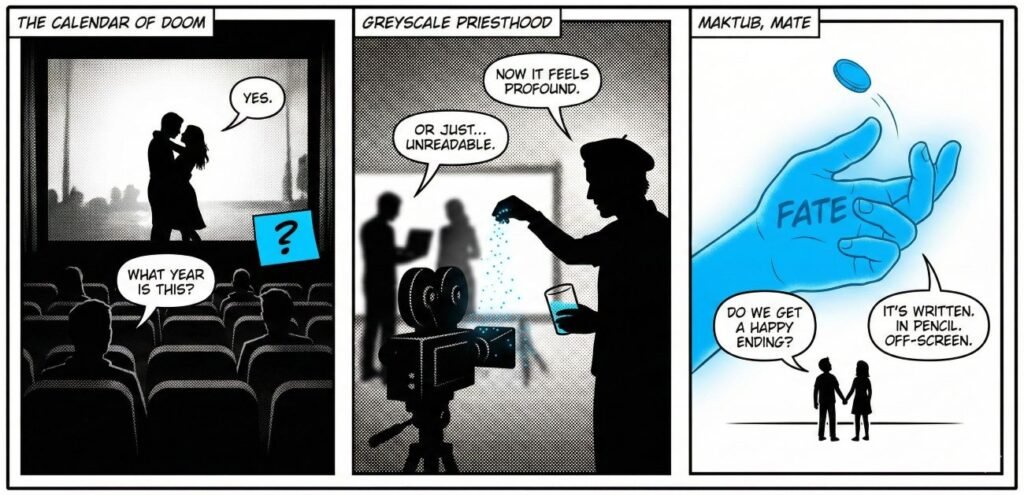
Scene 1: The Calendar of Doom
A cinema screen shows a romance scene, but the corner date stamp is censored with a sticky note.
Dialogue:
Viewer: “What year is this?”
Film: “Yes.”
Scene 2: Greyscale Priesthood
A director in a beret sprinkles grain like holy water over a black-and-white shot.
Dialogue:
Director: “Now it feels profound.”
Editor: “Or just… unreadable.”
Scene 3: Maktub, Mate
A giant hand labelled “FATE” flips a coin onto two tiny characters holding hands.
Dialogue:
Character: “Do we get a happy ending?”
FATE: “It’s written. In pencil. Off-screen.”
What to watch, not the show
- Remake incentives: keep the famous structural trick (monochrome/time) because it’s recognisable, even if it costs clarity.
- Prestige signalling: grain and black-and-white as a shortcut for “serious cinema” rather than better storytelling.
- Audience endurance testing: romance plus time jumps plus minimal labels equals “if you miss one cue, you’re lost”.
- The theatre gap: films like this remind you why cinemas matter, right up until the film forgets basic legibility.
The Hermit take
Fate is scary enough without the editor playing hide-and-seek with the calendar.
If love is the point, give it clean air – not smoke and static.
Keep or toss
Keep / Toss
Keep the ache, the performances, and the grown-up idea that love can be real even when it fails.
Toss the coy timeline games – label the years and let the heartbreak do the heavy lifting.
Sources
- YouTube trailer: https://youtu.be/ekG9oxWV6Rw?si=3WDJHFY2xHlsZTMC
- Soompi – trailer write-up and release date: https://www.soompi.com/article/1804955wpp/watch-mun-ka-young-and-koo-kyo-hwan-regret-letting-go-of-one-another-in-once-we-were-us-trailer
- Maeil Business Newspaper (MK) – synopsis and remake context: https://www.mk.co.kr/en/culture/11496537
- Korea JoongAng Daily – interview and story framing: https://koreajoongangdaily.joins.com/news/2025-12-23/entertainment/movies/Actor-Koo-Kyohwan-sheds-his-intense-persona-for-a-romantic-role-in-Once-We-Were-Us/2483228
- Hankyung – director remarks on black-and-white device, remake framing: https://www.hankyung.com/article/202512182304H
- Monoplex listing – rating and runtime listing: https://www.monoplex.com/movie/694361f40232832068162b71
- AsianWiki – basic film profile (runtime, writers, distributor): https://asianwiki.com/Once_We_Were_Us
- Wikipedia – Maktub definition: https://en.wikipedia.org/wiki/Maktub
- Wikipedia – Us and Them (2018) original film context: https://en.wikipedia.org/wiki/Us_and_Them_%28film%29
