Lede
When a society fails people materially, someone always arrives to sell them meaning, rank and a laminated pass to the truth.
Hermit Off Script
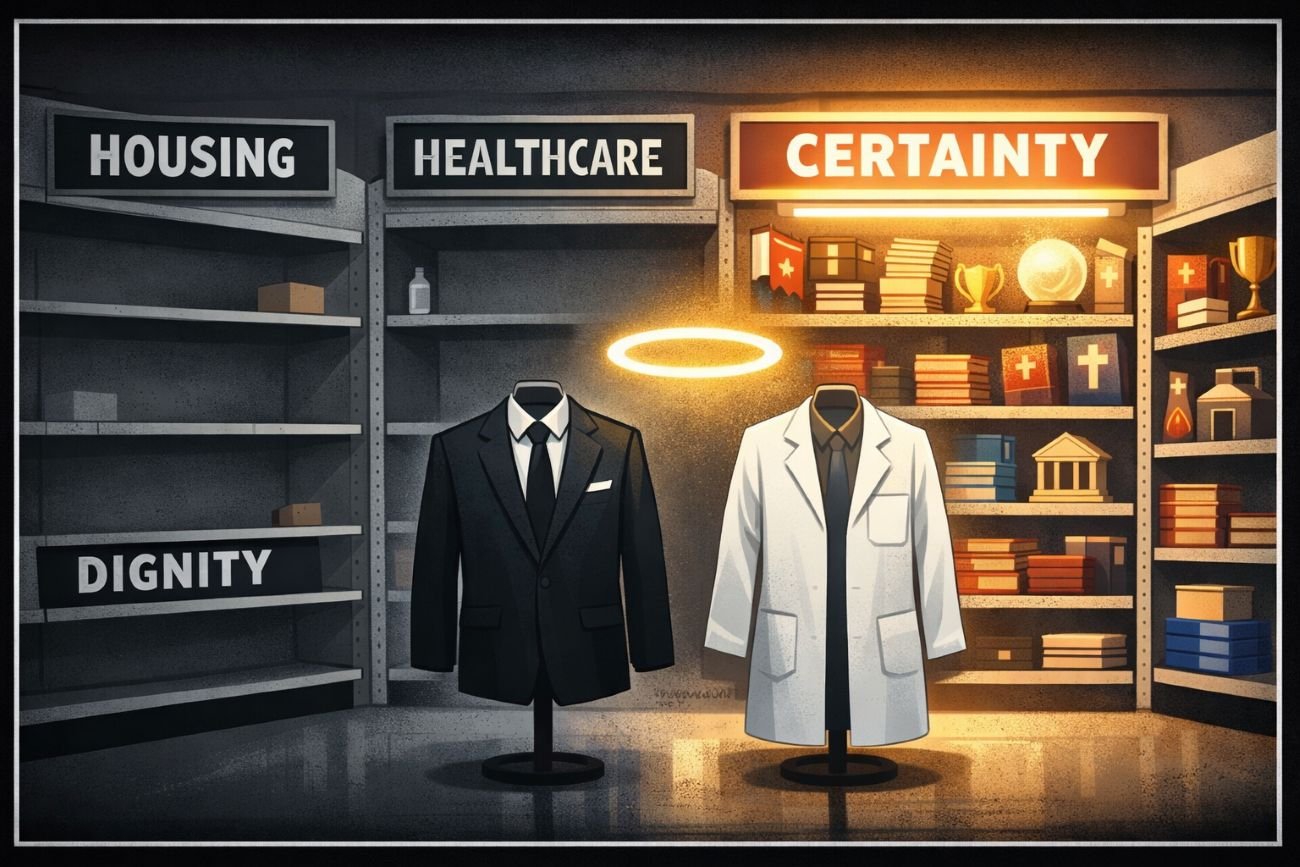
This whole topic is not really about religion being for “the stupid”. That line is too easy, too smug, and frankly too lazy for the size of the mess. Yes, in many countries people with less education are more likely to say religion matters deeply to them, and poorer societies often report higher religiosity. But the numbers also ruin the cheap sneer: some of the most educated religious groups in the world are still very religious, and in the United States some religious groups sit well above the national average for university attainment. So no, this is not a tidy graph of brains versus candles. What I see instead is a market for certainty. When society leaves people insecure, isolated or humiliated, belief systems of every flavour rush in with the same starter pack: belonging, explanation, moral rank, cosmic purpose. Then the strong announce they are chosen, the clever package status as destiny, and the whole racket starts smelling like incense with a management degree. Even science gets dragged into the circus. Not science as method, which is disciplined doubt and testing, but science as slogan, mascot and priest collar for people who want authority without the inconvenience of humility. The real absurdity is not that vulnerable people reach for belief. Of course they do. The absurdity is that power abandons them first, then mocks them for buying the only certainty left on the shelf. That is not enlightenment. That is a protection racket with better fonts.
What does not make sense
- We cut support, dignity and security, then act shocked when certainty merchants gain customers.
- We pretend religion belongs only to the uneducated, then ignore highly educated religious groups when they ruin the neat little theory.
- We say science is a method, then use “the science” like a tribal password and wonder why people smell the sermon.
- We call success merit, then quietly bless the winners as if hierarchy came gift-wrapped from heaven.
- We sneer at the desperate for believing in signs, while elites believe just as hard in markets, branding and their own moral deodorant.
Sense check / The numbers
- As of 2020, 75.8 per cent of the world’s population identified with a religion, while 24.2 per cent did not. Religion is not some niche hobby for the dimly lit corner of society – it remains the global norm. [Pew]
- In Pew’s 2025 survey across 36 countries, people with more education were, in most countries surveyed, less likely to say religion is very important in their lives. But that is a broad tendency, not a universal law. [Pew]
- Global education data break the lazy equation of religion with ignorance. Jewish adults average 13 years of schooling worldwide, Christians and the religiously unaffiliated about 9 years, Buddhists 8 years, and Muslims and Hindus about 6 years. [Pew]
- In the United States, 70 per cent of Hindus and 65 per cent of Jews have a bachelor’s degree or more, compared with 35 per cent of U.S. adults overall. So the phrase “religion is mainly for the uneducated” dies on contact with the evidence. [Pew]
- The “science became a movement” complaint has some sting, but it needs precision. In 2024, 76 per cent of Americans said they had at least fair confidence in scientists, 89 per cent said scientists are intelligent, yet only 51 per cent wanted scientists active in policy debates and just 43 per cent thought scientists make better policy decisions than other people. That is not pure worship. It is trust mixed with suspicion, which is a very modern religion in its own right. [Pew]
The sketch
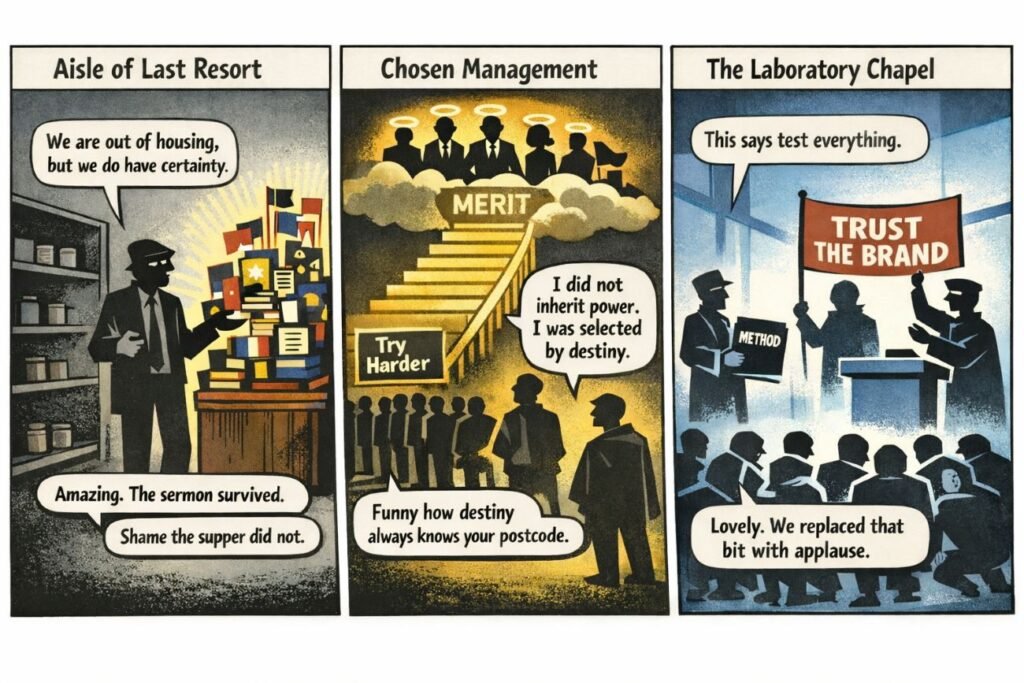
Scene 1: “Aisle of Last Resort”
Panel description + dialogue:
A bare food bank shelf on one side. On the other, a glowing stand stacked with books, flags, icons and miracle promises.
Seller: “We are out of housing, but we do have certainty.”
Hermit: “Amazing. The sermon survived. Shame the supper did not.”
Scene 2: “Chosen Management”
Panel description + dialogue:
A golden staircase marked “Merit” rises to a VIP cloud lounge where rich silhouettes wear halos like corporate badges. A queue of workers waits below a sign reading “Try harder”.
Executive: “I did not inherit power. I was selected by destiny.”
Worker: “Funny how destiny always knows your postcode.”
Scene 3: “The Laboratory Chapel”
Panel description + dialogue:
A lectern in a sleek lab. One figure holds a thick rulebook labelled “Method”, another waves a banner reading “Trust The Brand”. The crowd kneels to the banner, not the book.
Scientist: “This says test everything.”
Herald: “Lovely. We replaced that bit with applause.”
What to watch, not the show
- Material insecurity, because people rarely shop for absolute answers when life already feels safe and dignified.
- Institutional abandonment, because a vacuum never stays empty for long.
- Status laundering, where wealth, class and power get rebranded as virtue, destiny or divine favour.
- Media simplification, because complexity is bad for ratings and certainty is brilliant for sales.
- Algorithmic amplification, because the loudest creed often wins the scroll, not the truest one.
- Identity hunger, because belonging can feel more urgent than accuracy.
- Scientism, where a method for questioning reality gets marketed as a badge for the already convinced.
The Hermit take
Faith is not the main problem. Predatory certainty is.
When meaning is sold where justice is absent, the loudest priest usually wins.
Keep or toss
Keep / Toss
Keep spiritual search, honest doubt and science as method.
Toss the halo for hierarchy, the chosen-one economics and the smug habit of confusing deprivation with stupidity.
Sources
- Pew Research Center, global religious change 2010 to 2020: https://www.pewresearch.org/religion/2025/06/09/how-the-global-religious-landscape-changed-from-2010-to-2020/
- Pew Research Center, religion and education around the world: https://www.pewresearch.org/religion/2016/12/13/religion-and-education-around-the-world/
- Pew Research Center, religious importance and affiliation across 36 countries: https://www.pewresearch.org/religion/2025/05/06/religious-importance-and-religious-affiliation/
- Pew Research Center, which U.S. religious groups are most highly educated: https://www.pewresearch.org/short-reads/2026/02/19/which-us-religious-groups-are-most-highly-educated/
- Pew Research Center, public trust in scientists and their role in policymaking: https://www.pewresearch.org/science/2024/11/14/public-trust-in-scientists-and-views-on-their-role-in-policymaking/
- Gallup, religiosity highest in world’s poorest nations: https://news.gallup.com/poll/142727/religiosity-highest-world-poorest-nations.aspx
- Nature Human Behaviour, trust in scientists across 68 countries: https://www.nature.com/articles/s41562-024-02090-5