Lede
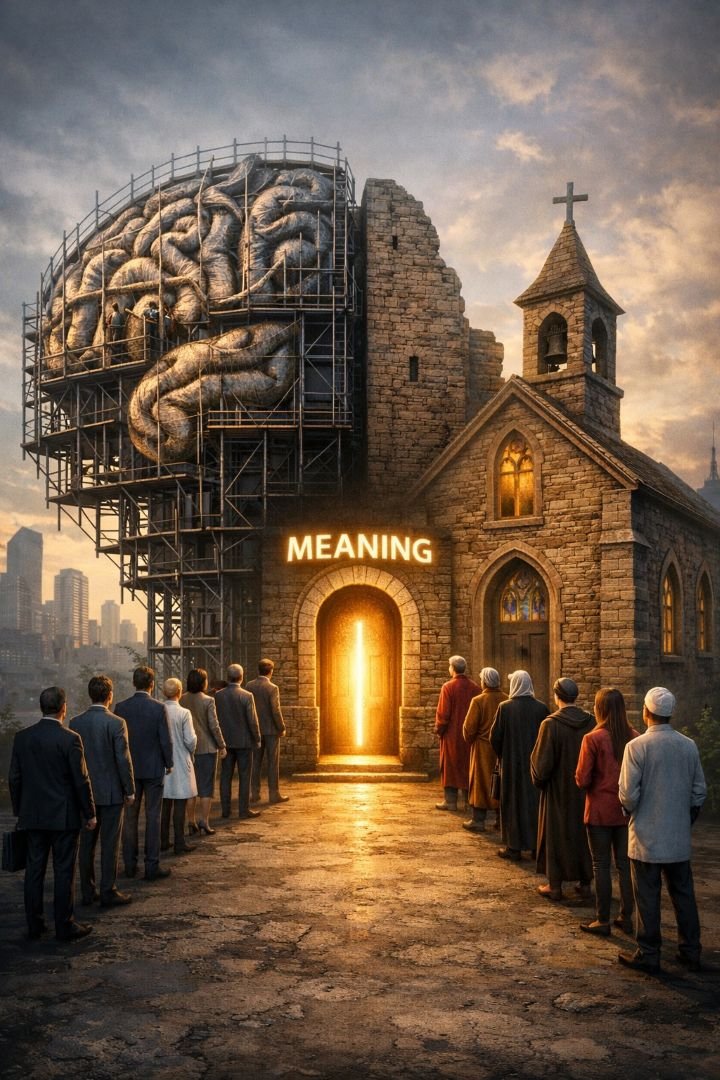
We keep asking “to think or to believe” like the brain and the soul are in a petty custody battle.
Hermit Off Script
It feels like watching clever people build a glittering scaffold around society, then acting shocked when it does not hug them back. Yes, the world is being held up by logic, coding, programming, maths, physics, and the kind of thinking that turns chaos into systems. Fine. Build it. But there is something beyond mind and body – call it soul if you like – and it does not show up just because you solved another equation or shipped another model. The body is simple: train it, feed it properly, and it will become a weapon or an athlete on demand. The mind is also trainable: memory, knowledge, information, disciplines, and you get personalities shaped by science on one side, and the humanities on the other, each with its own strengths and blind spots. Then there is the third crowd: people who master plenty of the above and still feel a missing room inside. So they reach for belief, religion, practices, meditation, and sometimes even try to abolish thinking entirely. Some of them built religions and scriptures that lasted thousands of years, and others made newer ones that still steer societies. So where is the line? It is not either-or. Thinking gets you through the world. Belief points beyond it, and if we are serious about the peak of human consciousness, we need both – without the fraud, and without the fluff.
What does not make sense
- Treating belief as the opposite of thinking, as if faith is a lobotomy with incense.
- Pretending logic alone makes a human complete, when plenty of geniuses still feel hollow at 3 a.m.
- Calling “abolish thinking” a solution, when it often just means “I am tired and want the pain to stop”.
- Mixing up soul with institutions, as if the only doorway to the inner life is a membership card.
- Acting like science and spirituality are enemies, when most of the conflict is about incentives and ego, not truth.
Sense check / The numbers
- The famous dilemma is not “to think or to believe” – it is “To be, or not to be”, from Shakespeare’s Hamlet, first published in 1603. A remix is not a revelation. [British Library]
- Pew Research estimated about 84 per cent of the world’s population was religiously affiliated in 2010, which means belief is not a niche hobby – it is a civilisational default setting. [Pew Research Center]
- The WHO recommends adults do 150 to 300 minutes of moderate-intensity activity per week – the body is literally designed to be trained, not just parked in a chair to worship a screen. [World Health Organization]
- Descartes published Discourse on the Method in 1637, putting disciplined doubt and reason on the map of modern thinking – and people have still been arguing with him ever since. [Stanford Encyclopedia of Philosophy]
- Alan Turing’s 1950 paper framed the modern question of machine intelligence via the imitation game – and we promptly turned it into a marketing contest. [Mind, Oxford Academic]
The sketch
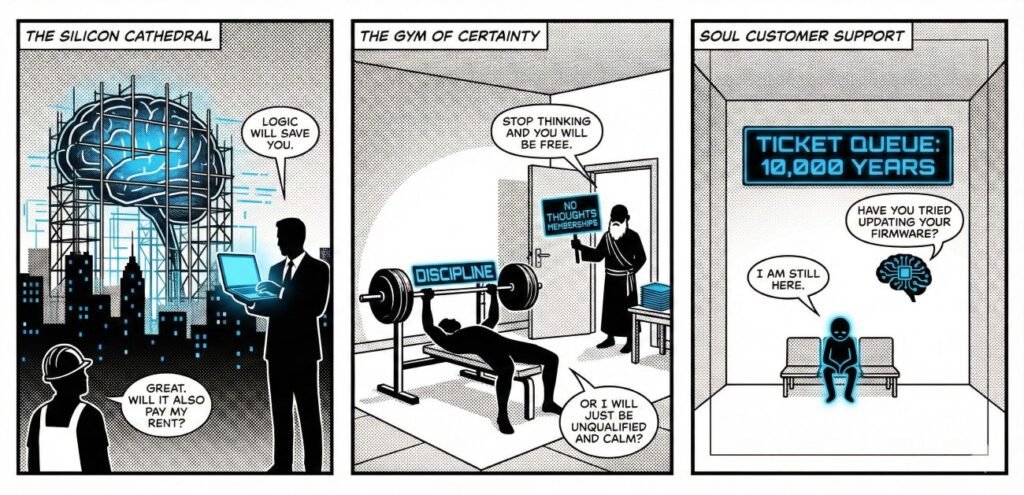
Scene 1: The Silicon Cathedral
A giant scaffold shaped like a brain looms over a city. A suited exec holds a laptop like a holy book.
Exec: “Logic will save you.”
Worker: “Great. Will it also pay my rent?”
Scene 2: The Gym of Certainty
A person bench-presses a bar labelled “Discipline”. A guru sells “No Thoughts” memberships at the door.
Guru: “Stop thinking and you will be free.”
Lifter: “Or I will just be unqualified and calm?”
Scene 3: Soul Customer Support
A tiny “Soul” sits in a waiting room under a sign: “Ticket queue: 10,000 years”.
Soul: “I am still here.”
Brain: “Have you tried updating your firmware?”
What to watch, not the show
- Money: AI funding and hype reward confidence, not wisdom.
- Status: “rational” becomes a costume, “spiritual” becomes a brand.
- Institutions: religions can guide souls, or manage populations, sometimes both.
- Attention: feeds punish slow thought and quiet practice.
- Loneliness: belief often grows where community is missing, not where facts are lacking.
- Power: whoever defines “truth” gets to steer the future.
The Hermit take
Think like your life depends on it, because in this world it does.
Believe like your humanity depends on it, because without that, you are just a clever tool.
Keep or toss
Keep / Toss
Keep the partnership: mind for navigation, belief for meaning.
Toss the fake war between them, and toss anyone selling certainty in either direction.
Sources
- British Library – Hamlet (Shakespeare) overview: https://www.bl.uk/works/hamlet
- Pew Research Center – The Global Religious Landscape (2012, based on 2010 data): https://www.pewresearch.org/religion/2012/12/18/global-religious-landscape-exec/
- World Health Organization – Physical activity recommendations: https://www.who.int/news-room/fact-sheets/detail/physical-activity
- Stanford Encyclopedia of Philosophy – Rene Descartes: https://plato.stanford.edu/entries/descartes/
- Oxford Academic (Mind) – Computing Machinery and Intelligence (Turing, 1950): https://academic.oup.com/mind/article/LIX/236/433/986238
