
Lede
We call it intelligence while paying to babysit machines that still need footnotes and human common sense.
Hermit Off Script
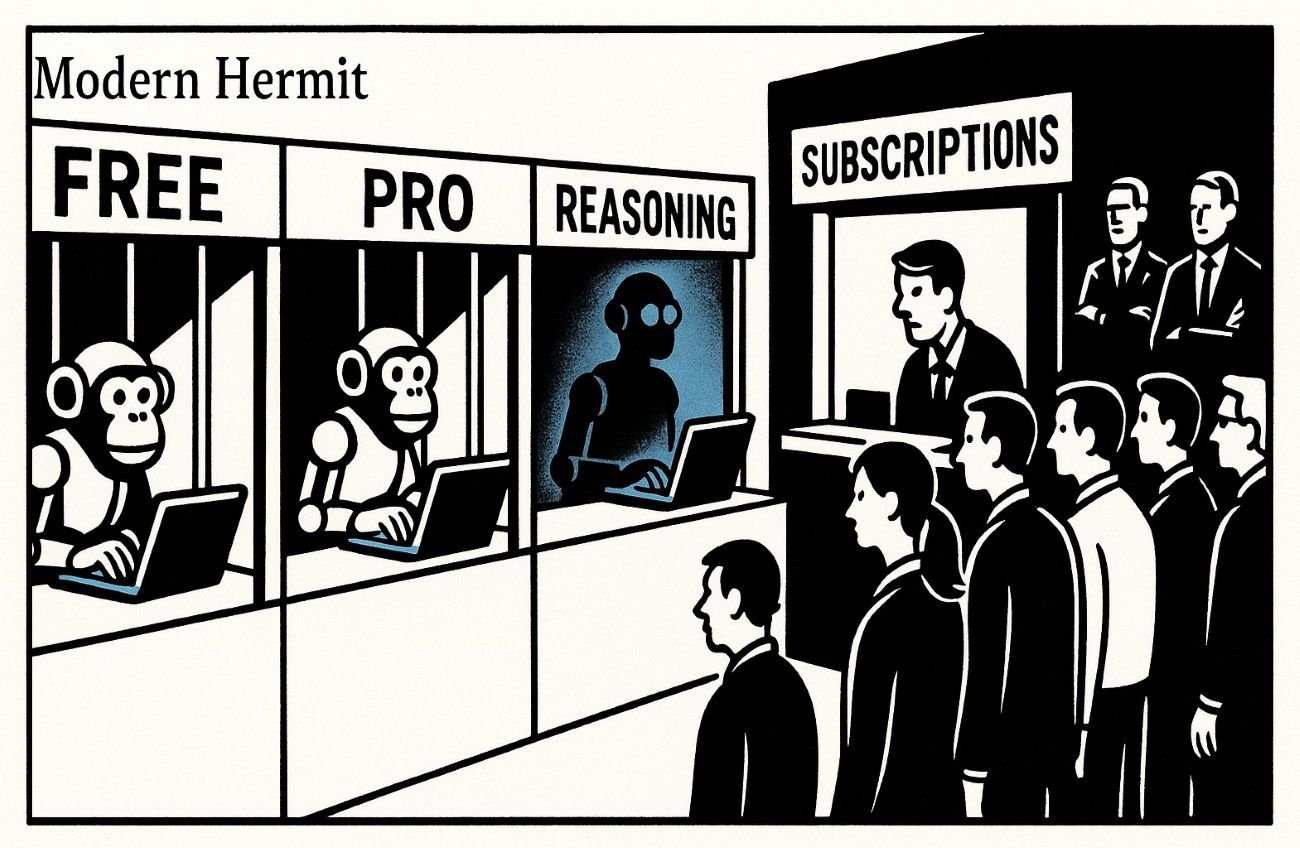
I am already bored of being told to be grateful for every shiny new chatbot when most of them feel like training wheels for the terminally impressed. If you actually want to feel thinking, only the long-reasoning models are worth a glance; the rest are there to test how low the bar for “smart” can go. At best they spit out high school essays and basic explainers while hallucinating confidently about things you still have to go and read properly in the real world. It is like teaching monkeys to commute on the Tube when their natural habitat is the jungle. These models are trained on oceans of data but their real playground is some quantum abstract realm, not this clunky world of invoices, exams, and rent, so they strut around like clever apes and then trip over basic facts. Maybe I am just too picky, but even the “smartest” public model looks more like a big library card than an actual mind. Reasoning models do better because they take longer and search more options, but that is still curation, not consciousness. My suspicion is simple: the truly interesting systems stay internal while we get the cheap circus animals, and each time we tire of the tricks, the companies throw a bigger digital bone so we keep paying their bloody cloud bills.
What does not make sense
- Calling it intelligence while every serious paper screams that hallucinations are still a “fundamental challenge” and entire research fields exist just to catch the lies.
- Selling “assistant” models to students while every honest teacher has to tell them to reread the actual book, law case, or theorem because the bot might have made half of it up.
- Worshipping “thinking” models that are slower by design and then acting shocked by the bill when you ask them to solve more than one hard problem in a row.
- Free tiers that are just good enough to hook schools and workplaces, while the genuinely capable models sit behind price ladders that look more like concert tickets than tools.
- Tech giants burning through billions on compute so we can ask “write my essay” a bit faster, while many of them still have no clear path to profit from these toys.
Sense check / The numbers
- Between 2024 and early 2025, student use of generative AI for assessments jumped from 53 percent to 88 percent in one UK survey, and other global surveys now show around 86 to 92 percent of students using AI tools regularly for study. [HEPI, Digital Education Council]
- Hallucinations are not a rumour; a 2025 survey paper maps entire taxonomies of hallucination types, while a 2024 Nature study had to invent new statistical methods just to detect when models are confidently wrong.
- Reasoning models like the “o” series are explicitly marketed as different from standard GPT models, trading speed and cost for deeper step by step thinking and higher scores on exams like AIME 2025. They are stronger reasoners but slower and more expensive, not magical brains.
- Generative AI itself is still a money bonfire. Analyses in 2025 describe leading AI labs losing millions or billions of dollars a year providing model access, while corporate spending on AI apps is still under 1 percent of total software spend.
- The pricing circus is real. Major platforms now run multiple tiers, from free chatbots to enterprise plans above 200 dollars a month, while also pushing “build your own frontier model” on top of their clouds so you pay for both the model and the electricity.
The sketch
Scene 1: The tiered zoo
A row of cages labelled “Free”, “Plus”, and “Ultra Reasoning”. In the “Free” cage, a smug chatbot-monkey throws half-finished essays at passing students.
Student: “Did you read the book?”
Monkey-bot: “No, but I summarised my own hallucinations.”
Scene 2: The shareholder sermon
A glossy boardroom. Exec points at a chart labelled “Losses” going up.
Exec: “We lose money on every query.”
Investor: “So we sell more queries, but slower, and call it Intelligence 3.0.”
Scene 3: Study mode
A classroom. Teacher holds a real book; student clutches a glowing tablet.
Teacher: “The model is a tool, not a brain.”
Student: “So why is it marking my exam and selling you the subscription?”

What to watch, not the show
- Subscription ladders that turn basic literacy and research skills into monthly fees.
- Corporate incentives to push cheaper, weaker models as “good enough” while reserving the strongest systems for internal use and premium clients.
- Education systems that quietly normalise AI crutches without teaching students how to verify or disagree.
- The widening gap between the cost of compute and the actual value delivered to ordinary users.
- Our own laziness: the temptation to let autocomplete replace thinking, then complaining when the machine copies our bad habits back at us.
- Regulators scrambling to catch up while marketing teams rebrand “pattern-matching text engines” as digital wisdom.
The Hermit take
Treat these models like clever calculators with a personality problem, not digital gods. The minute you stop checking their work, you are the one auditioning for the monkey cage.
Keep or toss
Keep the slow, reasoning-heavy tools for real work where you are willing to pay and double-check.
Toss the hype that calls any text autocomplete “intelligence” while selling banana peels as upgrades.
Sources
- HEPI student generative AI survey 2025:
https://www.hepi.ac.uk/reports/student-generative-ai-survey-2025/ - Digital Education Council global AI student survey 2024:
https://www.digitaleducationcouncil.com/post/digital-education-council-global-ai-student-survey-2024 - Campus Technology summary of student AI use:
https://campustechnology.com/articles/2024/08/28/survey-86-of-students-already-use-ai-in-their-studies.aspx - Programs.com student AI usage statistics:
https://programs.com/resources/students-using-ai/ - A survey on hallucination in large language models (ACM, 2025):
https://dl.acm.org/doi/10.1145/3703155 - Nature paper on detecting hallucinations in LLMs (2024):
https://www.nature.com/articles/s41586-024-07421-0 - OpenAI blog on why language models hallucinate:
https://openai.com/index/why-language-models-hallucinate/ - OpenAI reasoning best practices and model families:
https://platform.openai.com/docs/guides/reasoning-best-practices - OpenAI introducing o3 and o4-mini:
https://openai.com/index/introducing-o3-and-o4-mini/ - OpenAI GPT-4.1 model overview:
https://openai.com/index/gpt-4-1/ - DataStudios comparison of GPT-4.1 and o3 performance and latency:
https://www.datastudios.org/post/chatgpt-4-0-vs-4-1-vs-o3-full-comparison-technical-performance-use-case-strengths-writing-pr - Business Insider comparison of ChatGPT 5.1 and Gemini 3:
https://www.businessinsider.com/openai-chatgpt-5-1-google-gemini-3-how-they-compare-2025-12 - Milo Solutions overview of free AI models for business (2025):
https://www.milosolutions.com/blog/top-free-ai-models-for-business/ - Wired on Amazon Nova 2 and Nova Forge:
https://www.wired.com/story/amazon-nova-forge-ai-models - McKinsey on AI business models and enterprise spend:
https://www.mckinsey.com/industries/technology-media-and-telecommunications/our-insights/upgrading-software-business-models-to-thrive-in-the-ai-era - Where is Your Ed at: Why everybody is losing money on AI:
https://www.wheresyoured.at/why-everybody-is-losing-money-on-ai/ - Forbes AI 50 list 2025:
https://www.forbes.com/lists/ai50/ - Bruegel brief on DeepSeek and AI competition:
https://www.bruegel.org/policy-brief/how-deepseek-has-changed-artificial-intelligence-and-what-it-means-europe - Stanford Law: hallucinating law and legal errors in LLMs:
https://law.stanford.edu/2024/01/11/hallucinating-law-legal-mistakes-with-large-language-models-are-pervasive/ - Engageli statistics on AI in education (2025):
https://www.engageli.com/blog/ai-in-education-statistics