
Lede
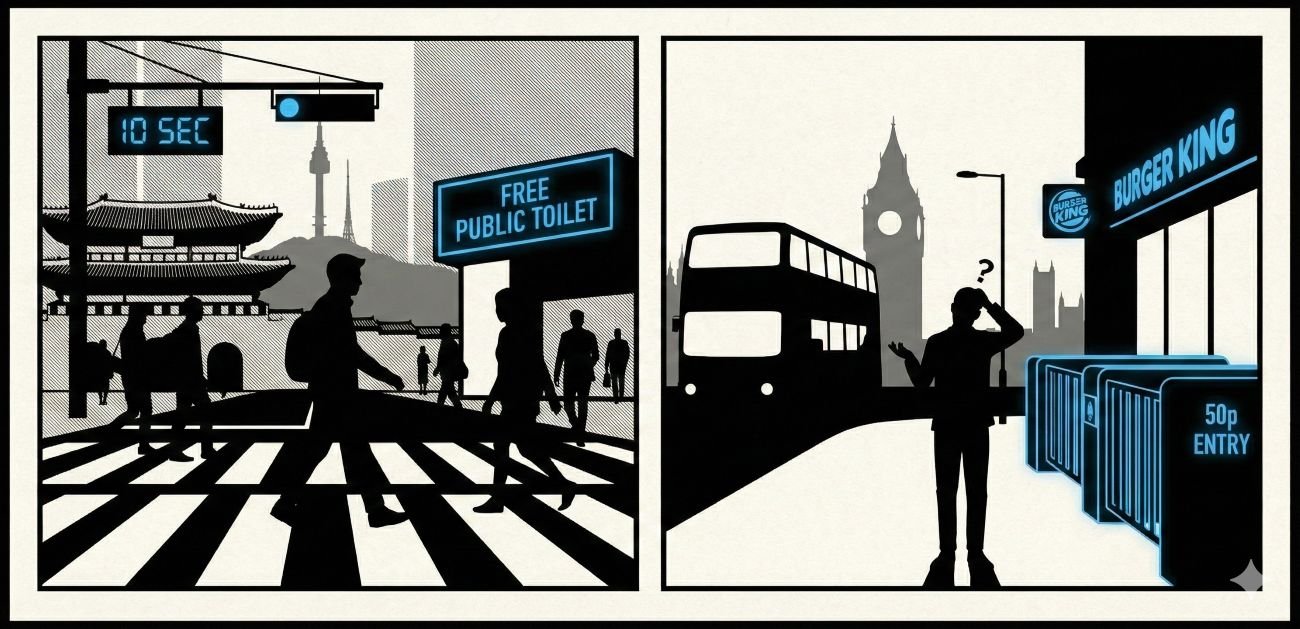
Seoul behaves like the city belongs to its people; London behaves like the people are lucky to be billed by the city.
Hermit Off Script
I land in Seoul, cross one street, and the traffic light politely tells me how many seconds of life I have left before it turns on me. Green countdown, red countdown, the whole thing feels like the system assumes I might want to survive the day. In the UK, half the crossings still look like a riddle, and if they could invoice you for pressing the button, they would. In Korea, most tourist spots do not feel like a wallet trap, loos are free from subway to back alley, and the state acts as if public money should actually flow back to the public. In Britain, they would meter your breath if they could fit a card reader to your lungs. Western governments act like landlords of the nation, with citizens as walking direct debits: rules for the many, freedom for the rich, bills stacked on industrial food that turns half the population into a captive market with a BMI. Meanwhile in Korea you can still eat something that tastes like an actual mum cooked it, without needing a loan. One day, maybe we will vote with a button, not with slogans funded by the same people who own the billboards.
What does not make sense
- A city that counts down seconds for pedestrians in Seoul but counts up parking fees in London.
- Toilets treated as a basic service in Korea and as a side hustle in the UK.
- Public money in Korea building free parks, palaces and museums, while UK councils quietly turn everything into a vending machine.
- Calling it freedom when only the rich can afford the lawyer, the season ticket and the organic salad.
- Governments announcing they will end poverty while pricing basic food like a luxury brand, and then blaming people for their weight.
- Everyday Korean food that still resembles cooking vs Western high streets run by industrial beige calories in cardboard.
- Pretending elections are the people’s voice when the loudest sound is always the campaign chequebook.
Sense check / The numbers
- Pedestrian crossings
Seoul has been rolling out countdown traffic signals that show how long you wait on red and how long you have left on green, with around 300 locations upgraded and citizen satisfaction above 98 per cent in recent surveys.
The whole point is to reduce jaywalking and stress, not raise fine revenue. - Public toilets as policy, not charity
Seoul’s government talks about managing roughly 20,000 public restrooms in the city and has national law backing the installation and management of public toilets as a state responsibility.
Korean development papers note that pay toilets once existed but have been steadily replaced by free facilities as part of public health goals. - Paying to pee in the UK
In contrast, the UK still treats toilets as coin slots. In some parts of the country, public loos charge around 50p per visit, with the most expensive examples charging £1 per use, including tourist-heavy spots and even some central London facilities. - Free culture versus ticket culture
Seoul regularly opens major royal palaces and national museums for free during holidays like Chuseok, and travel guides can list twenty-plus free attractions in the city without even trying.
Meanwhile, many flagship UK cultural sites lean heavily on ticket revenue or pricey add-ons around the edges of what is still technically public heritage. - Food and weight
On health, the numbers quietly underline the rant. OECD and related stats show obesity rates in the UK hovering around the 30 per cent mark, while Korea stays among the lowest in the OECD bloc, even as its own rates rise.
Turn food into an industrial profit pipeline, and you get exactly what you ordered: extra-large citizens and extra-large healthcare bills.
The sketch
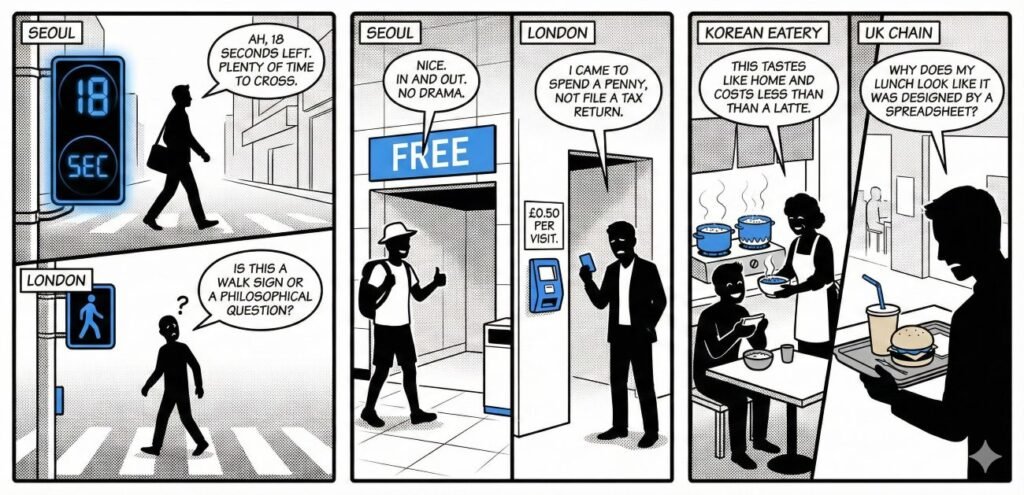
Scene 1: Crosswalk theology
A Seoul junction. Countdown traffic light over the road.
Pedestrian: “Ah, 18 seconds left. Plenty of time to cross.”
Cut to London crossing with no timer.
Londoner: “Is this a walk sign or a philosophical question?”
Scene 2: The 50p throne
Panel split. Left: Seoul subway loo, clean, bright, big FREE sign.
Tourist: “Nice. In and out. No drama.”
Right: London pay toilet with a card reader.
Sign: “£0.50 per visit.”
Londoner: “I came to spend a penny, not file a tax return.”
Scene 3: Dinner democracy
Left: Small Korean eatery, pots bubbling, ajumma serving.
Diner: “This tastes like home and costs less than… than a latte.”
Right: UK high street chain, beige burger and soda meal.
Customer: “Why does my lunch look like it was designed by a spreadsheet?”
What to watch, not the show
- Privatisation and outsourcing of basic services, such as toilets and transport.
- Austerity budgets pushing councils to monetise every square metre of public space.
- Food systems built for profit per calorie, not health per person.
- Urban design that prioritises cars, retail and tourism over residents on foot.
- Media narratives that blame individuals for debt, weight and stress rather than structure.
- Electoral systems where money and marketing still speak louder than any “vote with one click” fantasy.
The Hermit take
If a city really belongs to its people, you can see it in the crossings, the loos and the kitchens, not in the slogans. Follow the small daily mercies, and you will find out who your government actually works for.
Keep or toss
Keep / Toss
Keep the Korean habit of treating toilets, crossings and simple food as rights, not upgrades.
Toss the British habit of charging for every human need and then acting surprised when people feel broke, tired and one burger away from collapse.
Sources
- Seoul countdown pedestrian signals and satisfaction – https://world.kbs.co.kr/service/news_view.htm?Seq_Code=190748&lang=e
- Seoul expansion of countdown traffic lights – https://www.hapskorea.com/seoul-expands-countdown-traffic-signals-to-enhance-pedestrian-safety/
- Seoul public restrooms and spy-cam inspections (around 20,000 facilities) – https://english.seoul.go.kr/seoul-city-to-daily-check-entire-20000-public-restrooms-to-make-them-spy-cam-free/
- Public Toilets Act of Korea, state responsibility for installation and management – https://elaw.klri.re.kr/eng_service/lawView.do?hseq=19627&lang=ENG
- Korean public toilet improvement experience, pay vs free – https://archives.kdischool.ac.kr/bitstream/11125/42118/1/%282014%29%20Modularization%20of%20Korea%27s%20development%20experience_Korean%20public%20toilet%20improvement%20experience%20and%20its%20implications.PDF
- UK public toilet charges, 50p to £1 examples – https://www.excelsior-cubicles.co.uk/the-most-expensive-public-toilets-in-the-uk/
- Free palace and museum entry in Seoul during Chuseok – https://www.koreatimes.co.kr/lifestyle/people-events/20251002/cultural-experiences-to-enjoy-during-chuseok-holiday
- Guide to free attractions in Seoul – https://alovelettertoasia.com/free-things-seoul/
- Obesity rates, UK vs Korea comparison – https://www.statista.com/chart/20057/obesity-rates-eu/
- OECD Health at a Glance 2025, Korea profile – https://www.oecd.org/en/publications/health-at-a-glance-2025_15a55280-en/korea_40b1d2b4-en.html
- Korean obesity and overweight data, KDCA – https://www.kdca.go.kr/filepath/boardDownload.es?bid=0030&list_no=729058&seq=3