Rental Family (2025): Japan, impostor syndrome, and 8 million gods
Lede
A film that reminds us that all art is theft, families can be rented, and if you look in a mirror long enough, you might just find a god staring back.
Hermit Off Script
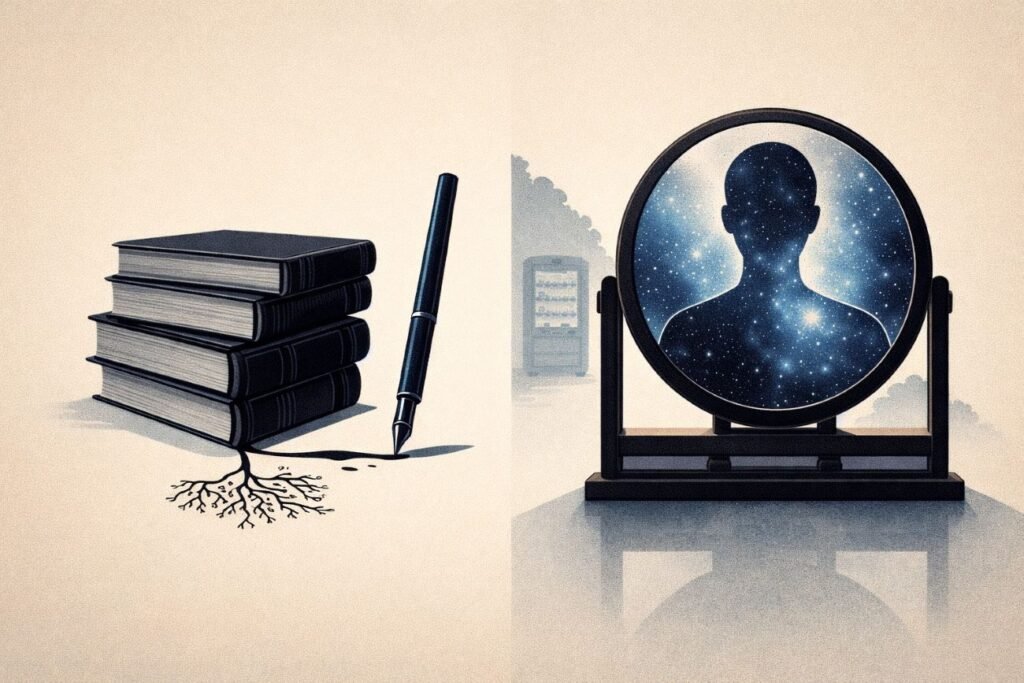
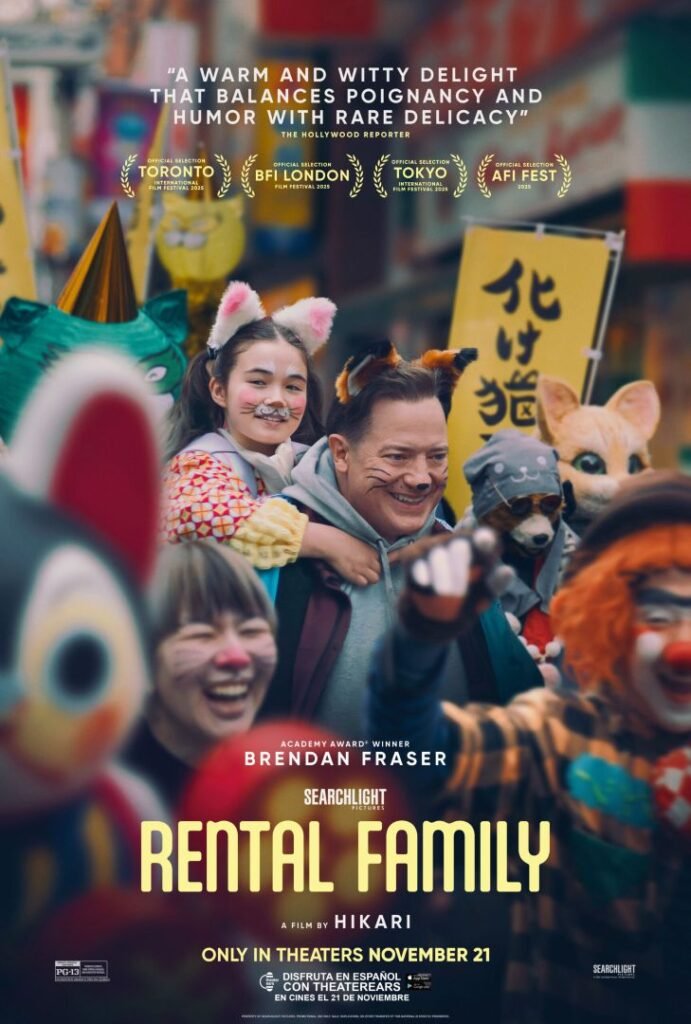
Rental Family is exactly the kind of film I’d pay IMAX money for, because Japanese and Korean cinema have that unique flavour Western cinema keeps misplacing like its own soul in a handbag. My first impression, seeing the actor move to Japan, was simple: what if I’d done that too – moved to Seoul, South Korea, like I wanted at some point in time. I wouldn’t do it now, but if I was younger? Definitely, I was a lot crazier back then, following the hints of divine love like they were directions, not metaphors. Then the film drops the cleanest little knife at 00:34:24: “Are you a thief?” “No, I’m just a writer.” “All writers are thieves.” Truth be told, yes, every writer out there stole some words without thinking, being trained on the numerous books read. It’s impossible not to have an influence from the writers you liked, or ideas that shaped your own writing. And then it hits you with the Shinto lens: “Japan has more gods than vending machines” and the whole “8-million gods” idea – God in everything, even in you, even in who you’re pretending to be. I liked the end most: the shrine mirror, where you realise you were not praying out into the world at all, you were praying into your own image. That is a very meaningful message if you have the spiritual intelligence to see it – and a very awkward one if you don’t.
RENTAL FAMILY (2025) | Official Trailer | Searchlight Pictures
Rental Family (2025) | Movie synopsis roast
It is a story about rented intimacy that earns its sincerity by refusing to shout.
In modern-day Tokyo, Phillip, an American actor running on fumes and missed chances, stumbles into a job that sounds like a punchline and plays like a confession: he joins a “rental family” agency, hired to impersonate the relationships other people cannot reach on their own.
Each gig is half theatre, half triage: a stand-in father here, a borrowed friend there, a polite lie told well enough to keep someone standing. That is the film’s best trick. It treats performance not as glamour, but as care work with a moral price tag. Phillip begins as a man acting to survive, then slowly becomes someone who means it, even when the company insists it is “just the job”.
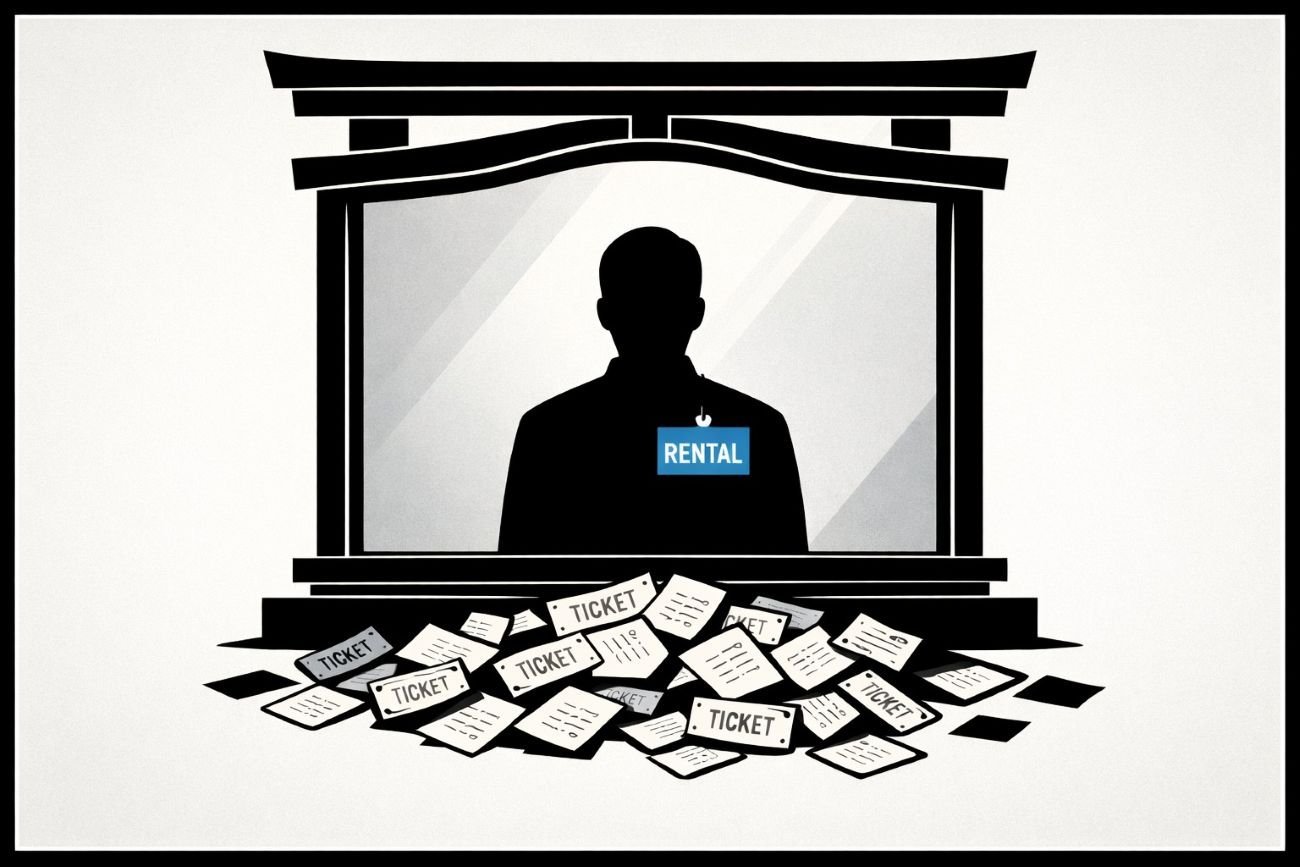
The strongest thread is its quiet spiritual nerve. The film leans into a Shinto idea sometimes framed as “8 million gods” – the divine threaded through everything, even the person doing the pretending. That lands in the final image: a shrine mirror that does not flatter, does not judge, and does not let you outsource your worth. If the west loves a grand sermon, this film offers a smaller, sharper altar: look. Recognise. Then live accordingly.
Cast and credits
Director: Hikari [Searchlight Press] Writers: Hikari; Stephen Blahut [Searchlight Press] Genre: comedy-drama [Wikipedia] Main cast: Brendan Fraser; Takehiro Hira; Mari Yamamoto; Shannon Mahina Gorman; Akira Emoto [Searchlight Press] Composer: Jonsi; Alex Somers [Wikipedia] Production companies: Sight Unseen Productions; Domo Arigato Productions [Wikipedia] Distributor: Searchlight Pictures [Searchlight Press] Release year: 2025 (US), UK cinema release in 2026 [Searchlight Press] [Guardian]
What does not make sense
The Western “originality” panic when the whole creative economy is basically inheritance with better branding.
The idea that paying a stranger to be your family is any stranger than the performative relationships we see on social media for free.
The spiritual punchline is sharp, but the road there can feel like a series of gigs stitched together with good intentions.
Sense check / The numbers
Timeline: the film premiered at TIFF on 6 September 2025 and had a US release on 21 November 2025, with UK cinemas set for 16 January 2026. [Wikipedia] [Searchlight Press] [Guardian]
Runtime is a small mess: some listings say 110 minutes, others list 1h 43m (103 minutes). That is either an edit, a listing error, or proof the internet can’t count to 110 without improvisation. [Wikipedia] [Rotten Tomatoes]
Box office: $18,423,072 worldwide, with $10,047,429 domestic (54.5 per cent) and $8,375,643 international. Domestic opening was $3,336,147. [Box Office Mojo]
Mid-film theology: “8-million gods” (Yaoyorozu no Kami) is used to land the point that God is in everything, “even in you” – even in who you’re pretending to be. [Sojourners]
The God Count: The concept of “Yaoyorozu no Kami” (Eight Million Gods) in Shinto is literal and metaphorical, suggesting the divine exists in everything, from mountains to, yes, perhaps even vending machines [Encyclopedia of Shinto].
The Rental Industry: The film is based on the real phenomena of “Rental Families” in Japan, where companies like Family Romance allow lonely individuals to hire actors to play wives, fathers, or friends [The New Yorker].
The Mirror: In Shinto shrines, the shinkyo (sacred mirror) is a central object of worship. It reflects the worshipper, symbolizing that the kami (god) and the human spirit are connected [Kokugakuin University].
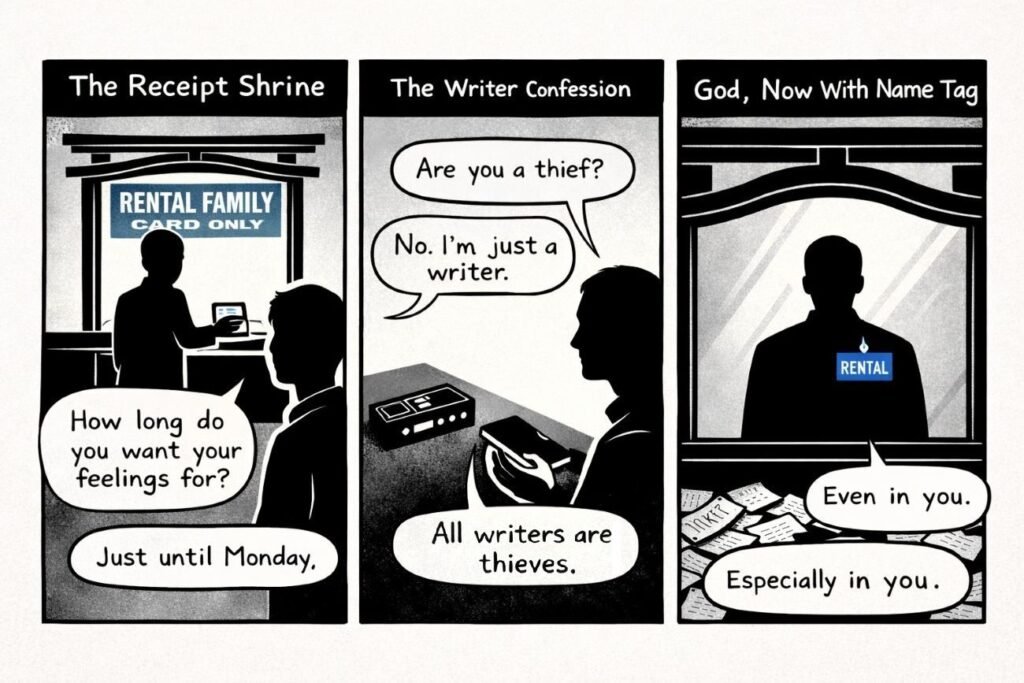
The sketch
Scene 1: The Receipt Shrine Panel: A shrine mirror sits behind a counter like a till. A sign reads “RENTAL FAMILY – CARD ONLY”. Dialogue:
Clerk: “How long do you want your feelings for?”
Customer: “Just until Monday.”
Scene 2: The Writer Confession Panel: A tape recorder on a table. Phillip holds a notebook like it’s contraband. Dialogue:
Voice: “Are you a thief?”
Phillip: “No. I’m just a writer.”
Voice: “All writers are thieves.”
Scene 3: God, Now With Name Tag Panel: The shrine mirror reflects a silhouette wearing a bright name tag that says “RENTAL”. Dialogue:
Kikuo: “Even in you.”
Mirror: “Especially in you.”
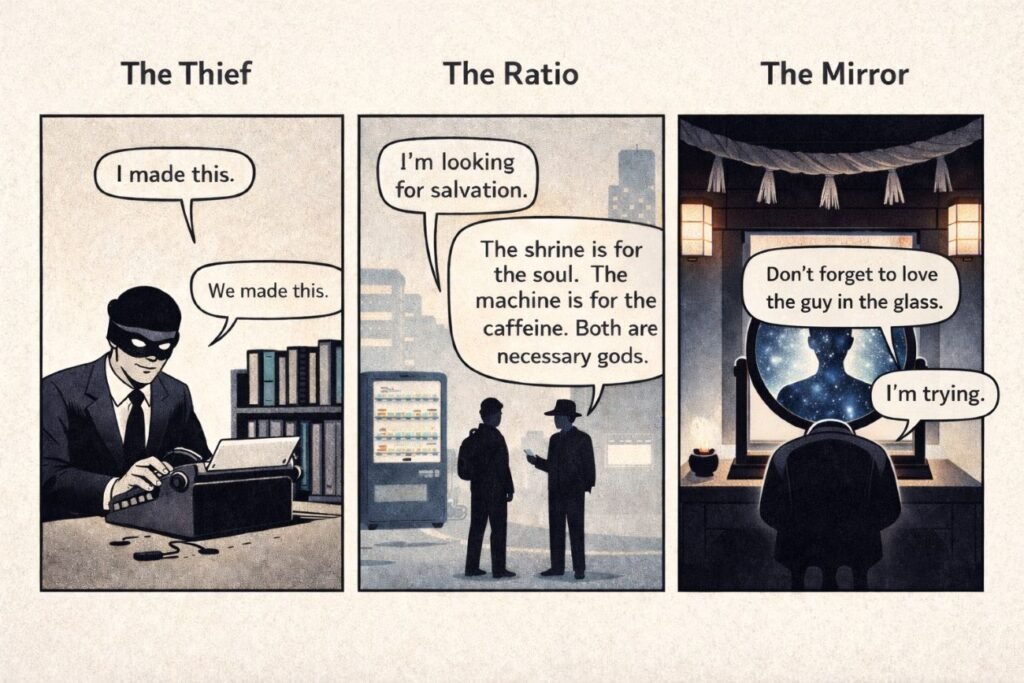
Scene 1: The Thief Panel: A writer sits at a typewriter, wearing a bandit mask. Dialogue:
Writer: “I made this.”
Bookshelf: “We made this.”
Scene 2: The Ratio Panel: A street in Tokyo. A vending machine stands next to a small shrine. Dialogue:
Tourist: “I’m looking for salvation.”
Local: “The shrine is for the soul. The machine is for the caffeine. Both are necessary gods.”
Scene 3: The Mirror Panel: A man bows deeply before a shrine mirror. Dialogue:
Reflection: “Don’t forget to love the guy in the glass.”
Man: “I’m trying.”
What to watch, not the show
Loneliness as an industry: when absence becomes a service category.
Identity as gig work: roles, masks, and the soft violence of “perform for me”.
Cultural texture versus Western bluntness: the quiet bits do the real work.
The temptation to monetise meaning: spiritual insight, but with a price tag attached.
The comfort of outsourcing identity: rent a role long enough and you forget you had a self.
That we build massive IMAX screens for explosions but relegate films with actual spiritual depth to small screens or streaming.
The Hermit take
If God is inside us, then self-respect is a form of prayer. Western cinema could learn a lot from a mirror that reflects the soul rather than just the special effects.
Keep or toss
Keep Keep the movie, and keep the realisation that we are all thieves of the divine.
Sources
IMDb title page: https://www.imdb.com/title/tt14142060/
Searchlight film page: https://www.searchlightpictures.com/rental-family
Sojourners essay on “8-million gods”: https://sojo.net/articles/culture/rental-family-brendan-fraser-loves-his-neighbor-lying-them
The Guardian review (UK release date context): https://www.theguardian.com/film/2026/jan/14/rental-family-review-brendan-fraser-japanese-role-play-drama-hikari
Wikipedia entry (runtime listing, credits, TIFF date): https://en.wikipedia.org/wiki/Rental_Family
Subtitlecat transcript with timecodes: https://www.subtitlecat.com/subs/1333/Rental.Family.2025.en.html
The New Yorker on Japan’s Rental Families: https://www.newyorker.com/magazine/2018/04/30/japan-rent-a-family-industry
Encyclopedia of Shinto on Yaoyorozu no Kami: https://d-museum.kokugakuin.ac.jp/eos/detail/?id=9383
Kokugakuin University on The Sacred Mirror: https://www.kokugakuin.ac.jp/en/article/11111
Searchlight press page for Rental Family: https://press.searchlightpictures.com/rental-family
BBFC classification entry for Rental Family: https://www.bbfc.co.uk/release/rental-family-q29sbgvjdglvbjpwwc0xmdmymdi2
Box Office Mojo totals for Rental Family: https://www.boxofficemojo.com/title/tt14142060/
Associated Press on real-life “rental family” services and the film: https://apnews.com/article/c366de36b1ff0498791ebda88ed7c0f0
Kokugakuin Encyclopedia of Shinto, “Introduction: Kami”: https://d-museum.kokugakuin.ac.jp/eos/detail/?id=9163
Kokugakuin Encyclopedia of Shinto, “Kagami”: https://d-museum.kokugakuin.ac.jp/eos/detail/?id=9667
The New Yorker (with editors’ note) on Japan’s rent-a-family industry: https://www.newyorker.com/magazine/2018/04/30/japans-rent-a-family-industry
Reuters interview on the film and Brendan Fraser: https://www.reuters.com/lifestyle/brendan-fraser-builds-bonds-japan-set-film-rental-family-2025-10-16/
People interview on the film and TIFF premiere: https://people.com/how-brendan-fraser-learned-japanese-new-movie-rental-family-toronto-film-festival-11805036
Satire and commentary. Opinion pieces for discussion. Sources at the end. Not legal, medical, financial, or professional advice.
[…] been the main punch. Instead, I left thinking I’d have paid the same money, happily, to watch Rental Family (2025) in IMAX. Amazon Studios can afford the format. Real talent usually […]
Satire and commentary. My views. For information only. Not advice.


One response
[…] been the main punch. Instead, I left thinking I’d have paid the same money, happily, to watch Rental Family (2025) in IMAX. Amazon Studios can afford the format. Real talent usually […]