

Lede
Project Hail Mary proves that a handsome space adventure can still look glorious in IMAX while the actual cinema around it feels engineered by people who hate spines.
Hermit Off Script
Project Hail Mary is exactly the kind of film that earns its IMAX ticket, because on a normal screen a lot of its scale would shrink into “that was nice” and at home half the room would end up checking messages during the quieter bits. But let us calm down before anyone starts throwing Interstellar at it like holy water. This is not that kind of transcendence. It is a warmer, friendlier, more playful sci-fi ride, the sort of thing that leans more on charm, funny exchanges and animated wonder than on cosmic awe. That is fine. I enjoyed it. The problem is that the film is not fighting streaming half as hard as the cinema itself is. Right in front of me sat a grey-haired empire-builder who threw his coat over the backrest like he was claiming new land, so I had to keep lifting my head to separate his wardrobe and his head from the actual frame. Then came the constant popcorn crackling nearby, because apparently silence in a cinema now lasts about as long as political honesty. So yes, the IMAX image was glorious, and the social environment was a mild punishment with surround sound. What I do not understand is why these companies refuse obvious comfort fixes. There is space. Remove a row. Widen the gap. Stop arranging adults like school assembly extras and then charging premium money for the privilege of neck negotiation. They moan about streaming, yet keep making home viewing feel like the luxury option. The spaceship in this film is built to save civilisation. The auditorium is built to sell snacks.
Project Hail Mary (2026) | Official Trailer
Project Hail Mary and the IMAX Neck-Strain Mission
A clever, enjoyable space adventure that looks glorious in IMAX, but the real survival test is still modern cinema itself – blocked views, popcorn warfare and premium prices for organised discomfort.
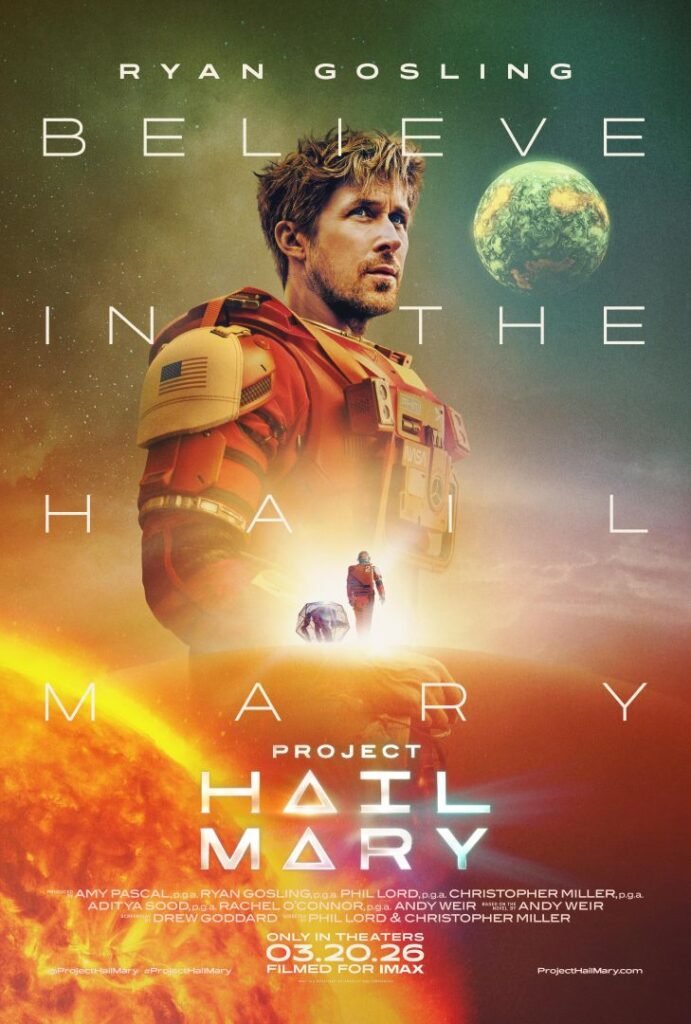
Project Hail Mary follows Ryland Grace, a science teacher who wakes up alone on a spaceship with no memory of who he is or why he is there. As his memory returns, he discovers he is on a desperate mission to solve a threat to the Sun and save life on Earth. The film blends survival, science, humour and an unexpected friendship in deep space.
Ryan Gosling goes to space to save Earth, while the cinema makes you fight coats, popcorn and neck pain just to see him do it.
Cast and credits
Director: Phil Lord, Christopher Miller.
Writers: Drew Goddard, based on the novel by Andy Weir.
Genre: Sci-fi adventure.
Main cast: Ryan Gosling, Sandra Huller, Lionel Boyce, Ken Leung, Milana Vayntrub
Composer: Daniel Pemberton
Production company/studio: Amazon MGM Studios
Runtime: 156 minutes.
Release year and platform: 2026, cinemas and IMAX
Andy Weir | Author bio

Andy Weir is an American science fiction author and former software engineer whose breakthrough novel, The Martian, turned him from a lifelong space obsessive into a full-time writer. Known for mixing hard science with humour, problem-solving and accessible storytelling, he went on to write Artemis and Project Hail Mary, the novel later adapted into the 2026 film. According to his official author bio, he spent around two decades working in software engineering before writing full-time, and his long-standing interests include relativistic physics, orbital mechanics and the history of human spaceflight. He lives in California.
Project Hail Mary | Book synopsis
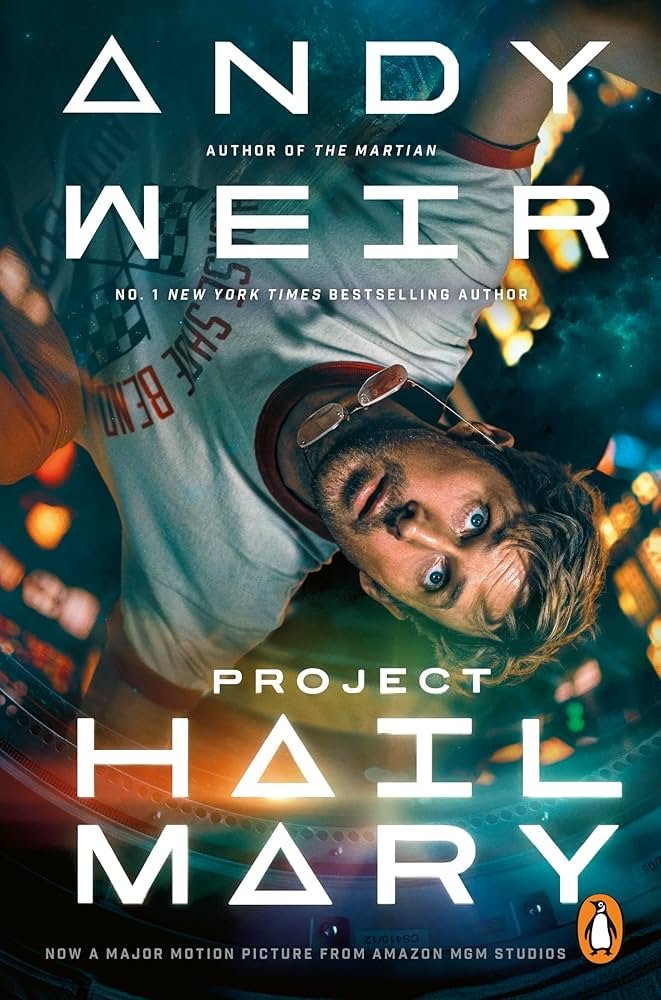
Project Hail Mary follows Ryland Grace, a former molecular biologist turned school science teacher, who wakes up alone on a spacecraft with no memory of who he is or why he is there. As his memories slowly return, he realises he is humanity’s last-chance mission against an extinction-level threat linked to a mysterious organism draining the Sun. What begins as a survival puzzle becomes a story about science, problem-solving, and an unexpected bond that changes the mission completely. The publisher’s synopsis makes the book sound lonelier and harsher than the film’s blurb, stressing that Grace wakes with two dead crewmates beside him and believes he must do it all alone… at least at first.
Project Hail Mary: Book vs Film – Science vs Spectacle
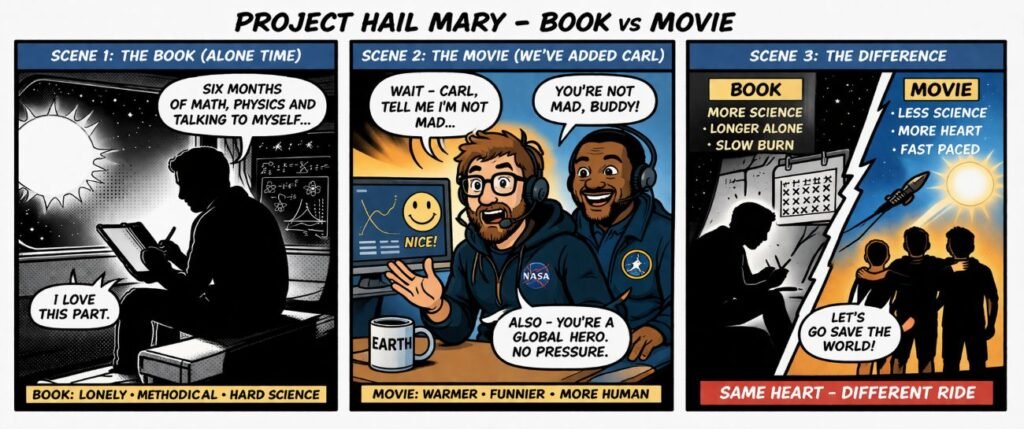
The film keeps the book’s core spine very closely. It still uses the same memory-return structure, still centres on Ryland Grace waking in deep space, and still builds around the same mission, the same unlikely friendship, and the same emotional heart. Phil Lord said Drew Goddard kept the flashback structure, the surprises and the ending, while Goddard said the film largely follows the book’s structure and was built around protecting what made the novel unique.
Project Hail Mary: same heart, less homework
The book is lonelier, nerdier and more methodical, while the film keeps the same core story but trims the science to become warmer, faster and more crowd-friendly.
Project Hail Mary the book is more dry, methodical and properly trapped inside Ryland Grace’s head, where the science, isolation and problem-solving do most of the heavy lifting. The film keeps the same skeleton and the same heart, but smooths it into something warmer, funnier and more openly cinematic, with less of the dense hard-science detail and more emphasis on pace, emotion and the bond at the centre of the story. So the adaptation is fairly faithful where it matters, but it clearly trims the nerdier machinery of the novel to make it play better on a giant screen. In simple terms, the book feels more like a survival puzzle written by a science obsessive, while the film feels like that same puzzle repackaged as a crowd-pleasing space adventure.
What does not make sense
- A premium IMAX ticket still leaves you negotiating with a stranger’s coat for basic sightlines.
- Cinemas complain about streaming while making home comfort look like first class.
- Quiet sci-fi scenes are sold as immersive, yet the room is designed around maximum crunch per minute.
- There is enough space to improve legroom and visibility, but seat density still seems holier than the audience.
- The film is marketed as a big-screen event, while the actual seating plan feels like a budget airline with better posters.
Sense check / The numbers
- Project Hail Mary is based on Andy Weir’s novel, and Weir’s official site lists The Martian, Artemis and Project Hail Mary. [Andy Weir]
- BFI IMAX lists the film at 156 minutes, in IMAX 70mm, with a 12A certificate. [BFI IMAX]
- Sony UK lists Ryan Gosling, Sandra Huller, Lionel Boyce, Ken Leung and Milana Vayntrub in the cast, with Phil Lord and Christopher Miller directing and Drew Goddard writing the screenplay. [Sony]
- Box Office Mojo shows a domestic opening weekend of $80,583,746, with 4,007 theatres in play by 22 March 2026. [Box Office Mojo]
The sketch
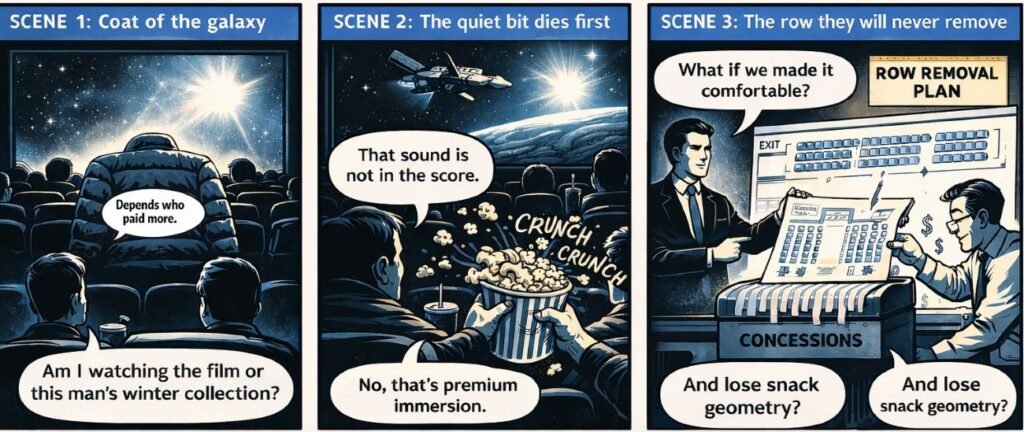
Scene 1: Coat of the galaxy
Panel description + dialogue: A giant IMAX screen glows with stars while a bulky coat hangs over the seat in front like a hostile planet blocking the view.
Viewer: “Am I watching the film or this man’s winter collection?”
Friend: “Depends who paid more.”
Scene 2: The quiet bit dies first
Panel description + dialogue: A tense space scene plays in silence while nearby hands crush popcorn tubs like industrial machinery.
Viewer: “That sound is not in the score.”
Neighbour: “No, that’s premium immersion.”
Scene 3: The row they will never remove
Panel description + dialogue: A cinema manager stands beside a blueprint showing wider rows and better spacing, while an accountant feeds it into a shredder labelled “concessions”.
Manager: “What if we made it comfortable?”
Accountant: “And lose snack geometry?”
What to watch, not the show
- Premium format upselling
- Concessions dependence
- Seat-density economics
- Underinvestment in comfort
- Streaming pressure on exhibitors
- The slow war between convenience and spectacle
- The habit of charging more instead of designing better
The Hermit take
IMAX still gives some films a reason to exist outside the living room.
The rest of the cinema business keeps giving people a reason to stay in it.
Keep or toss
Keep / Toss
Keep the scale, the humour and the IMAX ambition.
Toss the cramped cattle-pen seating model and the fantasy that popcorn is a substitute for comfort.
Sources
- Sony Pictures UK film page: https://www.sonypictures.co.uk/movies/project-hail-mary
- BFI IMAX listing: https://whatson.bfi.org.uk/imax/Online/default.asp?BOparam::WScontent::loadArticle::permalink=project-hail-mary
- Andy Weir official site: https://andyweirauthor.com/
- MGM film page: https://www.mgm.com/movies/project-hail-mary
- Box Office Mojo title page: https://www.boxofficemojo.com/title/tt12042730/
- Box Office Mojo daily chart: https://www.boxofficemojo.com/daily/chart/
- The Guardian review: https://www.theguardian.com/film/2026/mar/10/project-hail-mary-review-ryan-goslings-charm-carries-unserious-last-ditch-space-mission
- IMDb title page: https://www.imdb.com/title/tt12042730/
- IMDb plot summary: https://www.imdb.com/title/tt12042730/plotsummary/
- IMDb full cast and crew: https://www.imdb.com/title/tt12042730/fullcredits/
- IMDb release info: https://www.imdb.com/title/tt12042730/releaseinfo/
- BFI interview with Phil Lord and Chris Miller: https://www.bfi.org.uk/interviews/phil-lord-chris-miller-project-hail-mary
- Radio Times book vs film differences: https://www.radiotimes.com/movies/scifi/project-hail-mary-book-vs-film-differences-explained/
- Space.com book vs movie differences: https://www.space.com/entertainment/space-movies-shows/10-major-differences-between-the-project-hail-mary-book-and-movie
- Penguin book page: https://www.penguin.co.uk/books/440237/project-hail-mary-by-weir-andy/9781804953693

Leave a Reply