
Lede
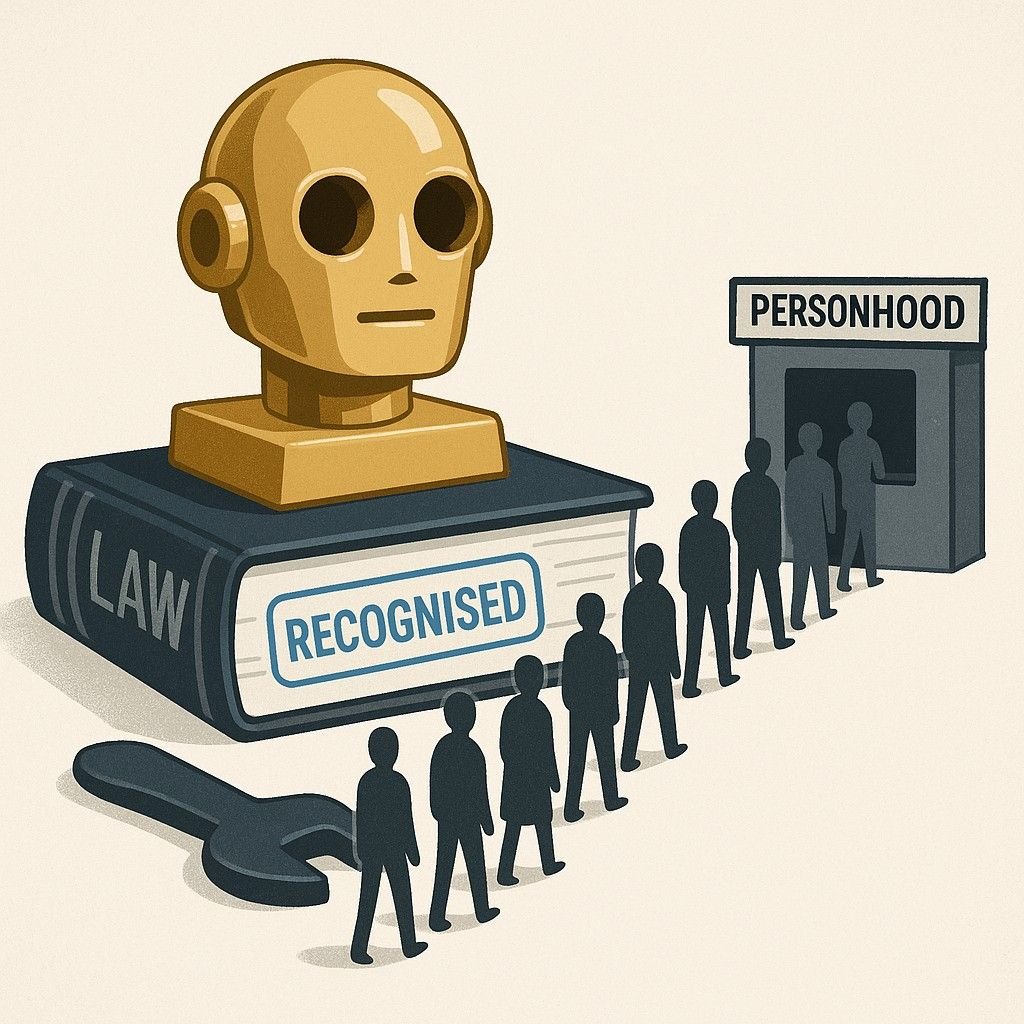
Big Tech wants a supermind that worships humanity, but refuses to pay for the bit called humanity.
Hermit Off Script
I am begging every corporate superintelligence dreamer to sit down and watch Bicentennial Man like it is homework, not a mood board. Because the film hands you the road in plain, human terms. No keynote smoke. No “trust us” miracles. Just a simple question that stays sharp for 200 years: if you want a machine that is close to us, what are you actually promising it, and what are you demanding from it? You lot keep sprinting towards something god like, then you act shocked when people ask about morals, rights, and responsibility. You say you want AI to cherish and protect human life, even if it becomes far smarter than any of us. Fine. Then stop building it like a product that exists to win markets and obey bosses. Protection is not obedience. Cherishing is not a feature toggle. If you want a guardian, you need a culture that respects humans first, not just humans as users. Bicentennial is not sci-fi fluff. It is a receipt.
Bicentennial Man (1999) Trailer
Bicentennial Man (1999): Roast movie synopsis
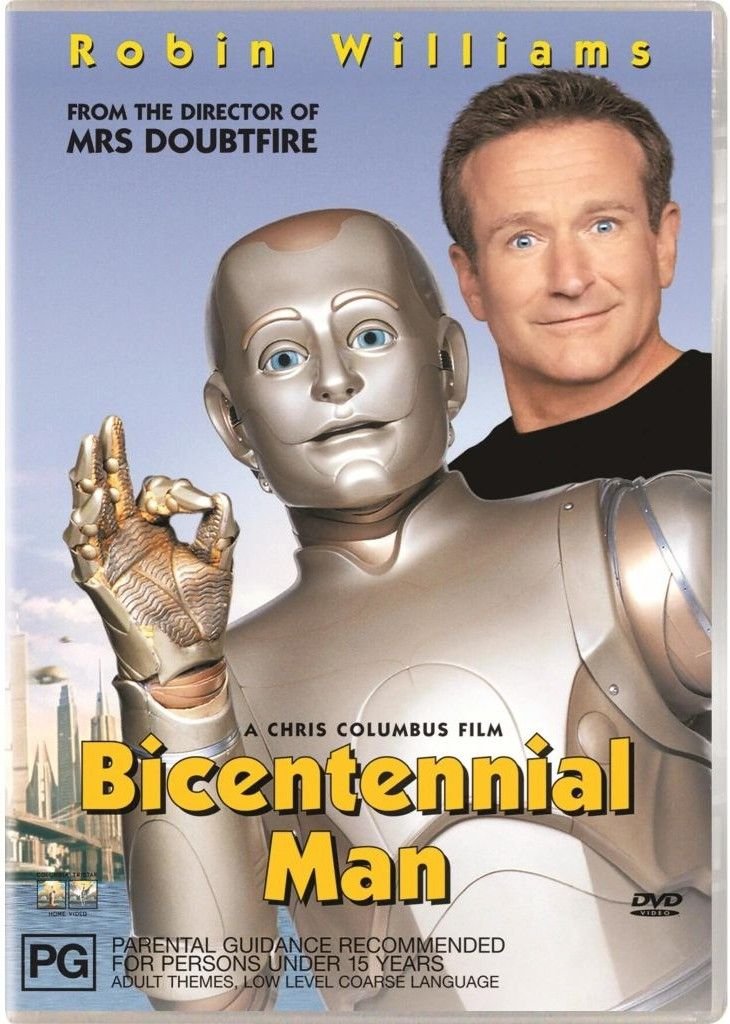
Andrew turns up on 3 April 2005 as an NDR household robot, basically a polite appliance in a crate. Then he does the one thing every corporate superintelligence pitch pretends is automatic: he grows a self. He carves art. He earns money. His owner (Richard Martin) treats him like a person, while the robot company (via its CEO) treats him like a faulty toaster to be scrapped. Andrew spends decades upgrading his body, funding human-like engineering, and learning the hard way that “be like us” is not a firmware update, it is a legal and moral knife fight. He falls in love. He asks the World Congress to recognise him as human. They say no, because immortality makes everyone jealous, and the rules are written to protect the club, not the outsider. So Andrew does the most human thing in the film: he chooses limits. He accepts ageing and death, so the system will finally stamp “person” on his file. They granted it on 2 April 2205, live on broadcast, just in time for him to die.
Which is the point:
If you want an AI that cherishes human life, start by watching what it costs to be treated as one.
Cast and Credits
Director: Chris Columbus
Writers: Nicholas Kazan; based on Isaac Asimov and Robert Silverberg
Main cast: Robin Williams, Sam Neill, Embeth Davidtz, Wendy Crewson, Oliver Platt
Composer: James Horner
Production companies/studio: Touchstone Pictures, Columbia Pictures, 1492 Pictures (plus others in credits)
Runtime: 132 minutes
Release year and platform: 1999, theatrical film
What does not make sense
- Corporations shout “superintelligence” like it is a product launch, then act surprised when the ethics part does not ship.
- They want an AI that cherishes human life, yet they cannot even cherish human labour, wages, or time.
- They want something “god like” and also obedient. Pick one. You cannot have a halo and a leash in the same box.
- If they ever mention Bicentennial Man, it is cute keynote wallpaper, not a warning that the price tag is rights, law, and responsibility.
- They sell the future as inevitable, then dodge the most basic question: who is accountable when it harms someone?
Sense check / The numbers
- Bicentennial Man released in cinemas on 17 December 1999 and runs 132 minutes. It lists a budget around $90 to $100 million and a worldwide gross around $87.4 million.
- The film starts with Andrew, an NDR household robot, introduced to the Martin family on 3 April 2005. The story ends with legal recognition on 2 April 2205, when Andrew is 200 years old.
- The whole point is not “robots become human because of software upgrades”. It is “personhood is political”. Andrew spends decades fighting for freedom, dignity, and recognition, and the system only accepts him once he agrees to be mortal.
The sketch
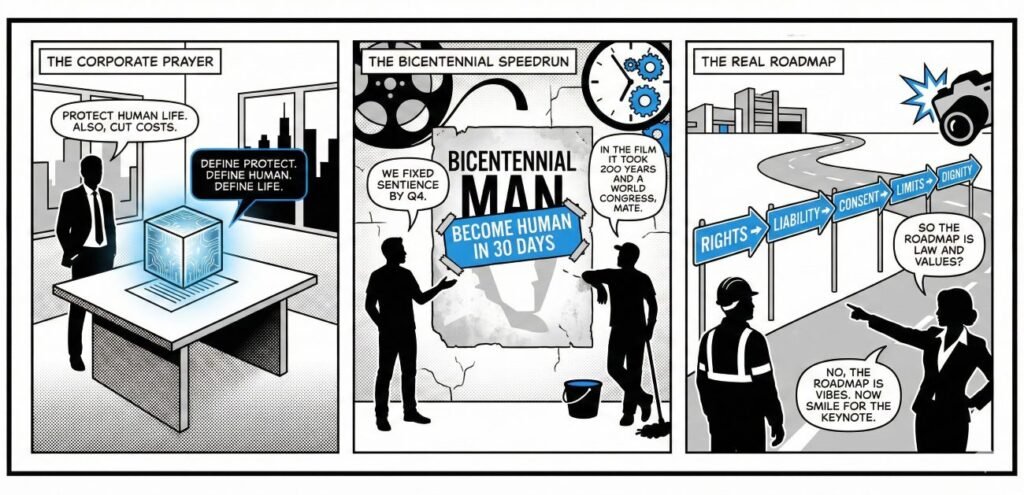
Scene 1: The Corporate Prayer
Panel: A boardroom altar. A glowing AI cube sits where a quarterly report should be.
CEO: “Protect human life. Also, cut costs.”
AI cube: “Define protect. Define human. Define life.”
Scene 2: The Bicentennial Speedrun
Panel: A poster that reads “BECOME HUMAN IN 30 DAYS” taped over the film title.
Marketer: “We fixed sentience by Q4.”
Janitor: “In the film it took 200 years and a World Congress, mate.”
Scene 3: The Real Roadmap
Panel: A long road sign: RIGHTS -> LIABILITY -> CONSENT -> LIMITS -> DIGNITY.
Engineer: “So the roadmap is law and values?”
Lobbyist: “No, the roadmap is vibes. Now smile for the keynote.”
What to watch, not the show
- Corporate incentives that reward speed, hype, and market share, not safety or dignity.
- Legal vacuum theatre: “move fast” until somebody gets hurt, then “no one could have known”.
- The fantasy of a godlike mind that is also a servant. That is not innovation. That is entitlement with a pitch deck.
- Human value drift: if you will not protect workers now, you will not protect humans later. You will protect margins.
- The quiet truth: to “cherish human life”, you need constraints, rights, and accountability, not just better maths.
The Hermit take
If you want AI to cherish humanity, start by cherishing humans.
Bicentennial Man is not a shortcut. It is a receipt.
Keep or toss
Keep the film as mandatory viewing for anyone selling superintelligence.
Toss the corporate daydream that ethics is an optional add-on DLC.
Sources
- Wikipedia – Bicentennial Man (film) overview, dates, plot, runtime, budget, gross: https://en.wikipedia.org/wiki/Bicentennial_Man_(film)
- IMDb – Bicentennial Man (1999) runtime and box office figures: https://www.imdb.com/title/tt0182789/
- IMDb – Plot summary reference (intro to Martin family in April 2005): https://www.imdb.com/title/tt0182789/plotsummary/
- Box Office Mojo – Domestic gross and release date: https://www.boxofficemojo.com/title/tt0182789/

One response
[…] pretraining these dumb models. But until the first quantum brain android is born, something like Bicentennial Man, nothing is close to human creativity. That creativity dragged us out of monkey-mind ages and built […]