
Lede
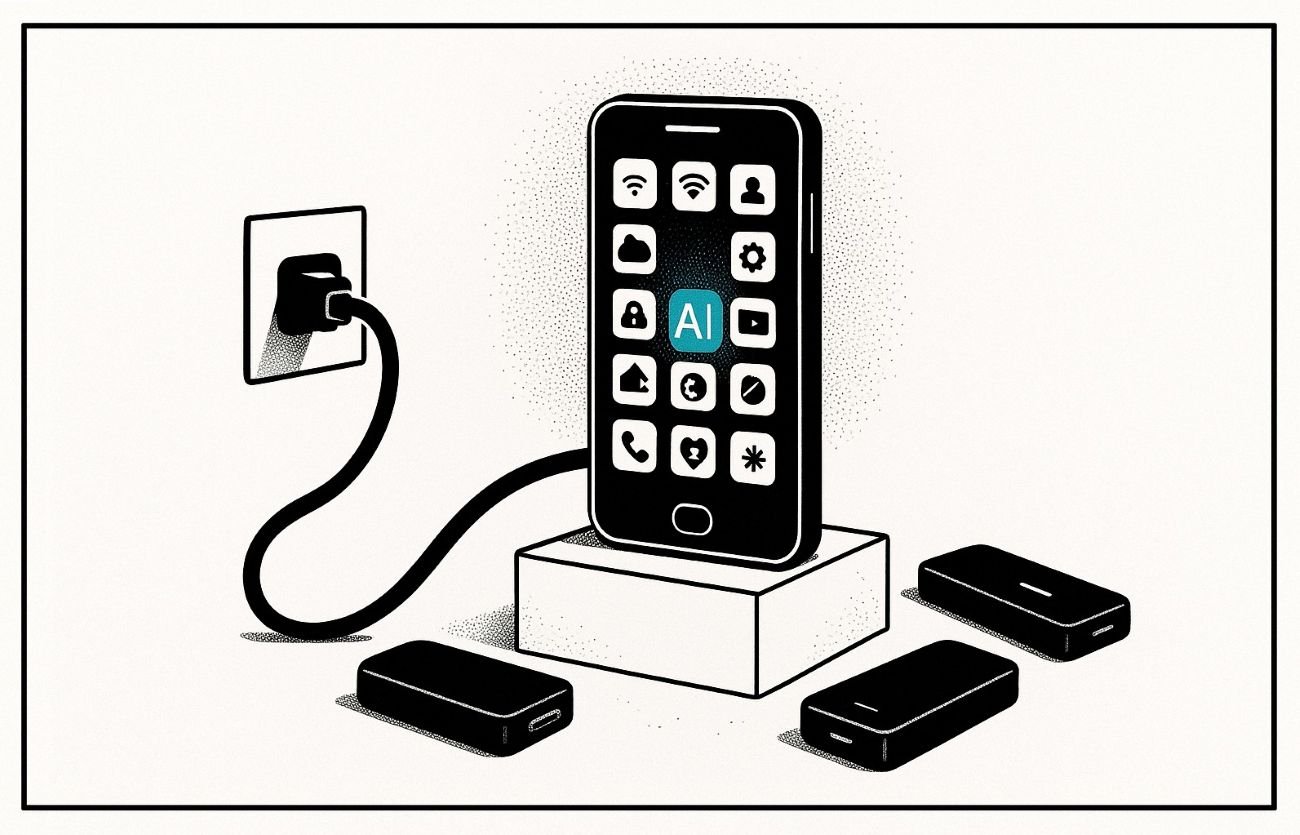
We built pocket supercomputers, then powered them with tech that panics after six hours of scrolling and regret.
Hermit Off Script
What annoys me is how everything else in tech sprinted ahead while the battery stayed in the stone age, pretending it is a complicated philosophy. Phones, laptops, headsets, cars, all brag about AI, neural nonsense and magical processors, yet if the thing survives one full day of real use, you basically need to light a candle in thanks. Most of the time, you get a few hours before the red bar shows up like a debt collector. At the speed everything evolved, batteries should last at least a few days, maybe even a week, not collapse after a commute and two voice notes. And now we get told to wait for AI researcher agents to fix it, as if humans just shrugged and moved on. Apparently, the same industry that raised billions for data centres and fake “intelligence” cannot figure out how to store power long enough for me to finish a podcast and a software update. Real progress would be a phone that does not behave like a nervous Victorian child every time I turn the brightness up.
What does not make sense
- We can raise billions for AI labs, but still act like boosting battery life from one day to three is science fiction.
- Phones average around 11 hours in lab browsing tests, yet in real life they die somewhere between doomscrolling and Google Maps.
- Energy density in lithium-ion batteries has more than doubled since the 1990s, but your daily experience still feels like “charge at breakfast, panic by lunch”.
- EV sales are exploding worldwide, demanding hundreds of gigawatt-hours of battery storage, yet we still treat long-lasting, everyday devices as a luxury feature.
- Solid-state batteries are “almost here” every year, with mass production now pushed to 2027 to 2030, which sounds a lot like “please stop asking”.
Sense check / The numbers
- Since the first commercial lithium-ion cells in 1991, energy density has climbed from about 100 to over 300 Wh/kg, roughly a threefold jump, while pack costs fell nearly 80 per cent from 2013 to recent years.
- Top-tier lithium-ion energy density has been improving at around 7 per cent per deployment, doubling since 1993, and closer to 18 per cent per doubling since 2012, yet user-facing battery life still feels stuck at “one day if you behave”.
- An average modern smartphone can last almost 11 hours in controlled web browsing tests, but to reach the top battery lists, you need nearer 16 hours, which most users never see outside a lab or marketing slide.
- Global demand for EV batteries hit more than 750 GWh in 2023, up about 40 per cent from 2022, with electric cars driving 95 per cent of that growth, which shows where the real battery attention is going.
- Solid-state and silicon-heavy designs are forecast to boost energy density by up to 50 per cent and reach commercial scale between 2026 and 2030, which is great news for future cars and a polite shrug for your dying phone.
The sketch
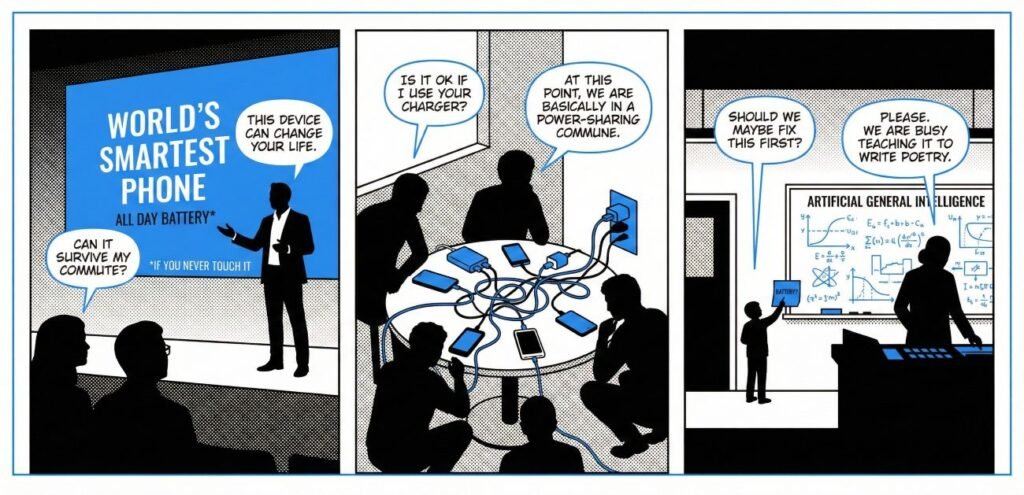
Scene 1: The keynote miracle
Panel description: A tech boss on stage with a giant slide reading “WORLD’S SMARTEST PHONE”. In tiny letters under it: “All day battery*”. A footnote says: “*If you never touch it”.
Dialogue:
Boss: “This device can change your life.”
Audience member: “Can it survive my commute?”
Scene 2: The charging altar
Panel description: A cafe table covered in tangled chargers, power banks, adapters, and three devices plugged into one sad wall socket. Everyone crouched around like pilgrims.
Dialogue:
Person 1: “Is it OK if I use your charger?”
Person 2: “At this point, we are basically in a power-sharing commune.”
Scene 3: The AI research lab
Panel description: A whiteboard full of equations labelled “ARTIFICIAL GENERAL INTELLIGENCE”. On the side, a tiny note: “Battery?” ignored. A small intern points at it.
Dialogue:
Intern: “Should we maybe fix this first?”
Lead scientist: “Please. We are busy teaching it to write poetry.”
What to watch, not the show
- Capital flows into data centres and AI chips while energy storage for consumer devices stays a side quest.
- EV and grid-scale demands hoover up battery research and materials, leaving phones and laptops with only incremental gains.
- Marketing habits that sell “all day battery” while quietly redefining “day” as “a few polite hours under lab conditions”.
- Supply chains and mining limits that push companies to optimise cost over radical longevity.
- Policy and regulation focused on emissions and vehicles, not on the waste stream from short-lived gadgets with tired cells.
- The risk that we normalise living tethered to sockets and power banks while calling it “mobile”.
The Hermit take
If your smartest device cannot make it from breakfast to bedtime without life support, it is not that smart; it is just overqualified and underfed. Real innovation is not another AI buzzword; it is the day you forget where you left your charger because you do not actually need it.
Keep or toss
Verdict: Toss
Toss the myth that “this is the best batteries can do” and the habit of worshipping specs while ignoring power.
Keep the pressure on research, on regulators, and on companies until week-long battery life is boring and expected, not a fantasy.
Sources
- Lithium ion energy density rise and cost drop – https://www.large-battery.com/blog/electric-vehicles-lithium-battery-advancements-2025/
- Historical Li ion performance trends – https://www.westchestercleanenergy.com/post/lithium-battery-energy-density
- Average smartphone battery life tests – https://www.tomsguide.com/us/smartphones-best-battery-life%2Creview-2857.html
- Smartphone battery endurance table – https://nanoreview.net/en/phone-list/endurance-rating
- Global EV battery demand 2023 – https://www.iea.org/reports/global-ev-outlook-2024/trends-in-electric-vehicle-batteries
- Global EV fleet and 2024 sales – https://www.virta.global/global-electric-vehicle-market
- Solid state and pilot production timelines – https://www.idtechex.com/en/research-article/solid-state-battery-commercialization-mass-production-taking-off/32942
- Industry forecasts for solid state around 2030 – https://www.sneresearch.com/en/business/report_view/212/page/0
- Future Li ion gains with silicon anodes – https://www.idtechex.com/en/research-article/the-future-of-li-ion-battery-technology/32135
