
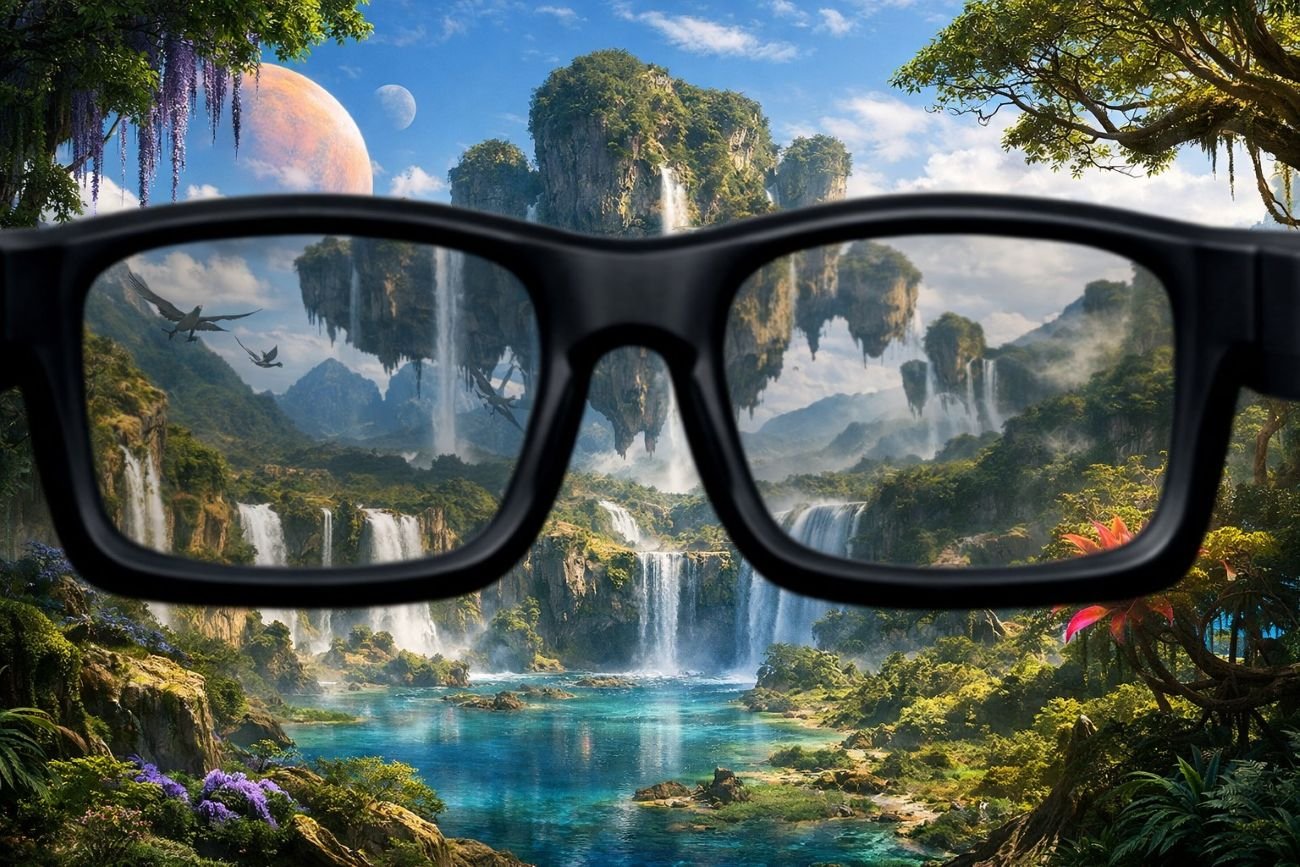
Lede
Avatar: Fire and Ash makes Pandora look alive while cinemas still ask audiences to wear dim plastic for the privilege.
Hermit Off Script
This rant is about cinema selling old discomfort as new progress. I first watched Avatar in 3D in Amman, Jordan, in 2009, and I still remember cursing the glasses. The lenses made everything dimmer, the colours looked weaker than normal viewing, and the technology became the headline while my eyes paid the ticket price.
I tried Avatar once or twice more in 3D, then watched it about 10 times in IMAX 2D whenever I could. The clean picture and the huge screen wiped the floor with the gimmick. After 16 years, I honestly expected something better: glasses-free 3D, lighter eyewear, or at least a system that did not make my nose ache and my eyes burn. Instead, I watched Avatar: Fire and Ash in Seoul in IMAX 3D and felt as though cinema had spent 16 years improving Pandora while leaving the object on my face untouched.
For half the film, my nose hurt and my eyes hurt. Around the edges of the glasses, I could see the clear image I actually wanted, as though Pandora was teasing me from outside the frame. The real problem is a business model that finds it cheaper to wash the same glasses, charge the premium again and leave the actual upgrade for another decade.
I went back and watched the film again in ScreenX 2D on a smaller central screen. It proved the point immediately. No glasses. No faff. No tinted lenses stealing colour and clarity. Given the choice, I would take IMAX 2D. The large screen and clean image do more for me than the depth effect.
Avatar will probably run for decades and sit beside Star Wars and Star Trek as a permanent fictional universe. AI may eventually make digital worlds cheaper and faster to build, which will leave stories with fewer places to hide. Maybe by 2029 I will finally watch convincing 3D without glasses. That is hope, not a technical forecast.
Pandora spent 16 years evolving. My nose got the same equipment.
Avatar: Fire and Ash (2025) – Trailer
Movie synopsis
Two weeks after the events of Avatar: The Way of Water, the Sully family is still grieving the death of Neteyam. Jake becomes increasingly protective while Neytiri struggles with anger and loss. Their path brings them into contact with the travelling Wind Traders and the Mangkwan, a Na’vi clan led by Varang whose faith in Eywa was broken by disaster. With the RDA still active, grief and conflict threaten both the family and Pandora.
Cast and credits
Director: James Cameron
Writers: Screenplay by James Cameron, Rick Jaffa and Amanda Silver; story by James Cameron, Rick Jaffa, Amanda Silver, Josh Friedman and Shane Salerno
Genre: Science-fiction action adventure
Main cast: Sam Worthington, Zoe Saldana, Sigourney Weaver, Stephen Lang, Oona Chaplin, Cliff Curtis, Kate Winslet, David Thewlis, Britain Dalton, Jamie Flatters, Trinity Jo-Li Bliss and Jack Champion
Composer: Simon Franglen, using themes originally composed by James Horner
Production company/studio: Lightstorm Entertainment and 20th Century Studios
Runtime: 197 minutes for the UK cinema versions
Release year and platform: Released in UK cinemas on 19 December 2025, including IMAX 3D, RealD 3D, ScreenX and other premium formats; released digitally on 31 March 2026 and on Disney+ on 24 June 2026
Avatar and Cameron in brief
Avatar (2009) – Trailer
Avatar (2009) introduces former Marine Jake Sully, who travels to Pandora and enters a Na’vi body through the avatar programme. He becomes caught between the human operation extracting Pandora’s resources and the Na’vi people whose land and way of life are under threat.
Avatar: The Way of Water (2022) – Trailer
Avatar: The Way of Water (2022) moves the story more than a decade forward. Jake and Neytiri are now parents, and the conflict becomes centred on the Sully family’s survival, grief and relationship with Pandora’s ocean clans. Fire and Ash continues directly from that family story, so the third film carries emotional damage that began before its opening scene.
James Cameron

James Cameron matters because he has spent much of his career joining technical ambition with simple human pressures: survival, family, fear and sacrifice. From The Terminator and Aliens to Titanic and Avatar, he has repeatedly used new filmmaking tools to make large stories feel physically immediate. That history explains why I expect more than beautiful scenery from Fire and Ash, and why cinemas showing his work through uncomfortable, dim 3D equipment feel especially behind.
What does not make sense
- Cinema sells 3D as progress while the audience still has to wear tinted plastic for 197 minutes.
- The film won an Academy Award for visual effects, yet the physical viewing equipment can still weaken the image before it reaches the eye.
- The surcharge pays for a premium format, but discomfort is treated as the customer’s private problem.
- Studios and exhibitors sell one joined experience, then separate themselves when the projection looks dim or the glasses feel poor.
- A story built around a glowing living planet can look clearer around the edges of the eyewear than through its lenses.
- Glasses-free displays keep appearing in laboratories and demonstrations, but the local multiplex remains committed to the washable solution.
- Streaming wins on comfort, while cinemas sometimes charge extra for the part that hurts.
Sense check / The numbers
- Avatar: Fire and Ash was released in South Korea on 17 December 2025, two days before its UK release, with IMAX and 3D presentations included in the rollout. [Disney Korea] [IMAX]
- A 2015 peer-reviewed study measured 60.8 per cent brightness loss in its tested stereoscopic workflow. That figure belongs to the study’s setup, not every cinema screen. [Applied Sciences]
- Cineworld currently charges Unlimited members a GBP 5 uplift for an IMAX screening. IMAX 3D glasses are included in the ticket price and returned after the film. [Cineworld]
- Box Office Mojo lists approximately USD 1.486 billion worldwide against a reported USD 400 million production budget. Ticket sales are not the same as studio profit. [Box Office Mojo]
- Avatar: Fire and Ash won the 2026 Academy Award for visual effects after receiving 2 Academy Award nominations. [Academy] [20th Century Studios]
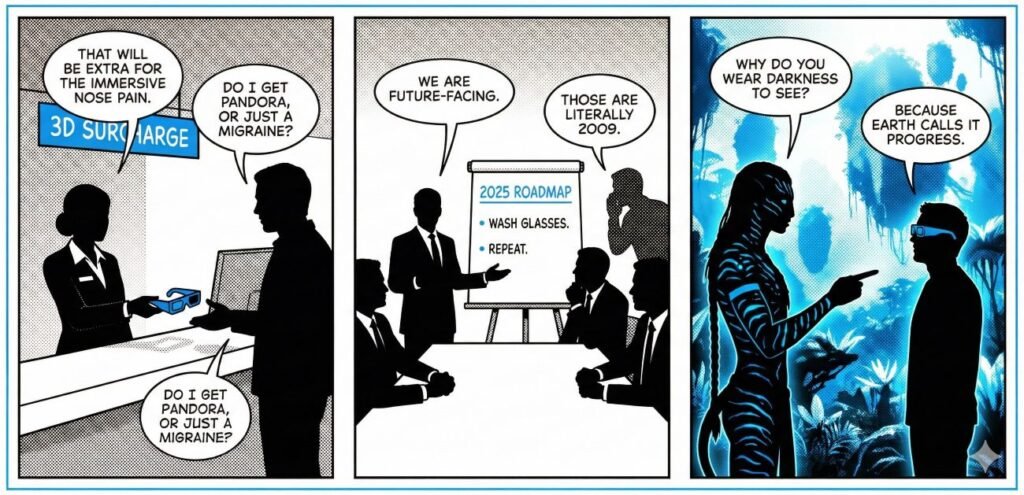
The sketch
Scene 1: Premium Discomfort
Ticket counter. A sign reads “3D surcharge”. A cashier slides a pair of plastic specs across like contraband.
Dialogue:
Cashier: “That will be extra for the immersive nose pain.”
Viewer: “Do I get Pandora, or just a migraine?”
Scene 2: Innovation Meeting
Boardroom silhouettes. A flipchart: “2025 Roadmap”. Under it: “Wash glasses. Repeat.”
Dialogue:
Exec: “We are future-facing.”
Engineer (whispering): “Those are literally 2009.”
Scene 3: Planet of the Clear Image
A Na’vi silhouette points at the human’s glasses. Behind them, Pandora glows perfectly sharp.
Dialogue:
Na’vi: “Why do you wear darkness to see?”
Human: “Because Earth calls it progress.”
What to watch, not the show
- Projection quality: format labels mean little without good brightness, focus and calibration.
- Pricing: a surcharge should buy a clearly better experience, not merely access to special glasses.
- Exhibition incentives: reusing eyewear costs less than replacing the display system.
- Research scale: a glasses-free prototype is not yet a solution for hundreds of viewers across one auditorium.
- Audience choice: cinemas should offer strong 2D screenings alongside 3D rather than treating 2D as the lesser event.
- Story pressure: as visual production becomes easier, character and writing will have fewer technical distractions to hide behind.
The Hermit take
Pandora keeps evolving.
Cinema keeps polishing the same glasses.
Keep or toss
Verdict: Keep / Toss.
Keep Cameron’s scale, visual craft and big-screen ambition.
Toss the assumption that premium 3D must remain strapped to face.
Sources
- Official film synopsis, credits and release information: https://www.20thcenturystudios.com/movies/avatar-fire-and-ash
- Official Avatar film page and story information: https://www.avatar.com/movies/avatar-fire-and-ash
- UK runtime, classification and cinema formats: https://www.bbfc.co.uk/release/avatar-fire-and-ash-q29sbgvjdglvbjpwwc0xmdmxntm0
- Worldwide box office totals: https://www.boxofficemojo.com/release/rl3389031937/
- 2026 Academy Award results: https://www.oscars.org/oscars/ceremonies/2026
- Study of brightness loss in stereoscopic presentation: https://www.mdpi.com/2076-3417/5/4/926
- SMPTE report on cinema screen brightness measurement: https://www.smpte.org/hubfs/er0992-2014.pdf
- Glasses-free 3D display research: https://www.nature.com/articles/s41586-025-09752-y
- Cineworld IMAX ticket uplift information: https://help.cineworld.co.uk/support/solutions/articles/103000314220-is-there-an-additional-charge-for-imax-screenings-
- Cineworld IMAX 3D glasses policy: https://help.cineworld.co.uk/support/solutions/articles/103000314219-do-i-have-to-pay-extra-for-3d-imax-glasses-
One response
[…] around virtual reality headsets where space and time are less of a cage? But no, here we go again: 3D with glasses we have worn for more than a decade, a format plenty of people do not even like, yet they are nudged into paying for it to watch the […]