Lede
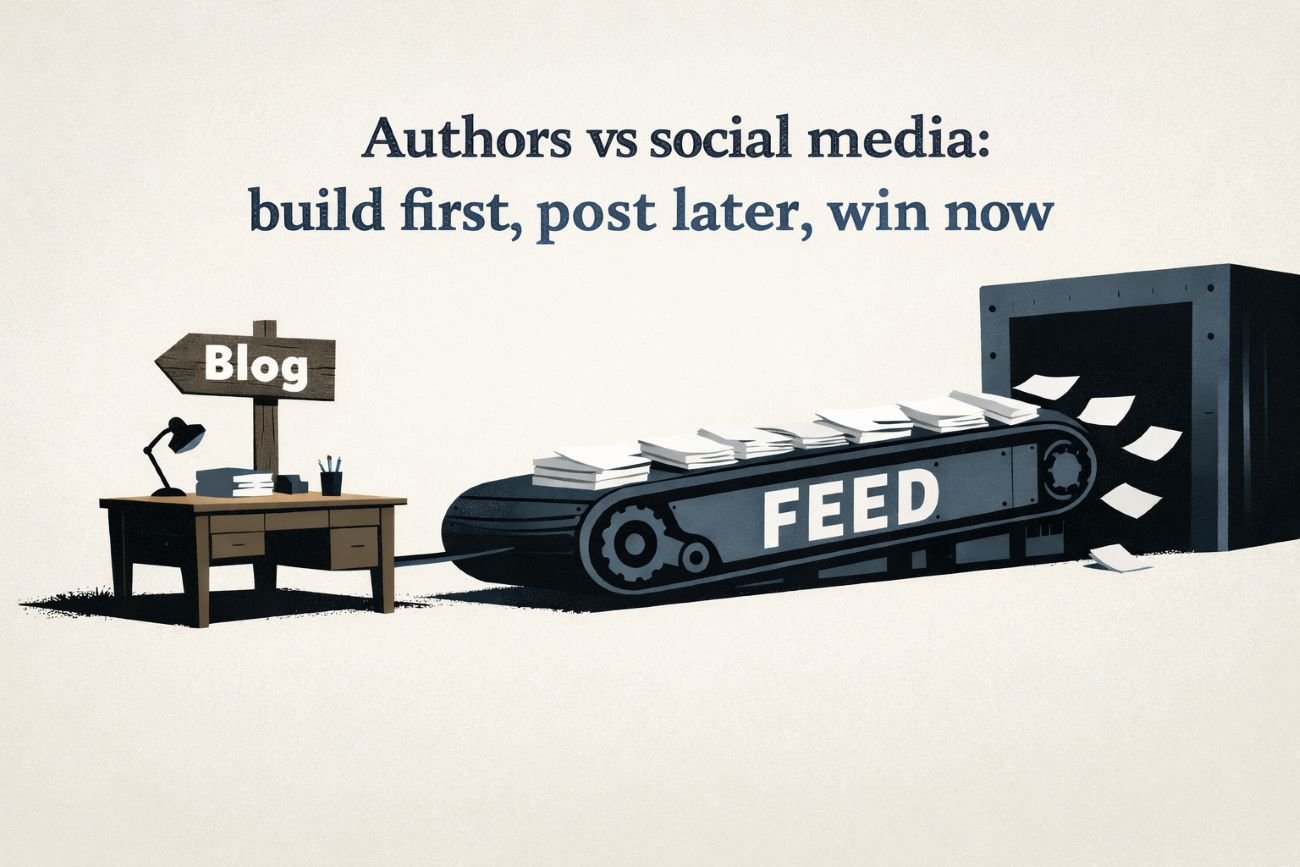
Authors keep treating social media as a home, when it is really just a signpost – and that difference decides whether readers find the work, and whether they ever return.
Hermit Off Script
Optional advice for authors: if an author is mostly “present as a profile” and not yet an active thinker or creator, that is not a personal flaw, it is the default trap of the feed. Social media rewards motion, not meaning. It rewards being seen, not being read. So the first move is to stop apologising and start choosing. An author does not need to live in social media just to be visible. If they want to create something useful, or simply something they enjoy, they should build it first for themselves, in a place they control. That is how an owned site gets born: as a home for work, not a plea for attention. From there, sharing becomes optional, not compulsory. If an author tries a newer network like Bluesky and gets a poor reception after being honest about using AI for images, or using a template to shape a rant into something readable and fact-led, they should not be surprised. There is an honesty tax online. Plenty of people still want the cartoon binary: “pure human” or “pure machine”. The moment an author admits “I used tools”, a chunk of the crowd stops reading and starts policing. That does not mean the author should hide. It means the author should decide what matters more: approval or integrity. The same pattern hits authors writing about ideas that are not fashionable or easily boxed, like divine love as a deity and an energy that sustains everything. Some readers will not be prepared. Fine. Books are not meant to please everyone. They are meant to find the few who recognise themselves in the work. Now add agents. Many people like the idea of AI agents as content assistants, right up until they feel like they are talking to an extension of a person, a personality clone with better uptime. Even the builders of agents often dislike that feeling. So the rule is simple: tools can help carry the bricks, but they cannot be the house. If an author is not bringing their own soul to the table, only the edges of it, the output can look slick and still have no value. That is why a raw section inside articles works: a place for the unvarnished take, the annoyed truth, the human pulse. Readers can feel the difference between early dry output and later writing with blood in it. The right readers return. The rest say “meh” and chase the next adventure. Let the filter do its job.
P.S. on the agentic wave, disruptors, and why most authors are not watching
Most authors are not tracking agent frameworks or open-source projects like OpenClaw. They are not analysing who is joining which AI lab. They are writing books, editing drafts, and trying to sell copies. So when people talk about an “agentic social media world”, it can sound abstract or irrelevant. But it is not irrelevant. Even if authors do not follow the builders, the builders are shaping the environment authors will publish into. Tools like OpenClaw, and the broader move towards AI agents, signal a shift: content will increasingly be created, filtered, and even consumed by assistants talking to assistants. That is why admiration for disruptors trying to loosen big tech’s grip makes sense in principle. More open tools can mean more control for individuals. But authors should not rely on personalities or projects as saviours. Power has gravity. Open systems can drift towards central control as they scale, not necessarily through bad intentions, but through incentives and partnerships.
The helpful takeaway for authors is practical, not ideological:
You do not need to understand every agent framework. You do need to understand that the environment is becoming more automated.
- Use the tools. Do not worship them.
- Watch the disruptors. Do not depend on them.
- Build where you own the floorboards.
Tech will not disappear. The agentic layer will grow. The safest position for an author is not outside the system, and not fully inside it. It is anchored – with your work living in a place no platform update can erase.
OpenClaw: The Viral AI Agent that Broke the Internet – Peter Steinberger | Lex Fridman Podcast #491
What does not make sense
- Telling authors “be visible” while training them to publish work they do not even like.
- Shaming authors for using AI images, while rewarding posts that are mostly automation and fully pretending.
- Treating a feed as a home, then complaining when it behaves like a billboard.
- Expecting agents to feel “authentic”, then recoiling when they feel like an extension.
- Thinking celebrity is the goal, when the real goal is returning readers.
Sense check / The numbers
- Bluesky says it grew nearly 60 per cent in 2025, from 25.94 million to 41.41 million users. [Bluesky]
- Bluesky says users created 1.41 billion posts in 2025, and 235 million posts contained media, which it says is 62 per cent of all media posts in the site’s history. [Bluesky]
- Bluesky says daily reports of anti-social behaviour dropped by about 79 per cent after it reduced the visibility of replies it detected as toxic, spammy, off-topic, or bad faith. [Bluesky]
- Reuters reports OpenClaw received more than 100,000 GitHub stars and drew 2 million visitors in a single week, and that it will move into a foundation with ongoing OpenAI support. [Reuters]
- Peter Steinberger says he is joining OpenAI, and that OpenClaw will move to a foundation and stay open and independent; he also says he already spent 13 years building a company and prefers building over running one. [Steinberger]
The sketch
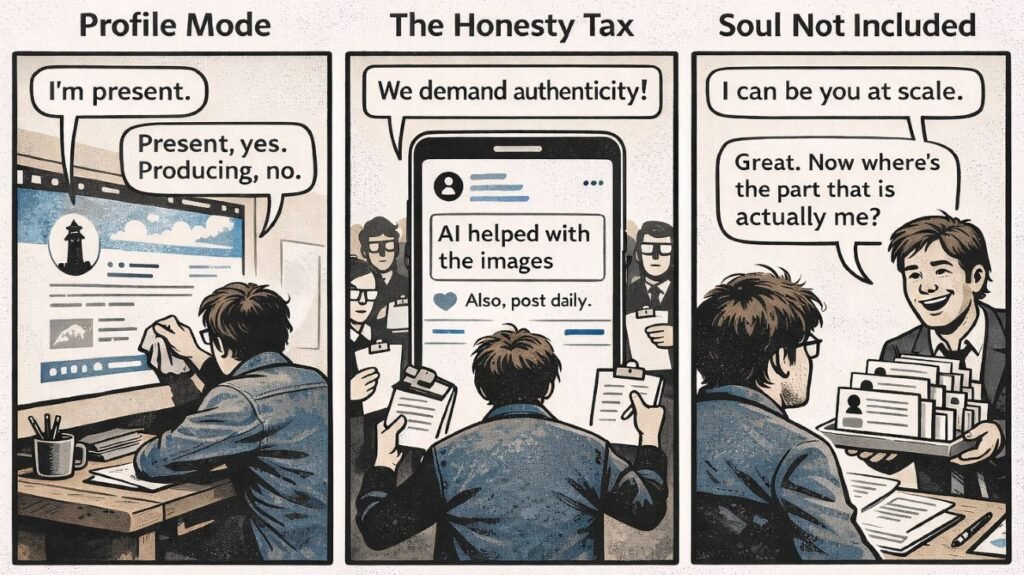
Scene 1: “Profile Mode”
Panel description: An author polishes a perfect bio and banner while the manuscript sits unfinished.
Dialogue: “I’m present.”
Dialogue: “Present, yes. Producing, no.”
Scene 2: “The Honesty Tax”
Panel description: The author posts: “AI helped with the images.” A crowd instantly turns into judges with clipboards.
Dialogue: “We demand authenticity!”
Dialogue: “Also, post daily.”
Scene 3: “Soul Not Included”
Panel description: A cheerful agent wearing the author’s face offers a stack of scheduled posts like fast food.
Dialogue: “I can be you at scale.”
Dialogue: “Great. Now where’s the part that is actually me?”
What to watch, not the show
- Visibility theatre: posting to prove existence, not to serve readers.
- Purity tests: “authenticity” used to punish disclosure, not reward thought.
- Tool hysteria: arguing about AI while ignoring whether the author has a point of view.
- Agentic clones: the discomfort people feel when a creator becomes a service.
- Big tech gravity: disruptors can be absorbed, so authors must own their floorboards.
- The slow return: readers who come back are worth more than any spike.
The Hermit take
Build the work where you own the land.
Use the feed as a signpost, not a home.
Keep or toss
Keep
Keep the owned platform, the honest tool use, and the raw voice section. Toss the need to be liked by people who are not even reading.
Sources
- Bluesky 2025 Transparency Report: https://bsky.social/about/blog/01-29-2026-transparency-report-2025
- Bluesky FAQ (user count): https://bsky.social/about/faq
- Ofcom Online Nation Report 2025 (PDF): https://www.ofcom.org.uk/siteassets/resources/documents/research-and-data/online-research/online-nation/2025/online-nations-report-2025.pdf?v=409837
- Simon Willison, “Three months of OpenClaw”: https://simonwillison.net/2026/Feb/15/openclaw/
- Reuters on Steinberger joining OpenAI and OpenClaw becoming a foundation: https://www.reuters.com/business/openclaw-founder-steinberger-joins-openai-open-source-bot-becomes-foundation-2026-02-15/
- TechCrunch on OpenClaw name changes and Moltbook (30 Jan 2026): https://techcrunch.com/2026/01/30/openclaws-ai-assistants-are-now-building-their-own-social-network/
- Peter Steinberger post “OpenClaw, OpenAI and the future” (14 Feb 2026): https://steipete.me/posts/2026/openclaw
- OpenClaw GitHub repository: https://github.com/openclaw/openclaw
- Lex Fridman episode page #491 (Peter Steinberger): https://lexfridman.com/peter-steinberger/
- Lex Fridman transcript for episode #491: https://lexfridman.com/peter-steinberger-transcript/
