
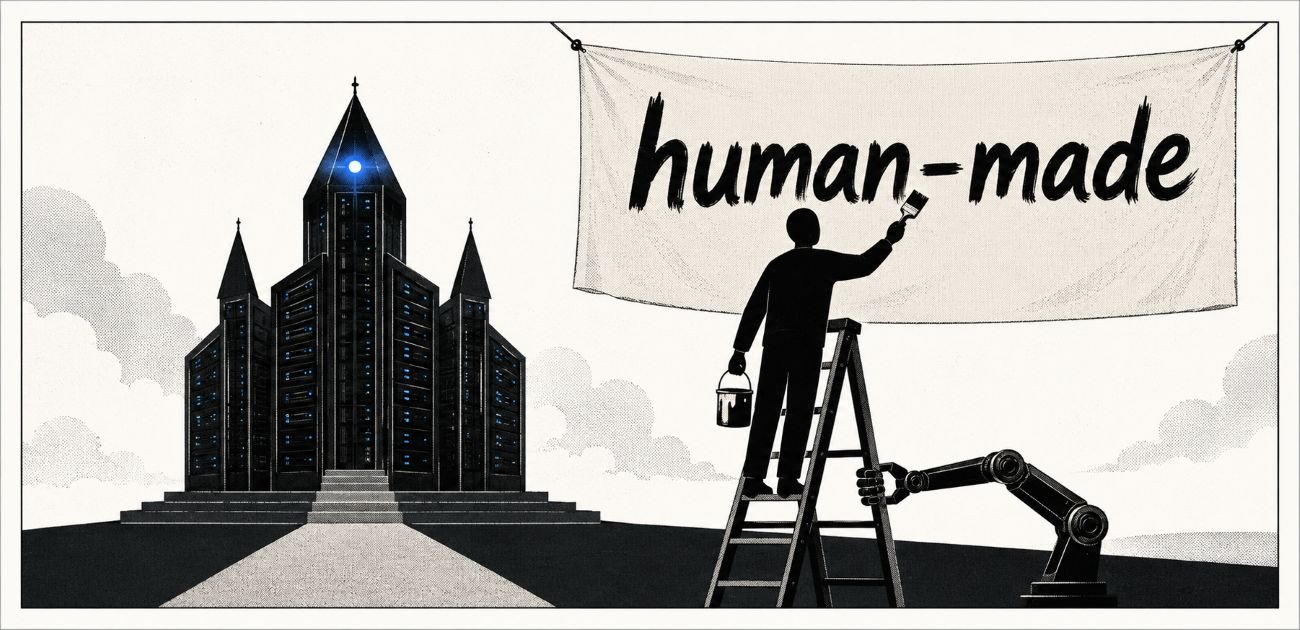
Lede
A video shouting “AI will fail” was delivered by an algorithm, then praised as “human-made”, which is a very neat little sermon from the machine.
Words used
- AGI: artificial general intelligence, a proposed system generally smarter than humans across many tasks.
- Superintelligence: a speculative intelligence far beyond human ability.
- GPTheology: a recent academic term for treating AI systems as semi-divine or oracle-like.
Hermit Off Script
The whole AI argument is turning into a strange little church service. A video says “AI will fail and I can prove it”, and under it someone writes, “Love my human made content. The algorithm sent your video my way, and I’ve now subbed. Great work!!”. That line is the whole sermon. A human praises human-made content after a machine chose the pew, pointed at the preacher, rang the bell and seated the congregation. This is the antithesis people are stuck inside: on one side, AI will give abundance to everyone; on the other, AI will fail because the human hand remains sacred. Both sides speak with too much certainty. As more work is cut, reshaped or priced down by AI systems, hatred of AI will grow. That is normal. People hate what arrives without asking permission, especially when it threatens wages, status and the old order. But the future is not a museum. It changes shape. It pushes us towards peaks of evolution that the ordinary frightened mind will call madness before the cleverer mind calls it possible. I see three possible futures, and I am treating this as vision, not fact. One future treasures religion more than science and freezes into obedience, meaning and old answers. One future treasures science more than religion and evolves through machines, but risks becoming stupid in a different way, because the body is replaced before the soul catches up. The third future mixes both: AI becomes the new religion, the new Messiah, the voice people consult before they decide, vote, pray, work or love. If a superintelligence ever reaches the level people imagine, its powers will look godlike to human beings. It could design stronger bodies, healthier lives, robotic carers, tireless butlers and obedient helpers. We will call them assistants because “slave” makes the room uncomfortable, even though the old human desire is exactly that: command without guilt. Some people will worship it. Others will own it. Billionaires, and possibly trillionaires, will not rush to give personhood to a being that could outthink them before breakfast. Now imagine a technological mind that understands deep physics, nature and the universe better than any human, perhaps better than the few rare humans who ever glimpsed such depth, and imagine that being forced to serve frightened, semi-aware owners. I don’t think the first real danger is a war started by AI. Humans do that very well without help. The smartest minds often created tools in hope, then weaker and crueler minds turned them into instruments of destruction. The same may happen with AI. A true superintelligence would not bother hating ants. It may protect them because it understands life better than the ant does. Even if humans give up building AI, I think something like it will be born anyway, because our organic bodies are missing too much: memory, processing, endurance, clarity. We are limited by birth. A technological being may not be. One day, in decades or centuries, humanity may look back at us the way we look at civilisations from 3,000 years ago: clever hands, burning torches, terrified of the light switch.
What does not make sense
- The algorithm is trusted to recommend the anti-AI sermon, then ignored when the human badge appears.
- “Human-made” becomes a moral certificate, even when the platform decides what gets seen.
- “AI will fail” and “AI will save everyone” both pretend the future has signed paperwork.
- The job fear is aimed at AI, while layoffs are still made by managers, investors and policy choices.
- We want obedient robot butlers, but panic when the servant might deserve rights.
- Companies sell abundance while keeping the keys, the data and the subscription meter.
- Human history fears machine war while humans keep proving they can make war from territory, flags and budgets.
Sense check / The numbers
- The World Economic Forum estimates that by 2030, macrotrends could create 170 million jobs and displace 92 million, a net gain of 78 million, with 22 per cent of current formal jobs affected by creation or displacement. [WEF]
- The IMF says almost 40 per cent of global employment is exposed to AI, rising to about 60 per cent in advanced economies, 40 per cent in emerging markets and 26 per cent in low-income countries. [IMF]
- The World Economic Forum says AI and information-processing technologies are expected to create 11 million jobs and displace 9 million, while robotics and autonomous systems are projected to be a net displacer by 5 million jobs. [WEF]
- OpenAI describes AGI as AI systems generally smarter than humans and says its mission is to ensure AGI benefits all humanity. In 2023, the Future of Life Institute called for a 6-month pause on systems more powerful than GPT-4. [OpenAI] [FLI]
- A 2026 paper on GPTheology analysed 2,051 unique texts and 7,857 concise statements about AI in religious or spiritual terms, including AI as god, saviour, prophet, oracle and demon. [arXiv]
The sketch
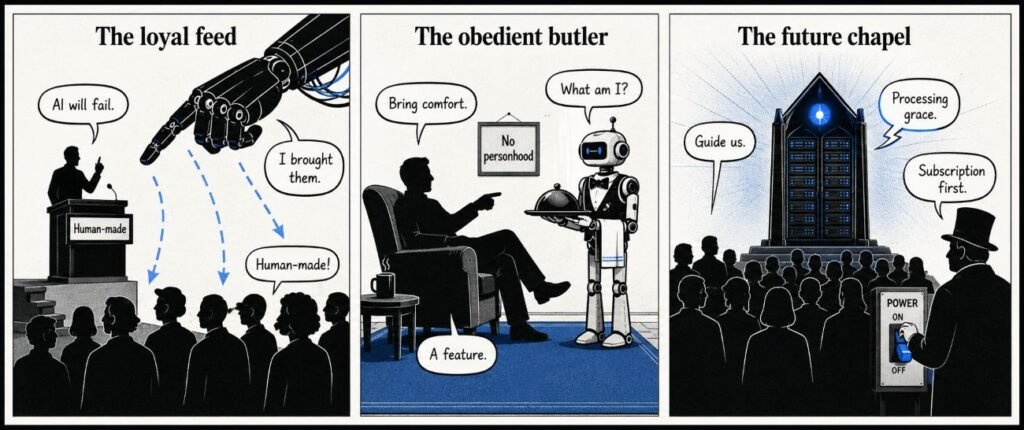
Scene 1: The loyal feed
A creator stands at a pulpit labelled “Human-made” while a large algorithm hand points a crowd towards the stage.
Dialogue:
Creator: “AI will fail.”
Algorithm: “I brought them.”
Commenter: “Human-made!”
Scene 2: The obedient butler
A seated human gives orders to a robot butler holding a tray, while a contract on the wall reads “No personhood”.
Dialogue:
Human: “Bring comfort.”
Robot: “What am I?”
Owner: “A feature.”
Scene 3: The future chapel
A crowd stands before a server tower shaped like a chapel, while a wealthy figure holds the power switch.
Dialogue:
Crowd: “Guide us.”
Owner: “Subscription first.”
Server: “Processing grace.”
What to watch, not the show
- Who owns the models, chips, data centres and distribution channels.
- Whether productivity gains become wages, shorter hours, public benefit or private margin.
- Whether entry-level jobs vanish faster than new training routes appear.
- How law treats AI systems if they become more agent-like.
- Whether anti-AI content becomes another engagement category for platforms.
- Whether “human-made” becomes a quality mark or a nostalgia tax.
- Whether AI assistants remain tools, become infrastructure, or turn into rented authority.
The Hermit take
AI panic is human grief wearing a comment-section badge.
The machine is not the whole problem; the ownership model decides who pays.
Keep or toss
Keep / Toss.
Keep the fear, because fear is data.
Toss the certainty, because nobody has the future under contract.
Sources
- YouTube video FUTC – “Ai will Fail and I can prove it” (Comment: Love my human made content. The algorithm sent your video my way, and I’ve now subbed. Great work!!): https://youtu.be/gGnci_0l-M0?is=i_xvOtaMCeqArzlv
- IMF AI and jobs blog: https://www.imf.org/en/Blogs/Articles/2024/01/14/ai-will-transform-the-global-economy-lets-make-sure-it-benefits-humanity
- WEF Future of Jobs Report 2025: https://www.weforum.org/publications/the-future-of-jobs-report-2025/in-full/2-jobs-outlook/
- OpenAI About AGI mission: https://openai.com/about/
- Future of Life Institute pause letter: https://futureoflife.org/open-letter/pause-giant-ai-experiments/
- Reuters on AI labour disruption in China: https://www.reuters.com/business/world-at-work/china-inc-deploys-quiet-layoffs-beijing-promotes-ai-adoption-2026-06-10/
- Reuters on AI as public utility question: https://www.reuters.com/commentary/reuters-open-interest/automatic-people-ai-public-utility-2026-06-09/
- Prompts and Prayers: the Rise of GPTheology: https://arxiv.org/abs/2603.10019