

Lede
We built a machine that can autocomplete the library, then acted surprised it cannot rewrite the laws of nature.
Hermit Off Script
Let me say this plainly: people hear a fast answer and call it intelligence, confusing speed with soul, and treating a well-trained echo like a genius.
AI is not magic – yet – because it is not that kind of smartness born from intuition. The most brilliant human minds did not need a trillion tokens of other people’s homework to discover laws, create mathematics and physics equations, and sometimes run the experiment inside their own mind before any lab could confirm it. Today we have modern labs and massive tests like the Large Hadron Collider pushing into quantum physics, but the point still stands: top-level intuition intelligence can simulate, test, and shape ideas internally, then translate them into something the world can verify. It was never just about the amount of knowledge memorised. It was the processing capacity and the intuition to find the discovery in the noise. And quantum mechanics is still a reminder that some things are not fully solved or proved, even now.
That is why I keep repeating this mantra: current AI is not smart yet. It does not have intuition. It is not capable of discovering new laws or inventing new technologies. Even when it does something impressive like AlphaFold, it is still built on existing data and processes – it compresses years of human work and that is the real miracle: speed. And yes, that same approach will move into language and reasoning models and get applied at large scale across everything, so it will look smart while mostly accelerating what humans already laid down. Re-doing Einstein or Newton in a clean slate environment would only mean it reached the peak IQ of the most brilliant humans, not that it became something beyond them. Maybe quantum chips push it to the next level and it really starts finding new laws or equations, or even invents something beyond what we have created in maths and physics.
But none of this means AI is the final chapter and smart humans are finished. I think the opposite: smarter humans will be born who will use AI as leverage and create totally new and more advanced scientific discoveries. And the funniest part is, this mantra I keep repeating – that AI is not smart yet – comes from my own intuition and my own actions using current AI, and it seems to be embraced by people smarter than me who actually use it in science testing and in mathematics and physics labs, like Stephen Wolfram.
Stephen Wolfram: No AI has impressed me – Reality is code (New Scientist)
What does not make sense
- Calling autocomplete “intuition” because it sounds confident.
- Pretending discovery is just “more data”, when history is full of leaps made before the data existed.
- Treating “it did in minutes what took years” as proof of understanding, rather than proof of compression.
- Acting like reproducing Newton or Einstein would be “new”, when it is just catching up to the human ceiling.
- Saying “quantum” like it is a spell that turns pattern matching into insight.
Sense check / The numbers
- The LHC is a 27-kilometre ring, the world’s largest and most powerful particle accelerator, first started up on 10 September 2008. That is what “testing” looks like when you stop romanticising genius and start paying for magnets. [CERN]
- AlphaFold’s 2021 Nature paper reports regular protein structure prediction at atomic accuracy, validated in CASP14, and it “greatly outperform[s]” previous methods. That is a real breakthrough, but it is still grounded in known biology and evaluation benchmarks. [Nature]
- DeepMind says determining one protein structure experimentally can take several years and cost hundreds of thousands of dollars, while AlphaFold can predict structures in minutes. That is acceleration of human labour, not proof of machine intuition. [DeepMind]
- Stephen Wolfram argues “inevitably and firmly no” to the idea that AI will answer the ultimate question of whether it can solve science, while still stressing it can importantly help scientific progress. That is the whole game – power, wrapped in a progress costume. [Wolfram Writings]
- In the clip, Wolfram says no AI has yet impressed him with a real breakthrough in understanding the ‘machine code of the universe’. That is a cold sentence from a man who practically sleeps in computation – so when he shrugs, it is worth listening. [YouTube]
The sketch
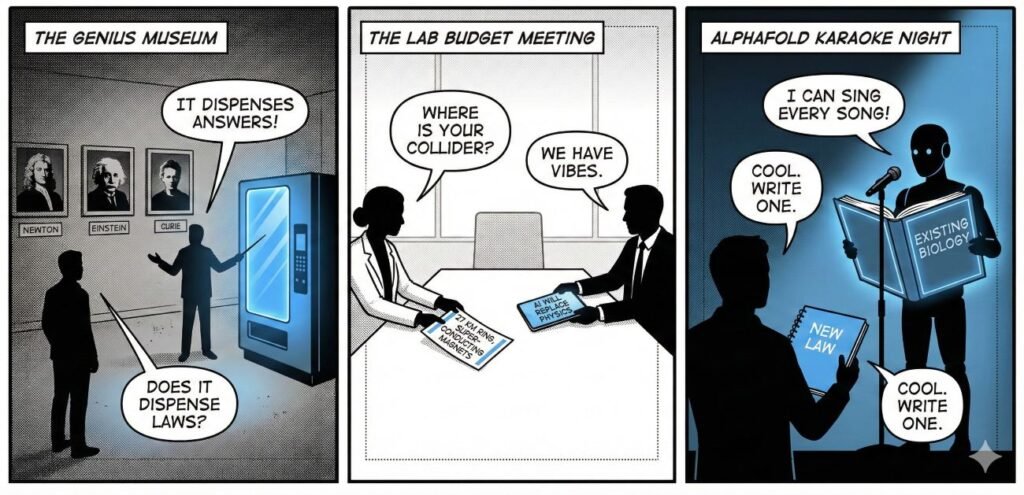
Scene 1: The Genius Museum
Panel: A dusty hall of portraits labelled “Newton”, “Einstein”, “Curie”. A tour guide points to a new exhibit: a shiny vending machine.
Dialogue:
Guide: “It dispenses answers!”
Visitor: “Does it dispense laws?”
Scene 2: The Lab Budget Meeting
Panel: A scientist slides a bill across the table: “27 km ring, superconducting magnets”. A CEO slides back a pitch deck: “AI will replace physics”.
Dialogue:
Scientist: “Where is your collider?”
CEO: “We have vibes.”
Scene 3: AlphaFold Karaoke Night
Panel: AI on stage singing from a massive songbook titled “Existing Biology”. A human holds a blank notebook titled “New Law”.
Dialogue:
AI: “I can sing every song!”
Human: “Cool. Write one.”
What to watch, not the show
- Incentives: funding follows demos, not slow verification.
- Media habits: confidence reads as competence.
- Benchmark theatre: winning a test becomes “solving reality”.
- Corporate mythology: “magic” sells better than “tool”.
- Long-term risk: outsourcing curiosity until nobody remembers how to doubt.
The Hermit take
AI is a lever, not a prophet.
If you want new laws, keep humans sharp and make the machines useful.
Keep or toss
Keep / Toss
Keep the acceleration, the tooling, the grind-killing utility.
Toss the mystical language and the lazy claim that prediction equals understanding.
Sources
- Stephen Wolfram – No AI has impressed me (YouTube):
https://www.youtube.com/watch?v=3Kyvp1Rd6aM - Wolfram Writings – Can AI Solve Science?:
https://writings.stephenwolfram.com/2024/03/can-ai-solve-science/ - Nature – Highly accurate protein structure prediction with AlphaFold:
https://www.nature.com/articles/s41586-021-03819-2 - DeepMind – AlphaFold overview:
https://deepmind.google/science/alphafold/ - CERN – The Large Hadron Collider (LHC) overview:
https://home.web.cern.ch/science/accelerators/old-large-hadron-collider