Hangul, Inyeon, and the Slow Korean Mystery Worth Keeping
Lede
Korean is not failing to become easy fast enough; modern learning culture is failing to understand why wonder should not be speed-run.
Words used
Hangul / Hangeul – Korean: 한글; Romanisation: Hangeul; Meaning: The Korean alphabet.
Hunminjeongeum – Korean: 훈민정음; Romanisation: Hunminjeongeum; Meaning: “The Proper Sounds for the Instruction of the People”, the original name of Hangul.
King Sejong the Great – Korean: 세종대왕; Romanisation: Sejong Daewang; Meaning: The Joseon king credited with creating Hangul.
Joseon – Korean: 조선; Romanisation: Joseon; Meaning: The Korean dynasty during which Hangul was created.
Hanja – Korean: 한자; Romanisation: Hanja; Meaning: Chinese characters used in Korean writing.
Idu – Korean: 이두; Romanisation: Idu; Meaning: An older system that used Chinese characters to represent Korean words and grammar.
Hyangchal – Korean: 향찰; Romanisation: Hyangchal; Meaning: An older writing system using Chinese characters to record Korean, especially old poetry.
Gugyeol – Korean: 구결; Romanisation: Gugyeol; Meaning: Reading marks used to help interpret Classical Chinese through Korean grammar.
Hangeul Day – Korean: 한글날; Romanisation: Hangeulnal; Meaning: The day commemorating the Korean alphabet.
Hermit Off Script
Hangul is where this whole slow Korean fever becomes suspiciously hard to quit. For a long time, I wasn’t interested in anything Korean beyond the occasional film when I was younger. Then 2019 happened, the inception of “Just Love Her” arrived, and the language started appearing like a quiet door left half open. Every year since, I have learned a little more. Not enough to impress the scoreboard goblins. Not enough to become one of those people who say “fluent” because they can order coffee and emotionally blackmail a phrasebook. Just enough to keep the mystery warm. That is the point. I keep the pace slow because every year Korean still has the nerve to surprise me. Then a word like Inyeon turns up, and suddenly ‘connection’ feels too small, too flat, too clean for what Korean is trying to carry. Then I learn more about Hangul, history, culture, traditions, the shape of sounds, the reason letters look the way they look, and somehow it echoes somewhere I cannot file under grammar. It started with a connection beyond mind and logic, which is a terrible thing to explain to sensible people and an excellent thing to keep alive. For a while, I wondered whether it came from past lives, alternate realities, or just a feeling before words, with the soul walking back and forth around the wheel of time like it forgot where it parked eternity. Maybe one day Korean will reveal all its rooms and no wonder will be left. I hope that day is late. I want another year, another word, another deeper meaning from Korean heritage. The app wants completion; I want the lamp still burning in the fog.
Choose the slow burn
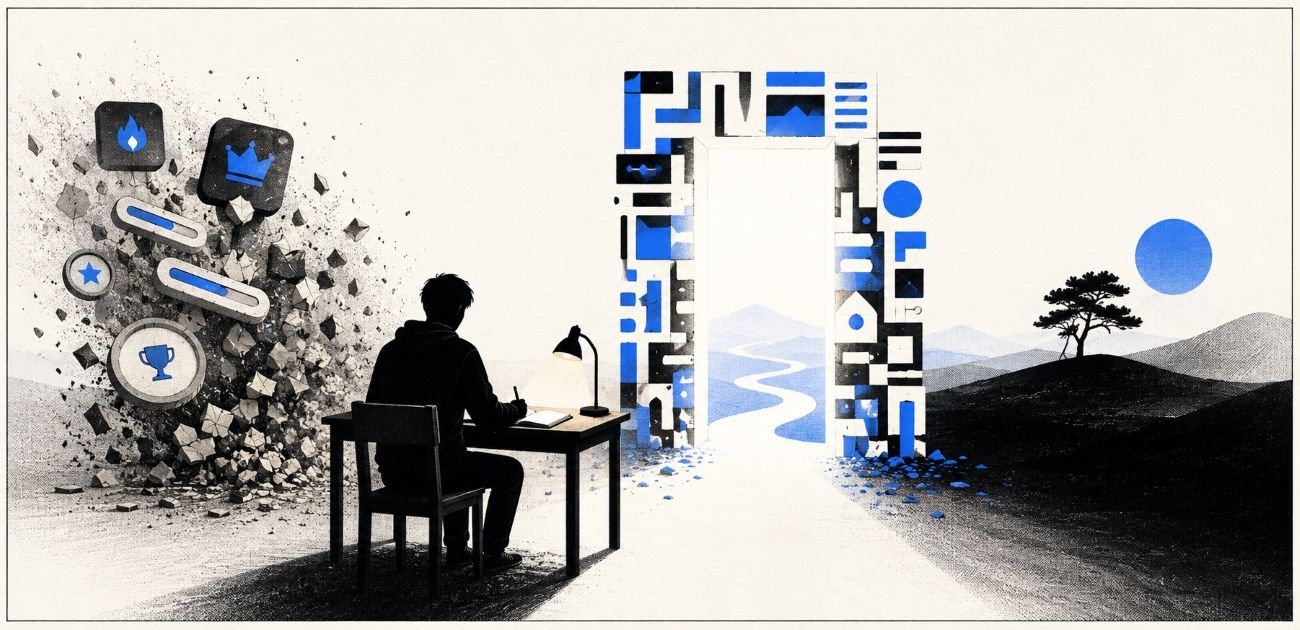
Three doors: the alphabet, the history, and the sketch. The lamp is optional. The wonder is not.
Hangul alphabet basics – names, letters and how it works
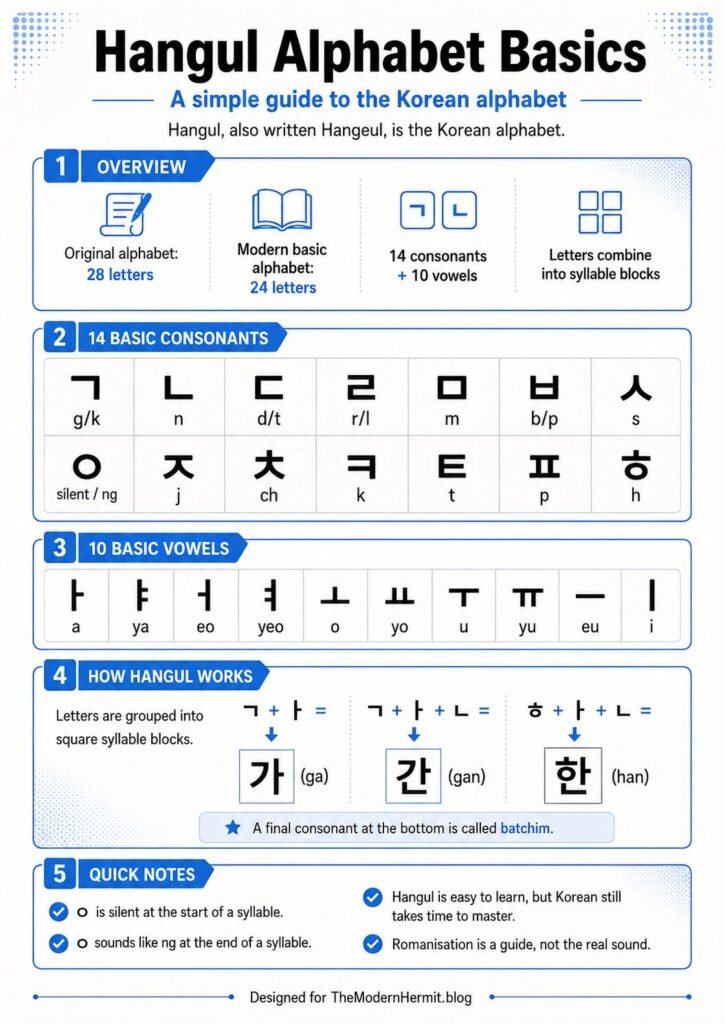
Hangul looks mysterious at first because it is not written in a straight line like the Roman alphabet. That is the first trick. It is still an alphabet, but it behaves like an alphabet wearing a neat square coat. The letters represent sounds, but the letters are grouped into syllable blocks. So Korean is not written as a loose row of letters like “h-a-n”. It is written as a block: 한. This is one of the reasons Hangul feels so clean once the first fog lifts. It looks like a symbol, but it is built from parts.
The Korean alphabet is called Hangul or Hangeul in English. “Hangeul” is the official South Korean romanisation, but “Hangul” remains very common in English. Its original name was Hunminjeongeum, usually translated as “The Proper Sounds for the Instruction of the People” or “Correct Sounds for the Instruction of the People”. That older name tells the truth better than most modern slogans. It was not designed as a decorative script. It was made so people could learn to read and write more easily.
The original alphabet created under King Sejong in 1443 had 28 letters. These were 17 consonants and 11 vowels. Modern standard Hangul uses 24 basic letters: 14 basic consonants and 10 basic vowels. That is the headline number every beginner should remember. 24 basic letters. Not thousands of characters. Not a secret mountain guarded by scholars with ink-stained sleeves. 24 basic letters, then the real work begins.
Modern Korean also uses extra doubled consonants and compound vowels, so learners quickly meet more written forms than the simple 24. That does not mean the alphabet lied to you. It means the 24 basic letters are the foundation, and Korean builds more shapes from them. Very polite, very logical, and still fully capable of ruining your confidence after breakfast.
The basic consonants
Modern Hangul has 14 basic consonants. In Korean, consonants are called jaeum. Each consonant has a Korean name. These names are useful because teachers, dictionaries, spelling explanations, and Korean learners often refer to letters by name.
Letter
Name
Rough sound
Simple note
ㄱ
giyeok
g or k
Often between English g and k, depending on position.
ㄴ
nieun
n
Similar to n.
ㄷ
digeut
d or t
Often between English d and t, depending on position.
ㄹ
rieul
r or l
Can sound closer to r between vowels and closer to l in other places.
ㅁ
mieum
m
Similar to m.
ㅂ
bieup
b or p
Often between English b and p, depending on position.
ㅅ
siot
s
Often s, but sound changes happen before some vowels.
ㅇ
ieung
silent or ng
Silent at the start of a syllable, ng at the end.
ㅈ
jieut
j
Often between English j and ch, depending on position.
ㅊ
chieut
ch
Aspirated ch sound.
ㅋ
kieuk
k
Stronger or more aspirated k sound.
ㅌ
tieut
t
Stronger or more aspirated t sound.
ㅍ
pieup
p
Stronger or more aspirated p sound.
ㅎ
hieut
h
Similar to h, though sound changes happen in real speech.
The clever part is that the consonant shapes were not random. The basic consonant designs were linked to the shape or position of speech organs: tongue, mouth, teeth, throat, and the back of the tongue. In simple language, Hangul tried to make the mouth visible on paper. That is a quietly brilliant idea. Most alphabets make you memorise shapes because history said so. Hangul looks at the mouth and says, “We can do better than decorative accident.”
A beginner should also know that Korean consonants change sound depending on where they appear in a syllable or word. This is why romanisation can feel slippery. ㄱ may be written as g in one place and sound closer to k in another. ㅂ may feel like b or p. ㄹ can feel like r or l. This is not Korean being cruel. This is speech being speech. English does it too, but English hides the crime under centuries of bad spelling manners.
The tense consonants
Alongside the 14 basic consonants, modern Korean uses 5 doubled or tense consonants. These are often taught early because they appear in common words.
Letter
Common name
Rough sound
Simple note
ㄲ
ssanggiyeok
tense k
A tighter, stronger ㄱ.
ㄸ
ssangdigeut
tense t
A tighter, stronger ㄷ.
ㅃ
ssangbieup
tense p
A tighter, stronger ㅂ.
ㅆ
ssangsiot
tense s
A tighter, stronger ㅅ.
ㅉ
ssangjieut
tense j
A tighter, stronger ㅈ.
“Ssang” means double or pair. These letters are not just louder versions. They are tighter in the throat and mouth. English speakers often struggle with them because English does not organise sounds in exactly the same way. That is fine. The mouth needs training. The app will pretend it can fix this in one lesson. The app is lying with confetti.
The basic vowels
Modern Hangul has 10 basic vowels. In Korean, vowels are called moeum. The basic vowel system is also built from design principles. Traditional explanation links the vowel shapes to three ideas: heaven, earth, and human. The dot or short stroke comes from heaven, the horizontal line from earth, and the vertical line from human. This is not just pretty folklore. It shows that the script was designed with sound, shape, and meaning working together.
Letter
Common romanisation
Rough sound
Simple note
ㅏ
a
a as in father
Bright open a sound.
ㅑ
ya
ya
ㅏ with a y sound added.
ㅓ
eo
between uh and aw
Hard for English speakers at first.
ㅕ
yeo
y + eo
ㅓ with a y sound added.
ㅗ
o
o
Rounded o sound.
ㅛ
yo
yo
ㅗ with a y sound added.
ㅜ
u
oo
Like oo in moon.
ㅠ
yu
yoo
ㅜ with a y sound added.
ㅡ
eu
flat u sound
No exact English twin. Think unrounded, tight sound.
ㅣ
i
ee
Like ee in see.
The vowels are where many beginners start to realise that romanisation is useful, then dangerous. ㅓ is written as “eo”, but it is not two sounds. ㅡ is written as “eu”, but it is not the same as the English word “you”. Romanisation is a bridge. Do not build a house on it. Learn the Hangul shape, learn the sound, and use romanisation as a temporary walking stick.
Compound vowels
Korean also uses compound vowels. These combine basic vowel elements into new vowel letters. Some are historically diphthongs, meaning they involve a movement of sound, though modern pronunciation can vary.
Letter
Common romanisation
Rough sound
ㅐ
ae
ae or eh
ㅒ
yae
yae
ㅔ
e
eh
ㅖ
ye
ye
ㅘ
wa
wa
ㅙ
wae
wae
ㅚ
oe
often pronounced like we
ㅝ
wo
wo
ㅞ
we
we
ㅟ
wi
wi
ㅢ
ui
ui, e, or i depending on word and position
For beginners, the main point is simple: do not panic. Compound vowels are not a second alphabet. They are combinations. Korean is doing Lego with sound. You still have to learn the pieces, but the logic is visible.
How syllable blocks work
Hangul letters are grouped into syllable blocks. Each block usually contains at least one consonant and one vowel. Many blocks also include a final consonant at the bottom.
The basic structure is:
Consonant + vowel = syllable
Example: ㄱ + ㅏ = 가
That block is read as “ga” or “ka”, depending on context and pronunciation.
Another example: ㄴ + ㅏ = 나
That block is “na”.
If there is a final consonant, it goes at the bottom:
ㄱ + ㅏ + ㄴ = 간
That block is “gan”.
This bottom consonant is called batchim, meaning supporting floor or final consonant. Batchim is one of the places where Korean pronunciation starts to become more interesting and more annoying. A letter may have one sound when it starts a syllable and another sound when it sits at the bottom. The learner thinks, “I know this letter.” Korean replies, “Do you, though?”
The silent ㅇ
The letter ㅇ deserves its own small warning. At the start of a syllable, ㅇ is silent. It is used as a placeholder because Korean syllable blocks need a consonant position. For example:
ㅇ + ㅏ = 아
This is pronounced “a”, not “nga”.
But at the end of a syllable, ㅇ is pronounced like “ng”:
강
This is “gang”, with the final ng sound.
So ㅇ is both nothing and something, depending on where it stands. Very philosophical. Also very Korean. A tiny circle enters the room and says, “I am silence until I am not.”
Why some vowels go right and some go below
The shape of the vowel decides where it sits in the syllable block.
Vertical vowels go to the right of the first consonant.
Examples: ㄱ + ㅏ = 가 ㄴ + ㅓ = 너 ㅁ + ㅣ = 미
Horizontal vowels go below the first consonant.
Examples: ㄱ + ㅗ = 고 ㄴ + ㅜ = 누 ㅁ + ㅡ = 므
Some compound vowels use both right and bottom positions.
Example: ㄱ + ㅘ = 과
This is why Hangul blocks look neat and square. The letters are not thrown into a pile. They are arranged by position. Once the eye understands the pattern, reading becomes much less frightening.
Original 28 letters and modern 24 letters
The original Hunminjeongeum system had 28 letters:
17 consonants
11 vowels
Modern standard Hangul uses 24 basic letters:
14 basic consonants
10 basic vowels
Some original letters are no longer used in standard modern Korean. The best-known old letters include:
ㆍ, often called arae-a
ㆁ, old ieung
ㅿ, called bansiot
ㆆ, called yeorinhieut
These old letters matter for history, older texts, dialect study, and the story of how Korean sounds changed. A beginner does not need to master them first. The beginner needs the modern 24, then the tense consonants, compound vowels, syllable blocks, and common sound rules. Do not start by trying to become a medieval inscription. Start by reading a cafe sign correctly.
Letter names and why they matter
The names of Korean consonants are not decorative. They help people spell, teach, and talk about the letters. English speakers say “bee”, “cee”, and “dee”. Korean speakers can say “giyeok”, “nieun”, and “digeut”.
For the beginner, learning letter names is useful, but it should not replace learning the sounds. The sound comes first. The name helps later.
The vowel letters are usually named by their sound: ㅏ is called a ㅑ is called ya ㅓ is called eo ㅕ is called yeo ㅗ is called o ㅛ is called yo ㅜ is called u ㅠ is called yu ㅡ is called eu ㅣ is called i
Again, romanisation is only a rough guide. The real alphabet is the Korean shape and the Korean sound. The sooner a learner stops leaning too heavily on romanisation, the sooner Hangul becomes alive rather than decoded like a password.
What makes Hangul beginner-friendly
Hangul is beginner-friendly because the number of basic letters is small, the shapes are systematic, the vowels combine logically, and syllable blocks follow visual rules. A learner can usually understand the basic structure quickly. That is the mercy.
But Hangul is not the whole Korean language. That is the trap. Learning Hangul lets you read Korean words out loud in a basic way. It does not mean you understand grammar, meaning, politeness levels, idioms, sound changes, or cultural depth. The alphabet opens the gate. The language is the long path after it.
That is why slow learning makes sense. You can learn the letters quickly, then spend years discovering what they carry. Hangul is easy enough to invite you in and deep enough to keep you humble. A perfect design, really. The door opens fast. The house takes a lifetime.
Quick beginner map
Learn the 14 basic consonants.
Learn the 10 basic vowels.
Learn how consonants and vowels form syllable blocks.
Learn the 5 tense consonants.
Learn the 11 common compound vowels.
Learn batchim, the final consonant position.
Start reading real words slowly.
Reduce romanisation as soon as possible.
Listen while reading so the letters connect to real sound.
Accept that Hangul is the beginning, not the finish line.
A simple guide to the Korean alphabet, from basic letters to syllable blocks.
A slow history of Hangul
Hangul did not arrive as a cute alphabet chart for tourists, language apps, and people trying to make their handwriting look spiritual on Instagram. It arrived as a political object, a design object, and a moral argument. That is why its history still matters. A script is never only a script. It decides who can read the law, who can write grief, who can record a prayer, who can leave a letter, who gets trapped behind the palace wall of education, and who gets told, with a straight face, that literacy is “not for everyone”. Very convenient. Always funny how complexity becomes sacred when it protects the desk of the comfortable.
Before Hangul, Koreans spoke Korean, not Chinese. That correction matters because people still confuse language with writing system, which is how history gets turned into soup. Korean speech existed, Korean life existed, Korean thought existed. The problem was writing. For centuries, educated Koreans used Chinese characters, known in Korean as Hanja, and much official and scholarly writing was done in Classical Chinese. This gave Korea access to a huge literary and administrative tradition across East Asia, but it also created a severe mismatch. Chinese and Korean do not work the same way. Korean grammar, word order, particles, endings, and sound structure had to squeeze through a writing system made for another language. It was like trying to drink tea through a locked door.
There were workarounds before Hangul. Korea used systems such as Idu, Hyangchal, and Gugyeol. These were not alphabets in the modern Hangul sense. They borrowed Chinese characters and adapted them to Korean sounds, meanings, grammar, or reading practice. Hyangchal is especially associated with old Korean songs and poetry, including Hyangga. Gugyeol helped readers understand Classical Chinese through Korean grammatical guidance. Idu was used in administrative and practical contexts and could record Korean words by meaning or sound through Chinese characters. These systems show that Koreans were not passively waiting in silence until 1443. They were already trying to force Korean speech through borrowed written machinery. The trouble was that the machinery was still heavy. It demanded training, status, time, and access. Ordinary people did not simply “fail” literacy. Literacy was built like a high wall, and then society looked surprised when most people stood outside.
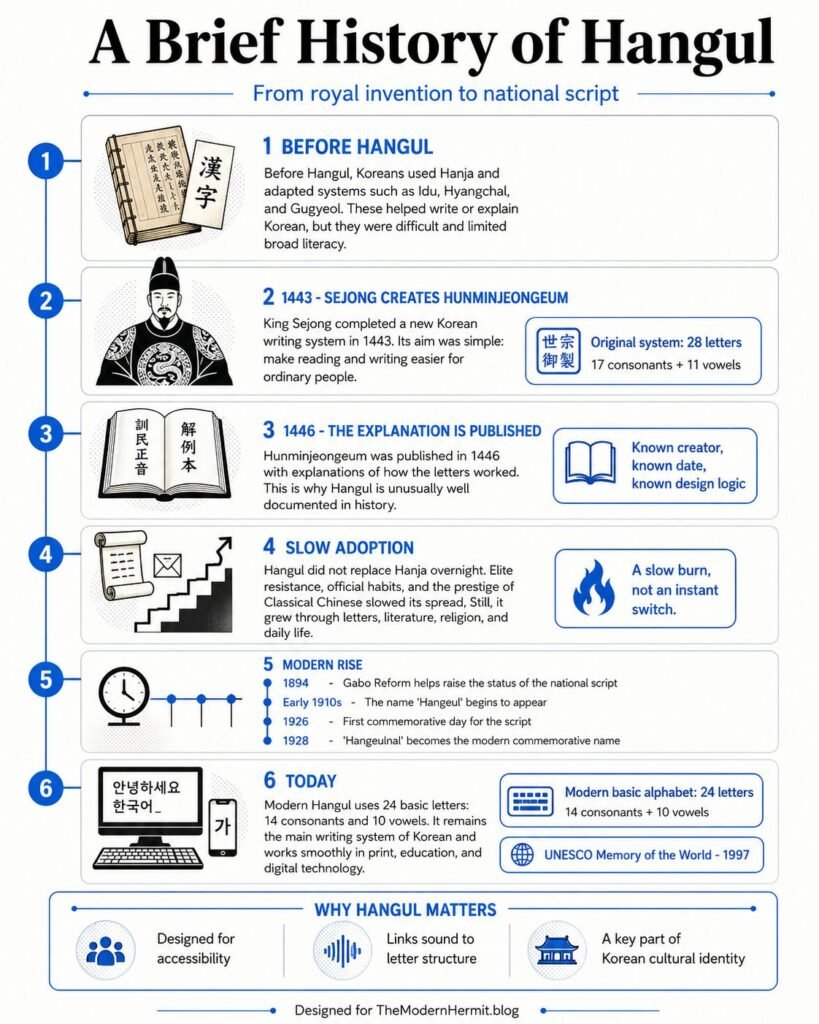
This is the background that makes King Sejong’s project so sharp. Sejong the Great, the fourth king of the Joseon dynasty, reigned from 1418 to 1450. In the twelfth lunar month of 1443, the record in the Sejong Sillok states that the king created 28 letters for the written language of Joseon and that this was called Hunminjeongeum. The name is usually translated as “The Proper Sounds for the Instruction of the People” or “Correct Sounds for the Instruction of the People”. That title is not decorative. It gives away the whole ethical engine. The purpose was not to make Korean look pretty on merchandise. The purpose was instruction, access, use. It was writing aimed at people who had been structurally locked out of writing.
Hunminjeongeum was completed as a book in 1446. UNESCO records that the manuscript published in the ninth lunar month of 1446 contains Sejong’s proclamation of the Korean alphabet, completed in 1443, along with Haerye, meaning explanations and examples by scholars of the Hall of Worthies. The surviving Haerye edition is one of the reasons Hangul is so extraordinary. Most writing systems grow slowly over time, with origins blurred by centuries of habit, migration, borrowing, argument, and accident. Hangul has something far rarer: a creator named in the historical record, a date, a purpose, and a design manual explaining why the letters look and work as they do. History usually hands us ruins and asks us to guess. Hangul hands us notes from the workshop.
There is debate around how much Sejong created personally and how much was shaped with scholars. Some sources and traditions stress Sejong’s direct role very strongly. Other accounts describe the project as led by Sejong and later explained, refined, or documented by scholars. The safest line is this: Sejong was the central creator and royal force behind Hangul, while the 1446 Hunminjeongeum Haerye included explanations and examples by scholars connected with the Hall of Worthies. That is not a downgrade. Great inventions often need both the spark and the scaffolding. The spark is Sejong. The scaffolding is the intellectual world around the court. The result is still one of the cleanest acts of writing-system design in recorded history.
The original system had 28 letters: 17 consonants and 11 vowels. Modern Hangul uses 24 basic letters: 14 consonants and 10 vowels. Four of the original letters fell out of regular modern use. This is already a nice insult to anyone who thinks a language is a frozen museum object. Scripts breathe. Sounds shift. Society changes. A writing system survives not by remaining untouched, but by staying usable.
The design is the real miracle, and for once “miracle” is not marketing glue. Hangul’s consonants were designed around articulation. The National Hangeul Museum explains that the basic consonants reflect the shapes or positions of the vocal organs used to make sounds: molars or the back of the tongue, the tongue touching the gums, the lips, the teeth, and the throat. In plain terms, the letters carry a memory of the mouth. The script is not random decoration. It looks at the body producing speech and turns that into written form. A letter becomes a small diagram of sound. This is where Hangul stops being merely easy and becomes quietly outrageous.
The vowel design brings another layer. The basic vowels were built from symbols associated with sky, earth, and human. In older explanations, this reflects a cosmological idea: heaven, earth, and humanity in relation. Again, modern learners should be careful not to turn this into mystical wallpaper. The point is not that every vowel should be placed in a crystal bowl. The point is that Hangul’s design joined phonetics, philosophy, and usability. It was technical and symbolic at the same time. That is a rare balance. Most systems choose between being practical and being beautiful. Hangul seems to have looked at that choice and said, politely, no.
The letters also work by expansion. The basic consonants can take added strokes to show related sounds. The basic vowels combine to form more vowel shapes. The script is built from rules, not brute memory. That is why people often experience Hangul as approachable compared with systems that require thousands of characters before basic reading becomes possible. This does not mean Korean itself is easy. That is the trap. Hangul is the door. Korean grammar, vocabulary, speech levels, idiom, history, sound change, and cultural meaning are the house. The door is beautifully designed. The house still has rooms, stairs, attics, ghosts, and that one cupboard no textbook wants to explain properly.
The social reaction was not simple. It is tempting to tell the cartoon version: benevolent king gives commoners writing, arrogant elites throw a tantrum because their monopoly is under threat, literacy rides in on a white horse, everyone claps. There is truth in the tension, but history is usually messier than the pub version. Scholars did oppose the new script. A famous 1444 memorial associated with Choe Man-ri and others criticised the use of the vernacular script. Their objections came from a Confucian world where Classical Chinese carried cultural authority, diplomatic seriousness, and scholarly prestige. They worried about Korea’s relationship to Chinese civilisation, about scholarly standards, and about the script’s place in statecraft. Was there also status anxiety? Almost certainly. Systems that require decades of training rarely welcome a ladder placed against the wall. But the cleanest historical reading is not “evil elites hated poor readers”. It is that Hangul threatened a whole written order built around Hanja, Classical Chinese learning, state hierarchy, and cultural legitimacy. Bureaucracy hates a new door. It has already printed the signs for the old one.
Hangul’s early use was gradual. It did not instantly replace Hanja or Classical Chinese. Court, scholarship, bureaucracy, and elite writing remained deeply tied to Chinese characters for centuries. Hangul was used in royal and religious publications, translations, letters, poetry, fiction, women’s writing, popular literature, education, and practical communication. Its status shifted across time. It was sometimes called Eonmun, meaning vernacular script, a label that could carry lower prestige. It was also called Jeongeum, Banjeol, Gukmun, or Gukseo in different periods. The modern name “Hangeul” or “Hangul” did not become common until the early twentieth century. The National Hangeul Museum notes that the name began to be used from the early 1910s and became more widely used through publications and language movement activity in the 1920s. In 1927, the Joseon Language Society published a research journal called “Hangeul”. In 1928, the commemorative day changed from Gagyanal to Hangeulnal. Even the name of the script had its own slow arrival. Apparently, even alphabets need branding eventually. Someone in 1928 was doing cultural identity work before social media had the decency to exist.
The late nineteenth century was a major turning point. The Gabo Reform period of 1894 helped raise the status of the national script, and the National Hangeul Museum notes that after the 1894 reform, Hunminjeongeum was commonly called Gukmun or Gukseo, meaning national script or national writing. Recent computational historical work also identifies a rapid shift from Hanja toward Hangul starting around 1890. That matters because it shows Hangul’s rise was not one smooth line from 1443 to modern Korea. It was a long, uneven fight across court culture, printing, education, nationalism, colonial pressure, modern administration, and everyday use. Slow burn is not just a metaphor here. It took centuries.
The colonial period under Japan made Hangul more than a writing tool. It became tied to Korean identity and survival. Korean language activism, standardisation, dictionaries, newspapers, teaching, and literary production became part of a wider struggle over culture. The Joseon Language Society worked on research and standardisation. Korean writing was not simply a convenience. It became a vessel for memory. When an occupying power pressures a language, every letter becomes less innocent. A script can become a border without walls.
After liberation in 1945 and the division of Korea, Hangul remained central in both Koreas, though terminology, spelling rules, language policy, and vocabulary developed differently. South Korea usually uses the spelling “Hangeul” in official romanisation, while “Hangul” remains common internationally. North Korea uses “Chosongul” in romanised form for its term. The script itself remains a shared inheritance, even across political division. That is one of Hangul’s quiet tragedies and quiet powers: the same letters cross a line that people cannot.
Modern Hangul is also a digital success story, though that sentence already sounds like a committee trying to sell a museum app. Still, the point matters. Korean text in computing is not a simple matter of typing a few letters. Hangul works through jamo, the component letters that form syllable blocks. In Unicode, 11,172 modern Hangul syllables are directly encoded. These syllables are built from sequences of leading consonants, vowels, and optional trailing consonants. In daily reading, people see neat syllable blocks, not loose alphabet letters in a row. The design from the fifteenth century still makes sense inside twenty-first-century code. That should embarrass a few modern systems whose password reset pages cannot cope with an apostrophe.
Hangul’s genius is that it is both simple and deep. A beginner can learn the basic shapes quickly. That is true. But quick entry is not the same as shallow meaning. Hangul opens fast, then keeps unfolding. The design carries sound. The history carries class, court, reform, resistance, colonial memory, national identity, and modern technology. That is why learning it slowly is not failure. It is respectful pacing. The writing system was made so people could enter, not so they could rush through and declare the room conquered.
There is also a useful warning here for modern learners. Hangul’s accessibility can trick the impatient into thinking they have “done Korean” once they can sound out words. No. You have learned the doorway. That is beautiful, but the doorway is not the whole city. Korean still has grammar that moves differently, vocabulary with Chinese roots and native roots, social levels that change the emotional temperature of a sentence, cultural words that resist neat English capture, and expressions whose meaning sits behind the dictionary like a cat refusing to come indoors.
That is where a word like Inyeon belongs. It is not a Hangul history term in itself, but it is exactly the kind of word that shows why the script matters. Hangul gives the word a readable body. Korean gives it a life. Translation gives you a thin coat. Time gives you the weather. The slow learner is not lazy. The slow learner is refusing to murder wonder for the sake of a progress badge.
So the history of Hangul is not merely “King Sejong invented an alphabet in 1443”. That is the headline, useful but too small. The fuller story is this: Korea had speech that deserved its own written form; borrowed Chinese characters were powerful but unsuitable for broad Korean literacy; earlier Hanja-based systems tried to bridge the gap but remained difficult; Sejong created a new script with a stated public purpose; the 1446 Hunminjeongeum Haerye preserved its design logic; the script faced elite resistance and slow adoption; it grew through religious, literary, domestic, educational, and popular use; it gained national force in the modern period; it survived pressure, reform, division, and digitisation; and it still sits there, calm as a lamp, letting a learner discover one more word without pretending the mystery is finished.
That is the roast hidden inside the history. Hangul was built to give ordinary people access to writing. Modern learning culture keeps trying to turn that gift back into a hierarchy of badges, streaks, rankings, and false fluency. Sejong gave people letters. The app gives people guilt with animations. Keep the letters. Question the guilt.
Key dates
Before 1443: Koreans used Chinese characters and Hanja-based systems such as Idu, Hyangchal, and Gugyeol to write or interpret Korean and Classical Chinese.
1418 to 1450: Reign of King Sejong the Great, fourth king of Joseon.
1443: Sejong completed the creation of Hunminjeongeum, according to UNESCO and Korean institutional sources.
1446: Hunminjeongeum was published, including explanatory material known as Haerye.
1894: The Gabo Reform period helped raise the status of the national script.
Early 1910s: The name “Hangeul” began to appear in records, according to the National Hangeul Museum.
1926: Gagya Day was created to commemorate Hunminjeongeum.
1927: The Joseon Language Society published its journal “Hangeul”.
1928: The commemorative name changed from Gagyanal to Hangeulnal.
1997: Hunminjeongeum was entered into UNESCO’s Memory of the World Register.
Modern Unicode: 11,172 precomposed Hangul syllables are directly encoded for modern Korean text.
A brief history of Hangul, from Sejong’s design to modern Korean writing.
What does not make sense
We praise ancient design when UNESCO says it is heritage, then treat language learning like a supermarket self-checkout with vowels.
Hangul was created to make writing easier for people, yet language apps now turn easy access into a daily guilt machine.
Inyeon can hold relationship, cause, history, and fate, but the app-brain still asks where the “mark as mastered” button is.
People say they want cultural depth, then panic when a word arrives with roots instead of a tidy one-word English twin.
Slow learning is treated like failure, even when slow learning is the only pace that leaves room for reverence.
The real absurdity is not that Korean takes time; it is that we now expect mystery to send weekly progress reports.
Sense check / The numbers
Space Daily published its Hangul piece on June 28, 2026, arguing that Hangul is unusual among major writing systems because it has a known creator and a documented design rationale. [Space Daily]
UNESCO says the Hunminjeongum manuscript was published in the ninth lunar month of 1446, that Sejong completed the alphabet in 1443, and that the manuscript entered the Memory of the World Register in 1997. [UNESCO]
The National Folk Museum of Korea says the original system had 28 letters: 17 consonants and 11 vowels. It also says modern Hangeul uses 24 letters: 14 consonants and 10 vowels. [National Folk Museum of Korea]
The National Hangeul Museum says Hangeul became the official national writing system only in 1894, more than 450 years after its creation. Slow burn, apparently, was already on the syllabus. [National Hangeul Museum]
A NIKL-sourced Korean dictionary entry gives Inyeon 3 core English senses around relationship, connection, and reason, and traces it to 2 hanja: one for reason or cause, and one for connection, fate, or relationship. [NIKL via HangulHanja]
The sketch
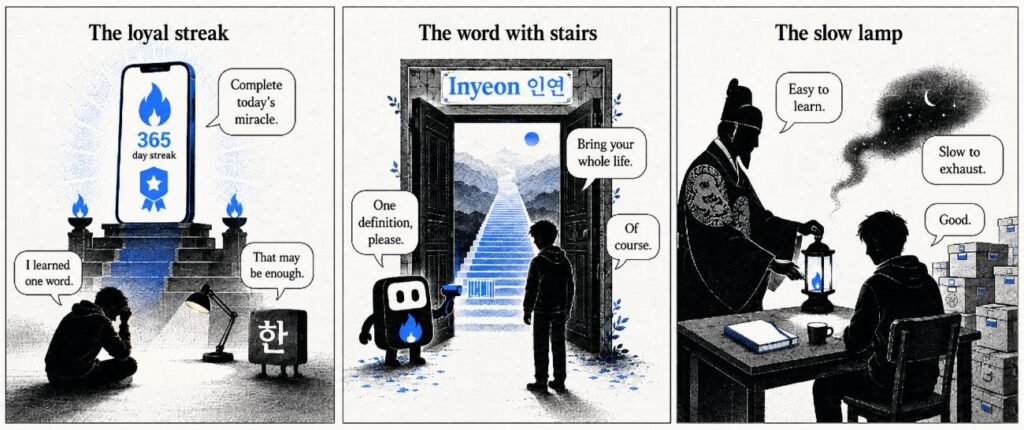
Scene 1: The loyal streak A giant phone sits on a shrine, glowing over a tired learner. A small Hangul block waits quietly beside an old lamp. Dialogue: Phone: “Complete today’s miracle.” Learner: “I learned one word.” Hangul: “That may be enough.”
Scene 2: The word with stairs A doorway marked Inyeon opens onto a long staircase. A language app mascot tries to scan it with a barcode reader. Dialogue: App: “One definition, please.” Inyeon: “Bring your whole life.” Learner: “Of course.”
Scene 3: The slow lamp A silhouette of King Sejong places a lamp on a desk. The learner sits nearby with one notebook, one cup, and many unopened boxes. Dialogue: Sejong: “Easy to learn.” Mystery: “Slow to exhaust.” Learner: “Good.”
The app wants completion; the word wants time.
What to watch, not the show
The app economy rewards return visits more than deep memory.
Language learning gets sold as identity decoration, not patient contact with another mind.
Algorithms flatten culture into useful phrases, cute fonts, and festival trivia.
The opposite trap is romantic fog: loving the mystery so much that you forget grammar exists.
The healthier road is boring and sacred: daily practice, slow revision, and space for awe.
Korean heritage should not be reduced to aesthetic wallpaper for Western longing.
A word with history should be allowed to stay difficult for a while.
The Hermit take
Korean keeps me slow, and that might be the cure. A streak ends at midnight; a word can haunt you for years.
Keep or toss
Keep / Toss. Keep the slow burn, the words, the history, and the stubborn wonder. Toss the app-brain that wants every mystery converted into admin.
Sources
Space Daily inspiration article: https://spacedaily.com/d-the-korean-alphabet-called-hangul-is-the-only-major-writing-system-in-human-history-with-a-known-inventor-and-a-documented-design-rationale-created-in-1443-by-king-sejong-of-the-joseon-dyn/
UNESCO Hunminjeongum Manuscript: https://www.unesco.org/en/memory-world/hunminjeongum-manuscript
National Folk Museum of Korea, The Korean alphabet, Hangeul: https://www.nfm.go.kr/k-box/ui/annyeong/hangeul.do?lang=en
National Hangeul Museum, Permanent Exhibition: https://www.hangeul.go.kr/en/exhi/dailyExhibition.do
HangulHanja dictionary entry for Inyeon, sourced from NIKL: https://hangulhanja.com/en/words/%EC%9D%B8%EC%97%B0
National Folk Museum of Korea, The Korean alphabet, Hangeul: https://www.nfm.go.kr/k-box/ui/annyeong/hangeul.do?lang=en
National Institute of Korean Language, About Hangeul: https://www.korean.go.kr/eng_hangeul/principle/001.html
National Hangeul Museum, About the Hangeul: https://m.hangeul.go.kr/lang/en/html/education/Hangeul.do
National Hangeul Museum, About the Hangeul: https://m.hangeul.go.kr/lang/en/html/education/Hangeul.do
National Folk Museum of Korea, The Korean alphabet, Hangeul: https://www.nfm.go.kr/k-box/ui/annyeong/hangeul.do?lang=en
National Institute of Korean Language, About Hangeul: https://www.korean.go.kr/eng_hangeul/origin/001.html
Seoul Metropolitan Government, Celebrating the Excellence of the Korean alphabet on Hangeul Day: https://english.seoul.go.kr/celebrating-the-excellence-of-the-korean-alphabet-on-hangeul-day/
FutureLearn and Sungkyunkwan University, Korean Writing Systems Before Hangeul: https://www.futurelearn.com/info/courses/what-is-korean-philosophy/0/steps/98315
Unicode, Korean FAQ: https://www.unicode.org/faq/korean.html
Open Korean Historical Corpus paper: https://arxiv.org/abs/2510.24541
Space Daily inspiration article: https://spacedaily.com/d-the-korean-alphabet-called-hangul-is-the-only-major-writing-system-in-human-history-with-a-known-inventor-and-a-documented-design-rationale-created-in-1443-by-king-sejong-of-the-joseon-dyn/
The concept of fate between two persons over time is embedded in almost all cultures and scriptures all over the world in one way or another, so it’s no wonder I found this concept in Korea as well and it’s called 인연 – inyeon – fate. What is different, though, is the concept of meeting the one not only as a choice but as a passing person going to the extreme just by touching their existence. Extrapolating the idea further, it isn’t limited to the loved one but to any other environment and people surrounding our existence. It’s known that some people have more or less influence in our lives than others. To what extent can a touch or piece of advice make a significant impact or only have a specific influence on decisions or the way our lives go on? It depends on too many variables. The most advanced concepts or scriptures are considered the work of divinity – anything a human can’t explain or understand. Still, with the advancement in AI technologies, the work of ‘divinity’ will no longer be a mystery, only a process we don’t fully understand or acknowledge.
16 July 2023, 4 am – I woke up in the morning, and after so many years in love with Her and the Korean connection, I still find new things and concepts with deep meanings in my soul. Randomly, I learned about the idea of fate between two lovers destined to last over years and past lives. Last night’s dream is the first in the series of my unbelievable dreams of possible past and alternate lives connecting my soul. I dreamt that I was a middle-aged black woman with some body weight doing some paperwork, and suddenly, a fire broke up after throwing a cigarette butt in the bin. Remembering the details after the dream was so fuzzy, but the character played was so interesting, and I knew that I had to put it in writing just as a reminder for myself that my dreams are out of this world.
INSPIRING MOVIE: PAST LIVES (2023) – directed by Celine Song



Leave a Reply