
Lede
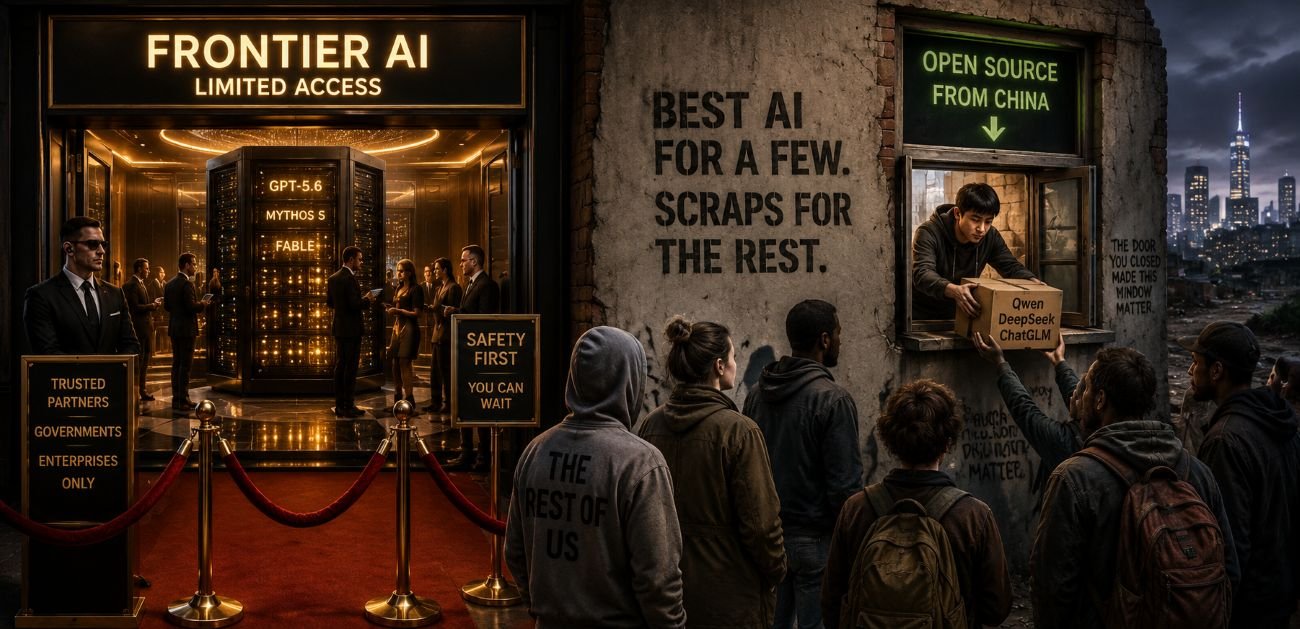
The danger is not that AI becomes a god; the danger is that the usual landlords put a velvet rope round it and call the queue “safety”.
Words used
- Frontier model – a very advanced AI system near the top of current capability.
- AGI – a contested idea for AI that can do most intellectual tasks as well as, or better than, humans.
- Open-weight model – an AI model whose weights are released for others to download, run, adapt or inspect, depending on the licence.
Hermit Off Script
I said this before: the AI close to AGI will not be for ordinary people. It will not arrive like public libraries, clean water or a train ticket you can almost afford if you don’t eat lunch. It will arrive like a private members’ club with better lighting. The public will get the scraps, the safety lecture and the cheerful blog post about responsible access. The rich, the governments and the approved companies will get the real machine, with a nice badge and a clause nobody outside the room can read. So yes, the future can already be guessed from the booking system. The big story is not that AI will wake up and destroy us while humming in binary. That is the doomers’ theatre. The cleaner danger is older, uglier and wearing a tax adviser as a hat: the people with money and power will use the best tools first, defend themselves with them, make more money from them, then tell everyone else the delay is for our own good. Wonderful. A gated apocalypse, now with compliance paperwork. The difference between rich and poor could become so wide that “competition” becomes a bedtime story told to interns. One side gets frontier models, robots, private security, capital returns, lobbyists and early access. The other side gets rent, algorithmic management, cheaper hallucinations and a chatbot that says it cannot help with that. I am not saying this is guaranteed as fact. I am saying this is the moral direction of the thing if we keep building intelligence inside the same old pyramid. The real danger was never the machine alone. It was the billionaire class that treats taxes as optional DLC, democracy as a useful costume, and poor people as scenery between airport lounges. The signs are here: GPT-5.6 starts under restrictions, Mythos access goes to trusted organisations, Fable waits, and everyone else is asked to admire the guardrails from outside the fence. Then governments act shocked when people look at Chinese open-weight models and say, “Fine, I will use that then.” I don’t celebrate that. I just recognise the majestic stupidity of closing the public door and then being surprised when the crowd climbs through the window.
P.S. The funniest, darkest possible future is that the West spends years warning everyone about Chinese AI, then makes its own best AI unavailable to normal people, and accidentally does China’s marketing for free. TikTok already showed the pattern. A foreign tool becomes useful, addictive and embedded before the state knows how to deal with it. Then the state arrives late with bans, forced sales, hearings and patriotic panic, looking like a man trying to arrest rain. AI could follow the same pattern, only worse. TikTok was one app. AI is a tool that can write, code, search, design, translate, plan and automate. Once people depend on the stronger tool, they don’t politely return to the toy version because a minister found a flag. So imagine it. Western companies keep the strongest models behind enterprise gates, government lists and polite little cages. They call it safety. Normal people get the padded version with a smiley face and a refusal script. Then a Chinese open-weight model appears that is cheaper, stronger or simply less locked. Developers use it. Small businesses build on it. Students learn with it. Creators wrap their work around it. Not because they want that system. Not because they trust it. Because when the powerful close every door, the poor stop asking which door has the nicer flag on it. They look for the one that opens. That is where the stupidity becomes cosmic. The richest countries may not lose public trust because China beats them in a lab. They may lose because their own elites treat intelligence like a private estate. Ban it later, cry about national security later, call everyone irresponsible later. It will not matter much once the habit forms. You cannot starve people of tools, then act shocked when they accept tools from whoever leaves the box open. The real AI war may not be democracy versus China. It may be closed privilege versus desperate access, and desperate access is a very stubborn animal.
P.P.S. And the Trump administration’s handling of this did not look like “safety for the people” from where I am standing. It looked more like: let us, the government, the defence world and our rich trusted friends use it first, then much later, after every dangerous, powerful and genuinely useful part has been wrapped in velvet, paperwork and refusal scripts, the public can have the polite version. The one that smiles, apologises and says it cannot help with the thing the approved people have already automated. Maybe that is not the official intention. Fine. But politics is also theatre, and this theatre has a very clear stage design. Powerful institutions get early access. Ordinary people get a waiting room. The rich get the engine. The rest get the dashboard with half the buttons removed. Then everyone is asked to clap because the sign above the door says “safety”. I don’t mind safety. I mind safety becoming the perfume sprayed over privilege.
What does not make sense
- The public funded the internet, supplied the data, trained the culture, produced the labour, then got handed a queue number.
- Safety testing makes sense. Secret customer-picking by governments and companies does not.
- Rich people are told to innovate; ordinary people are told to wait until the product is “safe enough” for their tiny little lives.
- Western governments warn about Chinese AI, then help create the exact market conditions that make Chinese open models attractive.
- The doomer story fears a rogue machine. The duller horror is a perfectly obedient machine serving the same old owners.
- If a model is too dangerous for the public, it is probably too dangerous to hand to companies whose main religion is quarterly growth.
- Calling exclusion “responsible deployment” is very elegant. So is calling a locked pantry “food safety”.
Sense check / The numbers
- On 26 June 2026, OpenAI said GPT-5.6 Sol, Terra and Luna would begin as a limited preview for a small group of trusted partners shared with the US government, with broader availability planned in the coming weeks. [OpenAI]
- Reuters reported on 26 June 2026 that OpenAI delayed the full public launch of GPT-5.6 at the US government’s request, while Anthropic’s Mythos 5 was restored to more than 100 trusted US organisations. [Reuters]
- A 2025 revision of a frontier AI cost paper estimated that the amortised cost of training the most compute-intensive models had grown 2.4x per year since 2016, and that the largest training runs could cost more than $1 billion by 2027. [arXiv]
- Oxfam reported in January 2026 that billionaire wealth rose by over 16 per cent in 2025 to $18.3 trillion, and had increased by 81 per cent since 2020. [Oxfam]
- SCMP reported in April 2026 that Alibaba’s Qwen family captured more than 50 per cent of global open-source model downloads as of March, reaching nearly 1 billion cumulative downloads. [SCMP]
The sketch
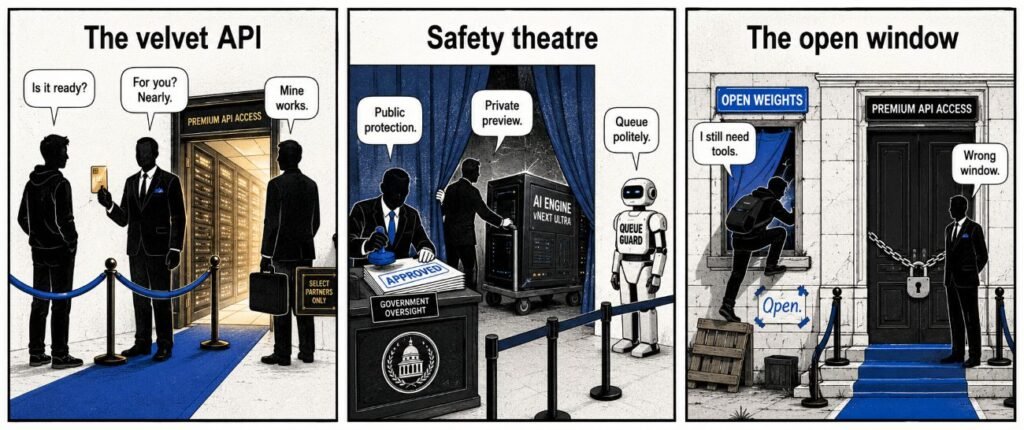
Scene 1: The velvet API
Three people stand at a rope barrier outside a glowing server room. A suited figure holds a golden keycard.
Dialogue:
Public: “Is it ready?”
Gatekeeper: “For you? Nearly.”
Investor: “Mine works.”
Scene 2: Safety theatre
A government official stamps papers while a company executive wheels a huge AI engine behind a curtain.
Dialogue:
Official: “Public protection.”
Executive: “Private preview.”
Robot guard: “Queue politely.”
Scene 3: The open window
A tired developer climbs through a side window labelled “open weights” while the front door remains locked.
Dialogue:
Developer: “I still need tools.”
Gatekeeper: “Wrong window.”
Window: “Open.”
What to watch, not the show
- Who gets first access to frontier models, and under what rules.
- Whether “trusted partners” means public-interest bodies or rich incumbents with better lobbyists.
- How compute, chips and data centre capacity concentrate power before anyone says “democracy”.
- Whether AI safety becomes a real public process or a private approval ritual.
- Whether open-weight models become the poor person’s frontier because closed models become luxury infrastructure.
- How AI raises returns to capital while wages wait outside with a paper cup.
- Whether governments regulate risk or simply pick winners.
- How robot labour, surveillance and automated decision systems change rights for workers and tenants.
- Whether tax systems catch AI wealth or politely wave it through first class.
The Hermit take
AI will copy the society that owns it.
Give it to a few, and it becomes a crown with autocomplete.
Keep or toss
Verdict: Keep / Toss.
Keep safety testing and open models.
Toss velvet-rope access, hidden approval lists and the sermon that calls exclusion protection.
Sources
- OpenAI GPT-5.6 preview: https://openai.com/index/previewing-gpt-5-6-sol/
- Reuters on GPT-5.6 restricted rollout: https://www.reuters.com/legal/litigation/openai-defers-public-rollout-gpt56-us-seeks-early-access-frontier-ai-models-2026-06-26/
- Reuters on Anthropic Mythos 5 access: https://www.reuters.com/technology/us-releases-anthropic-model-mythos-some-us-companies-semafor-reports-2026-06-26/
- Oxfam billionaire wealth report: https://www.oxfam.org/en/press-releases/billionaire-wealth-jumps-three-times-faster-2025-highest-peak-ever-sparking
- World Inequality Report on multi-millionaire taxation: https://wir2026.wid.world/insight/multi-millionaires-taxation/
- World Bank on AI inequality and data centre capacity: https://data360.worldbank.org/en/atlas/artificial-intelligence/
- Frontier AI training costs paper: https://arxiv.org/abs/2405.21015
- Stanford HAI on China’s open-weight AI ecosystem: https://hai.stanford.edu/policy/beyond-deepseek-chinas-diverse-open-weight-ai-ecosystem-and-its-policy-implications
- SCMP on Qwen open-source downloads: https://www.scmp.com/tech/big-tech/article/3349552/alibabas-qwen-family-captures-over-50-global-open-source-downloads-report-finds

Leave a Reply