

Lede
A workplace that answers dangerous heat with ice cream has mistaken a freezer drawer for a safety plan.
Words used
- Heat stress: what happens when the body cannot cool itself properly during hot work.
- Thermal comfort: the mix of air temperature, humidity, air movement, clothing and work rate that decides whether a place is bearable.
- Climate adaptation: changing buildings, work patterns and equipment so people can live and work safely in hotter weather.
Hermit Off Script
Ice cream instead of a real solution to heat is the kind of workplace idea that looks kind for about 4 minutes, then melts into evidence. A few years ago, I could understand why many places in the UK did not invest heavily in air conditioning. Summer was often confused with spring wearing sunglasses. You had a few hot days, maybe a dramatic fan on a desk, someone saying “drink water”, and then the grey sky returned like the national manager. It did not always make sense to spend serious money on proper cooling for a climate that behaved like it had borrowed summer for the weekend. But years later, the heat is not playing the same game. The temperature keeps going higher, and in the UK heat feels different. In some countries, 30 C is treated like a warm handshake. Here, 30 C can feel like hell on an island because the buildings, habits and workplaces were built for keeping heat in, not letting it out. Then you get the strange kingdom inside the same company: one area cold and comfortable, another large area cooking people slowly while everyone pretends morale is maintained because someone ordered frozen sugar. And this is where the real joke becomes ugly. Some companies seem ready to invest only in 2 cases: when a machine breaks because of the heat, or when people start collapsing badly enough that ignoring it becomes expensive. The first one I believe immediately. The second one I still question, because human discomfort often needs a purchase order, a witness, 3 meetings and a polite email before it becomes “action required”. Apparently the body is still cheaper than the machine, unless the machine stops production.
We warned you, therefore we cared
P.S. And of course, the modern solution is not always to fix the heat. It is to safeguard the company first. Make people sign warnings, print advice about drinking water, tell them what heat stress looks like, then send them back into the same oven. If a line cannot run safely without proper investment, maybe the honest answer is to close it, slow it down, or redesign it. But that costs money. A signed warning costs less. Apparently, responsibility now comes with a clipboard.
What does not make sense
- The cold office proves cooling exists, while the hot work area proves priorities exist.
- A broken machine can trigger investment faster than a sweating worker can trigger a risk assessment.
- Ice cream is treated as care, while proper ventilation, cooling and rest breaks are treated as luxury.
- The UK keeps breaking heat records, but some workplaces still act like summer is a brief scheduling error.
- Employers can say “every workplace is different”, which is true, but heat exhaustion does not become polite because the floor plan is complicated.
- A signed warning can protect the company faster than proper cooling protects the worker.
Sense check / The numbers
- The UK hit 40.3 C at Coningsby, Lincolnshire, on 19 July 2022, the first time 40 C had been recorded in the UK. [Met Office]
- UKHSA estimated 2,985 all-cause excess deaths associated with 5 heat episodes during summer 2022 in England. [UKHSA]
- HSE says there is no law for a maximum workplace temperature, but heat is a hazard and employers must control health and safety risks. [HSE]
- GOV.UK says indoor workplace temperatures must be reasonable, with guidance suggesting at least 16 C, or 13 C for physical work, but no maximum limit. [GOV.UK]
- Met Office climate projections say that, under a high-emissions scenario, UK summers by 2070 could be 1 C to 6 C warmer and up to 60 per cent drier. [Met Office]
The sketch
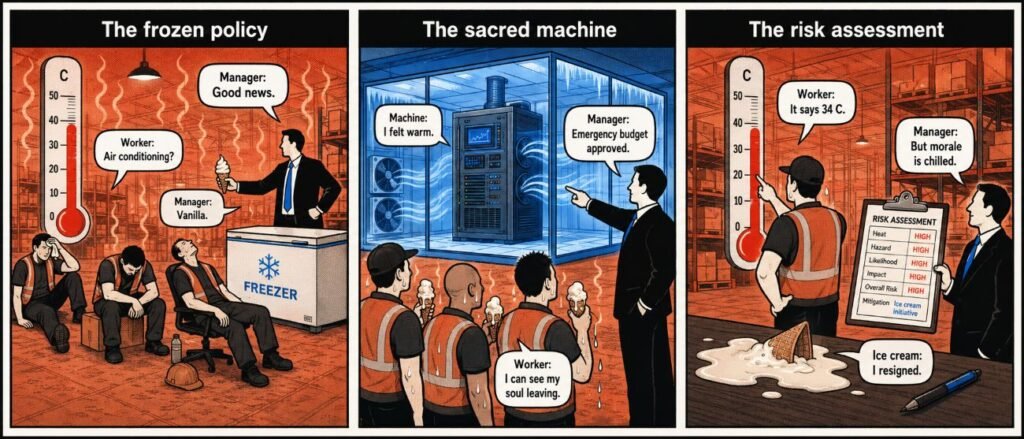
Scene 1: The frozen policy
Panel description. A manager stands beside a freezer box while workers sit under a huge red thermometer in a warehouse.
Dialogue:
Manager: “Good news.”
Worker: “Air conditioning?”
Manager: “Vanilla.”
Scene 2: The sacred machine
Panel description. A machine sits inside a cool glass room with fans around it. Workers outside hold melted ice cream.
Dialogue:
Machine: “I felt warm.”
Manager: “Emergency budget approved.”
Worker: “I can see my soul leaving.”
Scene 3: The risk assessment
Panel description. A risk form sits on a desk beside a puddle of melted ice cream. A worker points at the thermometer.
Dialogue:
Worker: “It says 34 C.”
Manager: “But morale is chilled.”
Ice cream: “I resigned.”
What to watch, not the show
- Whether hot work areas get proper cooling, ventilation and shaded rest spaces, not seasonal treats.
- Whether risk assessments mention heat stress, humidity, PPE and physical effort.
- Whether management protects production equipment faster than people.
- Whether work patterns change during heat, including earlier shifts, longer breaks and task rotation.
- Whether staff can report unsafe heat without being treated as difficult.
- Whether UK law keeps relying on “reasonable” while summers become less reasonable.
- Whether “heat safety” means actual investment, or just documents that protect management after the damage is done.
The Hermit take
Ice cream is fine for morale.
Cooling is the part that keeps people upright.
Keep or toss
Verdict: Keep / Toss.
Keep the ice cream as a small kindness.
Toss the fantasy that it replaces cooling, planning and duty of care.
Sources
- Met Office heatwave record: https://weather.metoffice.gov.uk/learn-about/weather/types-of-weather/temperature/heatwave
- Met Office climate projections: https://weather.metoffice.gov.uk/climate-change/what-is-climate-change
- HSE workplace temperature law: https://www.hse.gov.uk/temperature/employer/the-law.htm
- GOV.UK workplace temperatures: https://www.gov.uk/workplace-temperatures
- UKHSA heat mortality monitoring report 2022: https://www.gov.uk/government/publications/heat-mortality-monitoring-reports/heat-mortality-monitoring-report-2022
- TUC maximum workplace temperature guidance: https://www.tuc.org.uk/guidance/there-maximum-temperature-workplaces

Leave a Reply